Wednesday, 19 June 2013

Bat-Air Traffic Control

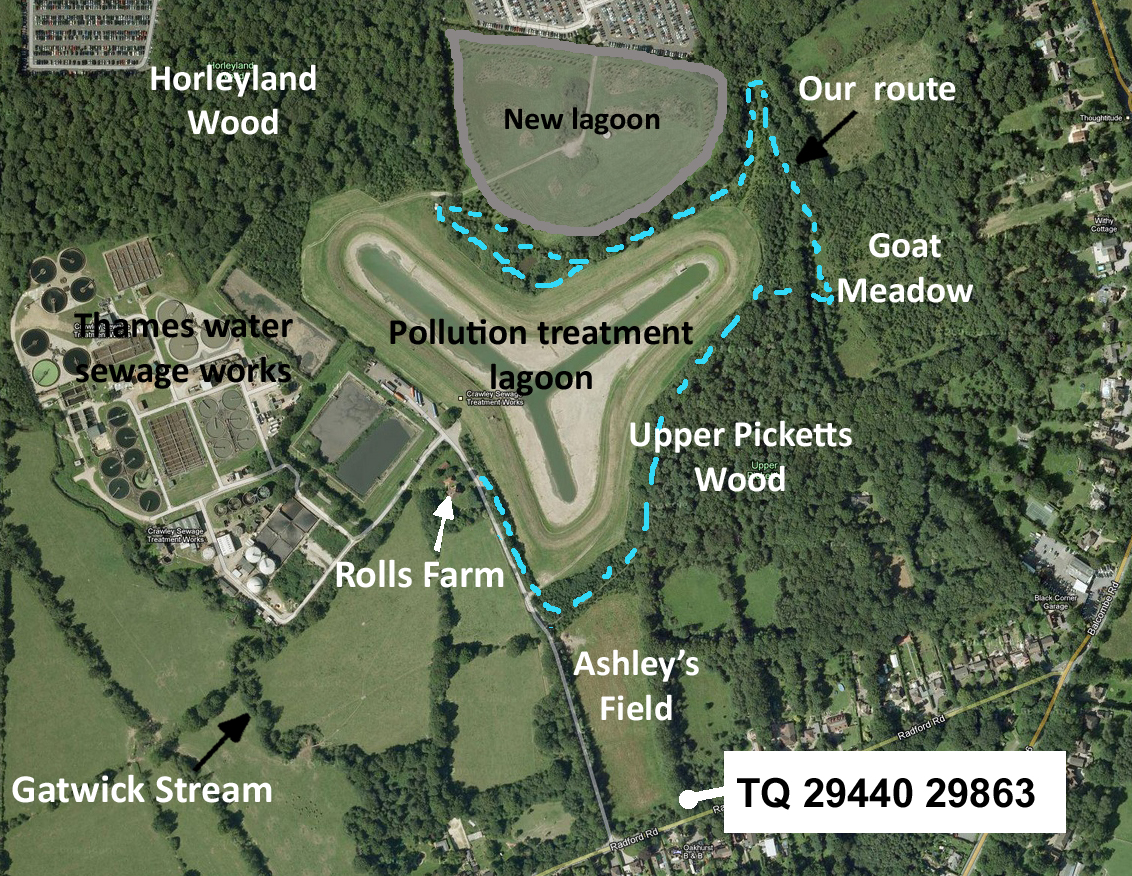
Last Friday an odd thing happened; the wind dropped, the clouds parted and the evening air was warm... The bat walk I had organised actually went ahead and 8 of us were led through Upper Picketts Wood by Martyn Cooke of Surrey Bat Group (also an air traffic controller here at Gatwick).

Torchlight trek through Upper Pickett's Wood
Gatwick's Land East of the Railway Line

As the sun was setting we stopped off at Roll's Farm, an old abandoned farm house by the sewage works. With its wild, tangled garden and loose roof tiles it really looks like the perfect bat haunt. Our bat detectors were on and we were busy chatting when suddenly a series of louds clicks swept us by... A Common Pipistrelle (Pipistrellus pipistrellus) was on the wing and loudly echolocating! Martyn was able to show us on his Anabat detector screen the 'hockey-stick' pattern of a Pipistrelle call:

The call of a Common Pipistrelle bat (Pipistrellus pipistrellus) which peaks between 45 and 50kHz

People were excitedly pointing but annoyingly I still couldn't see anything. It was getting frustratingly dark - suddenly I saw my first Pipistrelle bat as it veered around us, much lower and closer than I had expected! No chance of them bumping into us though as these tiny predators are aerial experts, catching their insect prey and eating on the wing. Martyn said they were probably feeding on midges which our group was attracting in (and beginning to feel!) I did my best to get a photo, if you look carefully you can just about make out the tiny bat as it shot past...


Ok a little joke, I didn't attempt a photo. However it was a great privilege to see and hear these usually unnoticed creatures. We heard only Common Pips but then at the very end of the walk we heard a Soprano Pipistrelle (Pipistrellus pygmaeus), which were only recently declared a separate species. Martyn is a brilliant source of bat info and has some great stories, including the only reported 'bat strike' in the UK... (Disclaimer Alert: bats pose zero threat to aircraft!)

Light Emerald moth (Campaea margaritata)

We also tested out torching for Great Crested Newts at our two woodland ponds; we were able to make out 2 large female G.C.N. and 1 small male. Also spotted were several Smooth Newts and 2 Common Frogs. While people were using their torches I was attempting (and mostly failing at) bare-handed capturing of moths drawn in by the light. I did manage to grab 2 macromoths which I potted and took home to photograph in the daylight.

Light Emerald (Campaea margaritata)

Common White Wave (Cabera pusaria)

Common White Wave (Cabera pusaria)

I feel a bit mean that I haven't shown any pictures of a bat, so here is a photo of two lovely little Common Pipistrelle, one of which a friend of mine rescued in Copthorne back in 2007. We took it over to the Jenny Clark of Sussex Bat Group who rehabilitated and released it back into the wild...

'Boost' the female pipistrelle and her new buddy 

You can find out about all of the UK's different bats species here: Bat Conservation Trust

Wednesday, 12 June 2013

Reptilian refuge

Britain's reptiles simply don't deserve the bad rep given by that larger and more aggressive species Homo sapiens. For sure there is something about the way a snake moves which can stir a primal fear inside us, but this is just a throw-back to a time long ago when it paid to be wary of a certain few venomous species. 

Young Grass Snake (Natrix natrix), probably a yearling - Photo by Natalie Kay. These guys are not 
venomous and are completely harmless (unless you happen to be a frog or newt).
 
The reason you don't often see reptiles out and about in the countryside is that they flee the scene before you stumble across them; snakes can find themselves on the menu of everything from Carrion Crows and birds of prey to Badgers, Foxes, Cats and even Hedgehogs! If they don't move out of the way that's because they are hoping you haven't spotted them. UK reptiles are extremely benign and our only venomous species, the Adder (Vipera berus), rarely bites. In the last century only 12 fatalities were reportedly due to Adders, which is much fewer than deaths caused by wasp stings, cows and stray golf balls (my new phobia!)

Grass Snake skin found under a refugia, Grassy Slope, North West Zone.
Apparently males slough their skin twice a year, females only once

We survey for reptiles at Gatwick by placing out roofing-felt mats or 'refugia', providing a safe place for these secretive and cold-blooded beings to hide away from predators while they warm up with the sun's heat. It is kind of like a solar charging mat or iPod docking station.

It feels like Christmas (in a good way) when I first lift up a mat...

Grass Snake trying its best to blend into its surroundings

Grass Snakes tend to be olive green in colour, have disconnected black stripe markings down the length of their bodies and a distinctive yellow collar at the base of their heads. We seem to have a healthy population here though I am sad to say that I have never seen an Adder at Gatwick... nor Common Lizard (Zootoca vivipara) or Slow Worm (Anguis fragilis) for that matter! As we are focusing our habitat management on as many different species as possible there is always the possibility of future appearances. In the meantime here are the other things which have been taking advantage of the refugia...

A young vole, not sure which species

 Glow Worm larvae (Lampyris noctiluca) in Ashley's Field

Rustic Wolf Spider (Trochosa ruricola)?

A tiny Common Toad (surely a risky business sharing refugia with Grass Snakes!)

Occasionally I am also lucky enough to be walking about the place and spot a Grass Snake out in the open...
Blending in with the grass, living up to the name. North West Zone

At home in the water - Land East of the Railway Line. I'm particularly proud of this photo - luckily it didn't see me and I was able to get this shot just before it about-turned!

Reptiles are protected for a reason; their numbers have suffered sharp declines in recent decades and their habitat is continually being removed and developed. If you are fortunate enough to come across one of these fascinating beasts please just let it do it's thing and enjoy that rare moment.

For more pics and info on Grass Snakes: http://www.arkive.org/grass-snake/natrix-natrix/

Wednesday, 5 June 2013

Record-breaking recorders

In the last 2 weeks I have been on holiday, been pretty unwell and been extremely busy preparing for the initial Biodiversity Benchmark audit here at Gatwick. As a result I haven't been able to get out in the field much, but happily I got my natural history fix last weekend after a biological recording day at the Knepp Estate in West Grinstead.
Mark Telfer and other pan-species listers, beating vegetation and catching invertebrates

Here I met an eclectic bunch of diligent, passionate and frankly hard-core naturalists, some of who are professional conservationists or ecologists, many who simply love the natural world and set themselves the lifetime challenge of observing as much of it as possible. These are the pan-species listers and I thoroughly enjoyed chatting with them to get a snapshot into their pursuits; from lichens and fungi, to beetles, birds and everything in between.

Mark using a pooter to collect up the tiny deadwood beetles for identification

 These guys and girls contribute an incredible amount to species records around Britain, often collecting data on lesser-known organisms and even discovering new unrecorded species. (Some may call it odd, I call it diligence that they travel so far in order to find a not-so-fresh deer carcass, donning their gloves and giving it a thorough cavity search for carrion-feeding invertebrates dwelling inside...) You can meet them and follow their progress on Mark Telfer's website: http://markgtelfer.co.uk/listing/
   I am rather new to ecology and seemingly much too distracted and indecisive right now to choose one species group to focus on learning. Below are my photos from the weekend, a very small sample of the showier species which we recorded:

Beetles:
A wasp-mimicking species of Longhorn Beetle (Clytus arietis)

Black-headed Cardinal (Pyrochroa coccinea)

Malachite Beetle Malachius bipustulatus (this one gave me a tiny nip)

Dragonflies and Damselflies (netted with my new insect net):

Azure Damselfly (Coenagrion puella)

Male and female Azure Damselflies in tandem (Coenagrion puella)

Female Scarce Chaser Dragonfly (Libellula fulva)

Blue-tailed Damselfly (Ischnura elegans)

Large Red Damselfly (Pyrrhosoma nymphula)

Moths (mostly from the overnight moth traps):

Brimstone (Opisthograptis luteolata)

Longhorn Moth (Nemophora degeerella)

Lime Hawk-moth (Mimas tiliae)

Pale Prominent (Pterostoma palpina)

White Ermine (Spilosoma lubricipeda)

Swallow Prominent (Pheosia tremula)

Poplar Hawkmoth (Laothoe populi)

Iron Prominent (Notodonta dromedarius)

 A rewilding project has been in place at the Knepp Estate for 13 years, based on a natural grazing regime in the old agricultural grasslands and the restoration of the River Adur floodplain to its natural function. This involves stepping back from hands-on land management, intervening as little as possible and letting nature dictate what happens. The idea is then to annually record the species and observe any of the changes over time in what turns up.

The wild Exmoor Ponies which freely roam the Knepp Estate

This exciting and long-term project contrasts greatly with our here method at Gatwick: our habitats are very small, fragmented and at times affected by airport operations, so we have to intervene in order to keep the ecosystems functioning. It has all been a great education for me on the different methods of wildlife conservation and countryside management. You can read more about Knepp Wildland project here www.knepp.co.uk

Sunday, 19 May 2013

Temperamental Mole

Ecological consultant Rebecca, taking water samples under the netted section of the River Mole

A tributary of the River Thames, the River Mole rises just south of Rusper village in West Sussex, flowing north-west for 50 miles (80km) before reaching the Thames at the north Surrey border.


At Gatwick our section of the River Mole is rather open and slow-flowing, passing under the airfield through a tunnel and exiting on the north side. At the southern point where it enters, a Kingfisher is regularly spotted zipping in and out.
   The course of the Mole has been altered several times since the airport began operating commercially in 1945. During a massive flood alleviation project in 1999 it was diverted once more from its course north of the airfield; now it travels west for 400m parallel to the taxiway before meandering in a north-easterly direction. With a good diversity of riffle formations, pool sequences, backwaters, lush wet grassland and reedbeds, it is in my opinion quite a lovely and natural-looking section of river.

The River Mole on Gatwick's Landholdings, north of the airfield

Vantage point from the grassy mound, overlooking the airfield - NWZ

Reedbeds in winter

The water level at Povey Cross has reached level 2 (my cunning theory is that the numbers represent 10cm, putting the water level at 1.2m.) In the past I have seen the water close to over-topping the stick.

Much of the catchment area of the Mole lies on impermeable rock, meaning that the water level responds extremely rapidly to heavy rainfall. My first week of surveying at Gatwick taught me a punitive lesson… a few of my reptile mats have probably washed up somewhere in Surrey.

Rebecca kicking the silt and netting the river-dwelling invertebrates

The water quality of the river can also fluctuate greatly depending on the season. The ecologists Rebecca and Victoria from Penny Anderson Associates regularly carry out aquatic invertebrate 'kick surveys', taking samples back to the lab for species identification under the microscope. Identifying the flora and fauna occurring in the waterways is particularly useful, as certain species are very sensitive to pollution and could act as indicators of any negative impacts of the airport's operations. On Monday they visited Gatwick and I was able to join in to see how it is done.

Damselfly nymph covered in silt - possibly a Banded Demoiselle?


Common Backswimmer (Notonecta glauca)


Diving beetle species


A small leech


Freshwater Shrimp (Gammarus pulex) is a type of amphipod crustacean

An Orb Mussel, a type of freshwater mollusc

I particularly enjoy this time of year when the Reed Warblers set up their territories all along the Mole. If you happen to wander west along the public right of way from Povey Cross you can hear their repetitive, mechanical sounding song...

I took this photo of a Reed Warbler along the Mole last summer -
 possibly my best birding photo so far!

And finally, one of the mystery coconuts which wash up regularly along the River Mole... No explanations have sufficed so far, but it gives me a hankering for lime and a tiny little umbrella.