Sunday, 1 March 2015

Late winter bird surveys 2015

February 12th - North West Zone


Despite dreary conditions it was a cheerful group of us who met in the morning, just north of the airfield. Traipsing through the wet and boggy grasslands, right away we picked up the drumming of a Great Spotted Woodpecker and the raucous cries of a Ring-necked Parakeet, a recently naturalised species which is well established in Reigate and spreading southward. 

Ex-arable grasslands west of Brockley Wood; thanks to their inaccessibility and 
the airport's boundary, they have been largely left undisturbed.


The hearty tune of a secretive Song Thrush could be heard emanating from the hedgerows, with their distinctive repetitive style which you can clearly see in this sonogram...

In fact, they were in all the bloody hedgerows! It was like Song Thrush City, with exceptionally high numbers possibly due to migrants passing through on their way to their summer homes.
   Wandering through the Solar Panel field, we flushed four Common Snipe with their characteristic erratic flight pattern. They even left us a calling card...

Common Snipe smatterings

Where the Mole begins to meander, we stood high on the track and observed two large shapes winging their way towards us... a wandering pair of Greylag Geese are an usual sighting on our surveys. Looking in the deeper wheel ruts of the rough track, tell-tale movements gave away the presence of Common Frogs gathering to spawn. Every year they take a gamble laying eggs here, but sometimes the froglets do make it! 


Wishing for a Water Rail in the reedbeds - no such luck

There is a great mix of habitats in one small area, so we can pick up woodland, scrubland and wetland species. Long-tailed Tits, Moorhen, Jackdaws and a Green Woodpecker were all in close proximity, along with the same group of Common Snipe we had just seen earlier. A pair of Bullfinch were piping loudly from the scrub...

If you look really, really closely, it's definitely a Bullfinch

Still getting to grips with this camera.

The River Mole is at a relatively low level for this time of year

Towards the end of our transect we saw a Little Egret and Grey Heron taking flight. I've seen this duo hanging around quite the past few weeks, one might be following the other around in order to find the best fishing spots. They always keep a respectful distance from each other though.

Little Egret in the foreground, Grey Heron at the back

Either a Great Tit spontaneously combusted, or a Sparrowhawk just had breakfasted

At the end of the transect near Povey Cross, we picked out a few more Ring-necked Parakeets perched up close to a group of Magpies. I had another go with the camera....


Getting better!

NWZ total: 29 species

1
Blackbird
Turdus merula
2
Blue Tit
Cyanistes caeruleus
3
Bullfinch
Pyrrhula pyrrhula
4
Carrion Crow
Corvus corone
5
Chaffinch
Fringilla coelebs
6
Collared Dove
Streptopelia decaocto
7
Dunnock
Prunella modularis
8
Goldcrest
Regulus regulus
9
Goldfinch
Carduelis carduelis
10
Great Spotted Woodpecker
Dendrocopus major
11
Great Tit
Parus major
12
Green Woodpecker
Picus viridis
13
Greenfinch
Carduelis chloris
14
Grey Heron
Ardea cinerea
15
Jackdaw
Corvus monedula
16
Jay
Garrulus glandarius
17
Little Egret
Egretta garzetta
18
Magpie
Pica pica
19
Mallard
Anas platyrhynchos
20
Moorhen
Gallinula chloropus
21
Nuthatch
Sitta europaea
22
Redwing
Turdus iliacus
23
Reed Bunting
Emberiza schoeniclus
24
Ring-necked Parakeet
Psittacula krameri
25
Robin
Erithacus rubecula
26
Snipe (Common)
Gallinago gallinago
27
Song Thrush
Turdus philomelos
28
Wood Pigeon
Columba palumbus
29
Wren
Troglodytes troglodytes
Greylag Goose Anser anser (fly-over)

February 13th - Land East of the Railway Line
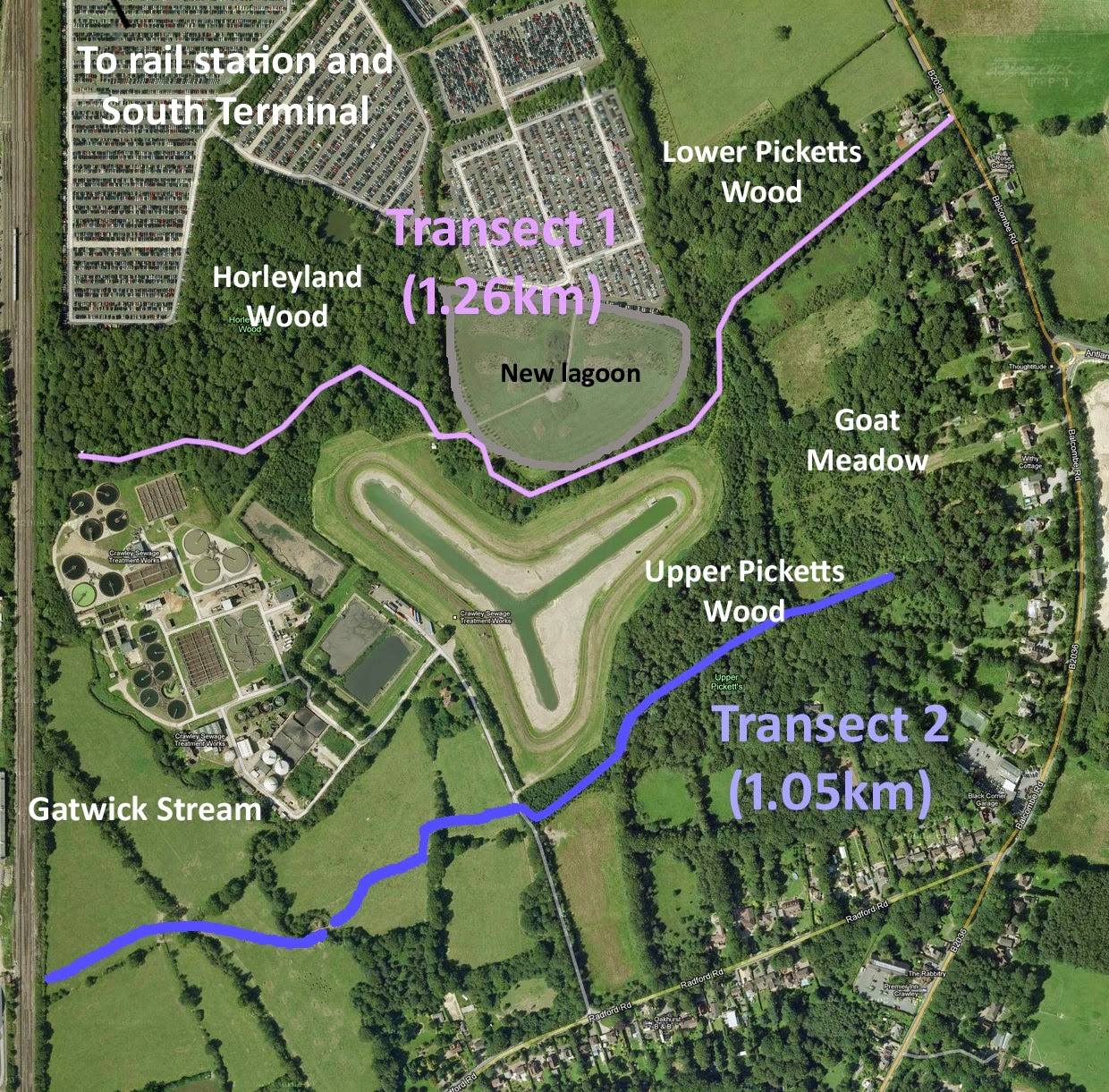


A brand new dull wet day, we reversed the usual direction of our transects and began instead on the Gatwick Stream floodplain. This area has been re-profiled on a large scale as part of a flood alleviation scheme, so now consists of extensive wet grassland habitat,


The first species to greet us were Chaffinch, Coal Tit and Green Woodpecker. A lonely Meadow Pipit flew overhead followed closely by a Pied Wagtail.


A series of large Oak trees can be found on islands of raised land, ringed off with post and rail fencing. They make a perfect perch point for this flock of around 20 Linnets...


As lovely as the Linnets were, it was something else which got us excited this morning...


Tom F. had spotted a pair of Little Owl perched up in the Oaks! Quick... Photo photo photo!

Bah. 

Yet again I was no where near quick enough with the camera settings, so this distant shot was all I got before they nipped off. Little Owl is a new species for our surveys at Gatwick and I am yet to see one close up. This pair were being very covert and quiet, but as it is ridiculously cute here's a recording of their calls from the Xeno-canto website...


The tracks of different birds and mammals stood out clearly in the bare mud, telling us which who had recently passed by:

More than one Red Fox

Roe Deer

We left the floodplain and entered the woodlands, where we picked up a roving flock of Blue Tit, Great Tit and a pair of Goldcrests. Further into the woods and the outskirts of Goat Meadow, we caught the song of a lonely Coal Tit and we glimpsed a sneaky Tree Creeper.


Craning our necks to look high up in the canopy, the swaying Scots Pines made us feel rather sea sick...


Which was about when my camera battery finally gave up after having taken many bad owl photos.
   Our transect then ended at the western edge of Horleyland Wood, finally bringing us Carrion Crow, Woodpigeon, and the incessant calls of a Great Spotted Woodpecker.

LERL total: 27 species

1
Blackbird
Turdus merula
2
Blue Tit
Cyanistes caeruleus
3
Carrion Crow
Corvus corone
4
Chaffinch
Fringilla coelebs
5
Coal Tit
Periparus ater
6
Common buzzard
Buteo buteo
7
Goldcrest
Regulus regulus
8
Goldfinch
Carduelis carduelis
9
Great Spotted Woodpecker
Dendrocopus major
10
Great Tit
Parus major
11
Green Woodpecker
Picus viridis
12
Jackdaw
Corvus monedula
13
Jay
Garrulus glandarius
14
Linnet
Carduelis cannabina
15
**Little Owl
Athene noctua
16
Magpie
Pica pica
17
Mallard
Anas platyrhynchos
18
Meadow Pipit
Anthus pratensis
19
Pied Wagtail
Motacilla alba
20
Redwing
Turdus iliacus
21
Robin
Erithacus rubecula
22
Song Thrush
Turdus philomelos
23
Starling
Sturnus vulgaris
24
Stock Dove
Columba oenas
25
Treecreeper
Certhia familiaris
26
Wood Pigeon
Columba palumbus
27
Wren
Troglodytes troglodytes
**New species to this survey

Many thanks to Tom F., Bethan, Sian and Donald for your help on these surveys!

Tuesday, 17 February 2015

Ground Support

(Pretty chuffed with myself whenever I get an aviation reference into a blogpost.)
  This is all about the good work of JSA Landscape Group, Gatwick's team of grounds maintenance contractors. The past few years they have proved invaluable in our larger-scale habitat and conservation project works.

Goat Meadow stag beetle loggery; withstands clambering human test

These guys and gals achieve a lot in no time at all with their heavy-duty kit and know-how. I hesitate to call them 'the big guns', only because that sort of terminology doesn't go down well round these parts.
   The only problem with handling all this big equipment is how it requires another level of logistical innovation for otherwise straight forward habitat enhancements...

Fred creates grass cutting piles for Grass Snake breeding areas 

In terms of access, Ashley's Field in the Land East of the Railway Line is no problem for Fred and his big ol' tractor 'n' trailer. Goat Meadow however is a remote piece of grassland in the middle of some boggy woodland, so shifting materials and equipment here presents a much greater challenge...

Moving large deadwood through Upper Picketts Wood

Transporting grass cuttings to Goat Meadow


Our sincere apologies once more to Tom S. and his volunteers for the state of their once carefully edged steps and footpath... Lucky we were able to supply you with all those extra wood chippings eh! 

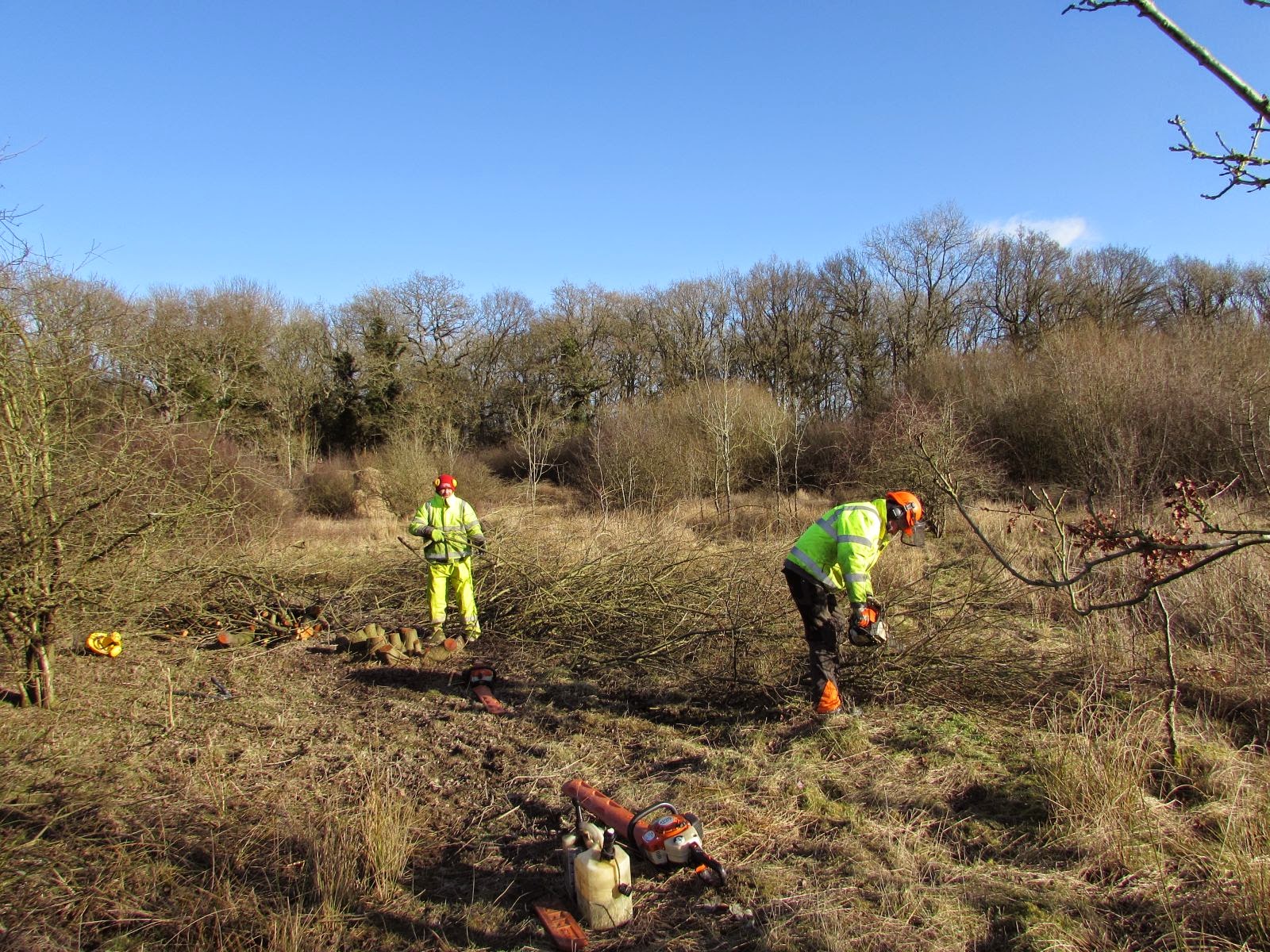
Mick and chainsaw vs. Willow in the North West Zone

In the depths of winter I like to take Mick and his team to all the best places, including trench-foot-inducing boggy grasslands to the west of Brockley Wood. It's hard to imagine right now, but in the height of summer-time these areas are alive with butterflies, bees and burnet moths, blissfully unaffected by the airfield just a few hundred meters away.

Gradual reduction of the Willow scrub to maximise the grassland area

These neatly staked brash-piles got the Thomas Simpson seal of approval (phew)

Hay cut along the River Mole, 2014

The cut-and-collect of our grasslands is our final job for the summer. By cutting around late September, we will minimise disturbance to any grassland species such as Harvest Mice, as well as allowing the maximum amount of meadow flower seed to drop.

Invasive species management

Lauren might be the smallest member of the JSA team, but it doesn't stop her from taking on forests of Himalayan Balsam growing along Gatwick's waterways (actually she's not that tiny, she's just very far away).

Nick uses a brush cutter to keep the woodland rides open. Horleyland Wood

Scrub management along the south bank of Man's Brook.
 This allows more sunlight to hit the banks, increasing floral diversity

Scott T. from Per Hire is another fella I've been fortunate to work with, providing us with his skills and experience in operating the 360 excavators. He has bags of energy and is an excellent problem solver; much appreciated when it comes to the difficult habitat works such as these... 

Dredging out a blocked channel along the River Mole to improve flow

Massive hibernaculum creation - North West Zone

Another hibernaculum in Goat Meadow, Land East of the Railway Line

Scott T's experience with almost every kind of digger means that nothing is too big or too small to stack...

Beginning a Stag Beetle loggery 

On occasion he's allowed to show off.

Unsubtle bag theft

Many thanks once again to all of the JSA's staff, getting these trickier habitat works 'off the ground'!

Monday, 9 February 2015

Legends from an Elm branch

Guest author: Nick Aplin

A post about Elm trees, bryo-parasites, cannibalistic fungi, new species and the joys of microecology...


One of the problems with recording fungi is that the bloomin’ things are everywhere.
   Seriously, everywhere. They’re in your fridge. They’re on every single leaf. They’re even in your lungs whilst you’re reading this. Considering their ubiquity, surveying a whole piece of woodland can be somewhat daunting for the average mycologist. Where should one start?
   I think the best thing to do is earmark a microhabitat or two; perhaps an old stump, a muddy ditch or maybe a little mossy patch. Around Picketts Wood there are thankfully many such nooks and crannies: A fallen Pine trunk here, a dead hedge there...


Late last year I stumbled upon a little stand of Elm trees, presumably struggling in their war against Ophiostoma novo-ulmi, a nasty fungus which is to blame for the fact we generally doesn’t see Elms around much anymore (Dutch Elm Disease has so far claimed the lives of about 100 million Elm trees in the Northern Hemisphere).
   These trees at Picketts Wood are a bit sad looking, with many droopy dead bits. Luckily the decomposing branches are home to lots of other organisms, including some curious little fungi. To give you a snapshot of the sheer omnipresence and diversity of the fungus kingdom, I’d like to tell you about some of the many species I found on just one Elm branch over the last few weeks:


The first two species are largely dependent on dead Elm wood for survival – I wonder whether they will both be in decline considering the effects of Dutch Elm Disease?

Orbilia comma

Orbilia comma, with its little spores that look like commas.
 (OK you have to squint a bit whilst using your imagination….)

Quaternaria dissepta

A cross section of Quaternaria dissepta, its ominous, black fruitbodies embedded in the substrate and its dark, curved spores. If Darth Vader were a fungus, I reckon he’d be this one.

Bionectria ralfsii

Some scaly fruitbodies of Bionectria ralfsii breaking through the bark. This species usually comes with two types of spore: hyaline, sexually produced ascospores (right) along with green, lemon-shaped asexual spores called conidia (left).  Yes, fungi have sex too – Gross, right?

Cryptodiscus (Karstenia) rhopaloides

Karstenia rhopaloides likes to break through the bark of dead branches and is surprisingly common on many different woody plants throughout the colder months. Officially, this species is known as Cryptodiscus rhopaloides, but I guess no one has had the time to move it to the right genus yet….
Can you spot it in the branch photo above?

Diaporthe eres

A cross section of Diaporthe eres - Here, the spores are created in chambers below the surface of the substrate and are then ejected through those long creepy looking black tubes.

Hyalorbila erythrostigma

Hyalorbilia erythrostigma -These little guys are found eating other fungi. Sometimes they like to parasitize Orbilia species (see O.comma above). This little group were growing near lots of other fungi too, so I wasn’t quite sure what they were up to here!  There are only 3 previous UK records for this species.


I have no idea what to call this one. I don’t even think it has a name, yet. I know that some mycologists are aware of its existence, but they don’t know what to call it either. Perhaps it’s a Lasionectria, perhaps something else entirely. Answers on a postcard….
   Isn’t it strange to think that there are undescribed species around Gatwick?

Octospora affinis

Finally, this is Octospora affinis, a bryoparasite. It has a rather boring diet. It only eats Orthothichum affine (the moss that you can see growing on the branch above – Thanks to Brad Scott for the ID). This collection on our Elm branch is the first time it’s been seen in the UK. Perhaps it occurs elsewhere; I can’t imagine many people out there are looking for it….
   I should say that I have no idea what species of Elm I've been looking at. Elm taxonomy eludes me. If you happen to find an Elm expert (Pteleologist!) hanging around Gatwick, please point them in my direction!

Nick Aplin (Sussex Fungi Group)

Monday, 2 February 2015

Gatsbees B-Log: January 2015


Hi, I’m Gillian the beekeeper and I fell into this excellent project by happy accident, so the bees and I would like to welcome to you to our B Log from the Gatwick apiary. 

Gatsbee Apiary in Ashley's Field

As it’s a project about biodiversity, our philosophy is about wildlife rather than honey... 


...but the odd pot or two is always a bonus.
  

Last season, Tom and Rachel soon became hooked on beekeeping and with their background of conservation and preservation, it seems appropriate for us to provide as natural a life as possible for the bees while trying not to let them go completely wild.
  

We recently moved Diana's (one of our queen bees) hive into the natural copse after the weather had been cold for several days, and propped a large branch over the entrance so that when the bees came out, they would know that their house had moved and think that their tree had fallen over. Think like a bee!


The bees cluster together in the winter, and Eve's (another queen bee) colony is under a glass cover for easy viewing. The colder the weather, the tighter the ball of bees...
  

...and this year I made a quilt for each hive out of an old cotton duvet cover, filled with sawdust, which will hopefully contain the warmth and absorb some of the moisture the girls create while keeping themselves warm by beating their wing muscles.

Brrr!

A couple of the bees braved the cold wind yesterday to go to the loo or collect water to dissolve the old stores of honey, but the sun didn't stay out long and they all rushed home before they got chilled. I know the feeling! 


 Stay warm. Gill