A brief update on Gatwick's colonies of Long-horned Bees (Eucera longicornis) during the 2021 field season.

Thoughts and experiences of ecologists and conservationists working at one of the UK’s busiest airports
Showing posts with label Eucera longicornis. Show all posts
Showing posts with label Eucera longicornis. Show all posts
Thursday, 16 September 2021

Tuesday, 4 July 2017
Weathering June
There were soggy June days….

Handy woodland foot bridges built by Tom S and his volunteers
And scorching June days...

River Mole grasslands, North West Zone
But most were great days on the project! Here is my round up of the June happenings:

We kick-started The Wildlife Trust's '30 Days Wild' with a series of wildlife
events for Gatwick staff and local residents. Uptake was much better this year, and it is incredibly gratifying to see people engaging with a range of wildlife walks, talks and activities such as forest schools.

Riverside Garden Park pollinator walk

Azure Damselfly (using a clip-on macro lens for my camera phone)
The Long-horned Bees have received further executive visitors in the form of Sussex University Profs. Francis Ratnieks and Dave Goulson, with their PhD
student Gigi.

Part of Gigi's project will be focusing on our LHB colonies, which is really exciting as few detailed studies have been carried out for this species. Her mark-recapture work (which doesn't harm the bees), could reveal insights into how many bees there are in each colony, which plants they like best, how the overall population is faring etc.

A queen-marking cage used for Honey Bees also work very well to temporarily hold this female Long-Horned still
Into the woods; this summer I'm spending most of my time carrying out repeated baseline habitat condition
surveys, which takes me back to 2012 and my first summer in ecology. Those early days were incredibly challenging, but then formative times mostly are!

Woodland habitat survey of Upper Picketts Wood, Land East
Looking back over my data, it seems I did alright with my botanical species identification... In fact, past-Rachel had indeed correctly identified Field Forget-me-not, so present-day Rachel has to amend a recent record. You win this round past-Rachel. (Took you over 4 years to find a Purple Emperor butterfly though didn't it?)

Ecologists Rina and Lucy with Royal Holloway Uni placement students Kajayini and Roxanne
While I was going a bit weird out in the woods, we had some extra help out on the sites for our annual ecological monitoring.

Adult Grass Snake just prior to shedding (Photo by Anna-Marie Lawn)

Late summer breeding bird surveys with Tom F : Two new species to the survey were Eurasian Hobby and a daytime calling Tawny Owl
Our Dormouse surveys haven't turned up any of the critters so far this year, but we did accidentally disturb this hornet's nest, which we felt bad about, but was pretty cool to see...
On the hottest day of the year, I happened to be up in London, as Gatwick Airport Ltd received several awards from the Royal Society for the Prevention of Accidents (RoSPA). My project work comes under Gatwick's central Environment, Health and Safety Team, who are an incredibly diligent and hard working bunch; my hat is off to this team and they really deserve the recognition. Despite near heat-death on the tube (next time it's hiking boots), it was good fun hanging out near the Royal Victoria Docks.

A smoggy haze is the downside to a hot day in the city
Gatwick was this year's headline sponsor for The Big Bang Fair at the South of England Showground. The festival celebrates science, technology and engineering careers, with students attending from schools all over South East England.

Kevin Lerwill from Gatwick Greenspace.
It was pretty intense and we engaged over 100 students with our biodiversity stand, which included water quality assessment through pond dipping for invertebrates.

Tom Errett from Gatwick's central EHS Team

Demonstration of bat sonograms and surveying technology by bat ecologist Martyn Cooke
Back over to our sites, and our invasive species management is well underway, with teams of Gatwick staff assisting Tom S with tackling Himalayan Balsam along the River Mole.

Goat's Rue is another invasive plant starting to spread here, so we are doing our best to dig it up cleanly from the roots. I don't know much about Goat's Rue management as their doesn't seem to be much online literature, so any further advice appreciated!

Our Gatwick Honey Bees (Apis melifera) had a challenging season with the extreme June weather, and decided they didn't feel like swarming this year. We have 6 colonies and a few of our queens have now superseded, so they should be looking stronger for mid-summer.
(Put your speakers on/ headphones in for these...)
Our trail cameras are picking up
some lovely footage (thanks to volunteers Luke and Jason for maintaining these); now the next step is to comb through it all and enter details into irecord!
The fluffy coat on this poor old fox must be seriously hindering him on the hottest day of the year...
The fluffy coat on this poor old fox must be seriously hindering him on the hottest day of the year...
I love Grey Wagtails, so am hoping this one has been breeding nearby...
However, our best day of June was The Day The Container Arrived (which sounds like a really dull dystopian sci-fi novel.)

This is exciting for us, as we've been planning for a field base for the past few years, and have hit a few challenges and hurdles along the way. It has been worth the wait though!

Tom S now has a new base for volunteer activities and forest schools
So I feel that I have shown admirable restraint the last few days, only very gradually sneaking the entire contents of my car inside...

Blimey, did you make it to the end of all this? That is some staying power, well done you!
Friday, 2 June 2017
BBC and the Plight of the Long-horneds
On Wednesday, the BBC Natural History Unit were here filming a piece for The One Show about our colony of rare Long-horned Bees, and despite the variable weather, we managed to find them a stonking number of both male and female Eucera longicornis.

Long-horned Bee nesting site, North West Zone (just north of the runway)
Along this section of the River Mole are some decent patches of Meadow Vetchling, where the males can be found nectaring, and a large clay mound, which is one of our main solitary bee nesting sites. We could even see females jostling each other at burrow entrances.

Long-horned Bee (Eucera longicornis) male

Female burrow with fresh excavations
The wildlife camera guy Tom had his work cut out though, as these bees are bloomin' hyperactive when the sun is out, then can disappear again in the blink of an eye as clouds roll in!

Wildlife filmmaker Tom Hartwell

This tiny fella is ready for his close-up
My part (if not so terrible that they decide to edit me out), was to carefully handle a male Eucera, holding it by two of the legs in order to avoid damaging him. I said a few things to the presenter George McGavin about them, which I really hope now wasn't a load of woolly crap.
In any case, what a fantastic opportunity to air the plight of this species, and to show off the support they get here at Gatwick. Perhaps this sort of exposure can galvanize other landowners into looking after their pollinators, as many of these species are truly on the brink.

Entomologist and TV presenter George McGavin, the BBC natural history unit, Stephen from Gatwick Communications, and my coolbox of mysteries

In fact, I dug around online for literature on Eucera longicornis and was really taken aback to hear how rapidly this bee is declining, particularly after reading this worrying report form Cornwall by Kernow Ecology (...around 75% loss of colonies at the important Cornish sites?!! That's truly awful).

River Mole grassland wildflowers: Ragged Robin (Lychnis flos-cuculi), Grass Vetchling (Lathyrus nissolia), Meadow Vetchling (Lathyrus pratensis)
Our only other species of Long-horned Bee in the UK, (Eucera nigrescens), is effectively extinct, and there are no guarantees that our longicornis friends will stick around. We already know habitat loss is a huge problem, but there are almost certainly hidden dangers too, such as potential effects of pesticides and fungicides (as being researched by University of Sussex.)
Fortunately here at Gatwick, what we do have is the right habitat and the means to manage it well! The seeded wildflower mix along the River Mole contains an abundance of plants from the Fabaceae and Lamiaceae families, which are hugely important to Eucera, as well as raised banks of bare clay for nesting. .
I hear that the piece might air in 3 weeks or so, but the One Show schedule is very much subject to change. When I find out I'll do a 'heads up' on Twitter.
The plant species we have seen being used as forage by Long-horned Bees at Gatwick include:
Meadow Vetchling (Lathyrus pratensis)
Grass Vetchling (Lathyrus nissolia)
Common Vetch (Vicia sativa)
Red Clover (Trifolium pratense)
Bugle (Ajuga reptans)
Ground Ivy (Glechoma hederacea)
Common Comfrey (Symphytum officinale)
Gatwick receives conservation advice for this species from organisations such as Sussex and Surrey Wildlife Trusts, Buglife and BWARS (Bees, Wasps and Ants Recording Society).
Monday, 16 May 2016
Why i-Record wildlife
This week has been a monumental one for many biological recorders, thanks to the new fantastic phone app by the innovative iRecord team (seriously my favourite people right now)...

Links for phone downloads here: http://www.brc.ac.uk/app/irecord-app
Why am I so excited about this (free) app? Because it effectively cuts down on hours and hours (and cups of coffee and biscuits), spent entering data into excel spreadsheets or online at the desk. Instead, you can input wildlife records swiftly and with ease while out and about, maximising time spent out in the field (hey, you could even lose weight using this app!). It's basically why I chose a hefty Samsung S5 after renewing my phone contract - to be iRecord-ready!!

Entering a biological record
The interface is clean and simple; the fields are editable just by tapping on them, but you can lock any for repeated use. The entire database of UK wildlife (scientific and common names) is pre-loaded, and it draws the locations from the phone GPS, with the added option to just select a point on a map.

Easy to create, edit or delete whole lists of wildlife records
Most pivotally, it works offline, so all data is automatically saved onto the device, ready for when you escape the 4G-blackspot or regain WiFi. A single tap, and all of your day's wildlife sightings are uploaded to the iRecord database, ready to be verified and feed into national wildlife recording schemes!
For my work at Gatwick this has arrived in the nick of time, as things go crazy on our two biodiversity sites at the peak of breeding season and ecological surveys are back-to-back.

Great Crested Newt egg on a leaf (photo by Rina Quinlan)
Other recent highlights include Great Crested Newts (Triturus cristatus), returning to breed in Pond 3 after the humane removal of hundreds of fish just last year. A successful ending to this pond project, and no better seal of approval from our newts! Many thanks to all who were involved.

BAM! Record goes in.
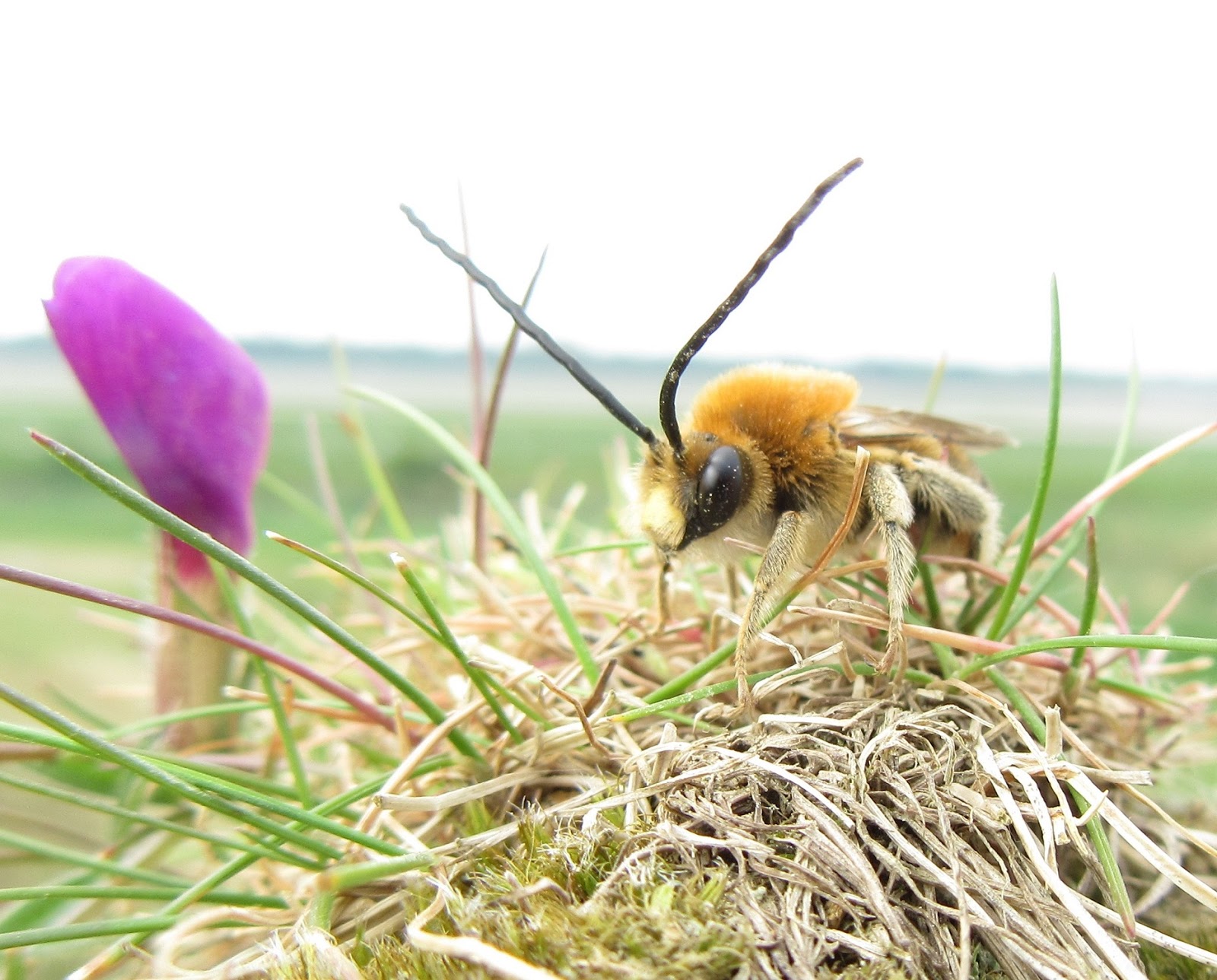
Long-horned Bee with Common Vetch flower

BAM! Another record in.
Gatwick has recently contributed a Buglife case study for this charismatic bee; you can find the publication and read more about our targeted habitat management by clicking here: Long-horned Bee at Gatwick Airport.

Eucera longicornis and a BA plane, Gatwick's North West Zone. 12/05/16

Just to top off a momentous week, we are now up to two male Nightingales (Luscinia megarhynchos) singing clearly in the North West Zone... and potentially even a third! I'll continue checking the site after evening moth and newt surveys; it would be incredible if they managed to breed here.
On the subject of Nightingales, I was recently shown this link by David Plummer - it's a famous recording of Nightingales signing in a Surrey garden on May 19th 1942. In the background, at about 2 minutes 30 seconds in, 197 Wellington and Lancaster bombers can be heard flying overhead on a raid to Germany. When you think about the violence and destruction these planes were portending, it gives the Nightingale song a rather melancholic edge.
Friday, 27 June 2014
Late summer invertebrating
You might not think there's much in the way of quality habitat around an airport. Fair doos, as I used to think that too.

Clay Slope, North West Zone
Last Monday, Jeremy, Scotty D and his little dog Ro returned to our site in the North West Zone for the follow-up invertebrate survey. By surveying twice at the same site, both early and late in the season, we can detect a greater diversity of species.

River Mole floodplain
The past few weeks, the River Mole floodplain at Gatwick has looked the bee's knees (I'll be coming back to the subject of bees!). This is the result of some large-scale sculpting works which took place back in 2000 when the watercourse was diverted. It is now a veritable hotspot in terms of floral diversity...

Greater Burnet (Sanguisorba officinalis)

Grass Vetchling (Lathyrus nissolia)

Betony, Ladies Bedstraw, Quaking Grass

Meadow Vetchling, Greater Bird's-foot Trefoil, Lesser Stitchwort to name but a few.
Artificially seeded? Either way, this lovely wildflower mix is a great thing for biodiversity

So colourful that my outlandish running trainers almost blend in
For this survey, we spread out to cover as great an area of the North West Zone as possible. The variety habitats, their different ages and structure provide plenty of options for food, water and shelter; potentially pleasing to even the fussiest kinds of invertebrate!


Scotty grubbing around the dry slope while Jeremy searches for bees down on the floodplain

Ro the dog, focusing his efforts on keeping cool


Bishop's Mitre Shieldbug (Aelia
acuminata).
The weird angular head and stripes reminds me of the Muto in the latest Godzilla movie

Small Skipper (Thymelicus sylvestris) in cute begging pose

Since our recent exciting find of a rare species of bee, Jeremy and I spent some time staking out this section of the clay slope. We were hoping to see a few of the female Long-Horned Bees (Eucera longicornis) returning to their nesting sites...

Possible Eucera burrow?

Sharing observations
A pretty good indicator of how well a survey has gone is the number of specimens which Scotty has to take home for further microscope identification...

Just a few of his tubes; dude's got his work cut out
This type of sampling might look a bit grim, but we are unlikely to impact any populations and it is all in the name of science, with all data being passed onto the Biodiversity Record Centres.
The following is a selection of Jeremy's excellent shots from the day (thanks again Jeremy!)...
+female.jpg)

Dusky
Cockroach (Ectobius lapponicus) female.
This is the first Cockroach species I have seen in Britain, and it is local to the south
This is the first Cockroach species I have seen in Britain, and it is local to the south

An uncommon and nationally notable species of Hoverfly (Neoascia interrupta) female

Hoverfly (Scaeva pyrastri) male. This is a migrant species to Britain

Semaphore Fly (Poecilobothrus nobilitatus) male. Lots of these happy chaps gathered around small pools in the wet clay. They are named for the outlandish dance which the males perform with their wings
.jpg)
Striped
Slender Robberfly (Leptogaster cylindrica), one of the most noticeable species out and about

Water Ladybird (Anisosticta
19-punctata), the first time I have knowingly seen this lovely beetle
And last, but most definitely not least...
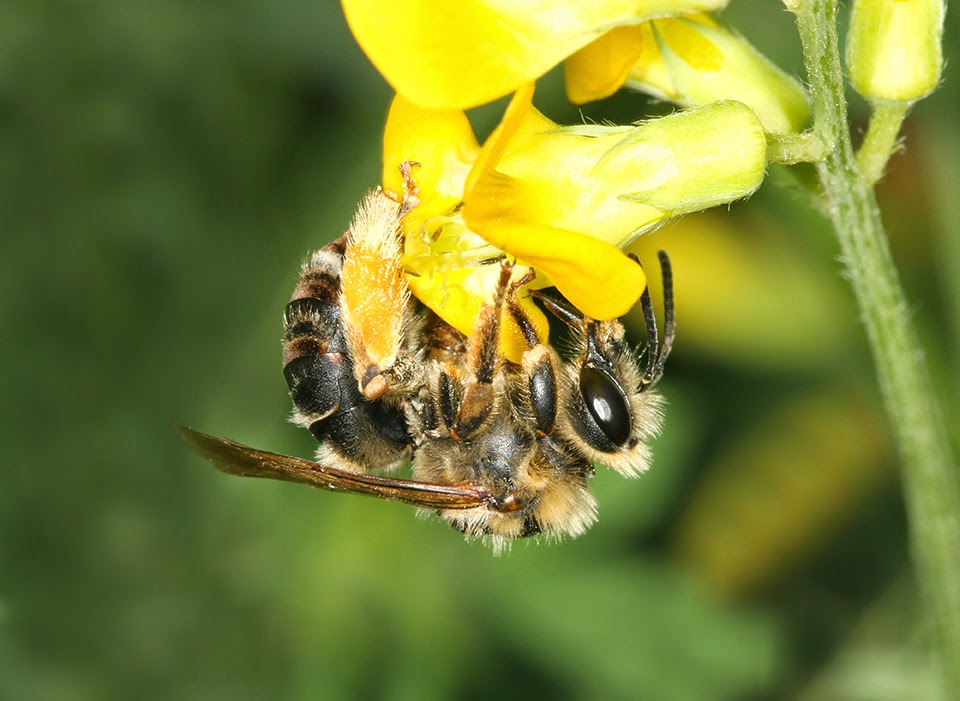
Long-horned Bee (Eucera longicornis) female. In the end we only spotted 3 individuals, so we had sadly missed its peak. In previous weeks we have counted over 10 in just one small area.
I'm afraid I will keep banging on about this particular bee until the cows come home (I have no cows).
Seriously though, the world of entomology means I can never be bored again!
Subscribe to:
Posts
(
Atom
)