Showing posts with label honeybee. Show all posts

Wednesday, 17 June 2015

Gatsbees B-Log: May 2015

Swarming is a joyful time for the bees, when half the colony leaves the nest with the old laying queen to find a new home...


...leaving behind a peanut shaped capped queen cell for the remaining bees to care for.

(That’s next month’s story)

They usually fly onto a nearby tree, fence, lamp post etc. (check out google images for whacky places on which they land) where they hang for between 20 minutes and a couple of days, to make sure the queen is with them!

And to send off the scout bees to look for a new home.


If nobody comes to collect them, they fly off again together, swirling through the air to make a nest in their new found location, which could be an empty hive...

A hole in a tree...

Or, If the weather changes, they often make their nest where they are – in a Cotoneaster hedge in this case;

A fantastic construction, but they are entirely at the mercy of the weather and they would be unlikely to survive.  


The cluster of bees contains a variety of ages, some of which would have been returning from foraging expeditions with pollen and nectar when the swarm emerged from the hive. This will last them for about 3 days.

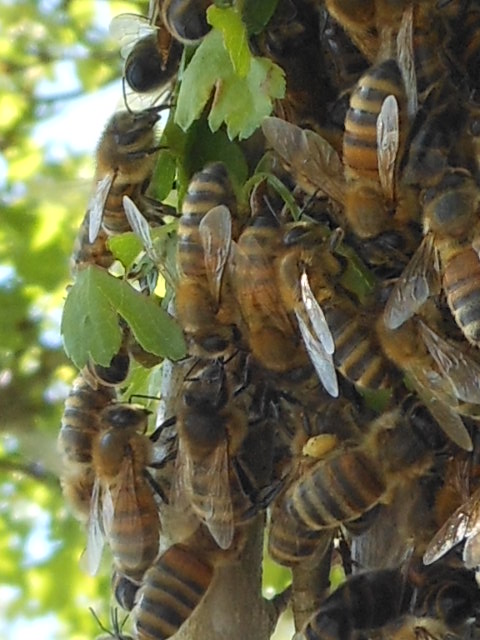


They don’t always make it easy for beekeepers to collect them...

Settled swarm on Hawthorn, Ashley's Field


The best method in this case was to put a cardboard box over the top of the swarm...


....then gently smoke them up into it.


The bees use a branch to bridge across the gap and begin to go up into the box.


Last few...


Just a quick look in the box…


As the bees hook onto each other from the top of the box, we can turn it upside down without disturbing them and place it on a sheet with a stick to make an entrance for them. No expense spared!


They fan their wings and send the scent (from their nasonov gland in the final section of their abdomen) into the air, to call in all the stragglers.


Ah, this a much better picture of fanning:

Nasonov gland visible as the lighter section near the tip of the abdomen

At dusk, when they have all found their way into the box, it’s wrapped up in the sheet and the bees are taken away, gently but firmly shaken from the box into a clean hive, the new frames carefully lowered on top of them and the hive closed up with an entrance left open. It’s a great time to have some help from my young apprentice!


The bees cluster together on the new frames and use the pollen and nectar, which they brought with them as stores...

...to fuel the energy they need to make beeswax in the glands under their abdomen... 


...while the foraging bees continue to bring in food from the May flowers.

Hawthorn (Crataegus monogyna)

Holly (Ilex aquifolium), the tiniest of flowers has a good source of pollen and nectar for the bees


Gillybee X

Friday, 6 March 2015

Gatsbees B-Log: February 2015

Mouse nest (Apodemus spp.)

A diligent mouse found a cosy winter hideaway in one of the hives, heated by several thousand bees with plenty of food in the larder. Unfortunately for the mouse, this excellent little nest was never lived in, as I put a metal mouse-guard over the entrance while she was out so that the hole was too small for her to get back in...


...which was lucky for me as mice make a terrible mess eating the wax comb, the honey, and the larvae and can disrupt the bees. Smelly too!
   In a strong colony, there may be up to 10,000 female worker bees left when spring arrives, as well as a queen, and the two pictures below will introduce you to the members of the Honeybee family (Apis mellifera):

Honeybees not wasps!

Queen: 'Daisy', in her third year, egg-layer extraordinaire, mother and grandmother to all the other queens whose colony names begin with the letter D. Very yellow in colour, her heritage is from Italy where it’s ok to be in light colours because the sun always shines. Virgin queens mate with around 10 to 15 drones, so their colouring soon averages out.

Drone: Drones don’t get names as they are only in the nest from April to September (up to 1000) as they are only there to mate with new virgin queens. Oh, and to eat as much honey as possible.

Female workers: dominate the nest with numbers of around 50,000 in late May or June.  The workers do just that, a lifetime of housework for the girls, living for 5 weeks over the summer and 6 months over the winter.

New generation of worker chewing its way out of the cell: I’m very hairy until it all rubs off, so somebody feed me, groom me and I’ll bee off to work!

Common Wasp (Vespula vulgaris) queen

Honeybees are often mistaken for wasps, so this is a queen Common Wasp; yellow and black, thin waist and yellow legs and later in the spring, she will be out of hibernation, looking for a place to build a new nest.


On a warm afternoon, after a time clustering inside the hive, Honeybees fly out backwards in ever increasing circles to remember landmarks, so although this photo looks like it’s from a very expensive slow motion camera, it’s because the bees are hovering. (Should have kept that one to myself!)

Sunshine in miniature (Crocus spp.)

Despite the continuing low temperatures, spring is definitely on the way and I was very happy to see that a few bees had popped out to collect some pollen on their back legs, a good sign that there must now be young bees developing, as pollen is the protein part of their food and the nectar (which they make into honey) the carbohydrate.

Flowers for bees, bees for flowers: Snowdrops (Galanthus nivalis)
Gill x

Wednesday, 6 August 2014

Honeybee freeloaders

Following Simpson's lead I've decided to have a try at this beekeeping thing. During a busy field season it means I get home even later, but on the other hand it is an excellent way to unwind.

The well-guarded hive entrance of the European Honey Bee (Apis mellifera). It is incredibly therapeutic to just sit and watch the comings-and-goings of  workers and drones.

We now have several hives which are packed to the rafters with honey and bee larvae, attracting a menagerie of predators and parasites. This means that during my new hobby, I still get to record new species!

Greater Wax Moth (Galleria mellonella)

The Greater Wax Moth is a new one for me; this individual met her demise in the top section of the hive (perhaps after being stung or balled to death by the workers). It lays its eggs on the waxy honeycomb, which then hatch into caterpillars and bore tunnels through the cells, feeding on the wax and other bee-substances. They can also burrow into the wood of the hive, so when present in high numbers they can cause a lot of damage to the structure.

I'm quite please with this pic. That red 'welt' on the top of the
abdomen is an individual Varroa Mite (Varroa destructor)

Varroa destructor is an apt name for this mite, indicating just how much beekeepers love them... Not only does this blood-feeding arachnid weaken the individual bees by sucking out their life-force, they spread several bee viruses and are incredibly difficult to contain. However, we do not intervene unless an infection is particularly severe. Symptoms can include stunted, scruffy, deformed wings and unsteady, drunk-looking bees. Having this mite must be like hanging out with your impulsive, booze-hound flatmate on a night out in town (not of course referring to anyone I live with right now).

 German Wasp (Vespula germanica)

Social wasps can be a right pain at this time of year (I need not tell). Attracted to the scent of the wonderful honey stores, as soon we lift the lid off the hive, then they appear, persistently pesky. They also scavenge the dead and dying bees from the ground around the hive; not such a bad thing in terms of good house keeping and removing infected individuals. This female German Wasp found a dying worker Honey Bee and set to it with her strong mandibles... There was an audible 'click' as she decapitated it!

Fencepost Jumper (Marpissa muscosa)

It seems that almost every time we start a check of the hives, a Marpissa jumping spider will pop out onto the side to see what all the fuss is about. They probably just use the hives as a well-defended shelter and are unlikely to bother the bees. Perhaps they love the sweet smell of honey and cedar wood as much as we do.

Beekeeper (Homo sapiens)

Of course, not forgetting those ultimate freeloaders! Which reminds me, it is about time I enter my first record for Homo sapiens into iRecord... Egotistical perhaps to submit myself as a specimen?

Nom.