Showing posts with label Kingfisher. Show all posts

Friday, 9 December 2016

Early winter bird surveys 2016 (Part 1)

Land East of the Railway Line: December 8th


Dawn breaks over the Gatwick Stream, and Tom Forward is about to have a date with destiny...


Actually, the date is with a Snipe, but this is not just any old Common Snipe (although we did see 7 of those); it's a little bit scarcer than that. He wanders along the wet flushes, keeping out a sharp eye...


A sudden burst of wings from the ground and it's off like a shot - a Jack Snipe! Another new record for our bird list at Gatwick.

Jack Snipe (Lymnocryptes minimus) RSPB

Common Snipe (Gallinago gallinago) RSPB

Much quieter than Common Snipe, the Jacks have a shorter bill and are a shorter, dumpier bird in general. The Common types will shoot off up into the air before you can get close, but Jacks can hold on until you almost step on them, then dropping onto the ground again after a short, low flight.
  A small flock of Meadow Pipits bounced past us through the air, and a Grey Wagtail descended rapidly down into the river channel.

 
Our next new discovery for this site is a Barn Owl roost in our 'Little Owl-Oak'. Not sure if the little-er owls would think much of their new neighbour....

White wash (owl wee) on the tree above what might be the Little Owl nesting hole

Barn Owl pellet

Poking our heads over the bank of the Gatwick Stream by the sluice gates, and were surprised to see a dark, sleek mammal gamboling in the water. American Mink are insatiably curious and this one actually came towards us, then hid in a small clump of rushes to check us out.

Not much of a photo of course.
How to tell apart Otter and Mink - a handy Wildlife Trust fact sheet.

Dashing back over grasslands to the next transect, and we were stopped in our tracks by a pair of Kingfishers zooming low over the grass. Although strongly associated with water courses, they are known to sometimes cut corners and even head into woodland habitat to do so. Hey, I would too!


Into the woods and a flock of Redwing were busy foraging in the understory. Winter thrushes vary what height they forage at depending on available food source. Towards the end of winter they feed more on the ground.

More white-wash beneath a mature oak - favored perching point for a Common Buzzard?


A Song Thrush sang from a distant hedgerow. A Wren and Robin were also in song; only a few birds do this through winter.
   At Dunnock corner, there were constant loud calls which signified the usual debauchery. They always seem to get louder in winter, kind of like my own family. I guess domestic drama helps to keep small birds warm. I still get Dunnock and Kingfisher calls mixed up, which after 4 years of these surveys Tom F. must be getting fed up with.


Through the woodland strip and out into Lower Picketts Wood, mixed flocks were abound of Long-tailed Tits, Blue Tits and Goldcrests. We checked a little closer through the binoculars but sadly couldn't turn any of them into a Firecrest. At the end of the transect, our trusty Treecreeper finally called.


The final species count for the morning was 33 (not 34, as I only recorded Common Buzzard when I returned to site at the end of the day):

1
Blackbird
Turdus merula
2
Black-headed Gull
Chroicocephalus ridibundus
3
Blue Tit
Cyanistes caeruleus
4
Bullfinch
Pyrrhula pyrrhula
5
Buzzard
Buteo buteo
6
Canada Goose
Branta canadensis
7
Carrion Crow
Corvus corone
8
Coal Tit
Periparus ater
9
Dunnock
Prunella modularis
10
Goldcrest
Regulus regulus
11
Goldfinch
Carduelis carduelis
12
Great Spotted Woodpecker
Dendrocopos major
13
Great Tit
Parus major
14
Grey Heron
Ardea cinerea
15
Grey Wagtail
Motacilla cinerea
16
Jack Snipe
Lymnocryptes minimus
17
Jackdaw
Corvus monedula
18
Jay
Garrulus glandarius
19
Kingfisher
Alcedo atthis
20
Linnet
Linaria cannabina
21
Long-tailed Tit
Aegithalos caudatus
35
Magpie
Pica pica
22
Mallard
Anas platyrhynchos
23
Meadow Pipit
Anthus pratensis
24
Mistle Thrush
Turdus viscivorus
25
Pied Wagtail
Motacilla alba subsp. yarrellii
26
Redwing
Turdus iliacus
27
Robin
Erithacus rubecula
28
Siskin
Spinus spinus
29
Snipe
Gallinago gallinago
30
Song Thrush
Turdus philomelos
31
Starling
Sturnus vulgaris
32
Treecreeper
Certhia familiaris
33
Woodpigeon
Columba palumbus
34
Wren
Troglodytes troglodytes

American Mink
Neovison vison
Eastern Grey Squirrel
Sciurus carolinensis

Barn Owl (roost)
        Tyto alba

Thursday, 12 December 2013

Early Winter Bird Survey - North West Zone

Gatwick Landscape Photographer of the Year
(self-appointed)

Sunrise: 07:45 December 9th 2013

Gosh... 

Spider webs on Dock seed heads, North West Zone

Oh my... 

 
Rough grassland and hedgerows, North West Zone

Goodness me...

Frost in the rough grassland, North West Zone

Ok, that's enough of that. On Monday morning, we began our Winter Bird Survey transect in the rough grasslands, north of the runway. I was accompanying Tom Forward of Gatwick Greenspace and volunteer James, for whom this was a first venture into birding. 

Rambling rosehips in the hedgerows

The open areas of grassland were mostly quiet and still, with bird activity being concentrated in the hedgerows. In the mud, there were plenty of animal tracks; clues as to who else had recently passed by...

Roe Deer tracks: the rear dew-claw marks are just about visible

Moorhen tracks

The hedgerows looked pretty awe-inspiring in the winter sun. Every section seemed to contain at least one singing Song Thrush; pretty unusual as spring is the normal time for staking out territories. A flock of around 10 Meadow Pipits broke the relative peace, peeping frantically overhead before settling in the hedgerows furthest from us.

Listening for thrushes in the hedgerows

Reed Buntings were in good numbers, hiding away in the tall Reed Canary Grass and then flitting up into the scrub. A Robin and a Dunnock were actively singing; a few Redwing were 'tseeping'; and mixed flocks of Great, Blue and Long-tail Tits nosily contact-called while foraging.

Blackthorn fruits (i.e. Sloe berries) and lichen

Approaching the first bend in the River Mole, a Moorhen squawked its presence and a Pied Wagtail passed overhead in bouncing flight. Our first flock of Fieldfare, a winter-visiting thrush from northernmost Europe, were nosily chatting away in the large Oaks overlooking the floodplain. On a bare patch of earth near the grassy slope, a Green Woodpecker had left its usual calling card...

In certain light, even bird poop can look quite marvelous.

Break it open and you will find the chitinous remains of ants

We had a poke around in the reed beds but sadly no signs of Water Rail, so Tom regaled us with an ear-splitting impression (although neither James nor I were really qualified to critique it). Still scattered around in the grass were feathers from the dead Grey Heron found earlier in the week - the foxes had an early Christmas dinner! 

Scrub West of Brockley Wood

Entering the scrub west of Brockley, a bout of action could be heard in the woodland margins with brawling Song Thrushes and a jeering audience of Redwing. Rounding the corner of the woodland, where the river passes close by, a mixed flock of Fieldfare and Redwing were happily foraging in the Hawthorn scrub.

Candlesnuff Fungus on river driftwood

Beginning our second transect further downstream along the Mole, Chaffinch, Goldfinch, Magpie and Reed Bunting were all in abundance. We also picked up a new first for this birding transect: a lone Rook. These birds are generally common around the airport so it is by chance they haven't cropped up earlier on our survey. 
   Continuing up the corridor of grassland along the river, we then entered a Fieldfare battle-zone! They were zipping back and forth over the river, between the lines of scrub and trees. Sounding rather like fighter plane machine-guns, one even let loose a small, tactical aerial-attack (fortunately though not directly overhead!).


Counting them was quite a challenge but we noted around 80 individuals in this one section, plus the usual handful of Redwing and Song Thrush. This is one of my favourite parts of the River Mole corridor, where the water passes over stones and gravel, creating 'riffles'. These fast-flowing areas are particularly beneficial for aquatic invertebrates, such as Stonefly and Caddisfly larvae.


Towards the end of transect 2, we paused to watch a brightly coloured Jay perched just a few meters ahead, posing proudly with acorn in beak. A moment later, there was a flash of orange and a Kingfisher appeared up on the tree. Then, it shot past us upstream, showing off its electric blue upper-side and bullet-like profile. We were also greeted by the lumbering flight of an impressive Grey Heron, moving off downstream... For James, these were two species he had never seen up-close, so well worth the early morning start!

Our two transects

Sunday, 19 May 2013

Temperamental Mole

Ecological consultant Rebecca, taking water samples under the netted section of the River Mole

A tributary of the River Thames, the River Mole rises just south of Rusper village in West Sussex, flowing north-west for 50 miles (80km) before reaching the Thames at the north Surrey border.


At Gatwick our section of the River Mole is rather open and slow-flowing, passing under the airfield through a tunnel and exiting on the north side. At the southern point where it enters, a Kingfisher is regularly spotted zipping in and out.
   The course of the Mole has been altered several times since the airport began operating commercially in 1945. During a massive flood alleviation project in 1999 it was diverted once more from its course north of the airfield; now it travels west for 400m parallel to the taxiway before meandering in a north-easterly direction. With a good diversity of riffle formations, pool sequences, backwaters, lush wet grassland and reedbeds, it is in my opinion quite a lovely and natural-looking section of river.

The River Mole on Gatwick's Landholdings, north of the airfield

Vantage point from the grassy mound, overlooking the airfield - NWZ

Reedbeds in winter

The water level at Povey Cross has reached level 2 (my cunning theory is that the numbers represent 10cm, putting the water level at 1.2m.) In the past I have seen the water close to over-topping the stick.

Much of the catchment area of the Mole lies on impermeable rock, meaning that the water level responds extremely rapidly to heavy rainfall. My first week of surveying at Gatwick taught me a punitive lesson… a few of my reptile mats have probably washed up somewhere in Surrey.

Rebecca kicking the silt and netting the river-dwelling invertebrates

The water quality of the river can also fluctuate greatly depending on the season. The ecologists Rebecca and Victoria from Penny Anderson Associates regularly carry out aquatic invertebrate 'kick surveys', taking samples back to the lab for species identification under the microscope. Identifying the flora and fauna occurring in the waterways is particularly useful, as certain species are very sensitive to pollution and could act as indicators of any negative impacts of the airport's operations. On Monday they visited Gatwick and I was able to join in to see how it is done.

Damselfly nymph covered in silt - possibly a Banded Demoiselle?


Common Backswimmer (Notonecta glauca)


Diving beetle species


A small leech


Freshwater Shrimp (Gammarus pulex) is a type of amphipod crustacean

An Orb Mussel, a type of freshwater mollusc

I particularly enjoy this time of year when the Reed Warblers set up their territories all along the Mole. If you happen to wander west along the public right of way from Povey Cross you can hear their repetitive, mechanical sounding song...

I took this photo of a Reed Warbler along the Mole last summer -
 possibly my best birding photo so far!

And finally, one of the mystery coconuts which wash up regularly along the River Mole... No explanations have sufficed so far, but it gives me a hankering for lime and a tiny little umbrella.

Sunday, 28 April 2013

Spring Breeding Bird Survey - April 2013

With Tom Forward of Gatwick Greenspace Partnership.

Day 1 - Land East of the Railway Line: 23/04/13


Spring seems to be in intense fluctuation and on some days everything decides to turn up at once...
We began our survey on Tuesday morning and the woodlands were dripping with bird song; it was easy to feel overwhelmed! Transect 1 begins at Lower Picketts Wood, travels south through the ancient woodland strip bordering the New Lagoon site, then dives into Horleyland Wood. Our usual woodland suspects were all present including Jay, Song Thrush, Blackcap, Wren, Chiffchaff, Nuthatch and Green Woodpecker.


This Chiffchaff in Horleyland Wood entertained us by wrestling with some nesting material right at our feet, almost oblivious to our presence. (I look forward to investing in a decent-proper camera one day!)

In Goat Meadow, there are sadly no goats.

Transect 2 begins at Goat Meadow and we get our first definite record of a pair of Bullfinch. Tom is pretty good at imitating bird calls; I decide to attempt it but forget that I am still eating a biscuit, which my lungs then reject; the Bullfinches don't hang about to listen to my hacking cough. Close by a Mistle Thrush was doing a good impression of a depressed Blackbird, then moving on through Upper Picketts Wood we passed many a territorial dispute between Great Tit, Blue Tit and Coal Tit.

Coal Tit and Goldcrest are regulars in the canopy of these massive pines in Upper Picketts

The final leg of Transect 2 is currently disrupted by the flood alleviation project, so we skipped a section and approached Gatwick Stream from the western side, through the archaeological dig site. At the very edge of the fields by the railway line we stumbled across a birding first for me: two female Redstart! This is a migrant species which will be just passing through on their way to a more ideal breeding site. 

A group of Common Buzzard - I have taken worse pictures than this!

At the very end of our final transect was a nice treat with Buzzards wheeling overhead and a Common Whitethroat starting up his song:
*Link to LERL Final species list*

Later on that same day I popped over to our other site in the North West Zone along the River Mole. I was replacing some reptile refugia, listening the first Reed Warbler in song and Common Toads 'getting busy' in the river.
Common Toadspawn in the River Mole - these are laid in strings rather than clusters like frogspawn

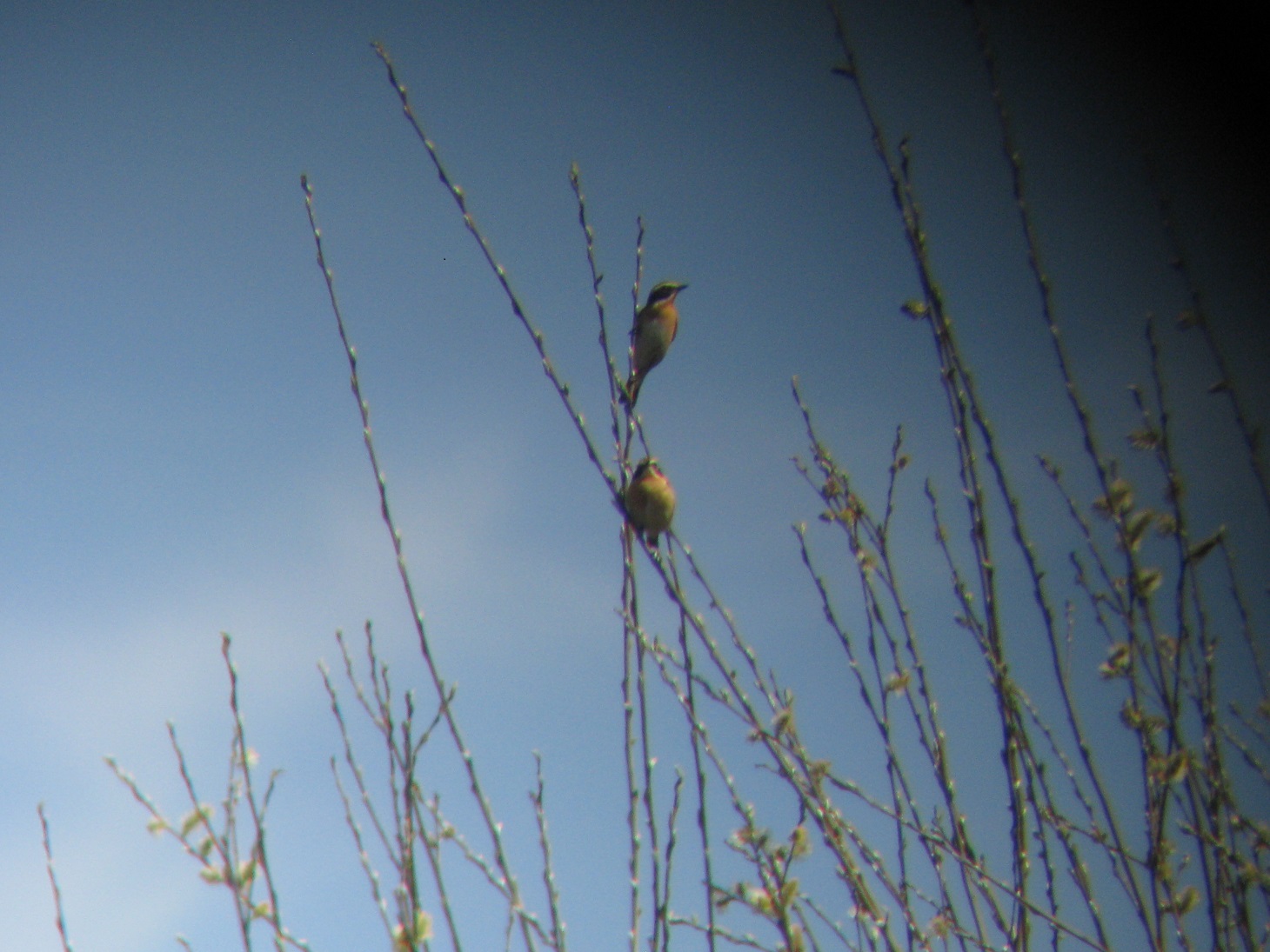
I disturbed a couple of rather striking birds which then sat boldly nearby in the young willow scrub, south-east of Brockley Wood. This was a species I didn't recognise so I tried my best to describe them on the phone to Tom while taking photos, holding my camera up to my binoculars... 


I emailed these across to him and he sent me a slightly disgruntled reply confirming them as a pair of Winchats, yet another migrant species previously unrecorded here, and this quite possibly tops the pair of Redstart he had spotted earlier! Score to me.

Day 2 - North West Zone: 25/04/13


On the Thursday we had another early start and Tom turned up in his car while still eating his breakfast of 8 rounds of toast... I was trying hard to hide my smug face, we both knew those Winchats had probably moved on!

A cold and misty start

We began Transect 1 at the point where the River Mole exits out from under the airfield, north of the runway. Grey Wagtail, Linnet, Common Whitethroat, Reed Bunting and a female Kestrel along the airside fence made for a good start. Rounding the first corner where the River Mole begins to meander we caught a glimpse of two Barn Swallow zipping along over the water, seemingly on their way to somewhere else.

Green Woodpecker droppings, full of the chitinous remains of tiny ants

The sun burning off the clouds along the floodplain grassland

Moving north into Transect 2 there was a sudden, manic piping-whistle and Tom spoted a Kingfisher passing along the woodland strip. I missed it because instead I am staring at a bright orange leaf through my binoculars! I was however pleased to hear it so clearly, a similar sounding call to the link below.


Further downstream of the River Mole and North of Brockley Wood the Reed Warblers have begun setting up territories in the sparse patches of last year's reeds. Along the scrubby edge of the grassland were several pairs of Common Whitethroat, a female Lesser Whitethroat and also a little male missing a tail, adding to its severe levels of cuteness.

A Yellow Scooter, probably stolen and abandoned in the River Mole by the human subspecies 'Chav'

Tom Forward (not the chav in question)

Where's Waldo the Kingfisher...

'Just as they were packing up, on the final day of the final hour...'
We were literally finishing up the last transect when I finally caught a break on the Kingfishers! A sudden manic piping noise and then some aerial altercations right in front of us - bright blue and orange shapes shooting upstream like a group of battling F1 Benettons...

Another terrible picture through the binoculars does this amazing creature no justice.

We saw 3 Kingfishers on the wing, possibly in a territorial dispute. We got 38 species of bird in one day along the NWZ which is our highest count yet... all in all, a top few days for us!!