After only making it back home in the wee hours of this morning, I was awoken at 7.30am to some great news; council workers had decided to try to repairing the communal recycling bin outside my bedroom window with a sledgehammer. I guess I'll really appreciate this the next time I take out the recycling.
Location: edge of Brockley Wood, adjacent to the north west aircraft stands.
Ah well, the late finish was totally worth it as we got to see a whole selection of bats utilising the site on the River Mole side of Brockley Wood. I also finally got to see a fairly common bat species which has eluded me for 5 years!
Martyn measuring the forearm length of a bat while Laurie takes notes
Martyn Cooke (Surrey Bat Group) is a licensed bat surveyor, who has been monitoring the bats around Gatwick for several years. A harp trap is his preferred tool, one of safest ways to capture bats and minimise their stress, in order to collect scientific data and feed back to the Bat Conservation Trust.
Harp trap set up on River Mole floodplain
The northern edge of the woodland is sheltered by a massive environmental bund, blocking out light and sound from the airfield. The weather conditions were almost perfect, with low cloud, barely a breeze and a balmy 17 degrees celsius. This turned out to be the best night's trapping I've attended in terms of species diversity; we caught 5 species in the harp traps and at least 2 others on the detectors.
An electronic lure plays out species-specific bat calls
Here's our haul of bats, in order of appearance...
Soprano Pipistrelle (Pipistrellus pygmaeus)
Soprano Pipistrelle wing
Whiskered Bat (Myotis mystacinus)
I was super excited when I released this one; just look at his little mouth!
Brown Long-eared (Plecotus auritus). He does have some eyes there, he's just blinking
The new one for my list is was the Daubenton's Bat! That brings my number of wild UK bat species seen up to 9.
Daubenton's (Myotis daubentonii)
These funny looking dudes have big bald patches around their eyes, and are specialists at hunting over water, scooping up small insects while in flight with their big tail membranes.
I didn't manage to get a good shot of the membrane, but we can confirm that this one is a fella
Lovely dark face of a Common Pipistrelle
Common Pipistrelle (Pipistrellus pipistrellus) female
Although we didn't trap one of the rare Bechstein's tonight (previous post about our first Bechstein's at Gatwick) or Martyn's target species the Nathusius' Pipistrelle, we did pick up this Myotis bat call on Martyn's sonobat, which he thinks could be one of the little dudes with attitude...
Bechstein's call?
Thanks to Martyn, Fiona, Laurie, Rina, Luke and Ryan for giving up your valuable time. Also to the bats for doing your bit for science; you all rock.
North West Zone. Approximate harp trap locations in yellow, mist nets in blue
I've really dropped the ball on blogging this season, so this is a round-up of our busiest summer yet on the project.
Firstly. some BIG news....
We did it!!
Gatwick Airport Ltd has won the 'Client Award' catergory in the CIRIA BIG Biodiversity Challenge. Our biodiversity project has been running for 4 years now, with thanks to great support from key people and various departments at Gatwick, plus the Gatwick Greenspace Partnership. The CIRIA certificate is another brilliant collaborative milestone and sits nicely alongside The Wildlife Trust's Biodiversity Benchmark Award, which we continually work to uphold.
Hannah Deacon, myself and Tom Simpson
The organisation CIRIA firmly believes that the construction industry, business and infrastructure can all do their part in preserving the UK's biodiversity. In the midst of unprecedented species decline and the loss of British countryside, this is becoming of vital importance in conservation.
Betony in flower along the River Mole, North West Zone (July 2016)
Summer conservation and habitat works:
We are incredibly grateful to all of our volunteers who have visited the sites and got stuck in this summer, as without you we would not have half a project! We've spent days with local businesses and Gatwick staff controlling Himalayan Balsam along rivers, managing glades in ancient woodlands and helping to fortify the woodland footpaths.
Himalayan Balsam flying through the air
Working along the River Mole in Gatwick Airport's North West Zone
Kevin Lerwill's regular team of Gatwick Greenspace volunteers make a great contribution to our sites, along with Tom's regular helpers, Harry and Robert, who are incredibly helpful on more technical tasks. Here they have installed a shiny new biodiversity information board, over at the Land East of the Railway Line.
Under no circumstances may we put any staples for posters in the new oak frames
...oops.
At the North Terminal Staff Memorial Garden; our pollinator friendly plants are filling out the spaces nicely, with signposts in place displaying information about each plant. Next year we will begin recording the pollinating insects here for the Sussex University LASI 'Plants for pollinators' study!
Jubilee Staff Memorial Garden - planting for pollinators
Tom Simpson with Sussex Wildlife Trust conservation trainee Bruno
Bumblebee on Hemp Agrimony (Eupatorium cannabinum)
Ecological monitoring:
Two new surveys conducted this year were clearwing moths and Purple Emperor Butterflies. Clearwing moths can be tracked down with the use of specific pheromone lures, which we bought from Anglian Lepidopterist Supplies.
Our first crack at using clearwing moth pheromones
It was rather challenging to even find a sunny afternoon in June and July! After a few attemps, our work experience placement student Ellie was our lucky charm and behold, after just 5 minutes the Sallow Clearwing Moth did appear!
This tiny moth is a very scarce (Nationally notable B) and likely under-recorded species. At first glance it looks like an ichneumonoid wasp...
Sallow Clearwing Moth (Synanthedon flaviventris)
We had no joy trying to tempt down Purple Emperor Butterflies from Oak canopies, despite using some incredibly stinky shrimp paste (apparently the males love to feed on noxious substances). However, with keen-eyed ecology volunteers like Ellie and Ryan, you don't always need a lure...
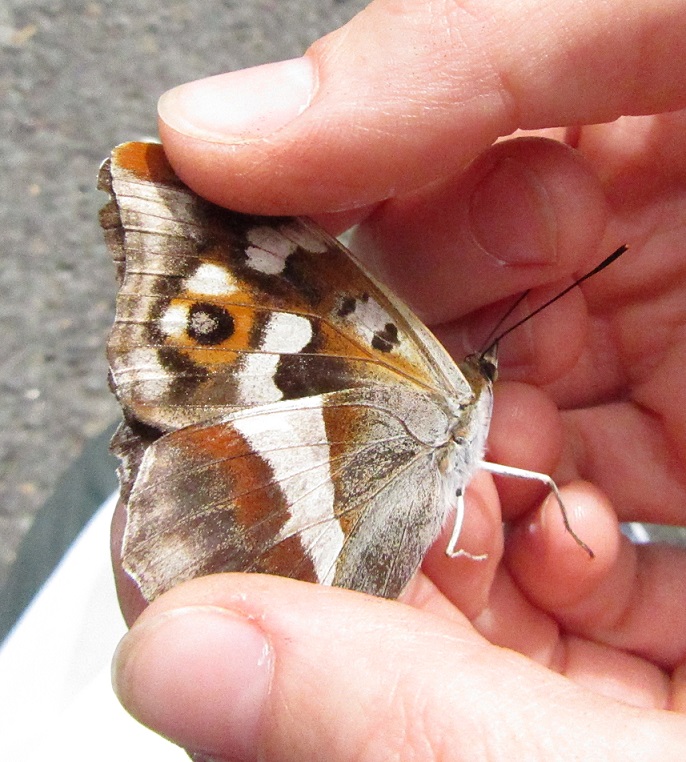
A White Admiral perhaps? But we can just make out two tiny eyespots...
Thanks to Ryan's netting skills (and a local resident for supplying an extendable pole and gaffer-tape), we were able to get a closer look to confirm our identification...
Large indicative eye spot on the underside of the upper wing
Purple Emperor (Apatura iris) female, one of Britain's biggest butterfly species
This is another fantastic record for the airport! Finger crossed that next year we hope to photograph the male.
Happy surveyors
Not only have we had new invertebrate species this year, but vertebrates too! Our very first Slow-worm has turned up in the Land East of the Railway Line. This is a bit of a landmark moment, as in over 4 years of continuous monitoring the only reptile species recorded at Gatwick has been Grass Snakes. Wildlife photographer David Plummer visited our site last week, turned over the first reptile mat he came to and found a new species!
A coppery flash...
Slow-worms are neither worms, nor particularly slow! I've seen this little lady hanging around a few times since now; each time she nipped off quicker than I could get a picture...
Slow-worm (Anguis fragilis) 'The Flash', eventually caught yesterday by myself and Ellie
Back to Gatwick's Grass Snakes, and we've had good results on our surveys this year, with several more sightings of these incredible melanistic (all black) specimens...
Grass Snake (Natrix natrix) melanistic form
Juvenile with the barest hint of a yellow collar, but otherwise entirely black.
The DNA samples we collect will be sent off to Bangor University for further analysis. Their study will be looking at relatedness of unusually coloured Grass Snake to other populations around the UK and the European sub-species.
Martyn Cooke of Surrey Bat Group has also sent off samples for DNA testing, from droppings collected at the bat roost in Charlwood Park Farmhouse. He was able to confirm they are Whiskered Bats (Myotis mystacinus), which are one of several species we've been detecting along the River Mole corridor.
Sleepy Brown Long-eared Bat (Plecotus auritus) waits patiently while having his box cleaned out
After our final bat box checks for 2016 (I think we now have around 75 boxes in total), we have confirmed Brown Long-eareds, Common Pipistrelle and Soprano Pipistrelle all in residence.
Ellie and Ryan on a beewalk survey along the River Mole
Rina Quinlan assisting on our reptile surveys
Tom Forward and Ellie on our breeding bird survey
We've hosted a wildlife week, a wildlife day, monitored a whole suite of protected species, recorded declining invertebrates, conducted ecology training courses and natural history group meetings, with many experts giving up their valuable time to help uncover Gatwick's diversity of species. As we go into autumn the work doesn't stop, with more ecological monitoring and habitat works yet to come!
A final big thank you to Royal Holloway University Ecology placement student Ellie Stradling for all her time, commitment and wildlife charming skills this past summer. Please come back again soon!
Ellie and a Southern Hawker Dragonfly (Aeshna cyanea)
Bat activity transect C, Land East of the Railway Line, July 11th 2015
It has felt like a good year for bats around our biodiversity sites, with lots of exciting acitvity monitoring by Laurie Jackson, Martyn Cooke and volunteers from Surrey Bat Group. We've been using 3 different survey methods here: activity surveys (walking set routes called 'transects', with bat detectors and recording equipment); trapping surveys (with Martyn's harp traps, loud speaker and bat call software system); and box checks (annual checking and cleaning of our woodland bat boxes).
Powerline Ride at dusk, Horleyland Wood
Although rarely seen, bats actually make up around a third of UK mammal species and so are a significant players in our ecosystems. Also being insectivores, they are directly affected by any crashes in invertebrate populations and are great indicators of our countryside's overall health.
Bat box recorder and logger
Bat logger live sonogram image
This recording equipment is all a bit beyond me, but Martyn Cooke (who also works in air traffic control at Gatwick) loves his tech and is a dab-hand at collating and translating this data.
Measuring the forewing of a Common Pipistrelle.
(To handle bats, you must be trained and hold appropriate licenses.)
Weighing a Pip in a cup
The biometric data collected includes the species type (some can only be identified by close examination in the hand), weight, sex, rough age, breeding condition and general health of the individual. I need to check again with Martyn, but I think we are up to 10 different species of bat recorded at Gatwick.
Assessing wing joints and bone ossification to gauge the age.
This health check might look pretty intrusive for a bat, but they are only kept for a few minutes before they are released back out into the night.
Common Pipistrelle (Pipistrellus pipistrellus)
Brown Long-eared (Plecotus auritus)
Bats face many threats due to extensive habitat loss and fragmentation from development, as such they are all protected by UK and European law. You might associate bats with roosting happily in buildings, but they really need natural features such as grasslands, hedgerows and woodlands to hunt and forage in. The monitoring and conservation efforts led by organisations such as Bat Conservation Trust are of vital importance to conserve the UK's bat species.
Get out of here, you.
Its not always deemed socially acceptable to be out in the woodlands after dark. but this bat work gives us special licence. Its also great to see and hear all the other wildlife out and about our biodiversity areas on warm summer evenings:
Light Emerald Moth (Campaea margaritaria)
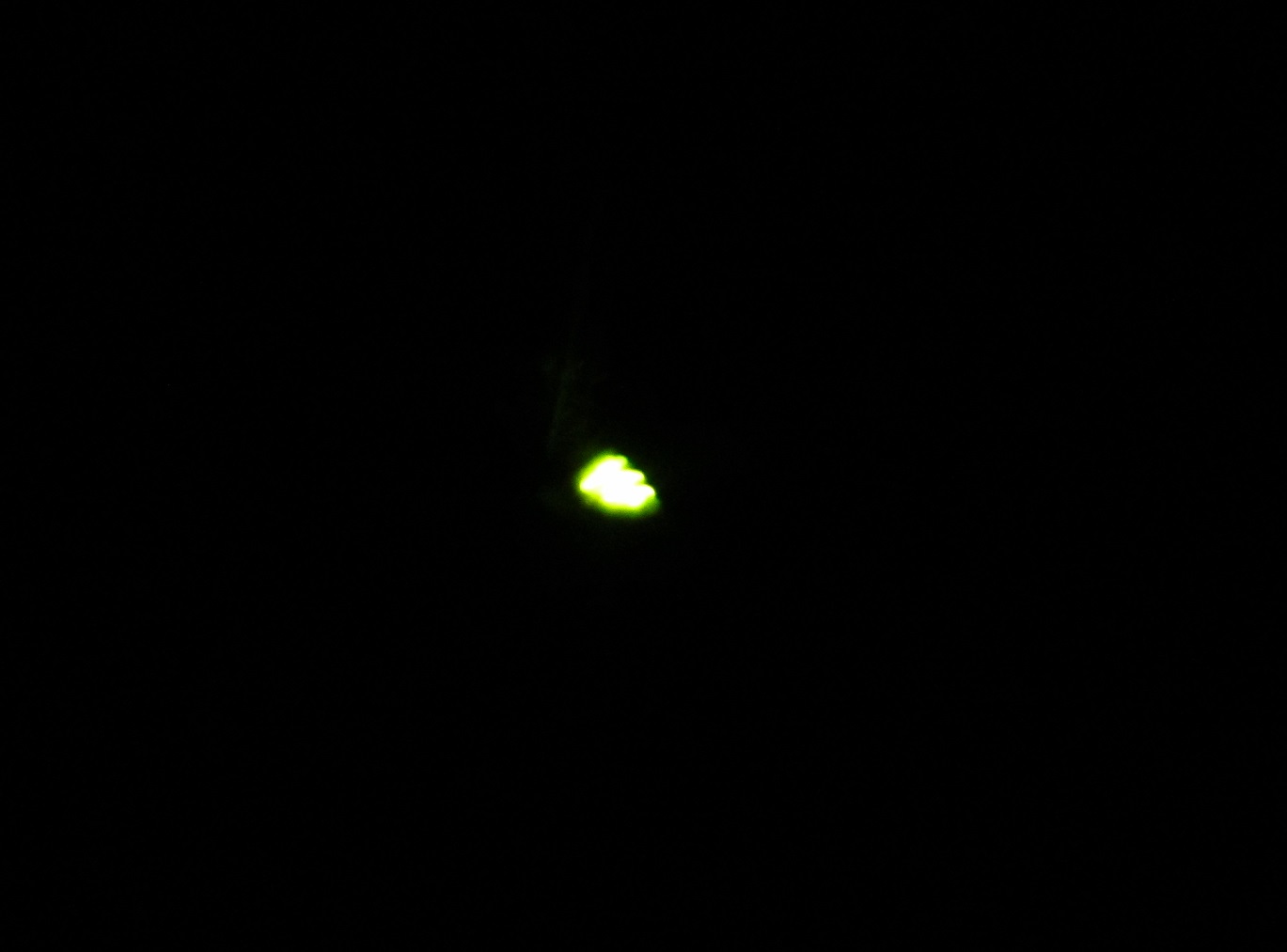
Glow Worm (Lampyris noctiluca), female
Photo with flash reveals that a Glow Worm is a large beetle
We often hear the strange hoarse squeaks of juvenile Tawny Owls, which sound like their voices are breaking...
Plus a rather impressive (and one of my favourite) species we have resident in our woodlands...
Araneus angulatus male, a rare spider in the UK, restricted to the southern counties
To learn about monitoring bats in your area, why not check out your local bat group.