Showing posts with label scotty dodd. Show all posts

Friday, 26 June 2015

Early invertebrate survey (the one that got away)

Wet weather and blustery conditions means that winged insects struggle to fly, instead staying hunkered down low in vegetation or hidden away in nooks and crannies (I wish it was the same for us ecologists).

Land East of the Railway Line

Earlier in the month, on a rare day of both sun and stillness, Surrey Wildlife Trust entomologist Scotty packed up his van and invertebrate surveying kit, stopping by to see what is happening under the radar of all the tourists and jet-setters.

Preparing sample tubes

Our task today was to check out some habitats which were missed off the previous surveys and needed looking at more closely. We've been keen to get back out to the Gatwick Stream since the flood alleviation project has come to a close...

Gatwick Stream grasslands

Wetland scrape with Great Reedmace (Typha latifolia), Gatwick Stream grasslands

Now the floodplain has had a full season of vegging up, in places it is looking quite stunning (albeit with the odd random exotic plant species cropping up). As the vegetation advances, the invertebrate lifeforms also begin to recolonise...

Agelena labyrinthica - Labyrinth Spider on dewy web

Underside of a Long-Jawed Orbweaver (Tetragnatha sp.)

A species of large diving beetle (Colymbetes fuscus)

Red-headed Cardinal Beetle - Pyrochroa serraticornis

Invertebrates form the essential base of many food chains and so can be excellent indicators of habitat quality. By seeing what species are dominating or what is absent, we can judge the success of our habitat management, then in a few years time we resurvey to measure the progress.
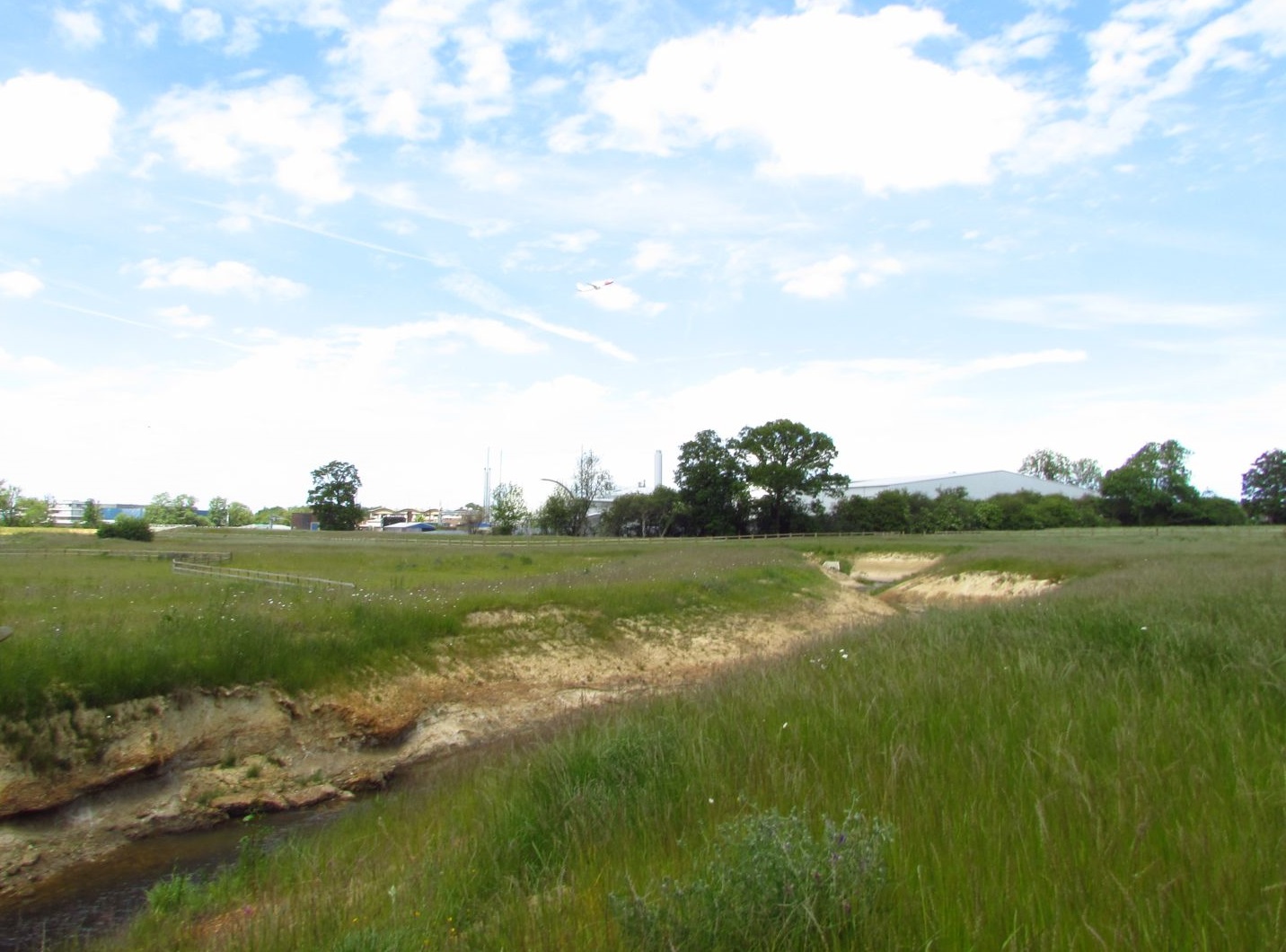
Gatwick Stream channel with its sculpted clay cliffs

The Gatwick Stream banks are still yet to green up, but even bare clay is appealing to some lifeforms, creating an interesting habitat matrix, suiting mining bees, mason wasps and beetle species. Even some birds too...

Kingfisher burrow

Here we had a brief interlude for some ancient bottle-collecting along the banks. These must have been underground for some time and washed out during the river re-alignment works...

Early 20th centruy Tizer bottle. "That belongs in a museum" 

Indiana Jones moment passed, it was time to look more closely at the pollen and nectar-gathering species...


Bumblebees on Fodder Vetch (Vicia villosa). Most were workers of either the Buff-tailed or White-tailed variety, as well as Tree Bumblebee

Corizus hyoscyami, aka the Cinamon Bug, or Squash Bug, or Scentless Plant Bug. 
(The perils of common names for invertebrates)

Over to another grassland area; Ashley's Field which is the subject of our green hay strewing project and home to our Honey Bee apiary, aka the 'Gatsbees'...

Ashley's Field - perhaps a little heavy on the Buttercup

Hitch-hiker: another Long-jawed Orbweaver

Into Upper Picketts Wood our the way to Goat Meadow, we stopped off to take a closer look at the understory.


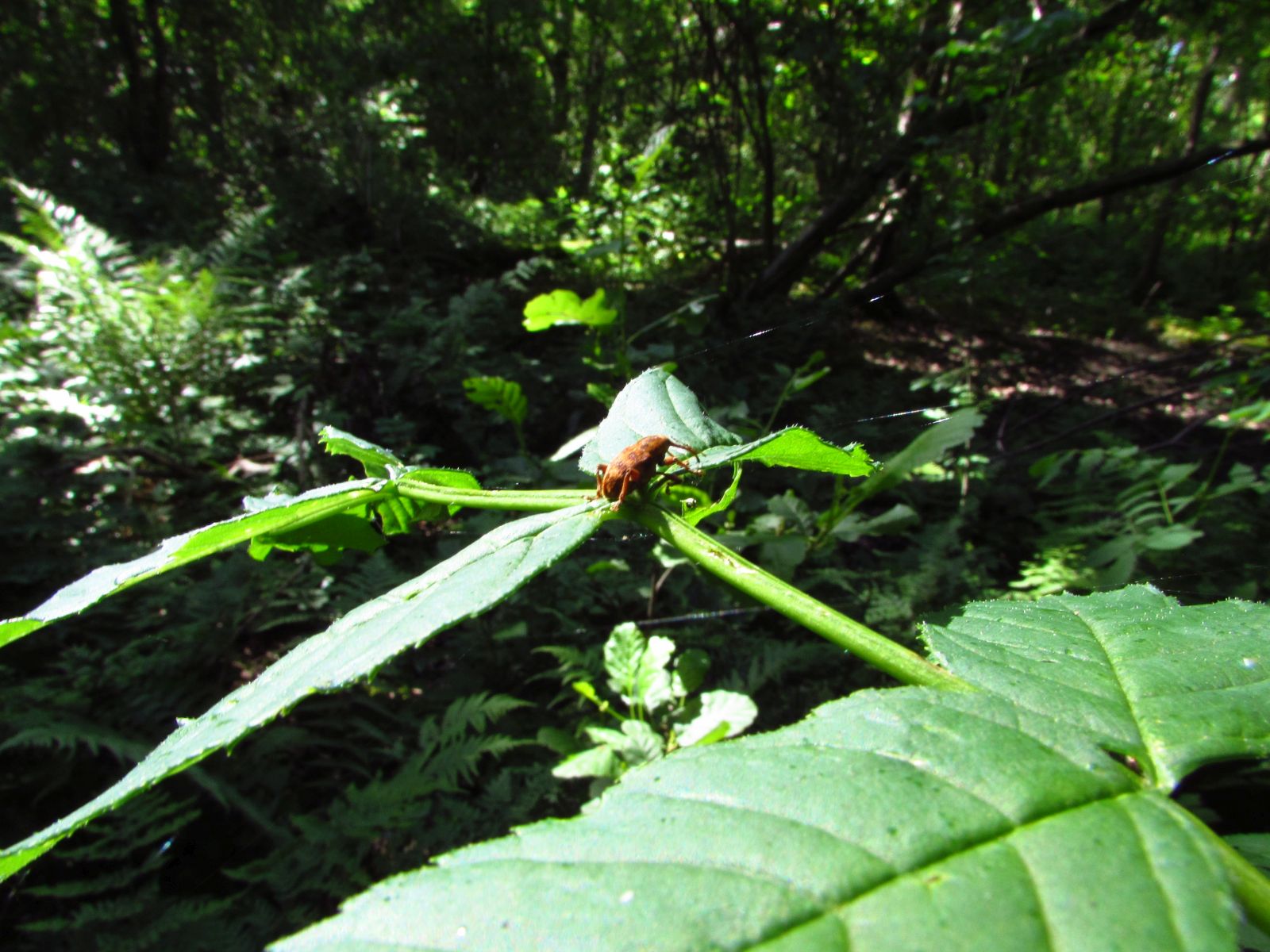
Nut Weevil (Curculio nucum

...giving Scotty a nip with its sharp, finger-boring mandibles!

Mr Finger-borer unfortunately took a nose-dive before I could focus for a close up.
   Over to Goat Meadow; a quieter, sheltered area of grassland. This lovely scrubby matrix is a real haven for butterflies and Grass Snakes. 


A few molluscs have made their way here too...

Wandering Pond Snail (Radix sp.)

Brown-lipped Snail (Cepaea nemoralis)

Scotty spent some time sweeping and beating the willow and oak scrub, turning up many interesting things including this funky little micromoth...

Alabonia geoffrella, with its funky, upturned labial palps

And I swept this punky caterpillar...

Vapourer Moth caterpillar (Orgyia antiqua). 
The adult female moths are wingless and emit pheromones to attract in winged males

14-spot Ladybird (Propylea 14-punctata)


A type of treehopper (Centrotus cornutus), one of only two species which occurr in the UK

Glowworm (Lampyris noctiluca) larva, commonly found under the reptile refugia

Scotty then called me over to take a look at this little beauty... 


A lovely little Jewel Beetle (Agrilus sp.)

Jewel Beetles are not very common in this area, so this could be quite an exciting find. We cooed over it for a bit, turning it over in the tube and I popped it back onto the willow leaf to get a better snap. It didn't stick around for long and this was as good as it got...

Agrilus sp. indet. cf.bickerisabloodymindedliberator

On handing Scotty back the empty tube, his face fell... Apparently there are over 3000 species of beetle in this single genus and he needed to check it under the microscope to identify to species level! Ooops.

...Fly, my pretty!

Friday, 27 June 2014

Late summer invertebrating

You might not think there's much in the way of quality habitat around an airport. Fair doos, as I used to think that too.

Clay Slope, North West Zone

Last Monday, Jeremy, Scotty D and his little dog Ro returned to our site in the North West Zone for the follow-up invertebrate survey. By surveying twice at the same site, both early and late in the season, we can detect a greater diversity of species.
   
River Mole floodplain

The past few weeks, the River Mole floodplain at Gatwick has looked the bee's knees (I'll be coming back to the subject of bees!). This is the result of some large-scale sculpting works which took place back in 2000 when the watercourse was diverted. It is now a veritable hotspot in terms of floral diversity... 

Greater Burnet (Sanguisorba officinalis)

Grass Vetchling (Lathyrunissolia)

Betony, Ladies Bedstraw, Quaking Grass

Meadow Vetchling, Greater Bird's-foot Trefoil, Lesser Stitchwort to name but a few. 
Artificially seeded? Either way, this lovely wildflower mix is a great thing for biodiversity

So colourful that my outlandish running trainers almost blend in

For this survey, we spread out to cover as great an area of the North West Zone as possible. The variety habitats, their different ages and structure provide plenty of options for food, water and shelter; potentially pleasing to even the fussiest kinds of invertebrate! 

Scotty grubbing around the dry slope while Jeremy searches for bees down on the floodplain

Ro the dog, focusing his efforts on keeping cool


Bishop's Mitre Shieldbug (Aelia acuminata). 
The weird angular head and stripes reminds me of the Muto in the latest Godzilla movie

Small Skipper (Thymelicus sylvestris) in cute begging pose


Since our recent exciting find of a rare species of bee, Jeremy and I spent some time staking out this section of the clay slope. We were hoping to see a few of the female Long-Horned Bees (Eucera longicornis) returning to their nesting sites...

Possible Eucera burrow?

I'll let you know the result of our great Eucera count at the end of this post!

Sharing observations

A pretty good indicator of how well a survey has gone is the number of specimens which Scotty has to take home for further microscope identification...

Just a few of his tubes; dude's got his work cut out

This type of sampling might look a bit grim, but we are unlikely to impact any populations and it is all in the name of science, with all data being passed onto the Biodiversity Record Centres.
   The following is a selection of Jeremy's excellent shots from the day (thanks again Jeremy!)...

 Broad Centurion (Chloromyia formosa) female. This looks like a Hoverfly but is actually a Soldierfly

Dusky Cockroach (Ectobius lapponicus) female. 
This is the first Cockroach species I have seen in Britain, and it is local to the south

An uncommon and nationally notable species of Hoverfly (Neoascia interrupta) female

Hoverfly (Scaeva pyrastri) male. This is a migrant species to Britain

Semaphore Fly (Poecilobothrus nobilitatus) male. Lots of these happy chaps gathered around small pools in the wet clay. They are named for the outlandish dance which the males perform with their wings

Striped Slender Robberfly (Leptogaster cylindrica), one of the most noticeable species out and about 

Water Ladybird (Anisosticta 19-punctata), the first time I have knowingly seen this lovely beetle

And last, but most definitely not least...

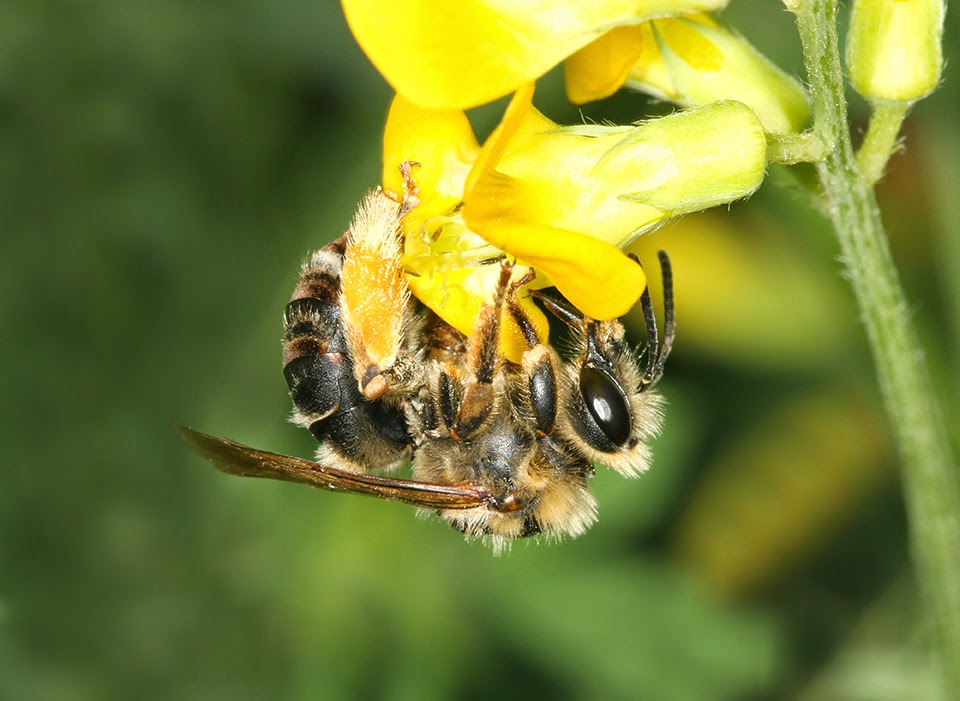
Long-horned Bee (Eucera longicornis) female. In the end we only spotted 3 individuals, so we had sadly missed its peak. In previous weeks we have counted over 10 in just one small area.

I'm afraid I will keep banging on about this particular bee until the cows come home (I have no cows).
Seriously though, the world of entomology means I can never be bored again!