Sunday, 26 October 2014

Nick's fruitful fungi foray

Guest Author: Nick Aplin

Sussex Fungi Group: 18th October 2014
(Contributing records to the Sussex Biodiversity Record Centre)

Brown Cup (Rutstroemia firma)

It was a dull and overcast morning on our first visit to Brockley Wood, but several of us were optimistic that the recent wet weather would bring out some interesting species. Finding fungi can sometimes be a fruitless exercise and the start of the season had certainly been quite patchy in many respects.

Our route - Brockley Wood in the North West Zone

Initially, we spent some time searching the grassland north of the runway, where we found a few species associated with buried wood and other debris, namely Lacrymaria lacrymabunda The Weeping Widow, Gymnopilus junonius Spectacular Rustgill, Coprinus comatus Shaggy Inkcap and Pholiota gummosa Sticky Scalycap.
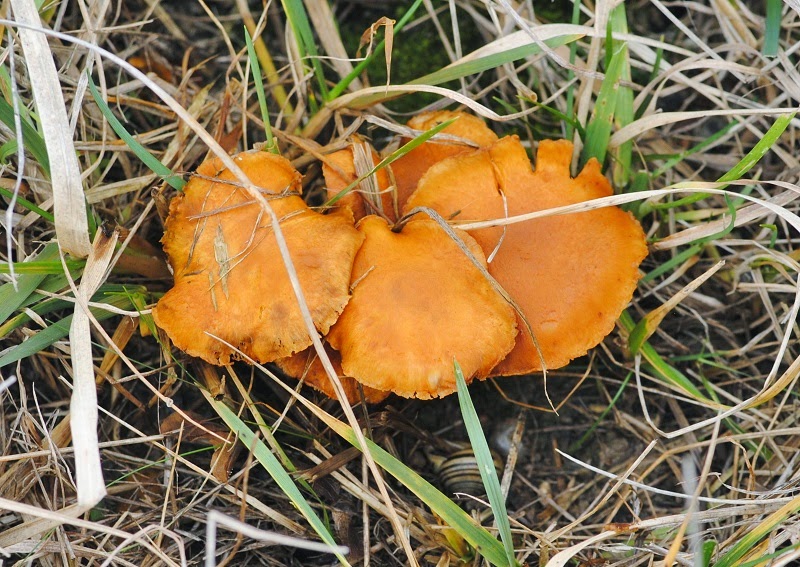
Spectacular Rustgill (Gymnopilus junonius)

(Coprinellus domesticusFirerug Inkcap

A large pile of rotting wood and roots yielded several small and common species including Hypholoma fasciculare Sulphur Tuft, Coprinellus domesticus Firerug Inkcap and Mycena adscendens Frosty Bonnet.


The delicately beautiful Bark Bonnet (Mycena speirea)

I had hopes that we’d see a few of the species which are indicators of unimproved grassland as we began climbing the path to the south east of Brockley Wood. True to form, we were greeted with our first rarity; the lovely but understated Arrhenia griseopallida, a species which seems to favour short turf and fairly exposed locations.

Arrhenia griseopallida

Although it was perhaps a little too early for Waxcaps, we also found two Entoloma species which are also unimproved meadow specialists, E.sericeum and E.sericellum, the latter growing on a very steep slope and proving very difficult to photograph!

Extreme-fungi photographing: Entoloma sericellum

‘LBJ’ (=little brown job) is an acronym that was, I think, created by birders but a term that we often ‘borrow’ to describe certain cryptic, anonymous-looking brown mushrooms.
Many mycologists don’t like LBJ’s, but some (like me!) take great interest in them. Good job, too, as we stumbled upon several as we entered Brockley Wood. The first three were Cortinarius species, a genus of mushrooms which like to grow in a special symbiosis (called a mycorrhiza) with tree roots, the tree and the fungus effectively ‘swapping’ nutrients to benefit both parties.
The first, Cortinarius decipiens Sepia Webcap, grows on the outskirts of the Wood, mycorrhizal with Willows.
 Sepia Webcap (Cortinarius decipiens)

The other two species seemed mycorrhizal with the same Oak tree. The rebellious Cortinarius vernus Spring Webcap clearly didn’t want to live up to its name. Interestingly, the majority of the UK records of this species are autumnal, so perhaps we should think up a new name? The Germans apparently call it ‘Pink Stalk’ so I might go with that, considering the colours at the bottom of the stem…Yes, Pinkstalk Webcap. Let’s go with that.

Pinkstalk Webcap (Cortinarius vernus)

The third species, Cortinarius psammocepalus, was a nice surprise and seems to be very rarely recorded, with only a dozen or so UK records. I can’t find a ‘common name’ for this one, so I’m tempted to go along with the beautifully descriptive Latin epithet and call it Sandhead Webcap. Oooh yes, that’s even nicer than my last made-up name.

Sandhead Webcap (Cortinarius psammocepalus)

Ash trees are apparently incapable of supporting any mycorrizal symbiosis with the larger fungi but to make up for it, they provide a very nice habitat for saprotrophic species after they die.
As there is plenty of dead Ash wood in Brockley Wood, it was no surprise that we recorded several species fruiting on it. 

Simocybe centunculus

Coniophora puteana Wet Rot

Another obscure LBJ; Simocybe centunculus, and the crustose Coniophora puteana Wet Rot were put to shame by a beautifully coloured but tiny fungus Crepidotus cinnabarinus (strange that this one has no common name either!), first recorded in 1995, probably as an introduction. The increase of reports in recent years seems to suggest that the species is spreading.

The tiny, yet striking Crepidotus cinnabarinus 

On our way back to the meeting point, we discovered several fruiting bodies of a Bird’s Nest Fungus, Crucibulum laeve, fruiting on and around the base of various dead herb stems. A cheerful sight to end the day!

Bird’s Nest Fungus, (Crucibulum laeve)

 Full species list:

Lacrymaria lacrymabunda
Leucoagaricus leucothites
Datronia mollis
Trametes versicolor
Mycena adscendens
Coprinellus domesticus
Phlebia radiata
Mycena speirea
Hypholoma fasciculare
Coprinellus disseminatus
Melanotus horizontalis
Lycogala terrestre
Crepidotus mollis
Lasiosphaeria ovina
Panaeolus semiovatus
Coprinus comatus
Marasmiellus ramealis
Crepidotus cinnabarinus
Parasola leiocephala
Mycena galericulata
Pluteus cervinus
Scleroderma citrinum
Gymnopus fusip es
Schizopora paradoxa
Tubaria furfuracea
Psathyrella microrhiza
Xylaria hypoxylon
Auricularia auricula-judae
Lycoperdon perlatum
Gymnopilus junonius
Crucibulum leave
Coprinopsis lagopus
Clitocybe rivulosa
Entoloma sericellum
Arrhenia griseopallida
Simocybe centunculus var.centunculus
Mycena flavescens
Mycena aetites
Pholiota gummosa
Crepidotus variabilis
Cortinarius psammocephalus
Cortinarius decipiens
Coniophora puteana
Cortinarius vernus
Rutstroemia firma

Monday, 20 October 2014

Desperately seeking Micro-mouse

Guest author: Laurie Jackson

In autumn 2012, I was walking through one of Gatwick's meadows with Rachel when my eye was drawn to something on the ground. A tiny woven nest tucked amongst recently-mown grass...


I recognised it straight away as a Harvest Mouse nest. Known rather aptly as Micromys minutus, its Latin name gives a clue to this mammal's diminutive size. Averaging 6-8g, an adult weighs about the same as one long-tailed tit (or 100 of Gatwick's Honey Bees).
   Harvest Mice inhabit a range of habitats including rough grassland, wetlands, scrub and arable margins. They spend most of their time above ground-level climbing through vegetation. It is here they build their characteristic spherical nests - using rigid stems to support or suspend them from. Stripped grass is neatly woven around these supports, forming a structure to rival any of Brunel's creations. Engineer, climber, is there no end to this tiny rodent's skills? I believe the harvest mouse may also be an illusionist…

A Gatwick Harvest Mouse - found with Surrey and Sussex Mammal Groups in 2013

Over the past year I have become more and more interested in this species. After a bit of reading, I soon found I knew more about harvest mice in Japan than I did about those in my local patch! I felt uneasy when I saw the current distribution map for Sussex; with less than 150 records, there is a lot of white space on our county map. Despite this evidence to the contrary, I believe that beneath our feet a miniature army is gathering.

I am keen to find out more about Sussex's Harvest Mice and uncover new populations. To kick this off, I recently led a field trip at Gatwick to show people how to search for signs. Autumn is the perfect time for Harvest Mouse surveys, as the vegetation dies down, making it easier to find their nests. Populations of this species fluctuate annually and I have a feeling this year will have produced a bumper crop. More mice mean more nests, and in little over an hour of searching we had found 12 nests in Gatwick's North West Zone. That's a 10% increase in records… or it would have been if our search area wasn't in the vice county of Surrey!
 Our average nest diameter was 6.25cm, at an average of 40.5cm above ground level.

The star find of the day was a disused breeding nest found by our intrepid University of Brighton students. The nest still contained green vegetation, indicating it was a new-build and that breeding had probably continued into October.

Ecology student Scott has got the hang of it...


Having read this far, your mind is surely filled with just one thought - I want to look for Harvest Mice too! I guarantee that the excitement and anticipation of searching for their nests will liven up any autumnal walk. Throw in the element of danger for those fearless surveyors rooting around in bramble patches (and perhaps a pub stop along the way), what isn't there to love about a harvest mouse survey?

For more information and to get involved with the hunt, please contact me (Laurie Jackson) through the Sussex Mammal Group Website

Wednesday, 8 October 2014

A Game of Drones

Its been a very steep learning curve since the Gatsbees arrived back in March, but their first summer has seen Gatwick's honey bees thriving! With the colonies rapidly expanding and swarming through the season it's not always easy for us novice beekeepers to stay on top of things. Luckily our mentor Gillian is keeping a close eye on everything and knows how to cope...  

Gillian and myself, adding frames to a hive

A frame of bees

Just as we thought everything was calming down, a late summer check of one of the hives revealed patches of large domed capping on several frames of worker brood cells.... Hmmm.
These larger cells containing drone (male) brood are expected earlier in the summer, when the colony is beginning its reproductive cycle. A drone's main task is to mate with virgin queens, after which they die. Those who have not fulfilled their duty are kicked out, usually in late August and then also die (tough gig). We should definitely not be finding drone-comb at the end of summer when the colony should be storing food for the winter!

The domed capping of drone brood can be clearly seen on these cells

A drone-laying queen might be an old queen, running out of her stores of sperm and only laying unfertilised eggs. However, after a bit of careful investigating, we discovered that this colony had beat us to it and replaced their old queen without swarming; a process known as supersedure. The only problem was she had been superseded by a tiny new queen which was obviously struggling to keep the colony going, only producing males and not enough workers for the colony to survive the winter.

This sub-standard queen was only recognisable by her orange legs

The solution is to remove the drone-laying queen and unite the bees with one of our other 'queenright' colonies. The hive next door, containing a strong colony with plenty of young bees and food stores, all in close proximity, made it the perfect choice for a merger.


The queenright colony is prepared by placing a sheet of newspaper and a queen-excluder on top of the frames of the brood chamber. The (now queen-less), drone-heavy colony is placed on top and as both colonies slowly chew their way through the newspaper, their pheromones gradually mix and the bees are smoothly integrated but none the wiser.

  After a week, the bees have chewed their way through to unity 

This 'supercolony' with its shared resources should now have a much better chance of surviving through the winter... "When you do things right, they won't be sure you've done anything at all." (Futurama).

Abdomens pointed in the air, they fan their wings while releasing a pheromone, alerting the colony to the new entrance

Gill keeps diligent reference notes of dates and individual hives


Trophallaxis - where food and chemical secretions are transferred by mouth between individuals.
This occurs with many of the social insects such as ants, bees and wasps

Our beehives are now being left to their own devices as the colonies make good their stores for winter. We will check on the hives periodically and look out for any winter activity.

Thursday, 25 September 2014

Bat-boxing clever

North West Zone: 22/09/2014


At least once a year, we carry out a check and clean of the bat boxes with Martyn Cooke from Surrey Bat Group. Negotiating an ancient, brambly woodland with the massive ladder we borrow from air traffic control is not the easiest job!

Brockley Wood bat boxes

Aside from trying to locate boxes high up in the trees with the use of an incredibly vague map, you have to find secure anchorage for the ladder, avoiding numerous rabbit holes and the rotten branches hidden in the undergrowth. 
   Peeking inside the very first box, we came across this sleepy huddle...
   
A hareem of Soprano Pipstrelles

Feisty fella

A lucky find, with six sleepy Soprano Pipistrelle Bats (Pipistrellus pygmaeus) all roosting up together. At this time of year it is almost always just the one male with several females...
Chauvinists.

Donald looking impressed by Martyn's data entry form

Of course, while you are up those trees on that precarious ladder, bear in mind there might not always be bats living in your bat box! 

Martyn peeks into a hibernation box...

NOPE.

Thriving colonies of European Hornets (Vespa crabro) in two of our hibernation boxes is less than ideal. It not really worth disturbing these impressive Hymenopterans, so Martyn respectfully leaves these boxes untouched until the winter.

Other niceties from the day included:

Dark Bush-cricket (Pholidoptera griseoaptera)

Chuffed to see my first male Vapourer Moth (Orgyia antiqua); a little beaut

Speckled Wood Butterfly (Pararge aegeria) on Wood Spurge (Euphorbia amygdaloides)


There was quite a racket coming from the Reed Beds just as we popped out of the woodlands... A Moorhen which hybridised with Kestrel and is trying to be a Water Rail, perhaps?

Tuesday, 16 September 2014

Detours for Dormice

Sadly, we have yet to detect the charming Muscardinus avellanarius in our woodlands at Gatwick, so I have to get my fix elsewhere... 

Hazel Dormouse

Last weekend I nipped off on a trip to that fair Isle of Wight, with Laurie and my housemate Debbie who is working towards her PhD in genetics. We were collecting hair samples for DNA extraction and had joined up with volunteers for the People's Trust for Endangered Species, monitoring Dormouse populations on the island.

Step 1. Finding the woodland...


Step 2. Finding the correct bit of woodland


Step 3. Finding ridiculously small nest boxes within forests of bramble and densely coppiced Hazel.


These woodlands at Briddlesford were fantastically well-managed by the PTES, but this did mean the terrain was tough, with areas of brambles at chest-height. Goose-stepping all day is hard work! 

As deer are absent from the island, a lack of grazing pressure results in healthy woodland understory

The Hazel Dormouse is a protected species in the UK and their populations have declined historically, so this data is all valuable and could contribute towards the conservation of this species.


Sleepy Dormouse mother with babies

Juveniles, individually weighed before being popped back into their nest


Mum receives a small hair pluck before being safely returned to the nest box

Ah jeez...

In the end we got lots of data for Debs, plus the Isle of Wight offered up some other niceties:

Wood Mouse (Apodemus sylvaticus) juveniles in a Dormouse box

Wood Cricket (Nemobius sylvestris), a nationally scarce species. 
These were quietly churring in the background

Common Carder Bee (Bombus pascuorum) on Devil's-bit Scabious (Succisa pratensis)

Volucella pellucens on Devil's-bit Scabious

Loads of Devil's-bit Scabious

Elephant Hawk-moth (Deilephila elpenor) caterpillar

A Linyphia spider, possibly L.triangularis

We were also treated to a sighting of the Red Squirrel (Sciurus vulgaris), but kinda like my birding photos...

Yeah no chance.