Showing posts with label Bat Conservation Trust. Show all posts

Tuesday, 26 September 2017

Gatwick's Dark Knights

After only making it back home in the wee hours of this morning, I was awoken at 7.30am to some great news; council workers had decided to try to repairing the communal recycling bin outside my bedroom window with a sledgehammer. I guess I'll really appreciate this the next time I take out the recycling.

Location: edge of Brockley Wood, adjacent to the north west aircraft stands. 

Ah well, the late finish was totally worth it as we got to see a whole selection of bats utilising the site on the River Mole side of Brockley Wood. I also finally got to see a fairly common bat species which has eluded me for 5 years!

Martyn measuring the forearm length of a bat while Laurie takes notes

Martyn Cooke (Surrey Bat Group) is a licensed bat surveyor, who has been monitoring the bats around Gatwick for several years. A harp trap is his preferred tool, one of safest ways to capture bats and minimise their stress, in order to collect scientific data and feed back to the Bat Conservation Trust.

Harp trap set up on River Mole floodplain

The northern edge of the woodland is sheltered by a massive environmental bund, blocking out light and sound from the airfield. The weather conditions were almost perfect, with low cloud, barely a breeze and a balmy 17 degrees celsius. This turned out to be the best night's trapping I've attended in terms of species diversity; we caught 5 species in the harp traps and at least 2 others on the detectors. 

An electronic lure plays out species-specific bat calls

Here's our haul of bats, in order of appearance...

Soprano Pipistrelle (Pipistrellus pygmaeus)

Soprano Pipistrelle wing

Whiskered Bat (Myotis mystacinus)

I was super excited when I released this one; just look at his little mouth!


Brown Long-eared (Plecotus auritus). He does have some eyes there, he's just blinking

The new one for my list is was the Daubenton's Bat! That brings my number of wild UK bat species seen up to 9.

Daubenton's (Myotis daubentonii)

These funny looking dudes have big bald patches around their eyes, and are specialists at hunting over water, scooping up small insects while in flight with their big tail membranes.

I didn't manage to get a good shot of the membrane, but we can confirm that this one is a fella

Lovely dark face of a Common Pipistrelle

Common Pipistrelle (Pipistrellus pipistrellus) female

Although we didn't trap one of the rare Bechstein's tonight (previous post about our first Bechstein's at Gatwick) or Martyn's target species the Nathusius' Pipistrelle, we did pick up this Myotis bat call on Martyn's sonobat, which he thinks could be one of the little dudes with attitude...

Bechstein's call?

Thanks to Martyn, Fiona, Laurie, Rina, Luke and Ryan for giving up your valuable time. Also to the bats for doing your bit for science; you all rock.


North West Zone. Approximate harp trap locations in yellow, mist nets in blue

Thursday, 10 September 2015

Dark Knights at Gatwick

Bat activity transect C, Land East of the Railway Line, July 11th 2015

It has felt like a good year for bats around our biodiversity sites, with lots of exciting acitvity monitoring by Laurie Jackson, Martyn Cooke and volunteers from Surrey Bat Group. We've been using 3 different survey methods here: activity surveys (walking set routes called 'transects', with bat detectors and recording equipment); trapping surveys (with Martyn's harp traps, loud speaker and bat call software system); and box checks (annual checking and cleaning of our woodland bat boxes).

Powerline Ride at dusk, Horleyland Wood

Although rarely seen, bats actually make up around a third of UK mammal species and so are a significant players in our ecosystems. Also being insectivores, they are directly affected by any crashes in invertebrate populations and are great indicators of our countryside's overall health.

Bat box recorder and logger 

Bat logger live sonogram image

This recording equipment is all a bit beyond me, but Martyn Cooke (who also works in air traffic control at Gatwick) loves his tech and is a dab-hand at collating and translating this data.

Measuring the forewing of a Common Pipistrelle.
(To handle bats, you must be trained and hold appropriate licenses.)

Weighing a Pip in a cup

The biometric data collected includes the species type (some can only be identified by close examination in the hand), weight, sex, rough age, breeding condition and general health of the individual. I need to check again with Martyn, but I think we are up to 10 different species of bat recorded at Gatwick.

Assessing wing joints and bone ossification to gauge the age.

This health check might look pretty intrusive for a bat, but they are only kept for a few minutes before they are released back out into the night.

Common Pipistrelle (Pipistrellus pipistrellus)

Brown Long-eared (Plecotus auritus)

Bats face many threats due to extensive habitat loss and fragmentation from development, as such they are all protected by UK and European law. You might associate bats with roosting happily in buildings, but they really need natural features such as grasslands, hedgerows and woodlands to hunt and forage in. The monitoring and conservation efforts led by organisations such as Bat Conservation Trust are of vital importance to conserve the UK's bat species. 

Get out of here, you.

Its not always deemed socially acceptable to be out in the woodlands after dark. but this bat work gives us special licence. Its also great to see and hear all the other wildlife out and about our biodiversity areas on warm summer evenings:

Light Emerald Moth (Campaea margaritaria)

Glow Worm (Lampyris noctiluca), female

Photo with flash reveals that a Glow Worm is a large beetle

We often hear the strange hoarse squeaks of juvenile Tawny Owls, which sound like their voices are breaking...
Plus a rather impressive (and one of my favourite) species we have resident in our woodlands...

Araneus angulatus male, a rare spider in the UK, restricted to the southern counties

To learn about monitoring bats in your area, why not check out your local bat group.

Wednesday, 4 September 2013

A very unexpected bat...

'On the very last day, at the final hour, just as they were packing up...' Funny how often it seems to go that way with natural history, a lesson on never giving up too soon!

Martyn Cooke and helpers, setting up a bat mist net on the edge of Brockley Wood

On the evening of Monday August 19th, a small group of us set off to the woods on a rather different kind of wildlife survey. Martyn Cooke of Surrey Bat Group is a licenced bat trapper and handler, currently working on a large project spanning the borders of Sussex and Surrey. Much is still unknown about bats in the UK such as their current numbers and their social and mating habits. I imagine that even less is known about bats living near an airfield! 

North West Zone with Brockley Wood, River Mole and grasslands

We set up two large mist nets and a harp trap at Brockley Wood with high hopes of capturing something. As the sun was setting we could even see bats flitting along Man's Brook. Our two mobile bat detectors were quickly switched on and we began picking up calls of both Soprano and Common Pipistrelles along the treeline.

Setting up the Harp Trap and an electronic lure

Bats are highly protected under both European and UK legislation and all trapping work is strictly licenced. The harp trap and lure was devised by Sussex University; basically a metal frame with vertical fishing lines strung-up between and a canvas collecting bag at the base. The lure is an ultrasonic loudspeaker which plays pre-recorded bat calls - not the usual calls made when bats are hunting or navigating, instead the social calls made when they are communicating with each other. This draws in curious bats which cannot detect the fine wires of the trap, so they bump into it and then slip unharmed into the bag below. 

 
Scrubland West of Brockley Wood. A great place for moth-chasing while the sun goes down.
(Photo by Joe Bicker)

After some time spent setting up the traps, then came the waiting game. We wandered about between the two nets, looking out for signs of anything caught up in it. Although we were detecting some bat activity nearby, tonight these nets remained determinedly empty.

Common Blue butterfly roosting in the dark (Photo by Joe Bicker)

We finally began packing up sometime before midnight, making the decision to take down the mist nets first and leaving the harp trap until the last possible moment. It was with baited breath that we approached the harp trap for the final time, trying not to get our hopes up....

Scored! 1 mystery bat (Photo by Joe Bicker)

....we struck bat! Such a great reward at the end of a long evening. It was difficult to tell which species this was right away. Martyn took a closer look and was pretty lost for words; this little lady turned out to be a Bechstein’s bat (Myotis bechsteinii), one of the UK's rarest bats! 

An exciting find: a rare female Bechstein's bat (Myotis bechsteinii) 

A Bechstein's in the hand is worth a thousand in the belfry... (Photo by Joe Bicker)

The southern counties of England from Dorset to Sussex are where Bechstein's bats are most likely to be found in the UK. This young female was actually within range of a known Bechstein's colony, but it was still a pretty unexpected find in a fragment of woodland next to an airfield!

Impressive ears match the impressive gape - important features for a night-time aerial hunter of insects (Photo by Joe Bicker)

Assistants Emma, Joe and James watch while Martyn takes the biometric data. 

Martyn is a trained expert in bat trapping and handling; first he determines the sex and general health, then takes various measurements such as weight and forearm length. He was able to determine she was born sometime in June and although slightly small for her age, her weight was within the healthy range. Afterwards the bat was released unharmed and we felt privileged to have been in her presence!

Moment of freedom: We didn't take up too much of her time and she flew quickly away from us

Our little Bechstein's call sequence, displayed visually here as a sonogram. 

As she flew out of Martyn's hand I made a recording of her ultrasonic echolocation calls. Taking these recordings and analysing them through smart computer software means we can get better at identifying individual bat species without capturing them. There is a chance we could have a small colony of Bechstein's using Brockley Wood and the mature trees along the River Mole corridor. Martyn will be continuing his work through trapping and setting up his passive bat-detectors around Gatwick's woodlands.

Soprano Pipistrelles in their mating roost

We also have several bat roosting boxes up around this and other woodlands which we will check and clean out each year. Here is a bunch of lovely little Soprano Pipistrelles (Pipistrellus pygmaeus) Martyn and I found last week, all huddled up in a sleepy bundle.

For more information about bats and the UK's bat species visit the Bat Conservation Trust website

Wednesday, 19 June 2013

Bat-Air Traffic Control

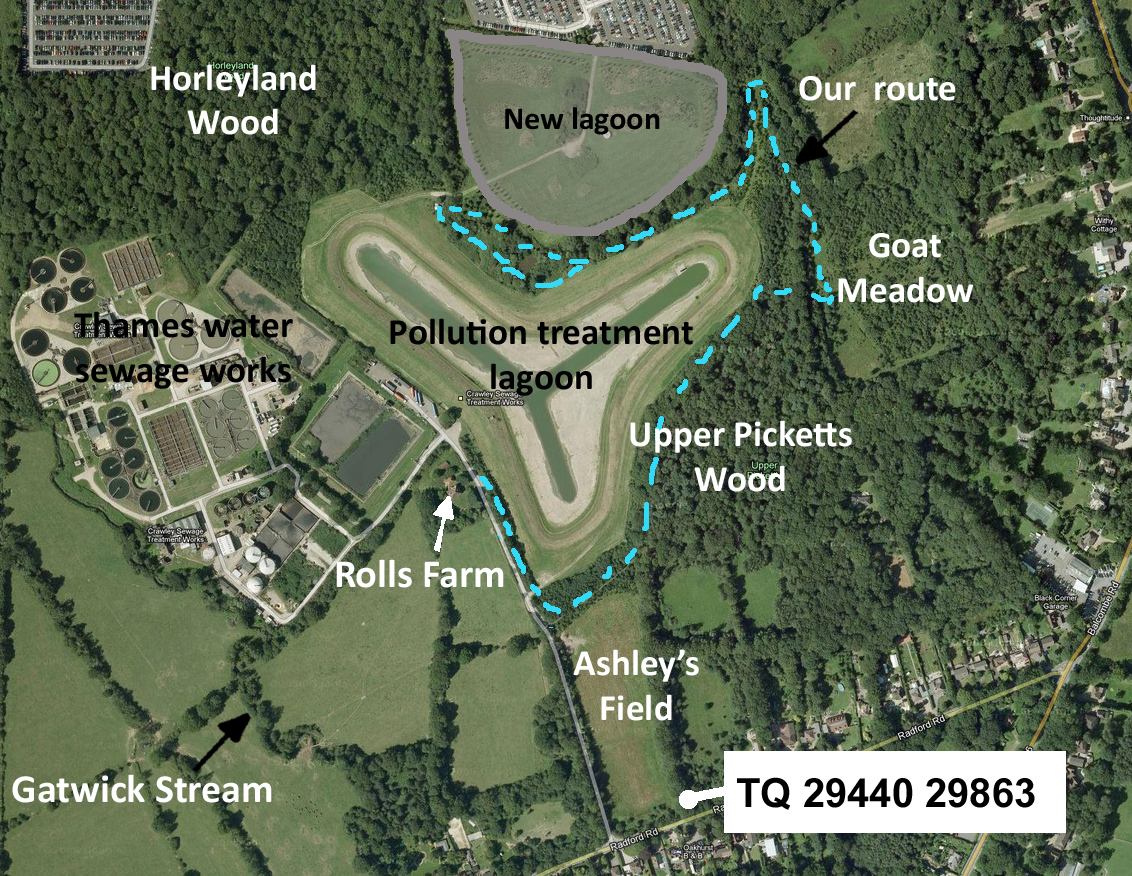
Last Friday an odd thing happened; the wind dropped, the clouds parted and the evening air was warm... The bat walk I had organised actually went ahead and 8 of us were led through Upper Picketts Wood by Martyn Cooke of Surrey Bat Group (also an air traffic controller here at Gatwick).

Torchlight trek through Upper Pickett's Wood

Gatwick's Land East of the Railway Line

As the sun was setting we stopped off at Roll's Farm, an old abandoned farm house by the sewage works. With its wild, tangled garden and loose roof tiles it really looks like the perfect bat haunt. Our bat detectors were on and we were busy chatting when suddenly a series of louds clicks swept us by... A Common Pipistrelle (Pipistrellus pipistrellus) was on the wing and loudly echolocating! Martyn was able to show us on his Anabat detector screen the 'hockey-stick' pattern of a Pipistrelle call:

The call of a Common Pipistrelle bat (Pipistrellus pipistrellus) which peaks between 45 and 50kHz

People were excitedly pointing but annoyingly I still couldn't see anything. It was getting frustratingly dark - suddenly I saw my first Pipistrelle bat as it veered around us, much lower and closer than I had expected! No chance of them bumping into us though as these tiny predators are aerial experts, catching their insect prey and eating on the wing. Martyn said they were probably feeding on midges which our group was attracting in (and beginning to feel!) I did my best to get a photo, if you look carefully you can just about make out the tiny bat as it shot past...


Ok a little joke, I didn't attempt a photo. However it was a great privilege to see and hear these usually unnoticed creatures. We heard only Common Pips but then at the very end of the walk we heard a Soprano Pipistrelle (Pipistrellus pygmaeus), which were only recently declared a separate species. Martyn is a brilliant source of bat info and has some great stories, including the only reported 'bat strike' in the UK... (Disclaimer Alert: bats pose zero threat to aircraft!)

Light Emerald moth (Campaea margaritata)

We also tested out torching for Great Crested Newts at our two woodland ponds; we were able to make out 2 large female G.C.N. and 1 small male. Also spotted were several Smooth Newts and 2 Common Frogs. While people were using their torches I was attempting (and mostly failing at) bare-handed capturing of moths drawn in by the light. I did manage to grab 2 macromoths which I potted and took home to photograph in the daylight.

Light Emerald (Campaea margaritata)

Common White Wave (Cabera pusaria)

Common White Wave (Cabera pusaria)

I feel a bit mean that I haven't shown any pictures of a bat, so here is a photo of two lovely little Common Pipistrelle, one of which a friend of mine rescued in Copthorne back in 2007. We took it over to the Jenny Clark of Sussex Bat Group who rehabilitated and released it back into the wild...

'Boost' the female pipistrelle and her new buddy 

You can find out about all of the UK's different bats species here: Bat Conservation Trust