Showing posts with label JS Agriculture. Show all posts

Tuesday, 20 January 2015

Behind the scenes...

Last Friday, Gatwick was officially presented with the Biodiversity Benchmark Award from The Wildlife Trusts. It resulted in a rare gathering of all the main players behind Gatwick's biodiversity project. Here's a run down of the key organisations involved, a sort of extended version of 'who we are':

On Friday Tom Simpson led the walk through Upper Picketts Wood, demonstrating the coppicing works which have been carried out by Gatwick staff along with external volunteers


Steve Bates Photography
(Part of the Sussex Wildlife Trust and funded by the Airport and local authorities)
Represented by Peter Crawford, Kevin Lerwill, Tom Forward and Tom Simpson, GGP educates and engages the local community through coordinating conservation tasks, forest schools and bushcraft, wildlife walks and events. They have been working in and around Gatwick under various different names for over 20 years and in 2014 alone 45 task days were run, totaling about 351 volunteers! A melting pot of practical abilities and local wildlife knowledge (plus of course dashing good looks), these guys happen to be the first people I volunteered with after graduating back in 2009. 

Gatwick's first official Bee Hotel, now complete and open for business in Ashley's Field

The central charity which works hard to promote wildlife awareness throughout the UK, linking up our landscape via 47 different regional Wildlife Trusts. The charity is responsible for giving out the country's only exclusively biodiversity-centered business award. Peter Dorans is the Benchmark Manager who traveled all the way from Nottinghamshire to visit Gatwick and present us with the certificate. He tells me that since the award system was set up, there are now collectively over 9,000 hectares of land managed by businesses for wildlife. Now I might have misheard, but I think that is the equivalent of all the wildlife reserve land put together in a large county such as Sussex!
  
Ashley's Field: part of a green hay strewing project to increase botanical diversity
(Steve Bates Photography)


Martyn Cooke of Surrey Bat Group, James Webster and Phil Milham of JSA, heckling at the back
(Steve Bates Photography)

JS Agriculture and Landscape Group 
These are the specialist grounds maintenance contractors (and my employers) who manage Gatwick's landscape both airside and landside. They carry out work in huge grass areas, shrub and flower borders, trees, hedgerows and footpath maintenance, all in an ecologically sensitive manner. With the kit and the know-how, they carry out heavier habitat works such as hay-cutting the River Mole grasslands, chainsawing and brushcutting plus transporting materials to and from our sites. James Webster is the fella who originally set up the Biodiversity Action Plans for Gatwick; now working for Ecology and Habitat Management Ltd, he consults in biodiversity at other airports as well as with us.

Tom Simpson, myself, Peter Dorans of The Wildlife Trusts, Ian Chalk and Hannah Deacon
 of Gatwick Airport Ltd (Steve Bates Photography)

Ian and Hannah (pictured above on the right) along with others on their team, oversee our biodiversity project and this work comes under Gatwick's many other environmental commitments. Their team's knowledge of the airport operations and business, plus their enthusiasm and commitment to the local environment helps our project to run smoothly, ensuring we maintain a tight ship. These guys work really hard for the airport and along with Gatwick's Communications, their department has been great at backing what we do.

The Gatsbee Hives (Steve Bates Photography)

(Steve Bates Photography)

Gatsbee honey with Gill's handmade labels
The Gatsbees
A small collection of bee hives were installed in Ashley's Field in early 2014, to be maintained and monitored by local mentor Gillian Sentinella of  Central Sussex Beekeepers Association. Tom Simpson and myself are Gill's avid students, learning about 'natural beekeeping' and maintaining colonies in balanced harmony with the surrounding environment. We hope to register in the near future as a Sentinel Apiary for monitoring Honey Bee health, watching out for pests, invasive species and other environmental concerns which Honey Bees can act as indicators for. We do take a little of the honey now and then but without overly depleting their hard-earned stores!

(Steve Bates Photography)

Although not everyone could make it on the day, it was great to have this fantastic bunch get together and share in the achievement over a generous amount of food, drink and honey tasting.


We would also like to say a special 'thank you' to the Parson's Pig pub on the Balcombe Road, who in the threat of stormy weather came to our aid providing last minute shelter for mingling and refreshments. The pub has a lovely homely atmosphere and they even lit the fire for us especially! You guys rock.

Monday, 3 November 2014

Not quite tree surgery


In the past few weeks, a group of arboriculturalists have injected some extra zeal and energy into our project, helping carry out some habitat enhancements in the North West Zone. The team from Roots Upwards Ltd, led by Matt and along with their own ecologist Ben, even gave up some of their precious weekend to move bat boxes in Brockley Wood.

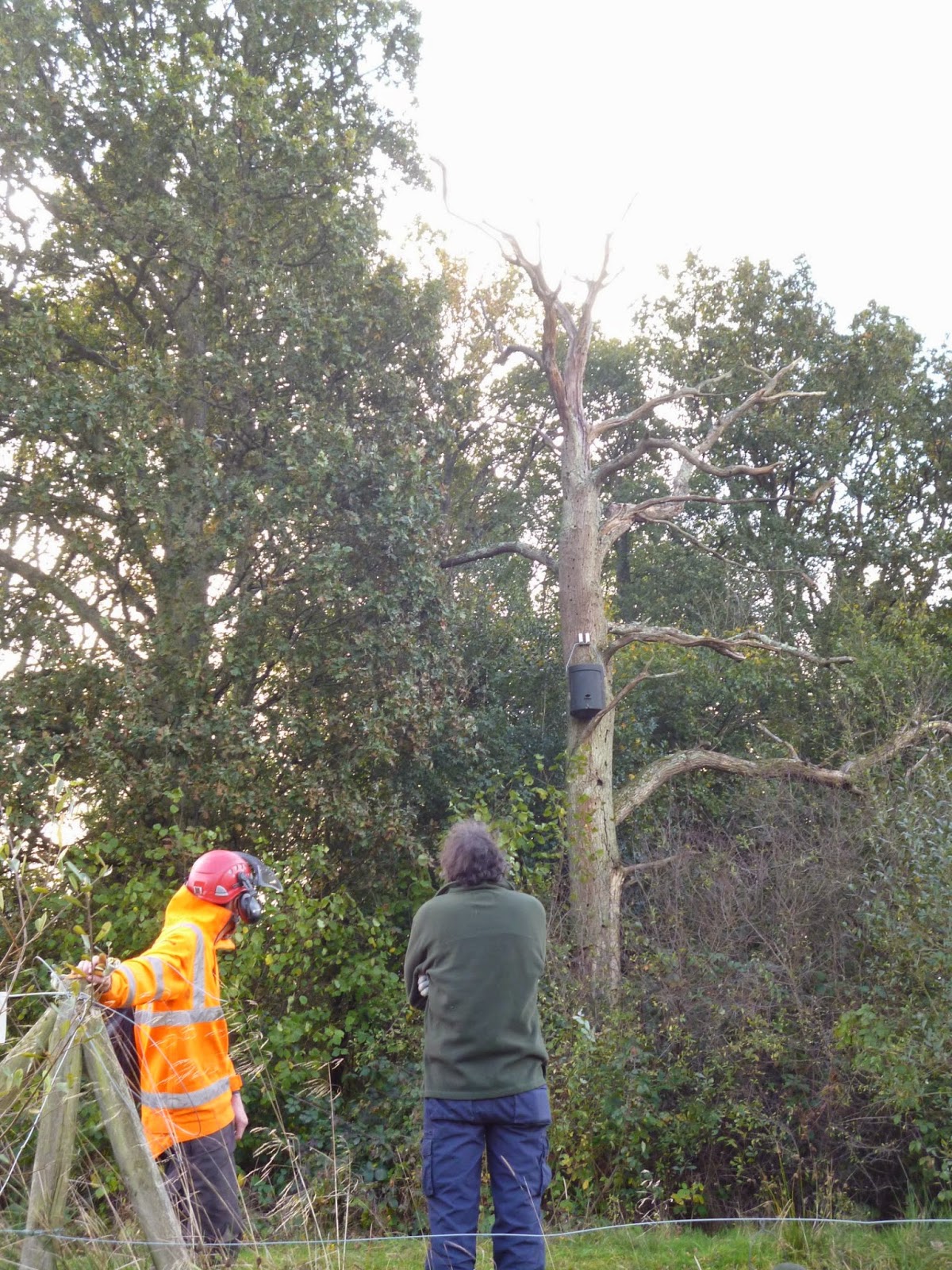
Martyn Cooke from Surrey Bat Group and tree climber Adam scouting for boxes


Shinning up the tall oak trees in Brockley Wood is no problem for these guys, and Adam carefully checks each box for occupancy before they are cleaned out and re-hung on the tree. In the last box he was treated to an unexpected 'Close Encounter of the Fuzzy Kind'...

Adam: "Hang on a sec... there IS a bat in here..."

"Hey, lads! Ahh, you alright lads?"
Natterer's Bats (Myotis nattereri)

I love witnessing encounters like Adam's; it's so rare to see an animal like a bat close up like this and a privileged moment. Martyn identified this cosy bat cluster as a group of Natterer's Bats (though it probably consists of a few ladies as well as lads). After taking these pictures for us, Adam carefully closed the box back up and left them to their daytime snoozing.   
   Another great help has been ecologist Ben; boosting our wildlife records for this site, ensuring disturbance is minimized during the essential works, then overseeing some extra habitat enhancements:

Foundations of  a beetle bank; ready to be finished off in spring with a cap of top soil and seed 

On top of the scheduled habitat works I oversee with J S Agriculture, Tom Simpson and guys like these contribute a heck of a lot to the project, adding another string to our bow as we shoot for the Wildlife Trust's Biodiversity Benchmark Award (our main audit is happening at the end of this month!) 

Brash piles securely staked high up on the floodplain, providing extra cover for wildlife where clearance works have taken place

Who ya gonna call? Matt of Roots Upwards

At the end of a rather extended summer, we are off to a flying start with the 3rd year of autumnal conservation works. We have more habitat enhancements coming up from JSA, an intensive Harvest Mouse survey with Surrey Mammal Group and Mr Simpson's conservation schedule is quickly filling up. So you better drop us a line soon if you want to get involved!

Friday, 31 January 2014

January Summary

JS Agriculture carrying out birch thinning in Horleyland Wood, Land East of the Railway Line

Things have been relentlessly damp here as that niggling hole in my hiking boots can attest to. The mud and standing water makes accessing sites with heavy duty equipment much harder work.

Coppicing on the south bank at Pond 3, Land East of the Railway Line 

Somewhere here, the pond stops and the path begins

JSA with Gatwick Greenspace, coppicing and habitat piling on the grassy slope, North West Zone

Creating bare earth patches on the grassy slope, North West Zone. Areas like this can be beneficial to certain invertebrate groups such as burrowing bees and carabid beetles

I quite like writing these summaries - searching through my photos from the the past month causes an 'oooh yeah, I forgot about that' moment.

A rare frosty day in January 2014. Wet scrubland west of Brockley Wood

I have continued with the odd wildlife survey and as the season progresses, our visiting thrushes seem to have changed their activity. They have been spending more time foraging at ground level while they search in the leaf litter. I am still seeing high numbers of Redwing, but much fewer Fieldfare then last month. The winter RiverSearch surveys have have been challenging, as the river features I am supposed to be mapping are mostly under the muddy water.

River Mole at Povey Cross. Today it was in-channel and mostly behaving

Also, we have carried out a dormouse box maintenance and winter clean-out job in Horleyland Wood. There has finally been some definite mammal activity in them, with plenty of Yellow-necked mice moving in. It is a similar story at the woodlands in nearby Crawley, where we even found a new nest of Yellow-necked mouse pinkies (babies). Despite the strange season, they will probably be doing quite well in this mild weather.

George turfing the old nesting material out of the dormouse boxes

Yellow-necked Mouse (Apodemus flavicollis), 
reluctantly waiting for us to finish the cleaning so she can move back in.

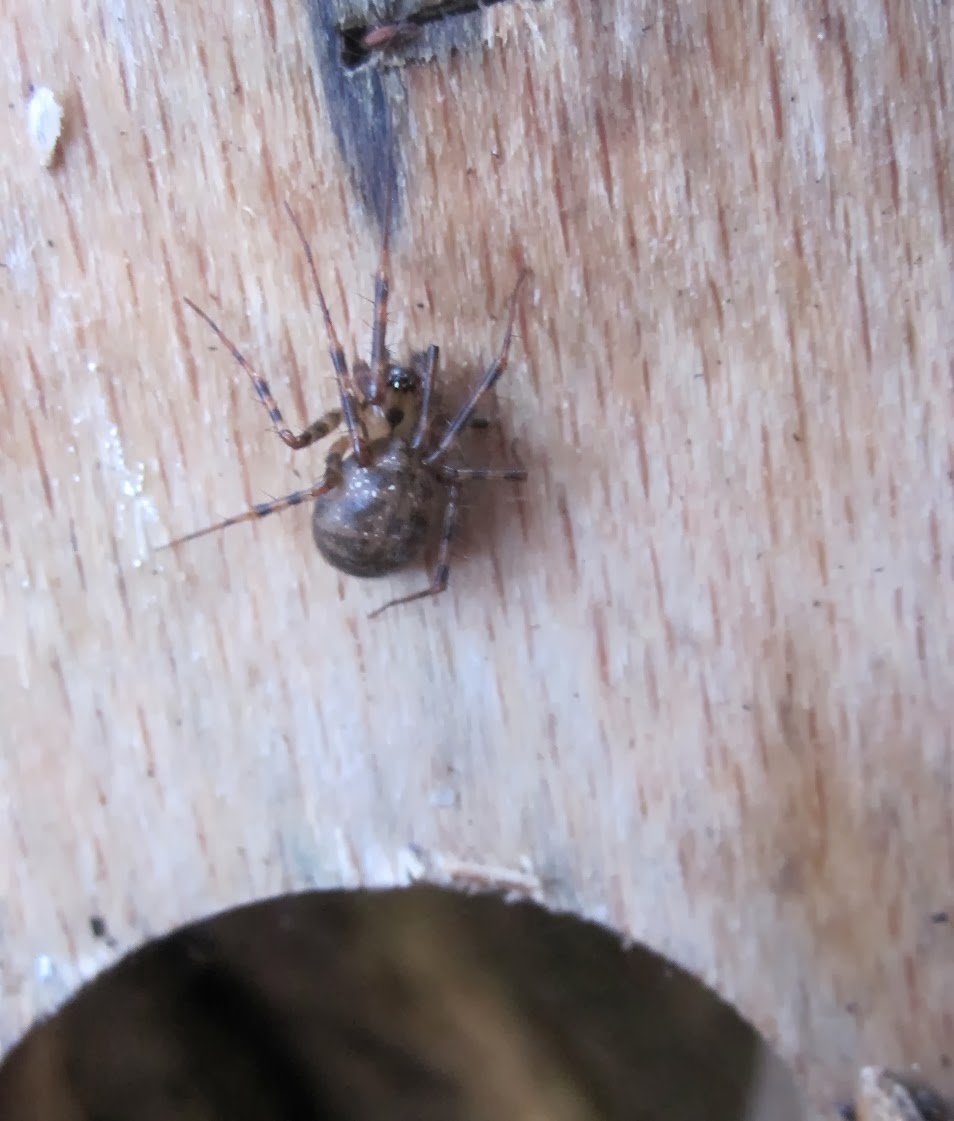
Making good use of our nesting boxes over winter, is the local spider community. I found around 6 different species on this day...

Your friendly neighbourhood Walnut Orb-weaver (Nuctenea umbratica),
 trying its best to look inconspicuous

Labulla thoracica, which belongs to the same family as the Money Spiders (Linyphiidae)

A small False Widow (Steatoda nobilis). And no, it did not go straight for my jugular

Thanks a bunch to Katie, George and my mum Sue for helping me out on these most recent surveys.
   I am amassing a collection of invertebrate pictures as I sort through the malaise trap invertebrate samples. One of the coolest things I've found so far is this awesome Sawfly: I think the genus is Cladius. It's feathered antennae look like massive antlers... I'll have to dedicate a separate post at some point to my desktop invertebrate finds.

Underside of a Sawfly (x10 magnification)

   I am still catching up on my species data entry for the past year. The final American Signal Crayfish count was 482, fished out of a 200m stretch of the River Mole. It will be interesting to see how many I get out of the same stretch next summer.

This was a single haul of the invasive crayfish species Pacifastacus leniusculus,
at the peak of summer 2013

Tuesday, 8 October 2013

Hibernacularing

I find it quite fun making up unofficial biological terms (many people don't know I coined the word 'ecologising', spelt the UK English way.) Sadly, the JS Agriculture team know me pretty well and, more often than not, I get called on it.

A snake 'hibernaculum' - Illustration by Larry Eifert (larryeifert.com) Demonstrating a pit
 filled with a mixture of rubble and deadwood, with a growing top layer of vegetation

I should stress though that hibernaculum is a real word; a place where beasties such as cold-blooded reptiles and amphibians like to bed down for the winter. These 'hibernacula' (as Jake pointed out is the pluralisation, not 'hibernaculars' ...thankyouverymuch) are structures which can be natural or created, even sometimes accidentally, as a refuge. It is based on very simple principles - a mound or pit filled with clean or natural materials with holes and gaps to squeeze/curl up amongst/wedge into, where the temperature remains fairly constant and the frost cannot get in.

 Expert Hibernacularist, Jake of JS Agriculture

A pit was dug on slightly sloping ground, about 30cm-90cm deep. The base was
 broken up with the pick, with sand and plenty of rubble added

'La belle monticule pour les amphibiens' - the concise French term for hibernaculum.
 (I may have made that up too)

The finished article is pictured above - 5 star luxury accommodation, bordered by a sunny mound for those short, opportunistic spring days of sunbathing. A rambling rose garden with bramble scrub is available for hiding away in should any birds of prey pass by, or pesky humans with their nosy dogs.

The next one is situated in a more wooded habitat, close to our newt ponds:

Lauren - our smallest but very enthusiastic hibernacularist 

A pile of broken bricks topped with deadwood, bark chips, logs and nearby brash

'Le hibernacle'. The actual and rather dull translation into French by Google

Another luxury 5 star winter holiday home available to rent; this one with more of a woodland character, containing a nice warming, rotting logpile and large pool just out the back. The varying locations of our hibernacula affect the decor: this one under more tree cover contains a larger amount of wood and vegetation, whereas the one in the grassland has more stone and turf. We will continue to add natural materials to these structures as our nearby habitat management continues.

Friday, 26 July 2013

Gatwick's Alien Invaders

A battle is being fought all around Gatwick Airport... Aliens landed here quite some time ago, but together JS Agriculture and Gatwick Greenspace Partnership have plans for defeating these invasive species!

American Signal Crayfish (Pacifastacus leniusculus)

Signal Crayfish burrows in the bank and Himalayan Balsam growing along
 a section of the River Mole at Povey Cross

An important part of our Biodiversity Action Plan is to monitor the presence of non-native species occurring on Gatwick's land and to come up with plans to tackle them. As they have been established in our countryside for quite some time they are virtually impossible to eliminate, so instead we aim to control them as best as possible, reducing their impact on our native flora and fauna.

Bucket 'o' crays:  They have reached plague proportions in our part of the River Mole.
We humanely euthanise them under instruction from the Environment Agency

Tiny wee Signal Crayfish from the River Mole

The American Signal Crayfish (Pacifastacus leniusculuswas introduced to Britain in the 1970's and escaped from fish farms into our waterways. Having witnessed the size and quantity of their tiny larvae I'm not surprised they did! They are tough little pioneers and easily colonised our waterways; unfortunately they carry a disease which our native White-Clawed Crayfish (Austropotamobius pallipes) is vulnerable to. As a result White-Clawed Crayfish are now pretty rare and highly protected in areas where they still remain.

Our licensed crayfish traps with fish bait. 

Signal Crayfish have a voracious appetite and eat whatever they can get their claws on, be it aquatic plants, fish fry or invertebrates. They also burrow deep into river banks which causes destabilisation, erosion and eventually bank collapse. By trapping them on a section of the river and reducing the number of large, voracious adults I hope to see a positive effect on the aquatic biodiversity.


Gatwick Greenspace volunteers Adrian and James removing Himalayan Balsam; 
waders are not such a bad job on a hot summers day

Another problem alien here is Himalayan Balsam, which was introduced to Britain in 1839 as an attractive ornamental garden plant. It is a rapid coloniser, spreading along our waterways, growing very tall and quickly out competing our native flora. It has impressive pink flowers which are a good nectar source for bees and other pollinators, but perhaps at some cost to our own native wildflowers.

Himalayan balsam (Impatiens glandulifera) in flower

The root of the problem: the fleshy roots die back each winter, meaning the soil is left loose and exposed. This however does mean it is easy to pull up. 

The seed pods are pressurized, popping open at the lightest touch, scattering seeds into waterways which are then carried far and wide. The roots of this plant are weak and die back each winter, resulting in exposed mud which then erodes easily away .


Gatwick Greenspace volunteers are all-weather people with the correct gear, precautions and an ample supply of refreshments (I can testify to their high-standard biscuit selection!) On one of the hottest days of the year, they tackled a good length of the River Mole around Povey Cross, pulling up every individual balsam plant they could find.

Balsam is heaped into piles to rot down before it has flowered and seeded

Volunteer Georgina with a near full-grown Signal Crayfish

Gatwick Greenspace Partnership conservation volunteers at Povey Cross, North West Zone

The JS Agriculture team, balsam-bashing in the southern part of Horleyland Wood,
 Land East of the Railway Line

We are continuing the fight against Gatwick's invaders for the next few weeks. If you interested in volunteering and conservation around Gatwick then check out the website for Gatwick Greenspace Partnership, part of the Sussex Wildlife Trust.