

After reading my excited text, she tries to call me back right away. Of course, as I'm somewhere in Gatwick's woodlands with unpredictable phone reception, this goes on for sometime...
And so, after finally getting through to each other, I then get to say the words: we've got Dormice!

The elusive Hazel Dormouse (Muscardinus avellanarius)
Gatwick's sneaky ginger-ninjas have finally been spotted in the fur; they couldn't elude us anymore! Laurie is a licence holder for several UK protected species and experienced in Dormouse handling, so I was awesomely appreciative that she shot up to Gatwick to lend us a hand. We found two individuals in separate boxes; here they are, resplendent in their golden-brown refinery!
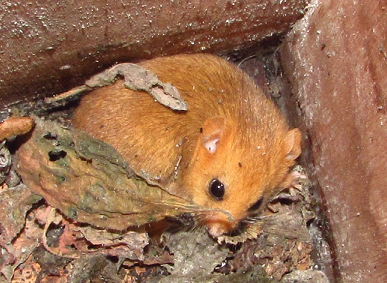
Hazel Dormouse (Muscardinus avellanarius)
We reckon these might some of the best-looking Dormice around too... (Not that we're biased).

Hazel Dormouse (Muscardinus avellanarius)
Big eyes, small ears, fuzzy tail. Evolved for maximum cuteness
These furry fiends are notoriously difficult to detect - they live in low numbers, are arboreal (tree-dwelling) and mostly come out at night. Still, after 3 years of surveying it was starting to wear that we hadn't seen the little blighters in the fur. Quite frankly, they were making us look bad.
On the other hand, our Wood Mouse and Yellow-necked Mouse record database had really come along!

For comparison: Yellow-necked Mouse (Apodemus flavicollis);
darker fur, bigger ears, pointy nose... Bigger attitude!
She might look chunky, but this little female weighed about 19g, making her over half the weight of a Yellow-necked Mouse which tipped the scales at 40g.

Hazel Dormouse (Muscardinus avellanarius)
Hey, remember folks, the camera adds 10 pounds
Slightly insulting was the fact that they were found in boxes installed by Tom Simpson's volunteer group, rather than mine from the 3 years before. This goes to show there is just no accounting for Dormouse taste (being from Crawley after all).

Laurie checks age and sex, then pops it into the weighing bag.

Unoccupied nest - the centre is tightly woven with fine strands of Honeysuckle bark,
the outside is layered with recently fresh hazel leaves
For now, we will continue with monitoring the Dormouse population at this site under the supervision of licence holders, carrying out regular box checks and looking out for signs of breeding.
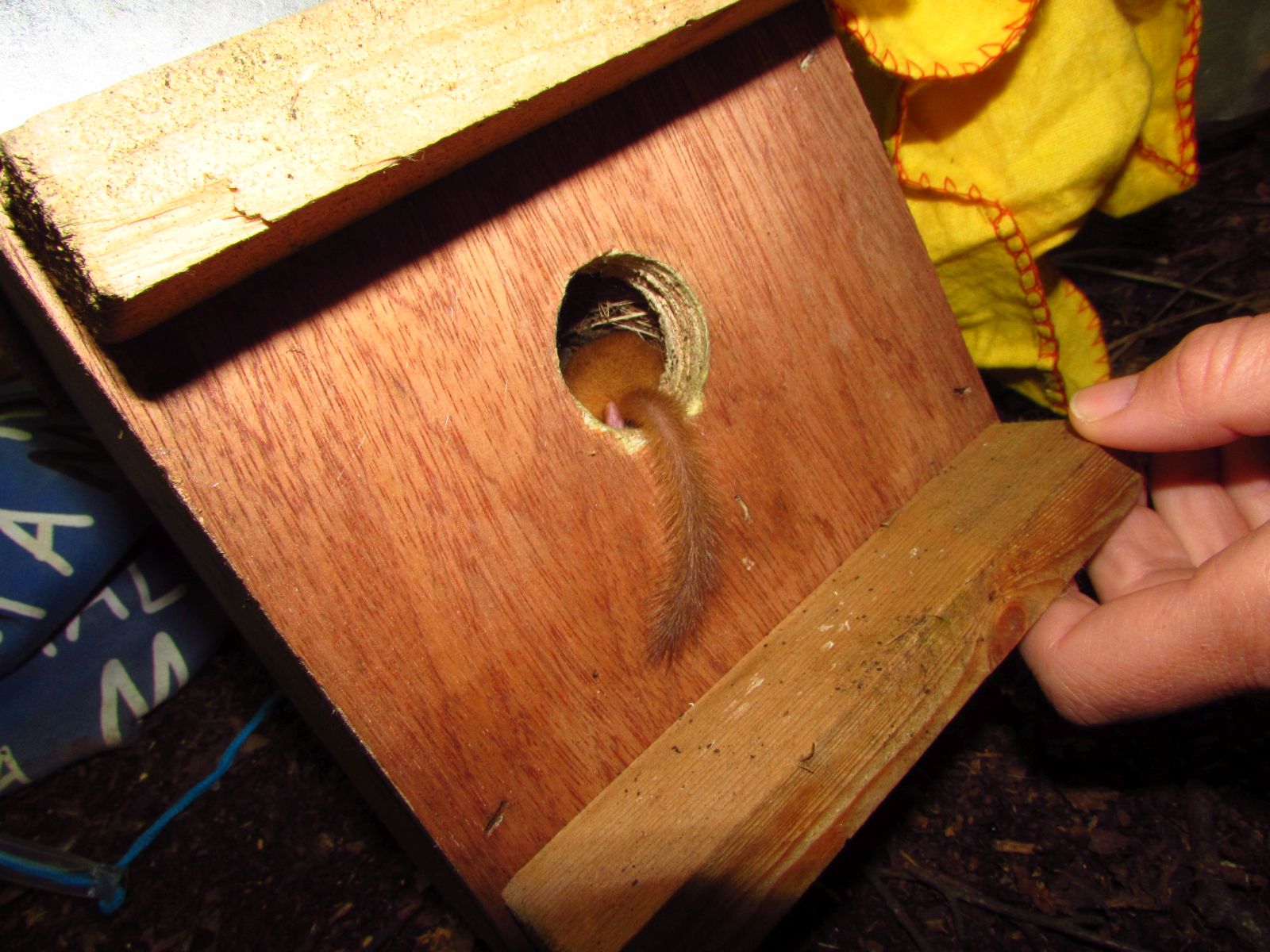
Home-sweet-home
About this time every year, a YouTube vid makes the rounds of the internet, featuring a Dormouse apparently snoring. The mammal officer who took the footage says the ridiculous sound was added on afterwards; the actual sound is more like a high-pitched whistle (d'awww!). Still, it is gorgeous seeing a Dormouse in torpor (deep sleep).


