Showing posts with label Goat Meadow. Show all posts

Wednesday, 19 September 2018

Goat Meadow moth trap - Sept 2018

It was the end of a long week, and I was still suffering from a CRTI (Crisp Related Throat Injury) due to a temporarily lodged Salt & Malt Vinegar McCoys. However, as one not inclined to moan, I soldiered on to join Jake Everitt of Sussex Moth Group for an evening moth survey. 


At around 7.30pm we set up a generator and light trap over at Goat Meadow, a herb-rich patch of grassland east of the woodlands. There are good reasons to monitor moths, as both the adults and caterpillars are important food sources for birds, predatory invertebrates, small mammals and bats. Moths are also indicators of local habitat conditions, as they are heavily dependent on a range of plants for their caterpillars and the adults which feed on nectar (making them effective night-time pollinators).

Evidence of chainsaw fairies out on site again

We had time for a site walk-over in the dusk, which was an opportunity to show Jake how the meadow has changed in the past year under management by Tom's conservation volunteers. Our groups have been working hard to reduce the amount of dominating willow scrub while opening up more of the valuable, species-rich grassland areas. 

The temperature dropped to around 14 degrees celsius, but otherwise the night was wind-less and peaceful; we were surrounded by nocturnal wildlife including feeding Pipistrelle bats and calling Tawny Owls


The Sallow Xanthia icteritia

Back at the light trap, and the moths were starting to gather in good numbers. Macro moths have some of the best (and most ridiculous) common names in natural history; many of those coming in were types of 'Sallow' moth. As we finally emptied the trap out at about 11pm, I collected a few up to photograph the next day...

The SallowXanthia icteritia

Barred SallowTiliacea aurago

Centre-barred SallowAtethmia centrago

And for the last one of the set.... I was too slow on the shutter :-(

Pink-barred Sallow - Xanthia togata 
(was 'ere)

Jake's highlight were the Oak Lutestrings which turned up towards the end.

Oak Lutestring - Cymatophorima diluta

Eudonia angustea (a type of micromoth)

Common Marbled Carpet  - Dysstroma truncata

Not only moths are attracted to the light, here is a selection of the evening's by-catch:

European Hornet - Vespa crabro

Great Blackclock - Pterostichus niger

Night-flying Dung Beetle - Aphodius rufipes

Green Shieldbug - Palomena prasina

Not a bad count in all for a September evening, and typically for this time of year Square-spot Rustic were in the greatest numbers.

Common Name
Scientific Name
Total Count
Aleimma loeflingiana
1
Epinotia ramella
Epinotia ramella
1
Epinotia cinereana
Epinotia cinereana
2
Eudonia angustea
Eudonia angustea
1
Oak Hook-tip
Drepana binaria
1
Oak Lutestring [sp]
Cymatophorima diluta
3
Common Marbled Carpet
Chloroclysta truncata
1
Willow Beauty
Peribatodes rhomboidaria
2
Light Emerald
Campaea margaritata
3
Large Yellow Underwing
Noctua pronuba
7
Lunar Yellow Underwing
Noctua orbona
1
Lesser Yellow Underwing
Noctua comes
1
Square-spot Rustic
Xestia xanthographa
28
Brindled Green
Dryobotodes eremita
1
Centre-barred Sallow
Atethmia centrago
1
Barred Sallow
Xanthia aurago
1
Pink-barred Sallow
Xanthia togata
2
The Sallow
Xanthia icteritia
6
Copper Underwing
Amphipyra pyramidea
1
Straw Dot
Rivula sericealis
5
The Snout
Hypena proboscidalis
2

Monday, 30 January 2017

Biodiversity sites in winter

(Filler-post alert!)

I've said before how differently I feel about winter since seeing our sites through the full cycle of seasons. When life goes back into the ground, everything takes an essential break to recuperate and replenish, readying for the kick-off again in the new breeding season. That gives us humans the time to restock, set out new goals, complete heavy-duty habitat works, tidy the piles of brash, clean out nest boxes, repair equipment and, of course, consume a copious amount of coffee and biscuits on the sites without too much disturbance to the wildlife.
  Here are a few shots of our biodiversity sites on the coldest and most peaceful days.

Grassland in the North West Zone

Wetland plants, North West Zone

Spring is just around the corner in the North of Brockley Wood

The River Mole, North West Zone

Gatwick Stream flood attenuation area, Land East

Rolls Field, Land East


The clearing in Goat Meadow, Land East


The Gatsbee Apiary, Land East


Ashley's Field, Land East


Ashley's Field

Roe Deer tracks

Red Fox print

Rabbit tracks

Tuesday, 17 February 2015

Ground Support

(Pretty chuffed with myself whenever I get an aviation reference into a blogpost.)
  This is all about the good work of JSA Landscape Group, Gatwick's team of grounds maintenance contractors. The past few years they have proved invaluable in our larger-scale habitat and conservation project works.

Goat Meadow stag beetle loggery; withstands clambering human test

These guys and gals achieve a lot in no time at all with their heavy-duty kit and know-how. I hesitate to call them 'the big guns', only because that sort of terminology doesn't go down well round these parts.
   The only problem with handling all this big equipment is how it requires another level of logistical innovation for otherwise straight forward habitat enhancements...

Fred creates grass cutting piles for Grass Snake breeding areas 

In terms of access, Ashley's Field in the Land East of the Railway Line is no problem for Fred and his big ol' tractor 'n' trailer. Goat Meadow however is a remote piece of grassland in the middle of some boggy woodland, so shifting materials and equipment here presents a much greater challenge...

Moving large deadwood through Upper Picketts Wood

Transporting grass cuttings to Goat Meadow


Our sincere apologies once more to Tom S. and his volunteers for the state of their once carefully edged steps and footpath... Lucky we were able to supply you with all those extra wood chippings eh! 

Mick and chainsaw vs. Willow in the North West Zone

In the depths of winter I like to take Mick and his team to all the best places, including trench-foot-inducing boggy grasslands to the west of Brockley Wood. It's hard to imagine right now, but in the height of summer-time these areas are alive with butterflies, bees and burnet moths, blissfully unaffected by the airfield just a few hundred meters away.

Gradual reduction of the Willow scrub to maximise the grassland area

These neatly staked brash-piles got the Thomas Simpson seal of approval (phew)

Hay cut along the River Mole, 2014

The cut-and-collect of our grasslands is our final job for the summer. By cutting around late September, we will minimise disturbance to any grassland species such as Harvest Mice, as well as allowing the maximum amount of meadow flower seed to drop.

Invasive species management

Lauren might be the smallest member of the JSA team, but it doesn't stop her from taking on forests of Himalayan Balsam growing along Gatwick's waterways (actually she's not that tiny, she's just very far away).

Nick uses a brush cutter to keep the woodland rides open. Horleyland Wood

Scrub management along the south bank of Man's Brook.
 This allows more sunlight to hit the banks, increasing floral diversity

Scott T. from Per Hire is another fella I've been fortunate to work with, providing us with his skills and experience in operating the 360 excavators. He has bags of energy and is an excellent problem solver; much appreciated when it comes to the difficult habitat works such as these... 

Dredging out a blocked channel along the River Mole to improve flow

Massive hibernaculum creation - North West Zone

Another hibernaculum in Goat Meadow, Land East of the Railway Line

Scott T's experience with almost every kind of digger means that nothing is too big or too small to stack...

Beginning a Stag Beetle loggery 

On occasion he's allowed to show off.

Unsubtle bag theft

Many thanks once again to all of the JSA's staff, getting these trickier habitat works 'off the ground'!

Friday, 28 February 2014

February summary

Going on how busy February has been around this place, my fears about the impending loss of my social life this spring are well founded. Here are a load of photos summing up what we've been up to this past month:

Scrambling to the finish: coppicing and glade clearance with JS Agriculture in 
Lower Picketts Wood

We have opened up our glade close to this beautiful ancient Hornbeam

The spring firsts have already appeared and the online recording is picking up - Red Admiral butterflies and various Bumblebee species have been spotted also many birds have begun nesting. Snow Drops, Wild Daffodil and Dog's Mercury are all well underway in the woodlands, too.

Dog's Mercury - early woodland ground flora

Hazel catkins with their tiny pinkish red flowers

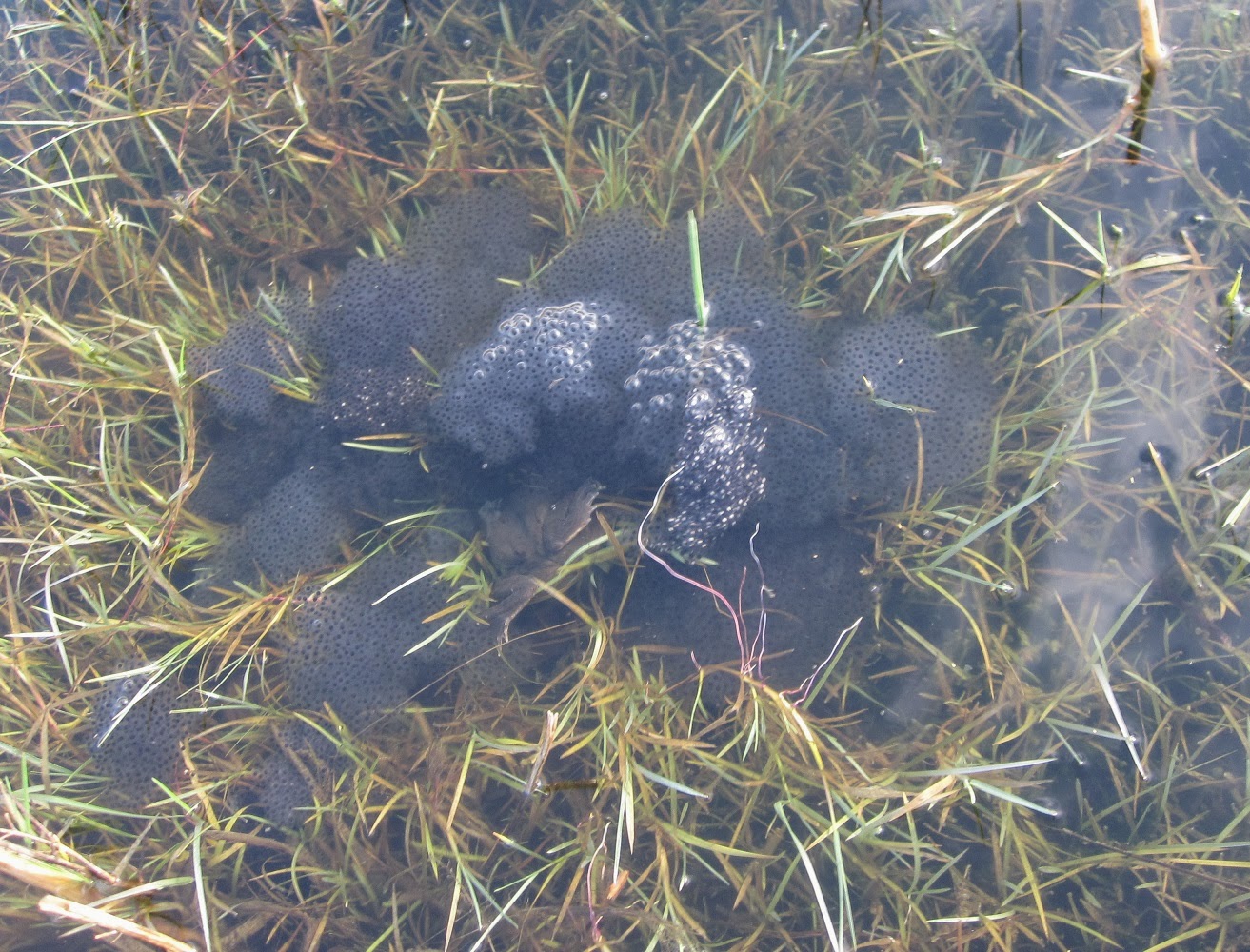
Amphibians have been quick off the mark this year and I saw our first lot of spawn much earlier this month.

Frog spawn in temporary pools in the grasslands; it might mean fewer predators but is still a risky practice

Common Toad hiding out under a reptile refugia

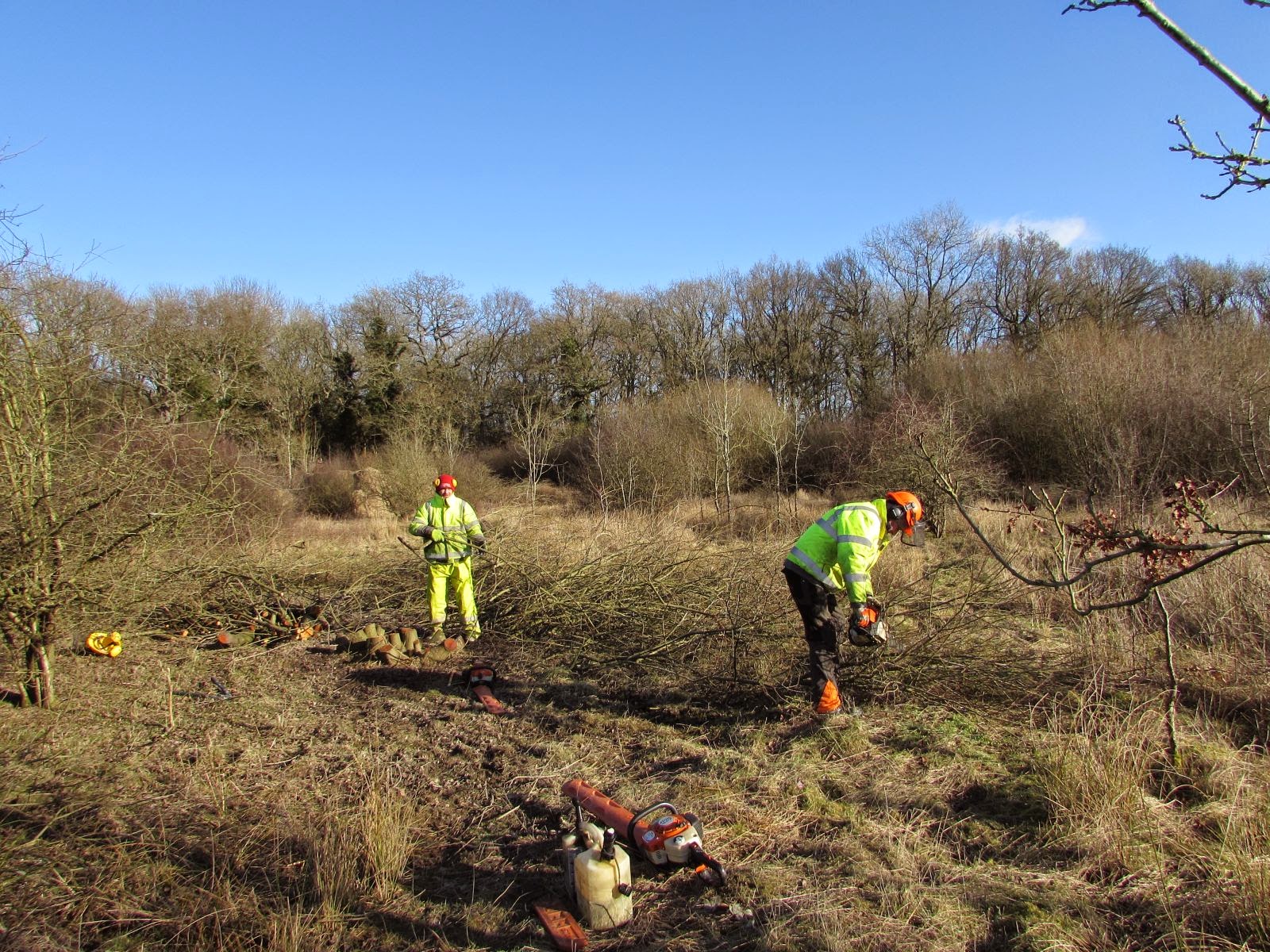
Tackling the scrub in Goat Meadow - West Sussex County Council Rangers and volunteers

We have now removed a significant amount of the encroaching Willow and young Oak trees which have been threatening our lovely wet meadow. Thanks to the WSCC guys Darren, Tom and their volunteers for coming out to do this; I think being whipped by the small Willow saplings and vengeful Hawthorn scrub might appear on future risk assessments!

Grass Snake hangout spot after a re-furb - now a fantastic Grass Snake boulevard strip of 
willow brashpiles and logpiles.

If you ever come out to volunteer with WSCC, you will note their passion for fine filter coffee and biscuits; also how they pack everything away with military precision...

 Quite literally. They are using army surplus ammo boxes!

I recently made up a display board on Gatwick for some biological recorders seminars, where local conservationists and naturalists congregate to rub shoulders, hear about new projects and updated wildlife records. These are some of my best pics of 2013.

Sorting through the malaise trap invertebrate samples is fun but starting to feel endless - some of my nearest and dearest have also been coerced into helping!

Easy to miss (and to get poked in the eye)

During our Winter Thrush surveys, I finally found some direct evidence of the Brown Hairstreak butterfly on site, in the form of these tiny yet distinctive eggs on the Blackthorn scrub.

Perfectly round with coral-like patterning - the caterpillar which hatches out of this will soon be munching on some tasty fresh Blackthorn leaves

Some extra Dormouse boxes were installed by Tom S. of Gatwick Greenspace Partnership and Gatwick's Environment Team. It seems however that they are not protected from random members of public with marker pens... Everyone's a comedian.

We got our first definite record of Badger on site, perhaps a year or so too late! Hopefully it wont be long now 'til we capture a live one on camera.


Tree-climber Allen from JS Agriculture assisted Martyn of Surrey Bat Group with moving old bat boxes from dizzying heights to more suitable locations. Before moving them, Alan opened each of the boxes to check they were empty, and was pleasantly surprised to come across these occupants...


According to Martyn, it is quite unusual to find the Brown Long-eared bats in this type of bat box (a 1FF Schwegler, which to me sounds like some kind of handgun). He had been hoping to get a confirmed sighting of this species onsite here for a while, although we have picked up their calls in previous bat detection surveys with Laurie.

Definitely one of the cuter bat species; this dosey couple were left alone to continue their napping

Alan was careful not to disturb them while taking these photos, but not much chance of that as they were in torpor (a sort of semi-hibernation). Also, in a few of these boxes were strips of honeysuckle bark... Possibly, some sneaky dormice are operating at height!

An old birds nest we fished out of a bat box with a suspicious amount of Honeysuckle 

The most abundant insect of the month award goes to the 7-spot Ladybird, 
lots can be found hidden under bark and leaves

Finally, our late winter bird surveys have pretty much become spring bird surveys with Chaffinch, Skylark, Reed Bunting and many others already in song. The Redwing are very loud at the moment with their pre-migration chatter, which I still think sounds like a flock of Siskin. Small mammals such as Short-tailed Voles and Common Shrews are abundant and active at the moment, as the mild winter has been easy on them. That reminds me of last autumn and how I got on the bandwagon for predicting a very harsh winter - that darn Eddard Stark got it completely wrong.