Showing posts with label Jeremy Early. Show all posts

Friday, 27 June 2014

Late summer invertebrating

You might not think there's much in the way of quality habitat around an airport. Fair doos, as I used to think that too.

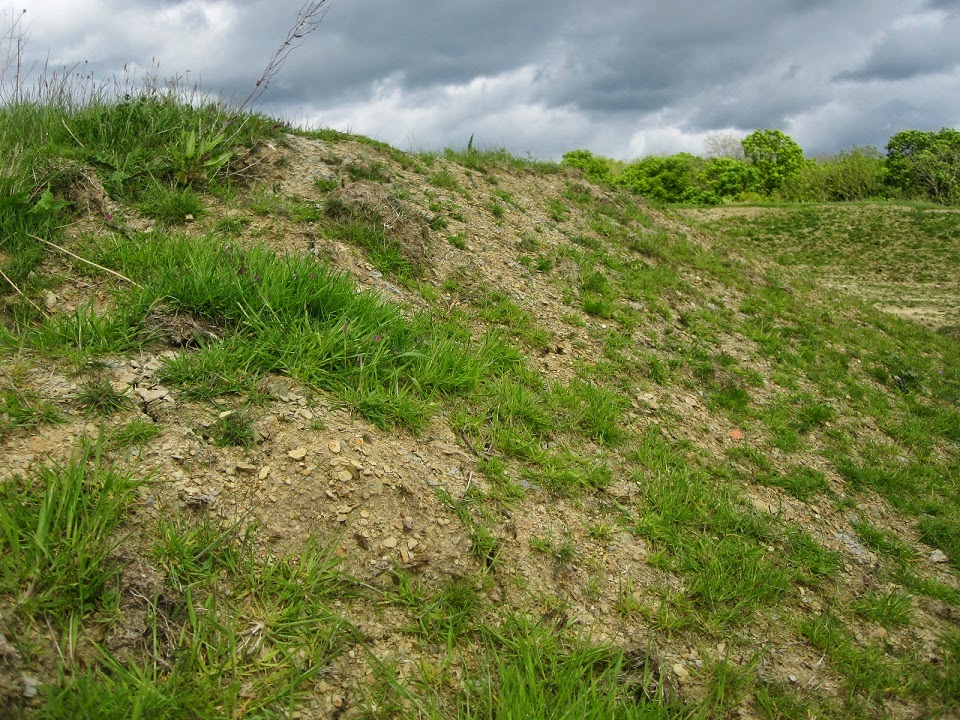
Clay Slope, North West Zone

Last Monday, Jeremy, Scotty D and his little dog Ro returned to our site in the North West Zone for the follow-up invertebrate survey. By surveying twice at the same site, both early and late in the season, we can detect a greater diversity of species.
   
River Mole floodplain

The past few weeks, the River Mole floodplain at Gatwick has looked the bee's knees (I'll be coming back to the subject of bees!). This is the result of some large-scale sculpting works which took place back in 2000 when the watercourse was diverted. It is now a veritable hotspot in terms of floral diversity... 

Greater Burnet (Sanguisorba officinalis)

Grass Vetchling (Lathyrunissolia)

Betony, Ladies Bedstraw, Quaking Grass

Meadow Vetchling, Greater Bird's-foot Trefoil, Lesser Stitchwort to name but a few. 
Artificially seeded? Either way, this lovely wildflower mix is a great thing for biodiversity

So colourful that my outlandish running trainers almost blend in

For this survey, we spread out to cover as great an area of the North West Zone as possible. The variety habitats, their different ages and structure provide plenty of options for food, water and shelter; potentially pleasing to even the fussiest kinds of invertebrate! 

Scotty grubbing around the dry slope while Jeremy searches for bees down on the floodplain

Ro the dog, focusing his efforts on keeping cool


Bishop's Mitre Shieldbug (Aelia acuminata). 
The weird angular head and stripes reminds me of the Muto in the latest Godzilla movie

Small Skipper (Thymelicus sylvestris) in cute begging pose


Since our recent exciting find of a rare species of bee, Jeremy and I spent some time staking out this section of the clay slope. We were hoping to see a few of the female Long-Horned Bees (Eucera longicornis) returning to their nesting sites...

Possible Eucera burrow?

I'll let you know the result of our great Eucera count at the end of this post!

Sharing observations

A pretty good indicator of how well a survey has gone is the number of specimens which Scotty has to take home for further microscope identification...

Just a few of his tubes; dude's got his work cut out

This type of sampling might look a bit grim, but we are unlikely to impact any populations and it is all in the name of science, with all data being passed onto the Biodiversity Record Centres.
   The following is a selection of Jeremy's excellent shots from the day (thanks again Jeremy!)...

 Broad Centurion (Chloromyia formosa) female. This looks like a Hoverfly but is actually a Soldierfly

Dusky Cockroach (Ectobius lapponicus) female. 
This is the first Cockroach species I have seen in Britain, and it is local to the south

An uncommon and nationally notable species of Hoverfly (Neoascia interrupta) female

Hoverfly (Scaeva pyrastri) male. This is a migrant species to Britain

Semaphore Fly (Poecilobothrus nobilitatus) male. Lots of these happy chaps gathered around small pools in the wet clay. They are named for the outlandish dance which the males perform with their wings

Striped Slender Robberfly (Leptogaster cylindrica), one of the most noticeable species out and about 

Water Ladybird (Anisosticta 19-punctata), the first time I have knowingly seen this lovely beetle

And last, but most definitely not least...
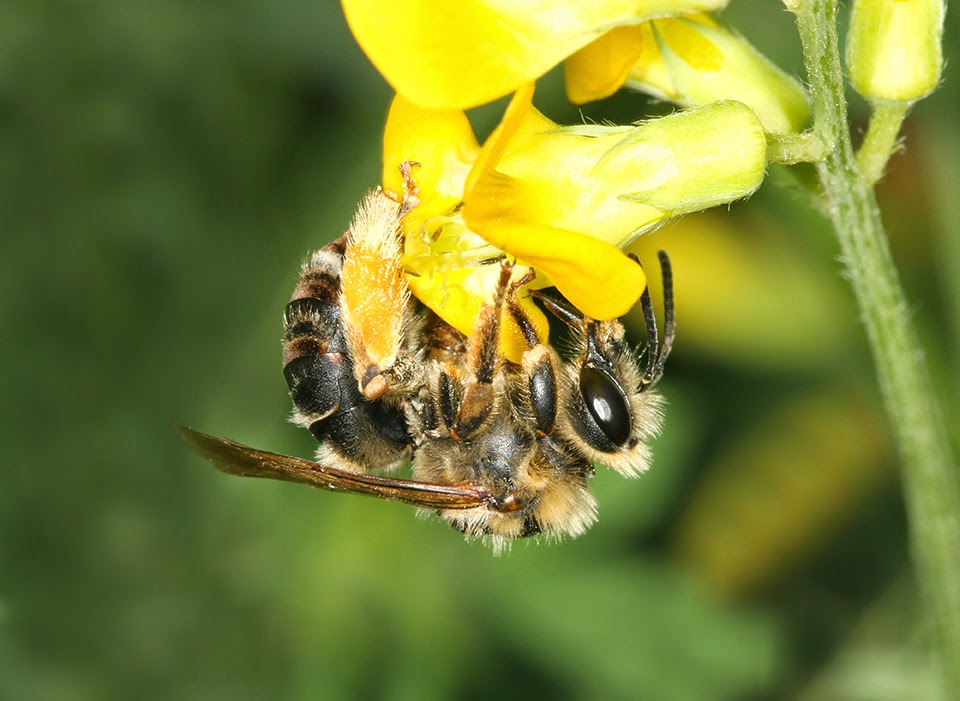
Long-horned Bee (Eucera longicornis) female. In the end we only spotted 3 individuals, so we had sadly missed its peak. In previous weeks we have counted over 10 in just one small area.

I'm afraid I will keep banging on about this particular bee until the cows come home (I have no cows).
Seriously though, the world of entomology means I can never be bored again!

Tuesday, 27 May 2014

Roving Records: Un-bee-lievable find in the North West Zone (20/05/2014)

Overlapping ecology surveys and a good dose of sleep deprivation means I'm a bit behind in blogging!
 North West Zone aerial map

After a morning newt-surveying at the Nursery ponds (which turned up only 2 adult Great Crested Newts), mum and I headed off to check on the reptile mats. Just as we arrived, the weather switched from warm and sunny to cloudy and blustery. These rubbishy, changeable conditions have been standard this past month; frustrating when looking out for winged invertebrates. This is what we turned up...

Mother Shipton Moth (Callistege mi), named after a 16th century soothsayer-witch

Long-jawed Orb-weaver Spider (Tetragnatha extensa)

Glow Worm larva (Lampyris noctiluca). Actually a type of beetle and close to pupating

Black Clock or Necklace Ground Beetle (Pterostichus madidus), munching on a caterpillar

While checking the reptile refugia in the scrubby areas for any of our scaley guests, I realised that a couple of mats had gone missing... Subsequently, I've heard they were used as props under the wheels of a Land Rover which had got stuck in some mud nearby. I'm pretty confident that action would have failed and that our Grass Snakes would have benefited from them more!

Reptile refugia (roofing felt mat) - not for un-sticking trucks

So, at the end of a slightly truncated survey, we turned up three Grass Snakes: two less than 20cm long and a 1 meter, camera-shy individual. Its head was buried right down into its coils, in a case of I-can't-see-you you-can't-see-me.

Grass Snake (Natrix natrix)

We also noticed this lovely little plant growing near to the dry grassy slope...

Shepherd's Purse (Capsella bursa-pastoris) seed pods

Shepherd's Purse (Capsella bursa-pastoris) flowers

After completing the reptile transect, I decided to loop around the clay slope one more time, just in case we could turn up something interesting. Jeremy Early advised me to keep an eye on this area on sunny days, as solitary bees and wasps could be taking up residence in it.


Winged insects, such as Butterflies and Damselflies, like to disappear from view as clouds pass over, then will suddenly reappear with the sun. Reaching the top of the slope, the fickle British sun popped out again and suddenly, small flying things were busily buzzing about. Frustratingly, my netting skills were lacking and I was entirely absorbed while ignoring Mum's incessant calls...

Until I heard that magic word: 'Bees!!'


But this ain't just any type of Bee. Oh no my friend.

Long-horned Bee (Eucera longicornis) males

This is is the Long-horned Bee, Eucera longicornis; a very scarce species in Britain and we did not only find one, but a small community! Their antennae are extraordinarily long which makes them very distinctive, and laughably cute like little cartoon characters. 

NBN Gateway Distribution

As you can see from the above map, their distribution is very limited and there are very few records since 2000. The designation for this species is Nationally Notable A, which means rare and scarce. It is also UK BAP priority species, meaning it needs some conservation action to help it out, so we will be updating our Biodiversity Action Plan with some new targets! 

Look at that face!! I think they look like some kind of Pokemon

Judging from Jeremy's excitement (that would be very excited indeed), this is one of the best species to have stumbled across in our fair isles. It loves high quality, flower rich grasslands for foraging and clay areas for nesting, which we have in abundance along the sculpted River Mole floodplain. We counted at least 10 of these little guys, possibly even more buzzing around the wildflowers below the clay slope. They will be nectar feeding on the plentiful vetches, meadow vetchling, clover and trefoils.

Difficult to snap as they were eagerly chasing each other around, as well as any poor, unsuspecting Damselflies and Butterflies

My photos don't do this gorgeous little beastie much justice, so here are a couple of Jeremy's which were taken in the past few weeks over at another site...

Long-horned Bee (Eucera longicornis) male. Photo by Jeremy Early

Long-horned Bee (Eucera longicornis) male. Photo by Jeremy Early

Once this annoying weather starts behaving again, I'll be back up on that slope trying to spot our first female!

Tuesday, 13 May 2014

Early summer invertebrating

Invertebrates are insanely underrated organisms; up close and personal, their hugely varied body plans and lifestyles make the humans in tabloid magazines look decidedly average.

This spider (Cyclosa conica) has a rear-end a Kardashian can only dream of...

When it comes to managing habitats around an airport, the best practice is not to do anything which might encourage large flocking birds to the area. This can make conservation more of a challenge, but focusing on habitat management for invertebrates is a smart way to go.
   Invertebrates are highly versatile and incredibly important for ecosystems: grazers, predators, nutrient recyclers, soil aerators, habitat manipulators and plant pollinators; to name but a few. Without them, food webs would collapse and biodiversity (including us) would be non-existant.

Searching for deadwood invertebrates

Just last week, I was lucky enough to have a crack team of entomologists visiting our sites in the North West Zone, just north of the airfield. Scotty D, Jeremy and Keith were looking at a variety of habitats, using varied searching techniques in order to list as many different invertebrates as possible.
  Here are some of the habitats we were scrabbling about in:

Entomologist in natural habitat, scrub west of Brockley Wood

Shaded section of Man's Brook, Brockley Wood

Brockley Wood South Ride

Excavated soil on a grass slope

River Mole floodplain grasslands

Everyone was kept busy as Jeremy searched out the solitary bee species, Keith hunted for deadwood invertebrates and Scotty listed everything and anything. Despite the variable weather conditions, the list grew rapidly and the 100 species target was easily passed. Here are some of my highlights (i.e. the stuff I could photograph before it got away)

Silver-ground Carpet Moth (Xanthorhoe montanata)

Spider with no common name (Cyclosa conica), but which I shall now think of as Cone-Bum Spider

Violet Ground Beetle (Carabus violaceus)

Shiny Woodlouse (Oniscus asellus), which is only half shiny because it is in the process of shedding its old exoskeleton in order to grow

 A less common wetland species of woodlouse (Trachelipus rathkii)

Green Hairstreak Butterfly (Callophrys rubi)

Thistle Tortoise Beetles (Cassida rubiginosa), a copulating pair

Flat-backed Millipede (Polydesmus angustus)

I've saved Jeremy's pics until last; these really show the jewel-like quality of certain insects. It's incredible to think that we swat these things away and think of them as a nuisance...

Black Colonel (Odontomyia tigrina), a type of Soldier Fly

Malachite Beetle (Malachius bipustulatus) female

Longhorn Beetle (Rhagium mordax) on Hawthorn

Mining Bee (Andrena carantonica) female on Hawthorn

Orange-tailed Mining Bee (Andrena haemorrhoa) female on Hawthorn

Scorpion Fly (Panorpa communis), male

Hoverfly (Helophilus pendulus), female

Hoverfly (Xanthogramma pedissequum)

Wasp Beetle (Clytus arietis)

It seems like most things want to be a wasp these days.
   I'm already looking forward to the follow up survey later in summer!