Showing posts with label gatwick honey bees. Show all posts

Monday, 21 December 2015

Gatsbees B-Log: Autumn 2015

With a mild beginning to October, we were able to make a final check of a couple of the colonies


and found a nuc (nucleus), which was queenless. It should have been strong enough to survive the winter, even though it was half the size of a full colony...


but the queen had died and in the centre of the comb the bees had constructed a queen cell, far too late for the production of a new one.


This is a butler cage, designed to introduce a new queen into a queenless colony and minimising the chance of them killing her. (The 50p is to give you an idea of the size, not how much they cost!)


She is placed into the cage and a piece of newspaper is wrapped around the open end and secured with an elastic band to give her somewhere to hide while they get used to her and feed her.


We then put it into the hive between the frames of brood, where the bees would expect to find her. At this time of year there will be no issues about them accepting her as they know they won’t survive without one!


Ilex aquifolium

The Holly and...

  Hedera helix

the Ivy. A fantastic winter plant for bees with irresistible flowers for bumbles, honeybees, wasps and hoverflies, and also juicy berries for the birds.


The next problem was in the hive on the right, also a small colony of 7 frames, where the queen was poor at egg laying and putting the colony at risk, so I took her out.


We opened up the bigger colony in the hive on the left and put a large sheet of newspaper over the frames of bees, covered by a wire queen excluder to stop it blowing away.


After dark, when all the bees were at home and clustered together, we lifted the whole hive, excluding the floor onto the main colony.


Over the next week, the bees in both hives chewed their way through the paper, gradually integrating smells and feeding each other...

Happy bees!


This visitor to the hive is a harmless Havestman (or Harvest-person?). Rachel says it is a type of arachnid, but not a spider.

(Leiobunum rotundum) female


All this mixing up of colonies causes a few battles on the landing board but the bees, which look like they are being attacked, will survive by being submissive by putting their heads between their legs and sweeping the floor with their tongues.


27th October; pollen still coming in by the leg load, but I'm not sure from which flower.


I’ve left enough honey (I hope) for the winter, but gave some back on the wax cappings from honey extraction, for the bees to clean up and store.


Ah, yes, honey. Extracting honey is my least favourite job, but I will get round to explaining its finer details one of these days…..


And so they close up any gaps which they don’t want with wax or propolis and go to bed. Although it’s now December, there are still stragglers finding traces of honey in my bee shed (where I thought it would be safe by now).

Can you spot the queen?

A really tricky ‘spot the queen’ photo last time but they do like to make it difficult; she was just disappearing round the top side of the frame with just her long abdomen showing.


If then, you think you may enjoy the ‘gentle’ art of beekeeping, you can join your local Association for theory courses, which usually begin in January. Get in touch with the British Beekeepers Association on the net for your nearest contact and they will be delighted to hear from you.


Local associations generally run practical sessions in an apiary from around April to September, so would be happy to let you hang around and practice all summer if you don’t feel confident, or if your garden isn’t suitable for you to keep bees there.


If still not for you, then perhaps you could grow plants with single flowers in your garden or in pots next year, which are easier for the bees to work. They don’t have to be native like this Green Alkanet (Pentaglottis sempervirens), but there’s always a corner for something insect friendly, whatever the growing conditions and whatever the time of year.

 Robin (Erithacus rubecula)  

So, that’s it for this extraordinary year; many thanks for your time and comments, it has been a pleasure sharing the girls with you all, amazing creatures that they are.

Big hug and a special thank you to Rachel and Tom too.

Gillybee X

Thursday, 29 October 2015

Gatsbees B-Log: September 2015

Money Spider (Linyphiidae)

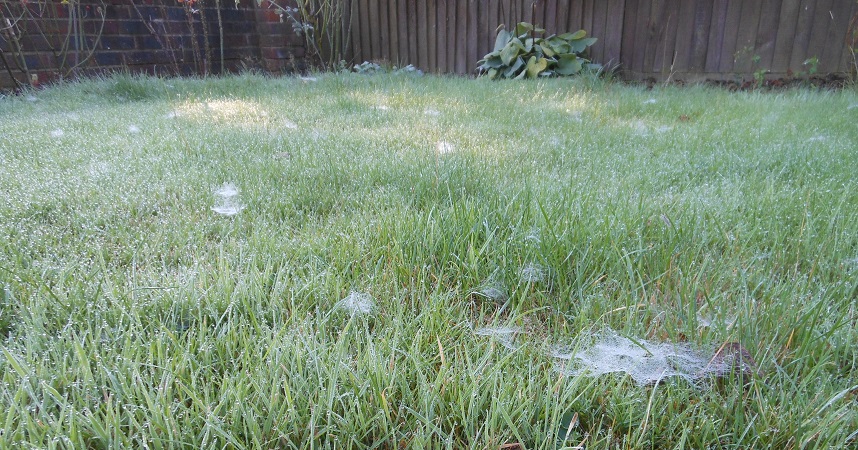
September brought cold nights and tiny, immaculate spider’s webs in the grass


and warm sunshine in the day to release nectar from the Sedum, much to the delight of the bees.


They are still throwing out unwelcome visiting wasps...


and are bringing in nectar and pollen from Himalyan balsam, Impatiens glandulifera. It begins to flower in July, is highly invasive, and is the tallest annual plant


with seed pods which burst, spreading them far and wide.


The bees carry a distinctive white patch of pollen on their thorax from the balsam and bring back loaded pollen baskets and nectar for weeks. Both bees are also collecting water; the bee’s tongue in the centre is just visible sucking up the dew on the leaf. Honest guv’na!


Beekeepers have a system for marking queens on their thorax with a coloured pen to denote which year they were born,

A small pink dot remain's from last year's marking

but generally I prefer to leave them unmarked so that I look for more than just a queen with a dot on her head. How influential are those that impress us first with their teaching!

Contain her, don't squash her!

The queen cage is pushed gently onto the queen to keep her still and she is marked on her thorax through the wire with one of the coloured pens.


It’s been good practice too for Tom and Rachel to find unmarked queens and now they are good queen spotters, it’s useful to mark one or two in the larger colonies. Job done!

Can you spot the queen? Answer next month...

It’s not easy to see queens amongst the 50,000 workers in summer...


unless she’s a big 1st or 2nd generation of commercially produced stock. As they interbreed with local drones, the queens get smaller. I look for a bee with long legs and a spidery walk, especially in the brood area where I’d expect to find her. Hope, not expect.


You may see her long abdomen, even though her head is in a cell checking it out for laying an egg and


a retinue of worker bees surrounding her, exchanging food and pheromones with the queen, which over 24 hours, informs all the workers that the queen is still there.

Trophallaxis

They in turn pass on the pheromones to each other, called trophallaxis.

Hawthorn (Crataegus monogyna)

Blackening Waxcap (Hygrocybe conica)

There are fairies at the bottom of the garden.


Fuchsia


They fill every nook and cranny with comb in a nectar flow in the summer


so there was a bit of housekeeping to do where the girls had built comb in an area of the hive without a frame.


They were quite calm while we cut it out


but there was surprisingly little food in it due to the wet and cold August, so we’ll have to make sure they have enough stores for the winter.


Forest Bug (Pentatoma rufipes) on hive lid


Hey wasp! Buzz off………………

Gillybee x

Wednesday, 17 June 2015

Gatsbees B-Log: May 2015

Swarming is a joyful time for the bees, when half the colony leaves the nest with the old laying queen to find a new home...


...leaving behind a peanut shaped capped queen cell for the remaining bees to care for.

(That’s next month’s story)

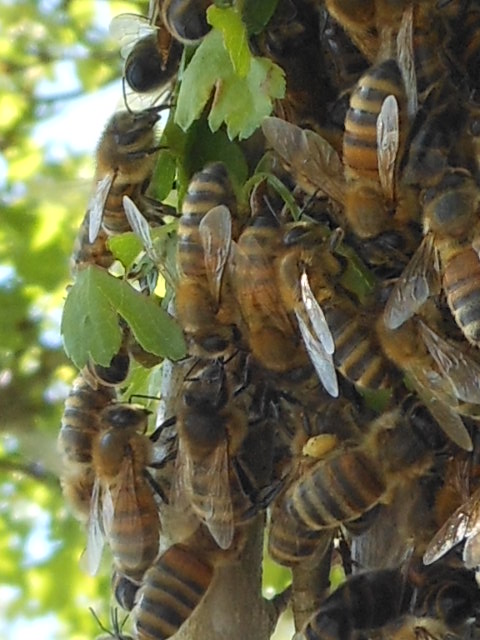
They usually fly onto a nearby tree, fence, lamp post etc. (check out google images for whacky places on which they land) where they hang for between 20 minutes and a couple of days, to make sure the queen is with them!

And to send off the scout bees to look for a new home.


If nobody comes to collect them, they fly off again together, swirling through the air to make a nest in their new found location, which could be an empty hive...

A hole in a tree...

Or, If the weather changes, they often make their nest where they are – in a Cotoneaster hedge in this case;

A fantastic construction, but they are entirely at the mercy of the weather and they would be unlikely to survive.  


The cluster of bees contains a variety of ages, some of which would have been returning from foraging expeditions with pollen and nectar when the swarm emerged from the hive. This will last them for about 3 days.


They don’t always make it easy for beekeepers to collect them...

Settled swarm on Hawthorn, Ashley's Field


The best method in this case was to put a cardboard box over the top of the swarm...


....then gently smoke them up into it.


The bees use a branch to bridge across the gap and begin to go up into the box.


Last few...


Just a quick look in the box…


As the bees hook onto each other from the top of the box, we can turn it upside down without disturbing them and place it on a sheet with a stick to make an entrance for them. No expense spared!


They fan their wings and send the scent (from their nasonov gland in the final section of their abdomen) into the air, to call in all the stragglers.


Ah, this a much better picture of fanning:

Nasonov gland visible as the lighter section near the tip of the abdomen

At dusk, when they have all found their way into the box, it’s wrapped up in the sheet and the bees are taken away, gently but firmly shaken from the box into a clean hive, the new frames carefully lowered on top of them and the hive closed up with an entrance left open. It’s a great time to have some help from my young apprentice!


The bees cluster together on the new frames and use the pollen and nectar, which they brought with them as stores...

...to fuel the energy they need to make beeswax in the glands under their abdomen... 


...while the foraging bees continue to bring in food from the May flowers.

Hawthorn (Crataegus monogyna)

Holly (Ilex aquifolium), the tiniest of flowers has a good source of pollen and nectar for the bees


Gillybee X