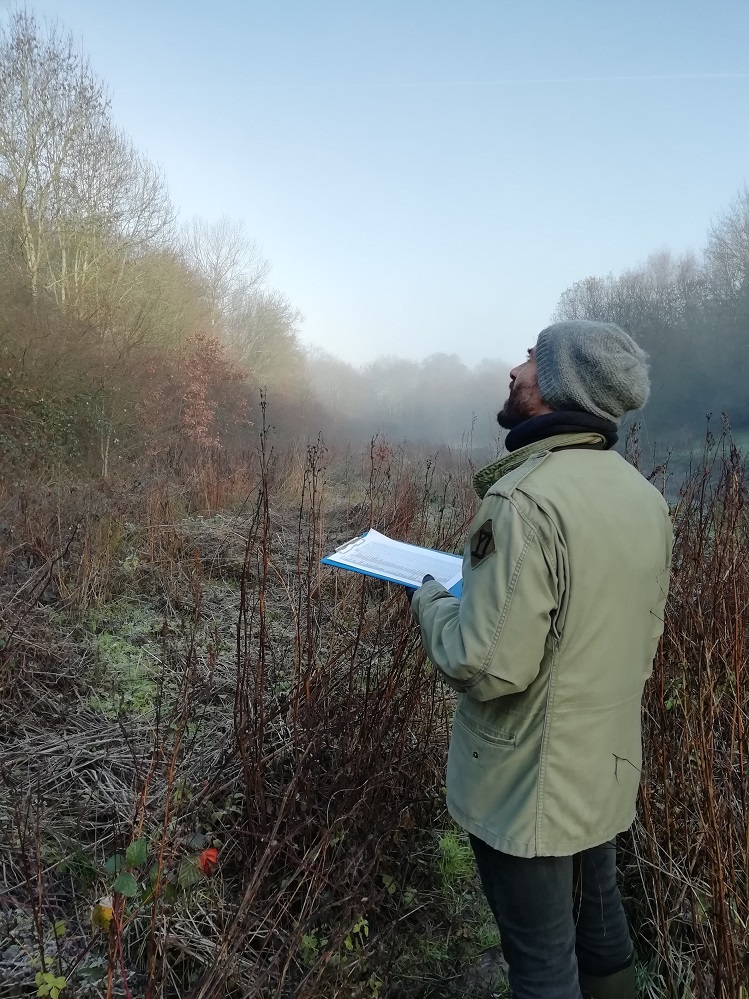
Can I get a whoop whoop Tom...

Juvenile male Black Redstart
A blooming Black Redstart (Phoenicurus ochruros) is our first species of the day!! This really is an exciting find; a red-listed species which was previously recorded as breeding at Gatwick (during my first year here in 2012), however we've had no reports of them for a number of years now. They are a very scarce bird in the UK, with only around 40 breeding pairs and 400 birds overwintering.
Tom F. must have been thinking the habitat looked just right for this species, on the urban edge of the airfield. This one seems to be a juvenile male in its first winter plumage; it flies up to perch at the top of the new Boeing hangar. At the end of the survey when we returned to the car, we were even treated to its bizarre scratchy song...

Got to love a good record shot

Our transect begins at the new Boeing Hangar, following the length of the River Mole through the North West Zone. At the old concrete batching works, as well as Black Redstart we pick up another red-listed species; Grey Wagtail (Motacilla cinerea) along with Dunnock (Prunella modularis), which is amber-listed. Like Robins at this time of year and our Black Redstart, the Dunnocks are busily singing away.

It turns out to be a hectic start to the transect, with a Kestrel (Falco tinnunculus), amber-listed, hovering over the scrub and a pair of Stonechat Saxicola rubicola perched up on Teasel seed heads.

A lone Robin ticks away, but the Wrens Troglodytes troglodytes are sounding off literally everywhere today.

Wren Troglodytes troglodytes RSPB

The grasslands are good and frosty this morning, with plenty of standing water, so fingers crossed that our wellies are up to the task (normally one or both of us are a bit leaky). A pair of Reed Buntings (Emberiza schoeniclus), amber-listed, can be heard calling from down at the river side.

After picking up a few species along the southern edge of Brockley Wood, we push through the scrub and move down toward the river reed beds. Pausing here just for a moment produces the faithful sound of Water Rail Rallus aquaticus squealing deep within the reeds.

The habitat mosaics here are pretty special. The area has been undergoing natural processes since this section of the River Mole was realigned and designed as a floodplain meadow in 1999. The western edge of Brockley Wood now graduates into mixed scrub habitat and long grass, which in turn blends into shorter grass and the floodplain meadow.

Intersecting habitats result in a high availability of ecological niches, which in turn results in a lot of different species. The only thing missing from these ecosystems are the larger herbivores and other animals which would have managed them, which means that we have to do a degree of the grass and scrub management ourselves.


On a small scale, Badgers (Meles meles) can behave rather like Wild Boar. In the picture above, they have been rootling through the turf and soil searching for hidden food (bulbs, invertebrates, mammals nests etc), resulting in local patchy disturbance. This process mixes up the seed bank, allowing for more wildflower diversity and creating important bare ground habitat.


Back down to the floodplain and the mist is still clinging to the banks and reed beds.

Rounding the corner of a reed bed, we are greeted by a flurry of beige-coloured feathers and a pinging sound....
NO WAY. IS that a Bearded Tit?!!!

No record shots today...


This section of the river is maturing nicely since its realignment, so perhaps we are now starting to see just the right ratios of scrub and reed habitat intermixed with floodplain grassland. It will be exciting to see what else turns up in the next few years.


Water Rail (Rallus aquaticus) RSPB

As we reach the end of the transect, we are treated to close up views of a Buzzard (Buteo buteo) carrying food in its talons, with two Jackdaws (Corvus monedula) winging their way in lazy pursuit.

39 species is a blooming good number for our winter bird survey sessions.
This was certainly a memorable one for both myself and Tom F!
Species
|
Scientific name
|
|
1
|
Bearded Tit
|
Panurus biarmicus
|
2
|
Black Redstart
|
Phoenicurus ochruros
|
3
|
Blackbird
|
Turdus merula
|
4
|
Blue Tit
|
Cyanistes caeruleus
|
5
|
Bullfinch
|
Pyrrhula pyrrhula
|
6
|
Buzzard
|
Buteo buteo
|
7
|
Carrion Crow
|
Corvus corone
|
8
|
Coot
|
Fulica atra
|
9
|
Dunnock
|
Prunella modularis
|
10
|
Fieldfare
|
Turdus pilaris
|
11
|
Goldcrest
|
Regulus regulus
|
12
|
Goldfinch
|
Carduelis carduelis
|
13
|
Great Spotted Woodpecker
|
Dendrocopos major
|
14
|
Great Tit
|
Parus major
|
15
|
Green Woodpecker
|
Picus viridis
|
16
|
Grey Wagtail
|
Motacilla cinerea
|
17
|
Jackdaw
|
Coloeus monedula
|
18
|
Jay
|
Garrulus glandarius
|
19
|
Kestrel
|
Falco tinnunculus
|
20
|
Long-tailed Tit
|
Aegithalos caudatus
|
21
|
Magpie
|
Pica pica
|
22
|
Mallard
|
Anas platyrhynchos
|
23
|
Meadow Pipit
|
Anthus pratensis
|
24
|
Moorhen
|
Gallinula chloropus
|
25
|
Nuthatch
|
Sitta europaea
|
26
|
Pheasant
|
Phasianus colchicus
|
27
|
Pied Wagtail (yarrellii)
|
Motacilla alba yarrellii
|
28
|
Redwing
|
Turdus iliacus
|
29
|
Reed Bunting
|
Emberiza schoeniclus
|
30
|
Ring-necked Parakeet
|
Psittacula krameri
|
31
|
Robin
|
Erithacus rubecula
|
32
|
Song Thrush
|
Turdus philomelos
|
33
|
Starling
|
Sturnus vulgaris
|
34
|
Stock Dove
|
Columba oenas
|
35
|
Stonechat
|
Saxicola rubicola
|
36
|
Treecreeper
|
Certhia familiaris
|
37
|
Water Rail
|
Rallus aquaticus
|
38
|
Woodpigeon
|
Columba palumbus
|
39
|
Wren
|
Troglodytes troglodytes
|