Showing posts with label British Airways Engineering Volunteers. Show all posts

Sunday, 29 December 2013

December Summary

 
Veteran oak tree, Land East of the Railway Line

It feels like we have packed an incredible amount into December. Winter provides us with only a short window for cracking on with habitat management and it is a race to complete these jobs before the spring wildlife starts waking up again. With the incredible amount of wet weather resulting in Gatwick's rivers and streams flooding out, this will be no mean task
   Earlier this month, conservation work started with JS Agriculture and Gatwick Greenspace Partnership working together in the North West Zone. We coppiced the willows and scrub on a grassy slope which was becoming over shaded.

Coppicing willows on the grassy slope


Gatwick's ranger Tom S then improvised by staking the cut wood into habitat piles half-way up the slope, providing cover for wee beasties but leaving the wet grassland clear of debris at the bottom.

Scott finishing up our hibernacula in the Scrub West of Brockley Wood

More recently, Scott T did a grand job of moving some logs and tree stumps onto the new hibernacula in Scrub West of Brockley Wood. Sometimes I wish I could be trained to use a digger, but then with great power comes great responsibility and I can get a little power hungry.

Another completed hibernaculum - not pretty but perfect for invertebrates, reptiles and other wildlife

Our regular group of British Airways Engineers (BAE) definitely have a pact with the weatherman; on a revoltingly sunny day in mid-December, they were led by Gatwick Greenspace Partnership (GGP) on a woodland conservation task. They bridged the ditch on the main path into Brockley Wood, improving access for future work, also removing the old barbed wire, plastic tree guards and some litter. Because they can smash out these jobs in record time, I barely got any photo opportunities...

BAE installing a footbridge, East of Brockley Wood

Railway sleeper footbridge

BAE and Gatwick Greenspace Partnership

As part of the National Harvest Mouse Survey by the Mammal Society, volunteers Rachael, Sue and me carried out some nest searches along the River Mole. We had a successful haul with 4 nests on single transect along a path in the grasslands. This helps inform us where to carry out further mammal surveys in the coming year.

Well-hidden: a ball of woven grass hidden in a large tussock

A rather large Harvest Mouse nest constructed of Cock's Foot grass. 
It was probably used as a breeding nest earlier this year

While carrying out these searches, we were lucky enough to be serenaded by a very loud Water Rail. This wading bird turned up in our winter bird survey last year but eluded us on our most recent one. It still counts though as an individual record and will be added to Gatwick's species database. I think they sound a bit like excitable piglets.


We completed our final early winter bird survey this month in the Land East of the Railway Line. The pace has really picked up with thrushes - mixed flocks of Fieldfare, Redwing, Song Thrush, Mistle Thrush and Blackbird are abound, testing our identification skills.

Recording on our Winter Bird survey

Goat Meadow's mug-holder tree. Sadly no coffee was left in them... Mean dog walkers.

Tom F in the scrub, deep in conversation with a flock of Redwing

Looking ahead to January and February, there is an incredible amount to do and we are going to need all the volunteer help we can get. My to do list will probably keep on growing, but I seem to be running out of whiteboard...

*gulp*

Tom S is planning some conservation taster days in the New Year, so if you want to find out whether all this 'getting-back-to-nature' stuff is overrated, drop Tom a line at thomassimpson@sussexwt.org.uk or learn more here about Gatwick Greenspace Partnership and their work.


River Mole culvert, North West Zone after recent heavy rains

A massive, massive thank you to all who have been involved this past year, you have helped make this a brilliant project to work on. We hope to see you again in 2014!

Thursday, 11 April 2013

Our first Gatwick Biodiversity Expo


Spreading the good word of Gatwick Greenspace Partnership
 and the passion of the BA Engineering Volunteers

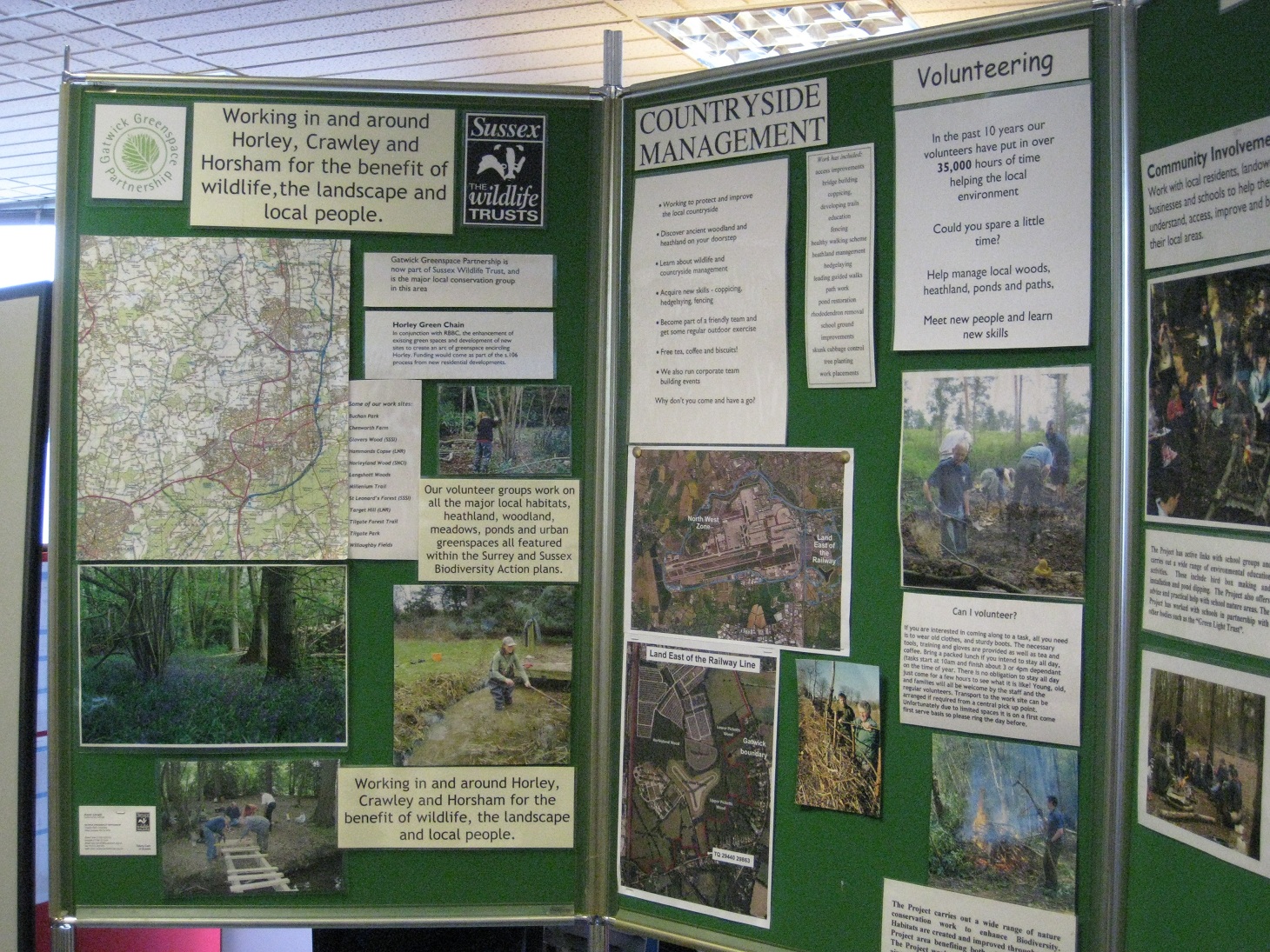
On Wednesday Carl Traynor from the British Airways Engineers and Kevin Lerwill from Gatwick Greenspace Partnership led our first combined biodiversity and volunteering expo at the BA Crew Report Centre at Jubilee House. This was primarily to spread the word about our work around Gatwick's conservation areas and to gauge people's interest in possible volunteering. We were delighted by the number of BA staff willing to give up their time to take a look at our display boards and chat to us about what they found interesting!


Most people are rather surprised to hear about the nature of what is right on their doorstep and that Gatwick Greenspace (part of the Sussex Wildlife Trust) has been working here for so long. We want to engage the wider airport community and this day has helped us to generate some new and exciting ideas of how best to do so... Watch this space!

From the left: Kevin Lerwill of Gatwick Greenspace Partnership, Colin Sexton of BA Engineering,
Me of JS Agriculture Ltd, Carl Traynor of BA Engineering

I believe all people have an appreciation for nature on some level whether aesthetic, cultural, scientific or simply instinctive. Some people might think their day to day jobs are far removed from wildlife, but often it can be found much closer than they imagined.

Our slightly controversial mascot: Boris the roe deer

Wednesday, 6 March 2013

Dormouse developments

On Friday of last week a new housing development was completed by the British Airways Engineering Volunteers in Gatwick's ancient woodland Horleyland Wood...

Dormouse box mounted in mature hawthorn with honeysuckle, Horleyland Wood

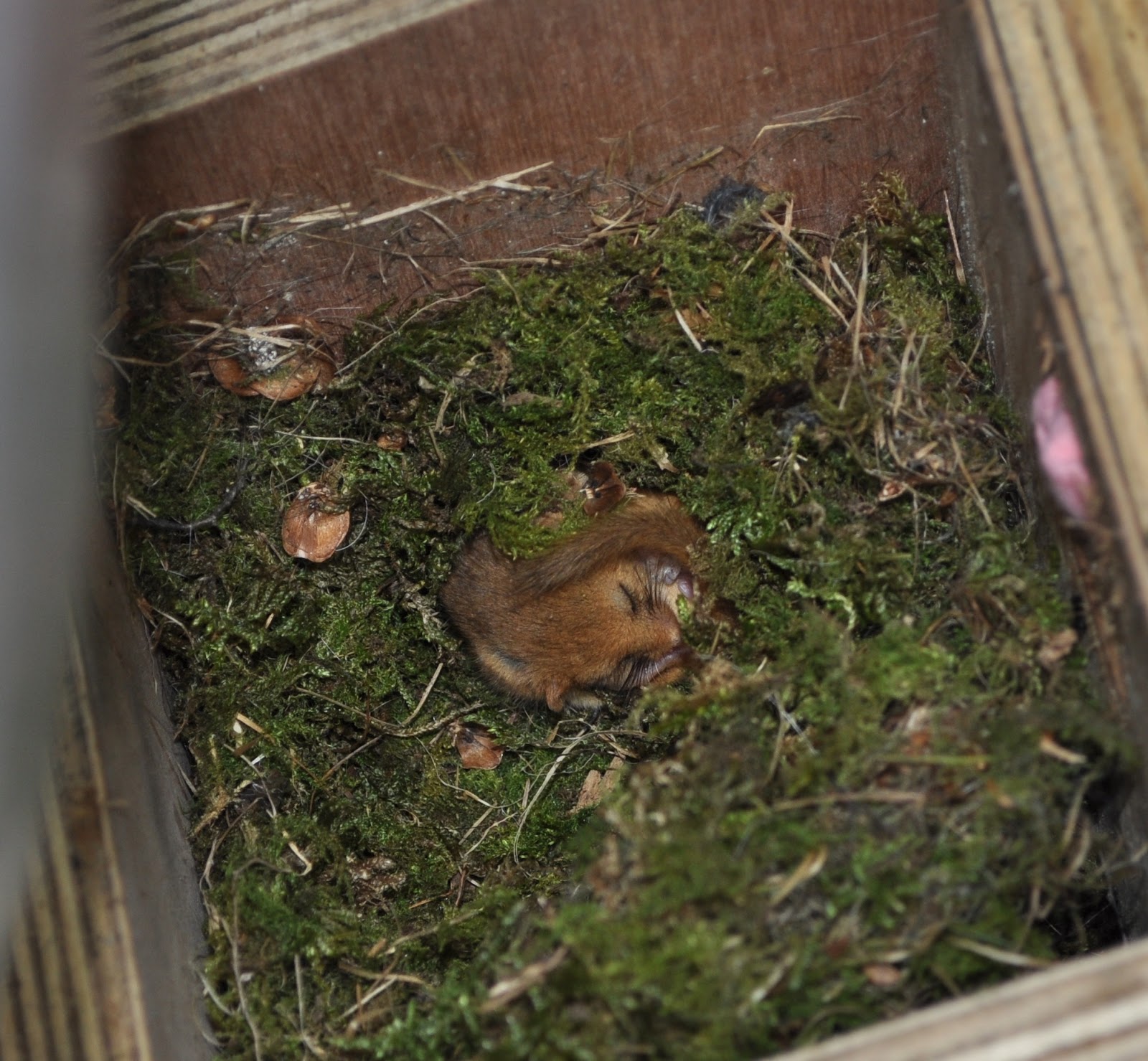
Torpid dormouse in a box, photo taken on a survey in nearby Crawley, 2012

As well as achieving pretty incomprehensible levels of cuteness, the hazel dormouse is an elusive wee beastie and the best way to survey for them is to tempt them in with luxury accommodation. Although I hesitate to use the word ‘fussy’ they sort of are... however by the same token they could be deemed good indicators of high quality woodland and levels of biodiversity.

A typical dormouse nest, photo taken at some nearby woodlands in Worth, 2012 

They tend to come out of hibernation around April and then start scoping out new accommodation for the breeding season. If their presence is confirmed then a licensed handler will be brought in to assist with weighing and sexing individuals, determining the health of the population. 

Dormouse bagged to be weighed and checked over, Crawley 2012

Due to their rapid decline in the past 100 years or so, the hazel dormouse is protected by law. Causes for the population crash are believed to be the loss of ancient woodland, fragmentation of woodlands, loss of hedgerows and unsympathetic woodland management; these issues we are confronting in our Gatwick Biodiveristy Action Plan.

The British Airways Engineering volunteers are a keen bunch with a zeal for helping improve the environment of Gatwick. They are very handy to have around with their technical skills and I will blogging all about their good work in the future.


Many thanks to Adrian Haines, Carl Treynor, Colin Sexton, Glyn Finch and Terry Sparrow of British Airways Engineering


Thursday, 21 February 2013

“You’re gonna need a bigger boat.” - Autumn/Winter habitat conservation

River Mole floodplain grassland during most of the summer


The ecological field surveying at Gatwick came to a close in autumn 2012 and it was declared one of the wettest summers on record... So a rather problematic first field season for me, then again even some of the hardiest ecologists I met along the way were suffering from dampness-doom! But enough about the wash-out summer, what then goes on during the autumn and winter once the final reptile and grassland surveys have been carried out?

The focus then switches to our first set of actions outlined in the Biodiversity Action Plan. From hedgerow-restoration to dormouse box installation, a new grass-cutting regime to scrub and woodland coppicing, we have now got the ball rolling on improving these habitats to benefit biodiversity. 

 Glade creation in Upper Pickett’s Wood with JS Agriculture


They say that a rolling stone gathers no moss, but what about when it hits the mud? ‘Challenging’ is the word I would use to sum up this conservation task season! There was very little chance for the land to dry out over summer, so the autumn and winter kept all our natural areas in the constant state of wetland. Habitat management became expeditions with teams of people, heavy equipment and large vehicles which were needed to get as close to a boggy woodland ride as possible. When four wheels wouldn't cut it, trucks were abandoned and it was down to the trusty wheelbarrow...

                  Weather-hardened Gatwick Greenspace Partnership Volunteers and JS Agriculture workers


However vehicles and equipment have their limits… 

A shuffle of our action plan schedule and we crack on with an alternative task. When it comes to biodiversity works it is a case of adapt to survive!

Our main habitat and conservation works this past autumn and winter:
•             Grassland cutting and collecting
•             New stock-proof fence and gate installation
•             Dense woodland and young plantation coppicing/thinning
•             Footbridge and fingerpost installation on public footpaths
•             Creation of woodland glades and opening up woodland rides
•             Hedgerow restoration and hard cutting-back
•             Rotational scrub coppicing
•             Pond and stream bank scrub management
•             Black Poplar tree planting along the River Mole
•             Habitat creation: nest boxes for dormice, hibernacula for reptiles and amphibians, dead-hedging and piling up deadwood for invertebrates


Gatwick Greenspace Partnership battling on in the rain, Horleyland Wood


 JS Agriculture carrying out bankside management of ponds (LERL)


                          British Airways Engineering Volunteers plantation coppicing

                                     (who had the inside info on the weather?)