Showing posts with label British Entomological and Natural History Society. Show all posts

Friday, 17 April 2015

The key thing about hymenoptera

My 5th weekend workshop at the British Entomological and Natural History Society (I know, I should just move right in) and I'm realising the best thing about these meetings (aside from the biscuits) is overhearing and chatting with such a diverse group of people about explorations into invertebrate identification.

BENHS HQ - Dinton Pastures workshop desks with light microscopes

Mike Edwards of BWARS led this course on Hymenoptera aculeata (bees, wasps, ants and sawflies), beginning with a presentation on their fantastic diversity and life strategies in the UK. These insects are broadly classified at having two pairs of clear wings (4 in total), joined by hooks and with an ovipositor at the rear which is modified into a 'stinger'. 

The walls are lined with drawers like this filled with carefully preserved and labelled specimens

Mike is an incredibly enthusiastic entomologist, one of many people trying to encourage a new generation of biological recorders. He asked us to bring along our specimens, so I brought some solitary bees from Gatwick, including one of my 'zom-bees' which came back to life after removing it from the fridge. I've subsequently learned a few tips on how NOT to preserve specimens...

...such as storing things in alcohol and then writing the labels in ink
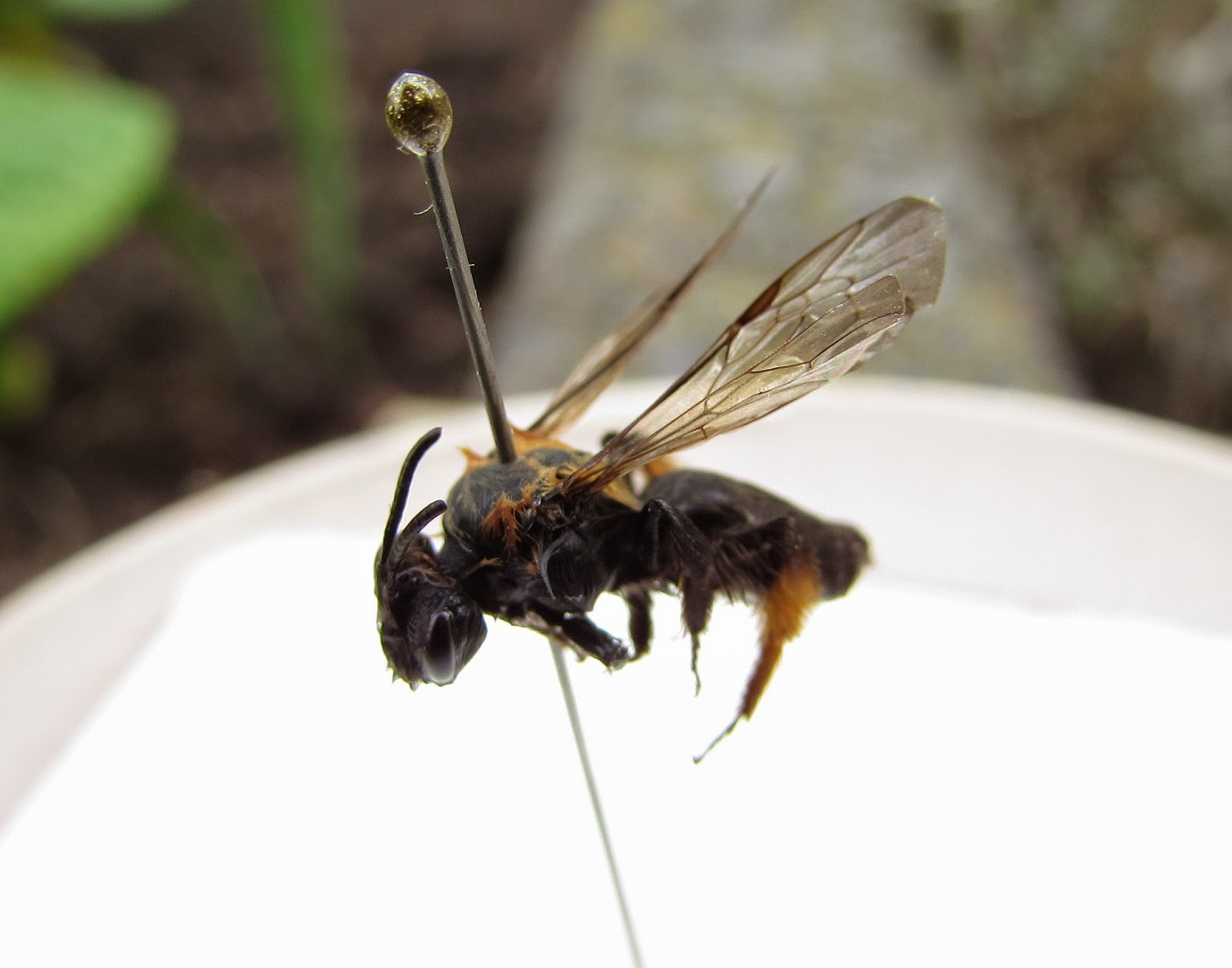
Alcohol will also mat the hairs of insects which can be an important identification feature. 
Plus its a little undignified. This was an Andrena solitary bee, species is probably clarkella 

Just to make a brief point here: I don't collect invertebrate specimens for fun or for ownership (I'm no Pokémon master). Present day Entomologists collect specimens in order to identify a species, and because certain features can only be practically observed when something is no longer moving. You can read more about the entomology code of conduct here:


Identification keys are quite like the 'Choose Your Own Adventure' books, in that you are presented with options and your choice tells you which page to go to. Mike has recently been updating and simplifying a key to British bees, this is a quick demo of part of it...
   For the pics I've used a smart phone down the lense of a microscope, but better naturalists than me will sketch features by hand as this helps with learning!

How to work out if your bee is male or female...

This female had 12 antennal segments...

...and 6 visible tergites (segments) on its rear end

So we know it is female, onto Key 2...


I can see 3 submarginal cells, slightly out of focus

Over to couplet 15...


Surface of eyes are definitely not hairy, and the marginal cell on the wing was relatively broad...

Over to couplet 16...

Couldn't see the tongue, but the wing vein was straight, plus the inner margin of the eyes are more straight than concave; over to 17...

I'm sure you get the jist! This one eventually keyed out to the genus Nomada, which is a type of Cuckoo Bee. These are common parasites of other solitary bees, laying their own eggs which after hatching then eat the larvae and food stores.

Now really is a good time to be getting into wildlife recording; with social media and online recources, everything is so much more accessible. Also, being able to share experiences with people at workshops or online means the entomological pursuit is no longer such an isolating one!

Many thanks again to Mike and everyone at BENHS who helps to put these workshops together.

Tuesday, 10 March 2015

Ground Beetles (Carabids) workshop

When we were kids in the 90's, my bro and I would squabble over who got to be the first to read the new issue of 'Bugs' magazine (I think that was what it was called). It came with free 3D specs for a double-page center image of a terrifying invertebrate, plus collectible glow-in-the-dark pieces of a spider model. It was also where I first read about the obnoxious habits of carabid beetles such as the Bombardier, which can spray a nasty concoction of boiling chemicals from their rear ends into the faces of predators... Those rascals.

Beetle body-plan: the weirdly named Sausage Ground Beetle (Carabus granulatus)

Last Saturday I visited the British Entomological and Natural History Society at Dinton Pastures, Reading to take part in the Ground Beetle (Carabidae) identification workshop. This is the 4th BENHS workshop I've been along to now and each one is uniquely fascinating.

Entomologist John Walters with the BENHS collection of Carabids

Today's course was jointly run by entomologists Mark Telfer (of Pan-species listing fame) and John Walters. It began with a presentation introducing the Carabidae family of beetles and their wonderful diversity in the UK. These include your classic black Ground Beetles, stunning Peacock Beetles, monstrous Tiger Beetles and the relatively tiny Bembidions.

Mark's precisely labelled and positioned specimens

Beetles are like living tanks with awesome customized add-ons which vary depending on their lifestyles. Being almost entirely predatory, carabids are monsters of the undergrowth with huge, curved jaws, massive eyes and spiked sprinting legs... Pimp My Beetle wouldn't work as a TV show, as they are already too damn pimped. 

Carabus granulatus (Sausage Ground Beetle) under the microscope. 
My Sony Xperia phone seems to take fairly good images this way 

The classroom session involved selecting specimens from the workshop collection and trying out different identification books and keys, including handy worksheets produced by Mark and John. These guys are on a mission to make the study and identification of insects (entomology) more accessible to beginners...

A detailed identification key to the features of Carabid beetles

But these brilliant worksheets were much more user-friendly

Superficially similar: Carabus granulatus on the left, Carabus arvensis on the right.

Of course is it always a beautiful day whenever microscopes are involved! Fortunately we had the opportunity to step outside for some live beetle handling/wrangling, learning about useful identification features out in the field:

Beetle wrangling (like a boss)

A live Violet Ground Beetle (Carabus violaceus) in the hand. 

The idea is to firmly grasp the middle and hind legs, which mostly immobilizes them so you can then examine from all angles. Their nip doesn't hurt too bad (unless you have open cracks on the sides of your thumb, then it bloody hurts).

Flipping the beetle

Momentary distraction with 3 Red Kites flying over our heads

At the end of the day, Mark demonstrated mounting a dead beetle specimen onto card... not your classic hallmark type of card (although I bet Mark wouldn't mind receiving one like that).


My first mounted Gatwick beetle specimen: Black Clock Beetle (Pterostichus madidus)


I had a sort through some of the Gatwick pitfall-trap sample jars, in which we had just 2 very common carabid species: Pterostichus madidus and Abax parallelepipedus.


So I'm 2 species down with some way to go before I amass a collection like Mark's. Hmmm, I forgot to ask when exactly he started off...

Mark Telfer's Website : A great resource for beetle identification keys and literature.
John Walter's Website : Beautiful natural history illustrations as well as downloadable identification keys
British Entomological and Natural History Society : Field meetings and indoor workshops, open to anyone with an interest in the astounding diversity of UK insects and other invertebrates.

Monday, 1 December 2014

Spidery bits and pieces

On Saturday morning while reading in bed, a tiny woodland spider wandered over the pages of my book. The only problem with recording indoor invertebrates (particularly those normally found in trees) is that I can't reliably state their origin further than my coat, which hangs up nearby.

One of my favourite species; the unmistakable cone-butt profile of Cyclosa conica. 

Taking it as a good omen, I potted up this little Cyclosa and brought her along for the ride to the spider identification workshop at Dinton Pastures, Reading. 


Hosted by the British Entomological and Natural History Society, today's course was led by Dr Peter Smithers, an expert arachnologist from Plymouth University. Peter is a brilliantly affable guy and his fascination and enthusiasm for spids is entirely infectious. We were started off with a captivating run down of Britain's main spider families, in all their glorious forms and lifestyles...

Jumping spiders (family Salticidae)

We were shown various identifiable features of spiders, including eye arrangement, leg structures, general body shapes and their most privatest parts. We were then let loose on a collection of specimens, making use of microscopes, books and worksheets provided.

Specimens arranged by family groups and their features

Collections Room at Dinton Pastures with microscopes and lamps 

Organised chaos

The key is to first identify the family your specimen belongs to (i.e. wolf spider, jumping spider, comb-footed spider) and to then locate the reproductive parts. In the males, these are a pair of modified limbs located at the very front called the pedipalps...

Photo taken down the lens of a light microscope (300x)

By looking closely at the finer structures of the palps and comparing with images in the book, I identified the above individual as a common species of Wolf Spider called Pardosa palustris... or possibly Pardosa agrestis. Or P. monticola
   I'll be needing a little more practice at this.


Due to their fidgety nature, spiders are mostly dispatched in alcohol before being examined under a lens. However, the two I had brought along with me were a couple of obliging little posers, including this adult female Comb-footed spider...

Some kinda species of Theridion...

The identifiable feature of females is the epigyne, a small opening which is uniquely shaped and patterned to each species. With Peter's help I identified this lady as Theridion sisyphium, who until recently had been living in the JSA portacabin loo.

Close-up view of the female parts on the underside of the abdomen

Peter also showed us some affordable tech to aid us in our future spidery investigations. I've checked and you can pick up a USB microscope like this for between £15-£40 online, which means I might be getting myself an Xmas present after all!

Cyclosa under the lens: she mostly behaved and only once was found wandering across the desk

Theridion under the lens

A live feed means you can also record great footage of spider behaviour

I've only been to a small number of workshops run by the BEHNS, which have all been awesome. This was my favourite so far and if they run it again next year, I'll be back for more!

Cyclosa, back in the trees somewhere in Hove Park

Sunday, 6 April 2014

Indoor aculeating

Yesterday, a last minute opportunity came up to go on an aculeate identification workshop (bees, wasps and ants). As I'm still feeling keen about bees, I jumped at the chance.


The course was run by the Bees Wasps and Ants Recording Society (BWARS) and held in the British Entomological and Natural History Society classroom at Dinton Pastures. It focused on using written keys to identify solitary and spider-hunting wasps; at first I felt pretty daunted, but the course tutors Mike Edwards and Graham Collins encouraged us to get cracking and just see how we got on.

Ectemnius wasp abdomen

Ectemnius wing - these features can vary between species, so are useful in working out which group a particular wasp belongs to

At first I made a lot of mistakes with the keys, continually coming to the wrong name and having to start the process again. Apparently that is the best way to learn, as I became increasingly familiar with the key anatomical features for identifying bees and wasps down to the genus level.The relaxed atmosphere allowed us to get on at our own pace and no question was deemed too amateurish or silly.


I even had a go at keying out and pinning some of my own specimens from last year's malaise trap. My pinning is a bit off-centre and badly angled, but practice will make perfect and hopefully this specimen will still be identifiable.

My first pinned specimen - a Ruby-Tailed Wasp (Chrysis spp.)

There was a fun moment when I met Ryan Clark, who I follow on twitter. I only realised we were in the same room on the same course after he replied to my tweet!


The bug inside me grows for getting to know solitary bees and wasps, so next I am signing up to BWARS!