Showing posts with label floodplain meadow. Show all posts

Thursday, 19 December 2019

Early winter bird survey - North West Zone December 2019

Just as we pull up in the car to the start of the transect, Tom Forward laments his wish to see a Black Redstart in the UK, after not having seen one for so many years.


Before I even switch off the engine, we spot a small bird bobbing up and down on a concrete wall.
Can I get a whoop whoop Tom...

Juvenile male Black Redstart

A blooming Black Redstart (Phoenicurus ochruros) is our first species of the day!! This really is an exciting find; a red-listed species which was previously recorded as breeding at Gatwick (during my first year here in 2012), however we've had no reports of them for a number of years now.  They are a very scarce bird in the UK, with only around 40 breeding pairs and 400 birds overwintering. 

Tom F. must have been thinking the habitat looked just right for this species, on the urban edge of the airfield. This one seems to be a juvenile male in its first winter plumage; it flies up to perch at the top of the new Boeing hangar. At the end of the survey when we returned to the car, we were even treated to its bizarre scratchy song...


Got to love a good record shot


Our transect begins at the new Boeing Hangar, following the length of the River Mole through the North West Zone. At the old concrete batching works, as well as Black Redstart we pick up another red-listed species; Grey Wagtail (Motacilla cinerea) along with Dunnock (Prunella modularis), which is amber-listed. Like Robins at this time of year and our Black Redstart, the Dunnocks are busily singing away.


It turns out to be a hectic start to the transect, with a Kestrel (Falco tinnunculus), amber-listed, hovering over the scrub and a pair of Stonechat Saxicola rubicola perched up on Teasel seed heads.


Stonechat Saxicola rubicola RSPB

A lone Robin ticks away, but the Wrens Troglodytes troglodytes are sounding off literally everywhere today. 

Wren Troglodytes troglodytes RSPB


The grasslands are good and frosty this morning, with plenty of standing water, so fingers crossed that our wellies are up to the task (normally one or both of us are a bit leaky). A pair of Reed Buntings (Emberiza schoeniclus), amber-listed, can be heard calling from down at the river side.


After picking up a few species along the southern edge of Brockley Wood, we push through the scrub and move down toward the river reed beds. Pausing here just for a moment produces the faithful sound of Water Rail Rallus aquaticus squealing deep within the reeds.


The habitat mosaics here are pretty special. The area has been undergoing natural processes since this section of the River Mole was realigned and designed as a floodplain meadow in 1999. The western edge of Brockley Wood now graduates into mixed scrub habitat and long grass, which in turn blends into shorter grass and the floodplain meadow.


Intersecting habitats result in a high availability of ecological niches, which in turn results in a lot of different species. The only thing missing from these ecosystems are the larger herbivores and other animals which would have managed them, which means that we have to do a degree of the grass and scrub management ourselves.


However, some of the local mammals still leave their mark...


On a small scale, Badgers (Meles meles) can behave rather like Wild Boar. In the picture above, they have been rootling through the turf and soil searching for hidden food (bulbs, invertebrates, mammals nests etc), resulting in local patchy disturbance. This process mixes up the seed bank, allowing for more wildflower diversity and creating important bare ground habitat.


Over to the north of Brockley Wood (likely named for the Badgers), as we poke our heads in a few Wood Pigeon (Columba palumbus) clatter off through the canopy, but otherwise all seems quiet. A lone Nuthatch (Sitta europaea) calls in the distance.


Back down to the floodplain and the mist is still clinging to the banks and reed beds.


Rounding the corner of a reed bed, we are greeted by a flurry of beige-coloured feathers and a pinging sound....

NO WAY. IS that a Bearded Tit?!!!

No record shots today...

I grab hold of Tom F's arm and I'm making tiny Water Rail noises myself... we can't actually believe it, this is such an unexpected find. This is certainly a first for our sites, and after consulting Twitter hive-mind, it might be a first ever record for the Mole Valley district!

Bearded Tit, aka Bearded Reedling Panurus biarmicus RSPB

This is my first ever clear sighting of this species, and even Tom F. hasn't seen one in years. It seems to be a lone male which is likely just stopping off for winter, or may have been pushed out of another more suitable habitat, but what an incredible record and such an affirming tick for the River Mole reed beds. I actually got a bit choked up!


This section of the river is maturing nicely since its realignment, so perhaps we are now starting to see just the right ratios of scrub and reed habitat intermixed with floodplain grassland. It will be exciting to see what else turns up in the next few years.


Pressing on along the floodplain, we are treated to another rare sight; a Water Rail! This is unusual for us as we normally only ever hear them. It flutters across our path, its long legs tucked in but feet protruding out in front as it disappears into the reeds.

Water Rail (Rallus aquaticusRSPB


As we reach the end of the transect, we are treated to close up views of a Buzzard (Buteo buteo) carrying food in its talons, with two Jackdaws (Corvus monedula) winging their way in lazy pursuit.


39 species is a blooming good number for our winter bird survey sessions. 
This was certainly a memorable one for both myself and Tom F!

Species
Scientific name
1
Bearded Tit
Panurus biarmicus
2
Black Redstart
Phoenicurus ochruros
3
Blackbird
Turdus merula
4
Blue Tit
Cyanistes caeruleus
5
Bullfinch
Pyrrhula pyrrhula
6
Buzzard
Buteo buteo
7
Carrion Crow
Corvus corone
8
Coot
Fulica atra
9
Dunnock
Prunella modularis
10
Fieldfare
Turdus pilaris
11
Goldcrest
Regulus regulus
12
Goldfinch
Carduelis carduelis
13
Great Spotted Woodpecker
Dendrocopos major
14
Great Tit
Parus major
15
Green Woodpecker
Picus viridis
16
Grey Wagtail
Motacilla cinerea
17
Jackdaw
Coloeus monedula
18
Jay
Garrulus glandarius
19
Kestrel
Falco tinnunculus
20
Long-tailed Tit
Aegithalos caudatus
21
Magpie
Pica pica
22
Mallard
Anas platyrhynchos
23
Meadow Pipit
Anthus pratensis
24
Moorhen
Gallinula chloropus
25
Nuthatch
Sitta europaea
26
Pheasant
Phasianus colchicus
27
Pied Wagtail (yarrellii)
Motacilla alba yarrellii
28
Redwing
Turdus iliacus
29
Reed Bunting
Emberiza schoeniclus
30
Ring-necked Parakeet
Psittacula krameri
31
Robin
Erithacus rubecula
32
Song Thrush
Turdus philomelos
33
Starling
Sturnus vulgaris
34
Stock Dove
Columba oenas
35
Stonechat
Saxicola rubicola
36
Treecreeper
Certhia familiaris
37
Water Rail
Rallus aquaticus
38
Woodpigeon
Columba palumbus
39
Wren
Troglodytes troglodytes

Friday, 27 June 2014

Late summer invertebrating

You might not think there's much in the way of quality habitat around an airport. Fair doos, as I used to think that too.

Clay Slope, North West Zone

Last Monday, Jeremy, Scotty D and his little dog Ro returned to our site in the North West Zone for the follow-up invertebrate survey. By surveying twice at the same site, both early and late in the season, we can detect a greater diversity of species.
   
River Mole floodplain

The past few weeks, the River Mole floodplain at Gatwick has looked the bee's knees (I'll be coming back to the subject of bees!). This is the result of some large-scale sculpting works which took place back in 2000 when the watercourse was diverted. It is now a veritable hotspot in terms of floral diversity... 

Greater Burnet (Sanguisorba officinalis)

Grass Vetchling (Lathyrunissolia)

Betony, Ladies Bedstraw, Quaking Grass

Meadow Vetchling, Greater Bird's-foot Trefoil, Lesser Stitchwort to name but a few. 
Artificially seeded? Either way, this lovely wildflower mix is a great thing for biodiversity

So colourful that my outlandish running trainers almost blend in

For this survey, we spread out to cover as great an area of the North West Zone as possible. The variety habitats, their different ages and structure provide plenty of options for food, water and shelter; potentially pleasing to even the fussiest kinds of invertebrate! 

Scotty grubbing around the dry slope while Jeremy searches for bees down on the floodplain

Ro the dog, focusing his efforts on keeping cool


Bishop's Mitre Shieldbug (Aelia acuminata). 
The weird angular head and stripes reminds me of the Muto in the latest Godzilla movie

Small Skipper (Thymelicus sylvestris) in cute begging pose


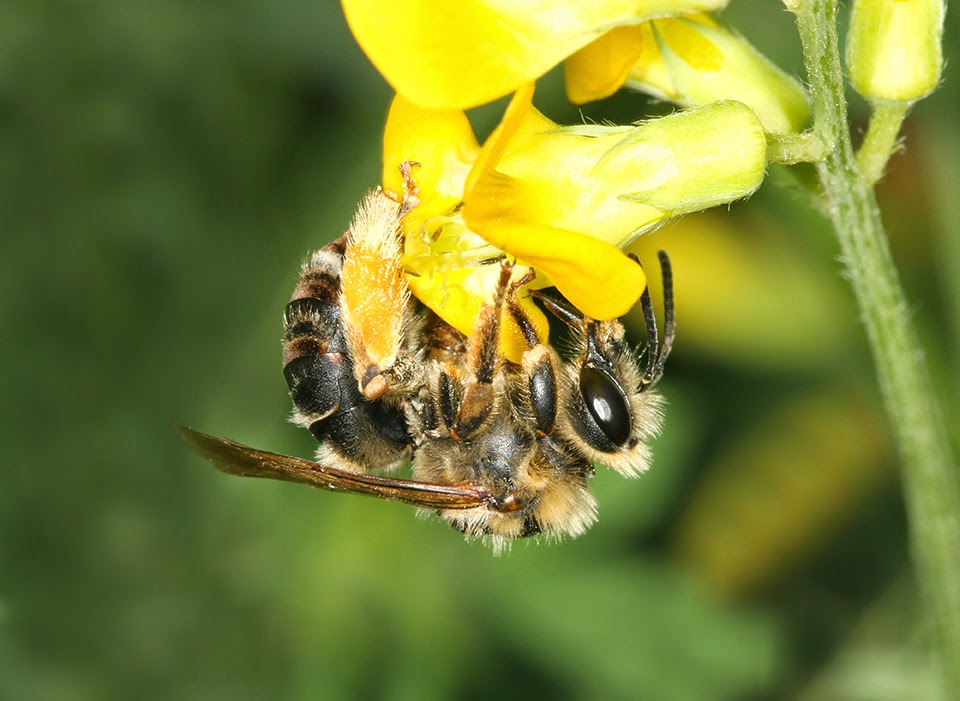
Since our recent exciting find of a rare species of bee, Jeremy and I spent some time staking out this section of the clay slope. We were hoping to see a few of the female Long-Horned Bees (Eucera longicornis) returning to their nesting sites...

Possible Eucera burrow?

I'll let you know the result of our great Eucera count at the end of this post!

Sharing observations

A pretty good indicator of how well a survey has gone is the number of specimens which Scotty has to take home for further microscope identification...

Just a few of his tubes; dude's got his work cut out

This type of sampling might look a bit grim, but we are unlikely to impact any populations and it is all in the name of science, with all data being passed onto the Biodiversity Record Centres.
   The following is a selection of Jeremy's excellent shots from the day (thanks again Jeremy!)...

 Broad Centurion (Chloromyia formosa) female. This looks like a Hoverfly but is actually a Soldierfly

Dusky Cockroach (Ectobius lapponicus) female. 
This is the first Cockroach species I have seen in Britain, and it is local to the south

An uncommon and nationally notable species of Hoverfly (Neoascia interrupta) female

Hoverfly (Scaeva pyrastri) male. This is a migrant species to Britain

Semaphore Fly (Poecilobothrus nobilitatus) male. Lots of these happy chaps gathered around small pools in the wet clay. They are named for the outlandish dance which the males perform with their wings

Striped Slender Robberfly (Leptogaster cylindrica), one of the most noticeable species out and about 

Water Ladybird (Anisosticta 19-punctata), the first time I have knowingly seen this lovely beetle

And last, but most definitely not least...

Long-horned Bee (Eucera longicornis) female. In the end we only spotted 3 individuals, so we had sadly missed its peak. In previous weeks we have counted over 10 in just one small area.

I'm afraid I will keep banging on about this particular bee until the cows come home (I have no cows).
Seriously though, the world of entomology means I can never be bored again!

Monday, 25 March 2013

Underwater excavations

A flood alleviation scheme is underway along Gatwick Stream just off Radford Road. This is a project to widen the channel and increase the water holding capacity of the adjacent grasslands.

Archaeological dig site along Gatwick Stream, LERL

An ancient piece of worked flint, fresh out of the Gatwick clay

I have never seen an archaeological dig before. So far this one has been beset by freak blizzards, a WW2 bomb scare, nosy ecologists, relentless rain and flooded excavation pits – the archaeologists assure me this is all quite standard stuff and they crack on with the work regardless. And I had thought JSA and GGP were weather-hardened!

Week 1, Day 1

Week 2, Day 2

Week 2, Day 3. What would Indy do?

But a little water doesn't stop these guys and girls, and the team are successfully uncovering flint items from around the Mesolithic period, which is about 10,000 to 5000 BC. Nomadic humans would have used their expert 'knapping' skills on this flint to create a variety of useful tools...

Flint fragment, possible evidence of the flint having been actually worked on this site

I don't know what this would be used for but I want one.

On the biodiversity side of things, this is a chance for the creation of another floodplain meadow, a species-diverse habitat which has become increasingly scarce. Wetland species such as Black poplar, Bur-reed, Meadowsweet, Flowering rush and Marsh marigold flourish in floodplains and support a great assortment of wildlife. Agricultural intensification and the lack of appropriate management have probably been the biggest cause of loss of wetlands.

Gatwick Stream as it stands at the moment: narrow channel and in places very steep sides

I have been on site each morning keeping an eye out for any breeding birds while JSA came in to remove the scrubby vegetation along the stream and future floodplain. Although the hostile weather seems to have kept ideas of nesting at bay, i have witnessed many aerial skirmishes within and between species including Pied Wagtail vs. Meadow Pipit and Blue Tit vs. Robin.

I keep a log of all the species I see out and about for this kind of work, here is a link to the list of what has turned up so far... Gatwick Stream Species March 13
Mink tracks, banks of Gatwick Stream

Black-headed gull tracks in the muddy fields

Roe deer hoof prints, showing an imprint of the rear 'dewclaws'

The team from Network Archaeology are going to be here for the next few weeks and I am excited to see what might come out of Gatwick’s ground next (humans being a part of Biodiversity history too!)