
The Gatwick Aviation Museum is a hidden gem of a place, containing an impressive collection of well-kept British aircraft manufactured between the 1940s and the 1970s. The main building is a large aircraft hangar located in a large field, north-west of Gatwick's runway.

The landscape here is made up of wetlands, hedgerows, mature English Oak trees and margins of long grass, which combined with a lack of human disturbance results in some excellent areas for wildlife. The site also has very few biological records, and as species listing helps us to build up a picture of the ecosystem health, this is an ideal location for our 5th annual wildlife recording event!

North West of the runway

The bioblitz area
Event kick-off: Friday 22nd June, 7pm
(One day after the summer solstice.)


On the second longest day of the year, there was plenty of time before sundown for the Gatwick Greenspace Partnership team to set up the recording base camp. We readied ourselves for a long evening of wildlife discovery, which involved brewing plenty of coffee and a bit of impromptu kazoo playing.

Aviation Museum pond
It was an incredibly warm summer evening with hardly a breeze. As the first guests arrived, our task was to put the overnight moth-trapping equipment out into the heart of the site.

Next up was the setting of longworth traps (used for live capture of small mammals) which were placed out around the perimeter of the site. As the sun finally began to set at around 9.20pm, Martyn Cooke and Kevin Lerwill began the bat activity survey.

Static bat recorder
Martyn's specialist bat recording software produced over 3000 sequences, and approximately 25,000 individual bat calls. Three species were positively identified; Common Pipistrelle, Soprano Pipistrelle and Noctule. Two species of Myotis bats were recorded, and noted as probable Bechstein's and Whiskered. A possible Leisler's bat flagged up, but was unfortunately the recording was quite poor.
Total bat species: 5
By the evening's end we had gathered many wildlife records of the nocturnal kind, including several species of amphibian, bats, spiders, and a very vocal Tawny Owl.

Common Toad Bufo bufo

Common Frog Rana temporaria
(Photo by Helen Cradduck)
Total amphibian species: 3

A beautifully polished Walnut Orb-weaver Nuctenea umbratica
Around midnight it was time to put the kazoos away and turn in for an ambitious attempt at getting some shut-eye next to an airfield.

Saturday June 23rd: 6am

(Photo by Lucy Groves)
The sun popped up again much sooner than we would have liked, and the team was mobilized at 6am. The first task of the day was a bird survey, which involved walking the entire perimeter of the site, keeping a sharp eye out and listening for calls.

The areas of wet scrub proved very productive, and we were greeted by the sounds of Reed Bunting, Goldfinch and Common Whitethroat. Along the mature hedgerows and Oak trees, the most vocal birds were Nuthatch and Song Thrush.

Common Buzzard Buteo buteo
(Photo by Helen Cradduck)
Total bird species (seen and heard): 32
After the birds, it was straight on to checking the small mammal traps, with local mammal expert Lucy Groves leading the group. We found 5 species of small mammal which we considered good going for a short survey; Wood Mouse, Yellow-necked Mouse, Bank Vole, Common Shrew and Pygmy Shrew.


Wood Mouse Apodemus sylvaticus
(Photo by Lucy Groves)
Larger mammals which were also seen on site included Rabbit, Red Fox, Roe Deer, Grey Squirrel and Brown Rat.

Red Fox Vulpes vulpes
(Photo by Helen Cradduck)
Total mammal species (not including bats): 12

After a quick breakfast and some fresh pots of coffee, next up was the moth trap reveal with Laurie Jackson and Bob Foreman leading the show. The overnight traps were emptied with every moth, large and small, closely examined for identification and then counted.

Elephant Hawk-moth Deilephila elpenor
(Photo by Helen Cradduck)

We were looked on by the yellow-and-black caterpillars of the Cinnabar moth, making short work of the Common Ragwort growing nearby.
But the rarity of the day (which caused the most excitement in the mothers' world) was the Dotted Fan-foot Moth, a nationally scarce species...

Total moth species: 68

Banded Demoiselle Calopteryx splendens
(Photo by Helen Cradduck)
Total dragonfly & damselfly species: 7
Vince Massimo carried out a survey around the perimeter of the site, giving our butterfly species list a boost. The most rewarding find for him was a Purple Hairstreak high up in the canopy of the oldest Oak Trees.
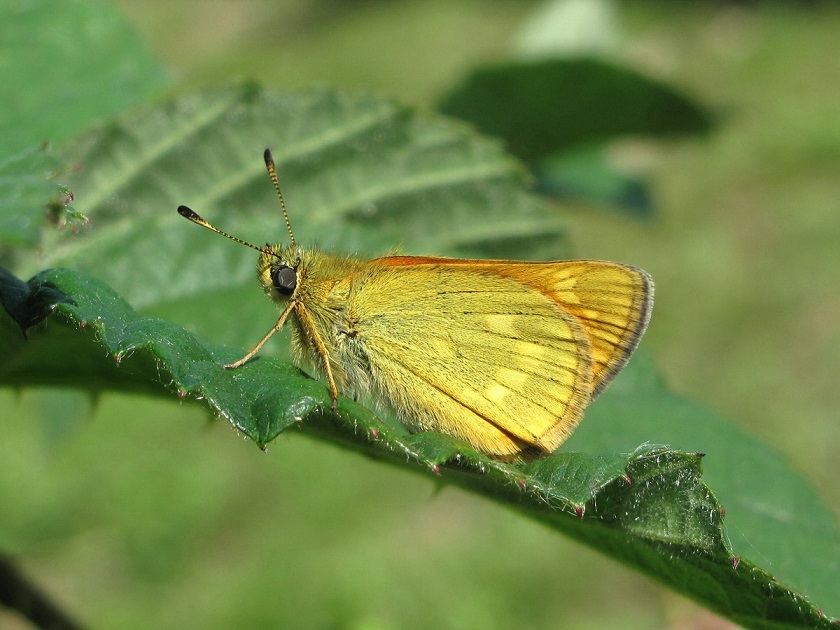
Large Skipper Ochlodes sylvanus
(Photo by Vince Massimo)

Small Tortoiseshell Aglais urticae
(Photo by Vince Massimo)
Total butterfly species: 17
Other invertebrate groups can be a great challenge to identify to species level, so we were lucky to have experts on site such as Peter Hodge who did a brilliant job of sorting out the beetles for us...

A species of Soldier Beetle - Cantharis rufa

Cantharis nigra

A tiny lacewing larvae


Labyrinth Spider Agelena labyrinthica
Total spider species: 7
Total fly species: 16

Arthur Hoare in action


Marsh Thistle (Cirsium palustre)
Total vascular plant species: 59Total lower plant species: 6
Total fungi species: 14
The final part of the day involved pond dipping for aquatic invertebrates. We are able to identify a few of the dragonfly nymphs and water bugs, as well as getting up close to the young frogs and newts.


Dragonfly nymph
(Photo by Lucy Groves)

Newt larva
(Photo by Lucy Groves)
By the end of the day, at about 2pm we had our running total, but it didn't stop there with experts taking away notebooks and specimens for closer examination.

This was the total count at around 2pm
As of now, the grand total for the day stands at 323 species!
A huge thank you to Tom Simpson, Kevin Lerwill, Tamara Jewell, and to all of the volunteers and guests who attended on the day. A special thank you also to Ashley and Jon of the Gatwick Aviation Museum for allowing use of their excellent site and facilities.
The latest breakdown of group totals from Lois Mayhew at the Sussex Biodiversity Record Centre:
| amphibian | 3 |
| bird | 32 |
| beetles | 42 |
| flies | 16 |
| moss and lichen | 6 |
| plants | 59 |
| moth | 68 |
| butterfly | 17 |
| earwig | 1 |
| true bugs | 27 |
| dragonfly | 7 |
| hymenoptera | 6 (includes 1 gall) |
| isopod | 1 |
| mollusc | 2 |
| Grasshoppers and crickets | 3 |
| mammals | 12 |
| spider | 7 |
| fungi/rust | 14 |
| Total Species | 323 |
| Total Records | 423 |


