Showing posts with label bullfinch. Show all posts

Friday, 14 December 2018

Early Winter Bird Survey - North West Zone 12/12/18


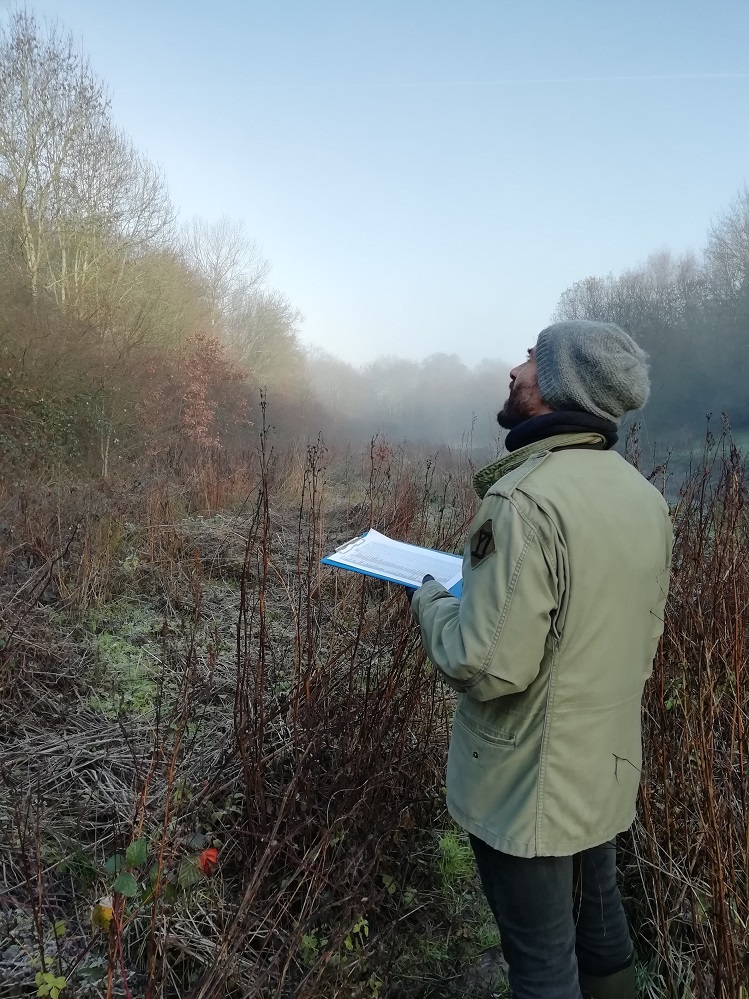
This morning was the start of a real cold snap here in Sussex, which always seems to tie in with our North West Zone bird survey transect. Tom F. and I set off along the northern side of the airfield fence a little after sunrise, giving the birds some time to get moving and active. Tom commented right away that this was a spookily quiet morning...


A group of Meadow Pipits are typically the first birds we come across, bouncing along the airfield fence. A Robin and several Dunnocks called sporadically, hidden away along the banks of the River Mole. Our first red-status species was a Song Thrush, giving it's subtle 'tseep' alarm call as it fled, nipping down into the river bank vegetation.


Down on the floodplain it truly felt bone-achingly cold. The reed beds seemed devoid of life, then a fiesty Wren struck up an alarm call as it faced us off from the top of a reed. Finally, a Reed Bunting called, although only faintly and with no replies forthcoming. It really felt like the birds hadn't got out of bed yet.


Further along the floodplain, we caught the distant calls of Water Rails. These secretive birds seem to be more vocal in winter, and their call is highly weird. If you happen to be standing right next to one when it sounds off, it's pretty alarming!


Over to the scrub west of Brockley Wood, a few Blue Tits and Long-tailed Tits were foraging together on the woodland edge. A sole Green Woodpecker headed off calling and a group of Wood Pigeon broke from the trees. Over in woodlands, a distant Nuthatch called.


This sheltered patch of grassland is one of my favourite spots in summer, dense in long herbaceous vegetation and absolutely humming with invertebrates. In winter however this tends to be the favourite patch of another highly-secretive and red-status bird; the Woodcock. We flushed one from the low scrub; its low, whirring flight really does give the appearance of a giant bat. 


Poking our heads into the north of Brockley Wood, we were hoping for some Redwing activity, however the flocks were conspicuously absent from the site this morning. The collective alarm calls of  Blackbird, Magpie and Wren indicated the presence of an avian predator, likely a perched-up Tawny Owl or Sparrowhawk. Whatever it was then moved off, as the alarm calls rapidly followed it through the wood.


Our final section of grassland along the River Mole turned up two Common Snipe, which had been well hidden in the rushes. One put on an amazing display, flying a wide loop over the environment bund and then skimming low past us at about waist-height. This whole transect was again peculiarly quite, and surprisingly one of the most numerous birds was Bullfinch; we counted a total of 6.


At the very end of the transect we had a buzz of excitement in the form of a perched Sparrowhawk, apparently causing upset with the resident Ring-necked Parakeets. It casually took off over the trees, leaving in its wake a string of songbird alarm calls.


Final species count = 34

Common name
Species
Blackbird
Turdus merula
Blue Tit
Cyanistes caeruleus
Bullfinch
Pyrrhula pyrrhula
Buzzard
Buteo buteo
Carrion Crow
Corvus corone
Chaffinch
Fringilla coelebs
Coal Tit
Periparus ater
Dunnock
Prunella modularis
Goldcrest
Regulus regulus
Goldfinch
Carduelis carduelis
Great Spotted Woodpecker
Dendrocopos major
Great Tit
Parus major
Green Woodpecker
Picus viridis
Grey Heron
Ardea cinerea
Jackdaw
Corvus monedula
Jay
Garrulus glandarius
Long-tailed Tit
Aegithalos caudatus
Magpie
Pica pica
Mallard
Anas platyrhynchos
Meadow Pipit
Anthus pratensis
Moorhen
Gallinula chloropus
Nuthatch
Sitta europaea
Reed Bunting
Emberiza schoeniclus
Ring-necked Parakeet
Psittacula krameri
Robin
Erithacus rubecula
Siskin
Spinus spinus
Snipe
Gallinago gallinago
Song Thrush
Turdus philomelos
Sparrowhawk
Accipiter nisus
Treecreeper
Certhia familiaris
Water Rail
Rallus aquaticus
Woodcock
Scolopax rusticola
Woodpigeon
Columba palumbus
Wren
Troglodytes troglodytes

Wednesday, 30 December 2015

Early Winter Bird Survey 2015 - North West Zone

Friday December 18th

R2-D2 Dreamliner

It was an incredibly a mild December morning when Jedi Birder Tom Forward, of the order Gatwick Greenspace Partnership, swooped in for our early winter bird survey.

The North West Zone, located in the Outer Rim Territories of Gatwick

Straight away we felt a strong presence in the force, scooping up a brand new species for our surveys landside at Gatwick... A Coot

It's a little odd that we haven't picked up Coot on previous surveys, but I have checked the ancient iRecord archive scrolls, dating back a whole 3 years and true it is confirmed to be.
  In some nearby scrub, we gained privileged views of a lone Fieldfare breaking its fast on tasty rose hips...


Other thrush species picked up here were Redwing, Song Thrush, Blackbird and Mistle Thrush. An excitedly singing Dunnock also made its presence known from a nearby hedgerow. 
   At the end of the canalised section of river, where the Mole begins to meander, we saw a dark shape nip into the reed bed... could it be?

The Water Rail victory dance

The calls of Water Rail are pretty unmistakable (and bizarre), sounding more like a squealing piglet than a wetland bird. Reed Bunting, Song Thrush and Wren also sounded off, hidden from view in the reeds, while a flock of Long-tailed Tits moved through the trees.

Reeds along the River Mole

Passing around the north side of Brockley Wood, Carrion CrowJackdaw and Jay were our first corvids of the day and the lively sound of a Redwing flock came from somewhere in the gloom. Incredibly, signs of spring were cropping up everywhere...

Elder (Sambucus nigra) coming into leaf


Out of the woods and into a busy section of floodplain, with Fieldfare flying overhead and mixed flocks of Blue Tits, Great Tits and Goldcrests foraged in the tree tops. As we rounded a bend in the river, the landscape was contrastingly tranquil, with softly calling Song Thrush and a lonely-sounding Bullfinch


Then again, all Bullfinches sound lonely... Maybe if they lightened up a little they would have more friends.
   Along the next section of river, the ground up from the boggy floodplain is on a rather steep incline and whippy Alder scrub makes the going tougher.


More Redwing zipped back and forth, busily foraging in the dense scrub and a Green Woodpecker spooked us with a loud yaffle, erupting up out of the grass.


A the furthest point downstream, just outside of our allowed survey time, we were treated to the sight of a Kingfisher perching directly in front of us and a small group of Roe Deer trotting off around the corner. (Even if noted outside of the survey time, we enter all of the day's species into iRecord.)


A final word of advice: before beginning your linear transect of 3km over difficult terrain, do check you have your car keys with you and they are not locked in the car all the way t'other end.

Fieldfare departs LGW

Species total: 32
  • Blackbird
  • Blue Tit
  • Bullfinch
  • Carrion Crow
  • Chaffinch
  • Common Buzzard
  • Coot
  • Dunnock
  • Fieldfare
  • Goldcrest
  • Goldfinch
  • Great Spotted Woodpecker
  • Great Tit
  • Green Woodpecker
  • Herring Gull
  • Jackdaw
  • Jay
  • Kingfisher
  • Long-tailed Tit
  • Magpie
  • Meadow Pipit
  • Mistle Thrush
  • Moorhen
  • Pied Wagtail
  • Redwing
  • Reed Bunting
  • Robin
  • Song Thrush
  • Starling
  • Water Rail
  • Wood Pigeon
  • Wren

Tuesday, 23 December 2014

Early winter bird surveys 2014

December 8th - Land East of the Railway Line


LERL Bird survey transects

It was a damp and dreary start to the morning over in the Land East, but Tom Forward rewarded us with a champion's breakfast of seasonal pies... Nice one fella!


Feeling a bit perkier after this sugary energy injection, we began our first transect in the western edge of Horleyland where woodland abuts the railway line. The open understory areas of the woodland were rather quiet, but we picked up the first ticks of the day in the form of Blue Tit, Blackbird and Carrion Crow.

Horleyland Wood with its open understory

A small group of Redwing were knocking about, although not in the same numbers as Jackdaw. Nuthatch and Tree Creeper made themselves known through some plaintive calling; the Nuthatch won this shouting match.


In quieter moments we picked up the 'teck' of a Great Spotted Woodpecker and the 'tick' of a Robin. Continuing on through the wooded strip linking Horleyland to Lower Picketts, we passed by the newt ponds where a pair of Grey Wagtail, a Bullfinch and three Mallards were larking about.


Our first transect ends at the boundary of Lower Picketts Wood; today this was our birding hotspot with a mixed flock of tits, several Tree Creepers, Goldcrests and Nuthatch noisily making themselves known along with 3 or so Redwing.


Still and quiet in Goat Meadow

Over to our next transect in Goat Meadow, where a lonely Marsh Tit was calling. I repeatedly promise this bird to Tom F. as it seems to avoid us on surveys; today the little sneak was found out! On the way to the beginning of the transect, we pass one of our newer reptile and amphibian hibernaculas... I wonder if they are occupied yet?

A disconcertingly grave-like reptile hibernacula. 

While passing though Upper Picketts Wood, a distinctive croaking call stops us dead in our tracks, and a dark shape wings its way towards us through the tree tops...


A Raven is definitely an unusual turn up on our Gatwick surveys! This larger member of the Crow family is more commonly found in upland areas over to the west of the UK. The rough, echoing cry of a Raven contrasts greatly with the impossibly high pitched calls of Goldcrests, which seemed to follow us around for most of the day.

Gatwick Stream floodplain, post-completion of the flood alleviation scheme

We break out of the cover of woodland and out into the Gatwick Stream grasslands, now open to access after some major landscaping works. We've been itching to get back into this area and weren't disappointed by views of a Little Egret, a beautifully white miniature heron. Also first for this area on our surveys was a flock of Meadow Pipits.

Extreme birding: the floodplain meadow lives up to its name

LERL species list:

1.       Blackbird
Turdus merula
2.       Blue Tit
Cyanistes caeruleus
3.       Bullfinch
Pyrrhula pyrrhula
4.       Carrion Crow
Corvus corone
5.       Chaffinch
Fringilla coelebs
6.       Coal Tit
Periparus ater
7.       Dunnock
Prunella modularis
8.       Goldcrest
Regulus regulus
9.       Goldfinch
Carduelis carduelis
10.   Great Spotted Woodpecker
Dendrocopus major
11.   Great Tit
Parus major
12.   Green Woodpecker
Picus viridis
13.   Greenfinch
Carduelis chloris
14.   Grey Wagtail
Motacilla cinerea
15.   Jackdaw
Corvus monedula
16.   Jay
Garrulus glandarius
17.  **    Little Egret
Egretta garzetta
18.   Long-tailed Tit
Aegithalos caudatus
19.   Magpie
Pica pica
20.   Mallard
Anas platyrhynchos
21.   Marsh Tit
Poecile palustris
22.  **   Meadow Pipit
Anthus pratensis
23.   Nuthatch
Sitta europaea
24.   Pied Wagtail
Motacilla alba
25. **    Raven
Corvus corax
26.   Redwing
Turdus iliacus
27.   Robin
Erithacus rubecula
28.   Song Thrush
Turdus philomelos
29.   Stock Dove
Columba oenas
30.   Treecreeper
Certhia familiaris
31.   Wood Pigeon
Columba palumbus
32.   Wren
Troglodytes troglodytes
** = newly recorded species

North West Zone - December 9th


NWZ bird survey transects

It was a much colder start to the day as we began our first transect just north of the airfield, where the River Mole emerges from under the runway.


One of the first species of the day is a Common Snipe, which exploded from the wet grassland with its characteristic fast erratic flight. Tom tells us the collective noun for a group of Snipe is called a 'Wisp'.
   Over in the hedgerows adjoining Brockley Wood, a Common Kestrel was perched up and blending in with the remaining leaves on the Oak trees.


We passed the grass mound where we first recorded our Long-Horned Bees in the summer. Today it is all very still except for a lonely Pied Wagtail.


On Tom's wish list for today is Water Rail, a skulking little wetland-lover related to the Crakes and Coots. We spend a little time listening by the reeds but sadly no luck here. Instead some 'tseeping' and flutterings indicate the presence of a small group of Song Thrush foraging in the reed bed litter.
   Looking back along the  River Mole from where we had come, an endearing site of two diving Little Grebe, aka 'Dabchick', which tend to crop up each winter.


We round the corner of Brockley Wood, jogging slightly to warm our feet. Here we spied a skulking Sparrow Hawk intently hunting along the line of immature trees. Poking our heads into the northern part of Brockley Wood, a Common Buzzard suddenly cries out and a small flock of Redwing take off from the woodland floor.


A daring crossing over the River Mole stepping stones

Futher down stream, we disturb a Little Egret fishing in the slow-flowing waters of the Mole. Towards the end of the 2nd transect, ten Ring-necked Parakeets flew over and 2 Mistle Thrush with their funny toy-gun calls. It must have been some sort of record for Bullfinch as we totaled 6 today; I love their unobtrusive and sad sounding little whistles. 


River Mole at Povey Cross

All in all, a very cold and quiet morning and despite us listing a good number of different species, birds were only out in small numbers and activity levels were low. There was also a distinct lack of  both Redwing and Fieldfare which I suspect will turn up in greater numbers in the late winter.


After Tom had departed, Sue and I traversed back to an area where we are cutting reeds for our insect hotel... what else then greets us but the incredible sharming cry of a Water Rail!


Our final list for NWZ...

1.       Blackbird
Turdus merula
2.       Blue Tit
Cyanistes caeruleus
3.       Bullfinch
Pyrrhula pyrrhula
4.       Carrion Crow
Corvus corone
5.       Chaffinch
Fringilla coelebs
6.       Common Buzzard
Buteo buteo
7.       Common Snipe
Gallinago gallinago
8.       Dunnock
Prunella modularis
9.       Goldcrest
Regulus regulus
10.   Goldfinch
Carduelis carduelis
11.   Great Spotted Woodpecker
Dendrocopus major
12.   Great Tit
Parus major
13.   Greenfinch
Carduelis chloris
14.   Grey Heron
Ardea cinerea
15.   Jackdaw
Corvus monedula
16.   Kestrel
Falco tinnunculus
17.   Little Egret
Egretta garzetta
18.   Little Grebe
Tachybaptus ruficollis
19.   Long-tailed Tit
Aegithalos caudatus
20.   Magpie
Pica pica
21.   Meadow Pipit
Anthus pratensis
22.   Mistle Thrush
Turdus viscivorus
23.   Moorhen
Gallinula chloropus
24.   Nuthatch
Sitta europaea
25.   Pied Wagtail
Motacilla alba
26.   Redwing
Turdus iliacus
27.   Reed Bunting
Emberiza schoeniclus
28.   Ring-necked Parakeet
Psittacula krameri
29.   Robin
Erithacus rubecula
30.   Song Thrush
Turdus philomelos
31.   Sparrow Hawk
Accipiter nisus
32.   Wood Pigeon
Columba palumbus
33.   Wren
Troglodytes troglodytes
(Water Rail would have made it 34, but instead we have noted this as a roving record.)