Showing posts with label surrey botanical society. Show all posts

Thursday, 28 July 2016

Turf wars

This is an long overdue blogpost is all about the brilliant bunch of botanists (an official collective noun?) who visited the Gatwick Stream site, east of the railway line back in May of this year.

Ragged Robin (Silene flos-cuculi) along Gatwick Stream
(Photo by Brian Pitkin)

This was no turf war (see what I did there?), but instead a meeting of two friendly botanical recording societies - Surrey and Sussex. Gatwick falls slap-bang in the no-man's-land of two differnet types of county border; modern county Sussex, vice-county Surrey (VC17). More details on county boundaries and biological recording can be found here:  http://www.ukbutterflies.co.uk/vicecounties.php

Gatwick Airport's biodiversity sites

Watch out you Sussex lot, Arthur has a stick and knows how to use it

The Gatwick Stream flood attenuation (adjacent to Thames Water Sewage Treatment Works) is a section of re-aligned river and excavated flood plain, created for the retention of huge amounts of water (around 186,000 m3 apparently) in major flood events. The site was artificially seeded 3 years ago and is being managed as an area for wildflowers and wetland plants.

The re-aligned section of the Gatwick Stream, June 2015

Having so many eagle-eyed botanists on site meant the gang was able to pick out even the tiniest specimens, resulting in a brilliantly comprehensive species list to add to our growing database at Gatwick!

Riparian vegetation grows well on the silt bars. Linda photographs in-channel vegetation

Pond Water-crowfoot (Ranunculus peltatus)

An important thing to note is that this area was artificially seeded and planted; many of these species might not have been found here naturally, and several sub-species from the continent have been accidentally introduced into the mix. While continuing to settle, it is still a very interesting site with winter waters eroding banks edges and rich silt deposits allowing new life to colonise.

The following are a selection of excellent photographs taken on the day by Jon Wilson and Linda Pitkin...

Narrow-fruited Watercress (Nasturtium microphyllum) (stamens dehiscing outwardly)
Photo by Jon Wilson

Grass Vetchling (Lathyrus nissolia)
Photo by Jon Wilson

Smooth Tare (Vicia tetrasperma)
Photo by Jon Wilson

Ragged Robin (Silene flos-cuculi)
Photo by Linda Pitkin

Fodder Burnet (Sanguisorba minor ssp. balearicum)
Photo by Jon Wilson

Fodder Vetch (Vicia villosa?)
Photo by Linda Pitkin

Brooklime (Veronica beccabunga)
Photo by Jon Wilson

Lesser Trefoil (Trifolium dubium)
Photo by Jon Wilson

Last year's ecology placement student Elliott rejoined us for the day; always rewarding to see the return of a familiar face! Today he was learning about using a loupe hand lens, what features should be examined more closely between similar species... and, bless him, HYBRIDS!

...Docks can do what?!


A sudden scramble over the fence by Caroline and her crew; they must have spotted something pretty interesting here...

Wild Service Tree (Sorbus torminalis). 
A relatively rare find and useful indicator of ancient hedgerows

Finally, a few non-plants from the day:

Small Heath butterfly (Coenonympha pamphilus)

Striped Oak Bug (Rhabdomiris striatellus)

Froghopper (Philaenus spumarius) cuckoo-spit on Fodder Burnet

Furrow Orb-weaver (Larinioides cornutus) - a common spider usually found near water

Thank you to all of you who attended, it was a real privilege to spend the day with such a collective of knowledgeable folk. We hope to see you again sometime!

Final species list:

Agrostis stolonifera
Creeping Bent
Ajuga reptans
Bugle
Alnus glutinosa
Alder
Alopecurus geniculatus
Marsh Foxtail
Anthoxanthum odoratum
Sweet Vernal-grass
Anthriscus sylvestris
Cow Parsley
Arctium minus
Lesser Burdock
Bellis perennis
Daisy
Bromus hordeaceus
Soft-brome
Callitriche stagnalis
Common Water-starwort
Carex flacca
Glaucous Sedge
Centaurea nigra
Common Knapweed
Cerastium fontanum
Common Mouse-ear
Cerastium glomeratum
Sticky Mouse-ear
Cirsium arvense
Creeping Thistle
Cirsium vulgare
Spear Thistle
Crataegus monogyna
Hawthorn
Cynosurus cristatus
Crested Dog's-tail
Dactylis glomerata
Cock's-foot
Digitalis purpurea
Foxglove
Digitalis purpurea
Foxglove
Epilobium parviflorum
Hoary Willowherb
Epilobium tetragonum
Square-stalked Willowherb
Festuca rubra
Red Fescue
Galium aparine
Cleavers
Geranium dissectum
Cut-leaved Crane's-bill
Glechoma hederacea
Ground-ivy
Glyceria declinata
Small Sweet-grass
Glyceria fluitans
Floating Sweet-grass
Heracleum sphondylium
Hogweed
Holcus lanatus
Yorkshire-fog
Hyacinthoides non-scripta
Bluebell
Juncus bufonius
Toad Rush
Juncus conglomeratus
Compact Rush
Juncus effusus
Soft-rush
Juncus inflexus
Hard Rush
Lathyrus nissolia
Grass Vetchling
Lathyrus pratensis
Meadow Vetchling
Leucanthemum vulgare
Oxeye Daisy
Lolium multiflorum
Italian Rye-grass
Lotus corniculatus
Common Bird's-foot-trefoil
Medicago arabica
Spotted Medick
Moehringia trinervia
Three-nerved Sandwort
Myosotis arvensis
Field Forget-me-not
Odontites vernus
Red Bartsia
Plantago lanceolata
Ribwort Plantain
Plantago major
Greater Plantain
Poa annua
Annual Meadow-grass
Poa trivialis
Rough Meadow-grass
Polygonum aviculare agg.
Knotgrass
Populus tremula
Aspen
Prunella vulgaris
Selfheal
Prunus spinosa
Blackthorn
Pteridium aquilinum
Bracken
Quercus robur
Pedunculate Oak
Ranunculus acris
Meadow Buttercup
Ranunculus repens
Creeping Buttercup
Rhododendron ponticum
Rhododendron
Rorippa palustris
Marsh Yellow-cress
Rubus fruticosus agg.
Bramble
Rumex acetosa
Common Sorrel
Rumex conglomeratus
Clustered Dock
Rumex crispus
Curled Dock
Rumex obtusifolius
Broad-leaved Dock
Rumex sanguineus
Wood Dock
Rumex x pratensis
R. crispus x obtusifolius
Sagina procumbens
Procumbent Pearlwort
Schedonorus arundinaceus
Tall Fescue
Scrophularia nodosa
Common Figwort
Senecio jacobaea
Common Ragwort
Silene dioica
Red Campion
Solanum dulcamara
Bittersweet
Sonchus asper
Prickly Sow-thistle
Sorbus torminalis
Wild Service-tree
Stellaria graminea
Lesser Stitchwort
Stellaria holostea
Greater Stitchwort
Tamus communis
Black Bryony
Trifolium dubium
Lesser Trefoil
Trifolium pratense
Red Clover
Trifolium repens
White Clover
Typha latifolia
Bulrush
Veronica chamaedrys
Germander Speedwell
Veronica serpyllifolia
Thyme-leaved Speedwell
Vicia hirsuta
Hairy Tare
Vicia sativa subsp. nigra
Narrow-leaved Vetch
Vicia sativa subsp. sativa
Common Vetch
Vicia tetrasperma
Smooth Tare
Vicia villosa
Fodder Vetch

Thursday, 14 May 2015

Gatwick Wildlife Day 2015

Thursday 7th May - the night before

Time: 2000hrs
Where: The River Mole, north of the airfield, Sussex/Surrey border (TQ260414)
Who: Gatwick Greenspace Partnership, local residents, keen volunteers, professional conservationists, ecologists and representatives from Sussex Moth Group and Surrey Bat Group.

Gathering around the moth trap: an actinic light bulb over an open plastic bucket 
with some empty eggboxes inside

This was Gatwick's second ever wildlife day, and energy levels were high as we arrived to set up basecamp. Over in the woods, Martyn erected his bat 'harp traps', while out on the floodplain, Penny and Dave set out the generators and moth trapping equipment. As the night gradually crept in, so did the wildlife and one of our very first records was a Noctule BatNyctalus noctula giving an impressive aerial display above us.

Our first few moth records:
Green Carpet Colostygia pectinataria
(Photo by Maria Donoghue)

Brimstone Moth Opisthograptis luteolata
(Photo by Maria Donoghue)

Tom Forward setting up a trail camera

Several humane longworth traps had been borrowed from Sussex Mammal Group, baited with hay and tasty rodent treats, hidden along the floodplain and the woodland strip...

Bag o'Wood Mouse; the trap is emptied into a bag, the occupant sexed and 
weighed before being released. (Photo by Helen Cradduck)

The traps came up trumps this evening with many occupants, but all happened to be the same species...

Wood Mouse (Apodemus sylvaticus) scruffing -  a safe holding technique for both rodent and human 
(Photo by Maria Donoghue)

One of Martyn's harp traps: frame with vertical strings, a collecting bag at the base and an electronic lure with attached microphone playing out high frequency bat calls. 

After last year's evening session had resulted in no bat captures, this year our luck had changed...

Common Pipistrelle Pipistrellus pipistrellus
(Photo by Maria Donoghue)

Common Pipistrelle wing 
(Photo by Maria Donoghue)

Brandt's Bat Myotis brandti
(Photo by Helen Cradduck)

Gently measuring the forearm length. All bats tend to look angry while ecolocating!

The traps gave us 3 individuals of 3 different species: Common Pipistrelle, Soprano Pipistrelle and Brandt's Bat. The biometric data collected by licensed bat workers like Martyn and bat groups is important stuff; we need to know as much as possible about our bat species if we hope to conserve them for the future.

Naturalists at night; important distinction between the words 
'naturalist' and 'naturist'; we were all fully clothed


Wildlife Day - Friday 8th May 

Time: 0900hrs
Who: Around 67 people including keen naturalists, Gatwick Airport staff, Gatwick Greenspace Partnership, representatives from Surrey Biodiversity Records Centre, Surrey Botanical Society, Sussex Fungi Group and Sussex Moth Group

A bright and sunny morning, with lots to catch up on from the evening before. After a coffee and a natter, Tom Forward gathered everyone in to give an outline of the day ahead.


First up was the moth trap reveal with Dave Green, checking out a fantastic variety of species and listing the numbers of overnight occupants...


Gatwick staff getting up close and personal with moths

Pebble Hook-tip Drepana falcataria
(Photo by Maria Donoghue)

Maiden's Blush Cyclophora punctaria
(Photo by Maria Donoghue)

Poplar Hawkmoth Laothoe populi 
(Photo by Krisztina Fekete)

Rose Parker of Surrey Biodiversity Information Centre, our records collator for the day

Our youngest biological recorder was Sid, pictured here getting to grips with a lovely Birch Mocha

Birch Mocha Cyclophora albipunctata 
(Photo by Helen Cradduck)

Mammal and reptile surveys


Tom Simpson and I led the groups on reptile and small mammal surveys. First of all we wetted appetites with a view of two beautiful male Slow-worms, borrowed from a friend's nearby garden...

Slow-worm (Anguis fragilis), a type of legless lizard

Then it was off into the field to retrieve our mammal traps...

Searching the vegetation along the River Mole

Wood Mouse (Apodemus sylvaticus)

We emptied the longworth traps of their overnight occupants, which once more all turned out to be Wood Mice! So not quite the diversity of small mammal species we were hoping for.
   We had our fingers crossed for the reptile refugia...

Lifting a reptile tin
(Photo by Kevin Lerwill)

The lucky afternoon group was rewarded with a glimpse of this quick-moving, gorgeous little Grass Snake...

A young Grass Snake Natrix natrix
(Photo by Ian Chalk)

Birds


Tom Forward lead teams out on a linear walk along the river footpath, identifying as many species of the feathered variety as possible. He was also testing the group's bird song identification and recall skills with recordings on his handy iPad (other brands of tablet computer are also available).

Common Buzzard wheeling right over our heads at basecamp
(Photo by Krisztina Fekete)

By making it into a game, this can help us to fixates information into our memories. A highlight for the group was seeing a male Song Thrush sitting out in the open, bellowing out its charismatic and variable tune...


 Swallow, House Martins and Common Swift also made their presence known...


And a blooming rare thing was one of my own bird photos coming out alright!!

Reed Warbler perched up in Blackthorn

Theirs is a distinctive song commonly heard from the reedbeds at Gatwick...


Tom and his groups finally tallied 42 species, easily beating our usual bird survey record!

1. Blackbird
2. Blackcap
3. Blue Tit
4. Bullfinch
5. Carrion Crow
6. Chaffinch
7. Chiffchaff
8. Coal Tit
9. Collared Dove
10. Common Buzzard
11. Dunnock
12. Garden Warbler
13. Goldfinch
14. Great Spotted Woodpecker
15. Great Tit
16. Green Woodpecker
17. Greenfinch
18. Grey Heron
19. Herring Gull
20. House Martin
21. Jackdaw
22. Jay
23. Kestrel
24. Kingfisher
25. L.Whitethroat
26. Long-tailed Tit
27. Magpie
28. Mallard
29. Mandarin
30. Moorhen
31. Pheasant
32. Reed Bunting
33. Reed Warbler
34. Robin
35. Rook
36. Song Thrush
37. Swallow
38. Swift
39. Tawny Owl
40. Whitethroat
41. Wood Pigeon
42. Wren

Lunch break


Coffee time! Hannah and Karen from Environment Health and Safety
(Photo by Ian Chalk)

Riverside lunch break just before the afternoon shift
(Photo by Kevin Lerwill)

In the afternoon the sun had retreated behind gathering clouds, but on the upside this made a great opportunity to snap flowering plants in good light, plus the 'roosting' invertebrates in the vegetation...

Plants & Invertebrates


Cuckoo Flower, aka 'Lady's Smock' Cardamine pratensis 
with a roosting female Orange Tip Butterfly on the left
(Photo by Ian Chalk)

Germander Speedwell Veronica chamaedrys
(Photo by Ian Chalk)

We were fortunate to have a good turn out of members from the Surrey Botanical Society, who collectively between them recorded around 150 species of plant. That will boost our count up!!

Banded Demoiselle (female) Calopteryx splendens
(Photo by Tom Forward)

A closer view of the Orange Tip Butterfly (female) Anthocharis cardamines 
(Photo by Tom Forward)

Four-spotted Chaser Dragonfly Libellula quadrimaculata
(Photo by Ian Chalk)

Helophilus pendulus a common hoverfly, fondly called 'The Footballer' for its stripey kit
(Photo by Linda Pryke)

Andrew checks his net after sweeping the vegetation
(Photo by Ian Chalk)

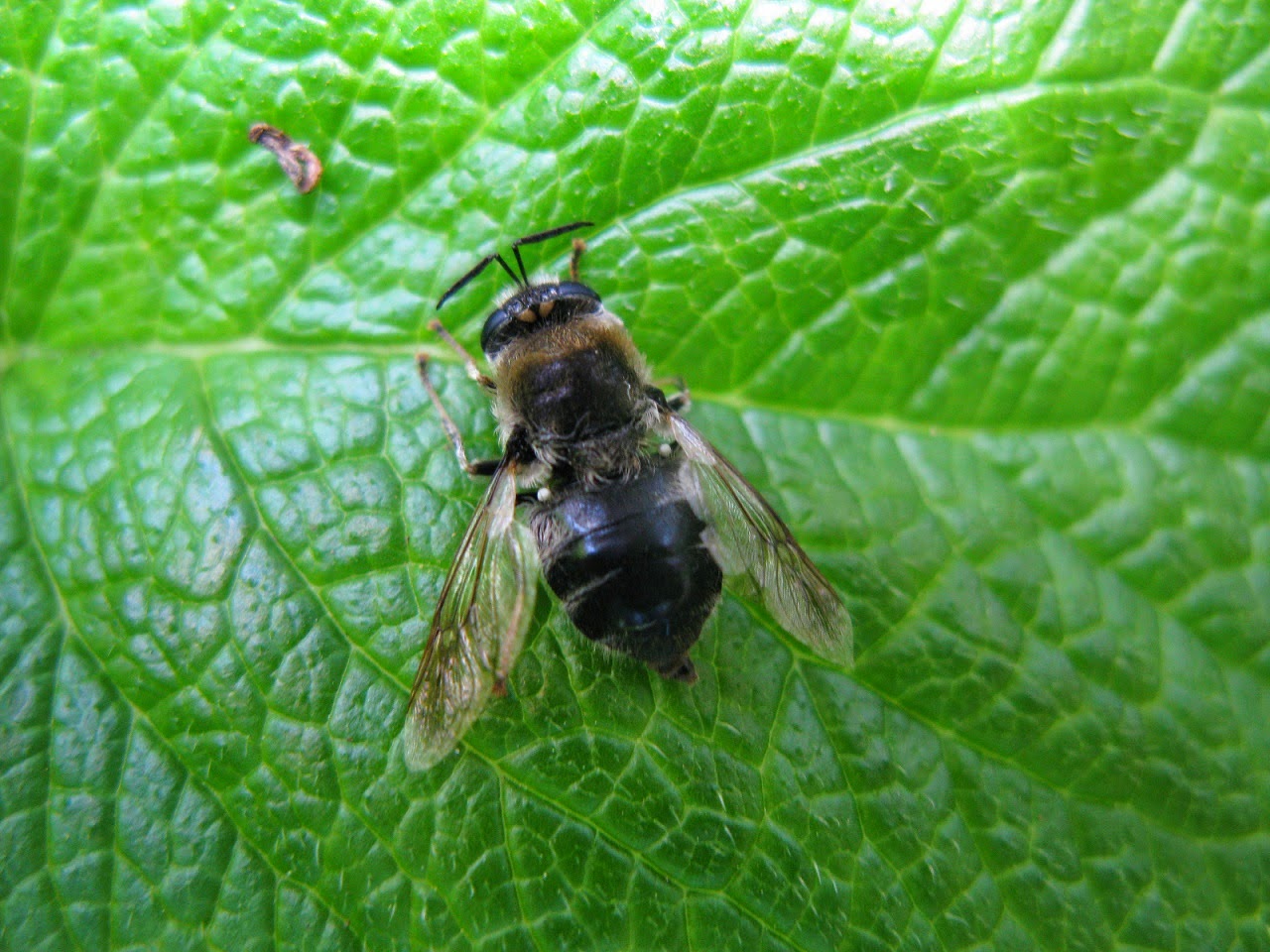
Entomologist Andrew Halstead was able to turn up some exciting species, including an extremely rare type soldierfly...

Stratiomys longicornis, also called the Long-horned General
It is a salt marsh specialist, so perhaps it hitched a ride from the coast?!
(Photo by Andrew Halstead)

And that was not the only Long-Horned beastie which Andrew managed to turn up!

Long-Horned Bee (Eucera longicornis)

I was particularly chuffed this charismatic little fella put in an appearance, as I'm going to be surveying for it through the summer. The organisation Buglife describe Long-horned Bees as only being present at a few dozen sites across the UK, mostly restricted to the coastline. This makes it yet another interesting find so far inland!
As the rain rolled in, we then shifted our focus onto the wetter species...

Fungi


Nick Aplin of Sussex Fungi Group, checking out microfungi with a hand lense

Nick was able to steal time out of his busy schedule for a scout along the River Mole, searching out the things we would most certainly have missed! His specimens (and photography) are quite exquisite... 

 Orange Bonnet Mycena acicula
(Photo by Nick Aplin)

Loving the name of this one...

Scurfy Twiglet Tubaria furfuracea
(Photo by Nick Aplin) 

Dock Rust Puccinia phragmitis is pretty stunning when viewed in macro. Looks almost Christmassy!
(Photo by Nick Aplin)

And for something even more bizaare, this fungus living on tree bark...

Hysteropatella prostii fruiting bodies on the left. Its ascopores are stained and here viewed under higher magnification on the right
(Photo by Nick Aplin)

Nick wants to check this one thoroughly, but this is potentially yet another new species for the UK! The above is just a tiny selection of Nick's 51 species, which is pretty darn good work for one day.

Aquatics

While surveying one of our amphibian ponds, no signs of of adult newts but some evidence of the Great Crested variety could be found...

Cranbrook Nursery pond

Great Crested Newt egg, laid on a Flag Iris leaf

Great Crested Newt Triturus cristatus larva or newtpole. only a couple of millimeters long at this stage

Tom Simpson and Kevin Lerwill of GGP lead the afternoon session of river kick-sampling

You don't always need to see the adult version of a beastie to know that it is present. Different life stages can also count as biological records, such as the larvae of Damselflies..

Kick sample of freshwater invertebrates, which need closer examination to get to species level 
Photo by Helen Cradduck


Sometimes, you can even trace back evidence of a species beyond the larval life stages...
.
The distinctive signature of the Willow Emerald Damselfly Lestes viridis - oviposition scars on the riverside Willow (where an adult female has laid eggs)
(Photo by Linda Pryke)

This species is a recent colonist to the UK, so I'll be keeping an eye on this spot later this season to try to glimpse an adult on the wing! Finally, our total number of species? Rose has counted well over 300 records with more being sent in to all the time, which means we have beat last year by a long shot! 

As this never ending blogpost actually comes to an end, I would like to say a huge thank you to Gatwick's Environment Team, absolutely everyone else who came along on the day, anyone who read this epic chronicle of a blogpost, and a special thanks to...


Tom, Kevin and Tom of the Gatwick Greenspace Partnershipwithout who these awesome events would not happen. Rest now lads, your work is complete.

Oh, alright then... One more bee pic for good measure.

Long-Horned Bee Eucera longicornis along the River Mole