Showing posts with label Varroa. Show all posts

Wednesday, 23 September 2015

Gatsbees B-Log: August 2015

Black-eyed Susan 
(Rudbeckia fulgida var. 'sullivantii Goldsturm')

By the time August arrives, the bees know for certain that winter is only around the corner

Runner beans (Phaseolus coccineus)

and the pantry must be full of honey and pollen.


I sometimes go to the apiary intent on doing ‘a job’ but occasionally I get there and the orderly haste I find persuades me to leave them alone and watch.


Much less stressful for all of us!


We found the queen in this colony (the one with the longer abdomen in the centre of the picture


and the peanut shaped cell from which she emerged (centred above the wooden bar)


We also found a text book queen cell torn open by the workers, where there is a dead queen larva, which would have been stung in its cell by the first queen to emerge. Queens have no barbs on their sting and so can kill more than one rival.

Cardoon (Cynara cardunculus)


It was at about this time when the weather changed for the worst; the bees were unable to leave the hive and forage


and nectar became a premium, one visiting the sedum, which had hardly begun to flower in the cold.


The rain began in earnest


And those bees still out foraging, chilled and died.


As I made the choice to not treat for varroa, one colony (although not at Gatwick) swarmed themselves out, couldn’t tolerate the viruses and were very sick. They become disorientated and unable to function and died out quickly but it’s difficult to watch and the temptation to throw medicine at them is huge.

 (Foreground: Bee with Deformed Wing Virus. Far right: bee with varroa mite on its thorax)

I found that treatments may kill the varroa mites, but the bees still become sick, albeit in different circumstances. Putting down a colony of bees is extremely dispiriting.


I’m sure that all beekeepers would love their bees to be hygienic; that is bees with the ability to recognise the presence of varroa mites in the cells, pull them out and eject them from the nest. This house bee is probably looking for mites on her sister, a good start and something we should try to look at in more detail next year. See Google: Swindon beekeeper Ron Hoskins

Peony (Paeonia) seeds

Creeping Thistle (Cirsium arvense)


One sunny afternoon, after Duchess’s colony became queen right again (had a laying queen) the workers began to evict the drones. They become a nuisance when they are no longer needed for breeding as they just hang around the hive eating the stores of honey.


It's a brutal event, with the workers trying to bite off the drones’ wings as they are forced out. It’s a one way ticket for a drone; die in glory if you mate with a virgin queen, die in the fury of the workers if you don’t.


You’ll be pleased to hear that wasps are useful in this world after all, picking up dead and dying insects to take back to the nest for their larvae to eat in spring and early summer, and receiving a sugary liquid in exchange, but now the nest will  have disbanded and it’s every wasp for herself.


At the same time, the ever neat and tidy bees are trying to pick the bodies up and fly away with them to drop them far away from the nest to eliminate the smell of death.

Other visitors to the hives:

(Balaustium spp.) A tiny mite regularly seen at the hives, it feeds 
on pollen and predates other tiny invertebrates

This nest of a Leaf-cutter Bee (Megachile spp.) is not part of the Honeybee colony

A brave choice of site for the nest of this Leaf-cutter bee, tucked in a gap between the roof and the crown board, crafted from rose leaves cut out with its mandibles and flown back to the nest.

Persicaria, agapanthus and verbena bonariensis.

Dahlia. 

Autumn is on the way. 

Gillybee X

Wednesday, 6 May 2015

Gatsbees B-Log: April 2015


Our local bee inspector called to check that there are no signs in our colonies already of these two tropical insects...

Small Hive Beetle (stolen from the internet obviously: ladepeche.fr)

...Small Hive Beetle, originally from Africa (Aethina tumida) and Tropilaelaps (a mite) from Asia, which are on their way to Britain and would cause havoc in the beekeeping industry.

The Beehive Gatwick

The Gatsbees apiary is part of a national scheme by The National Bee Unit, in which the beekeepers of apiaries close to borders, ports and airports where the insects may arrive, send samples to the NBU of debris taken at least twice a year from their colonies to check for evidence of these invaders.

Fencepost Jumping Spider (Marpissa muscosa)

One of our unofficial residents in the hives in Ashley's Field, and definitely my favourite, is the Fencepost Jumping Spider Marpissa muscosa, a great character which has 4 big eyes on the front of its head, 4 behind and it hunts by springing 50 times its own length onto its prey. I’m about to put some into training to eliminate the Varroa mites in my hives….

Varroa mite (1.5mm wide)

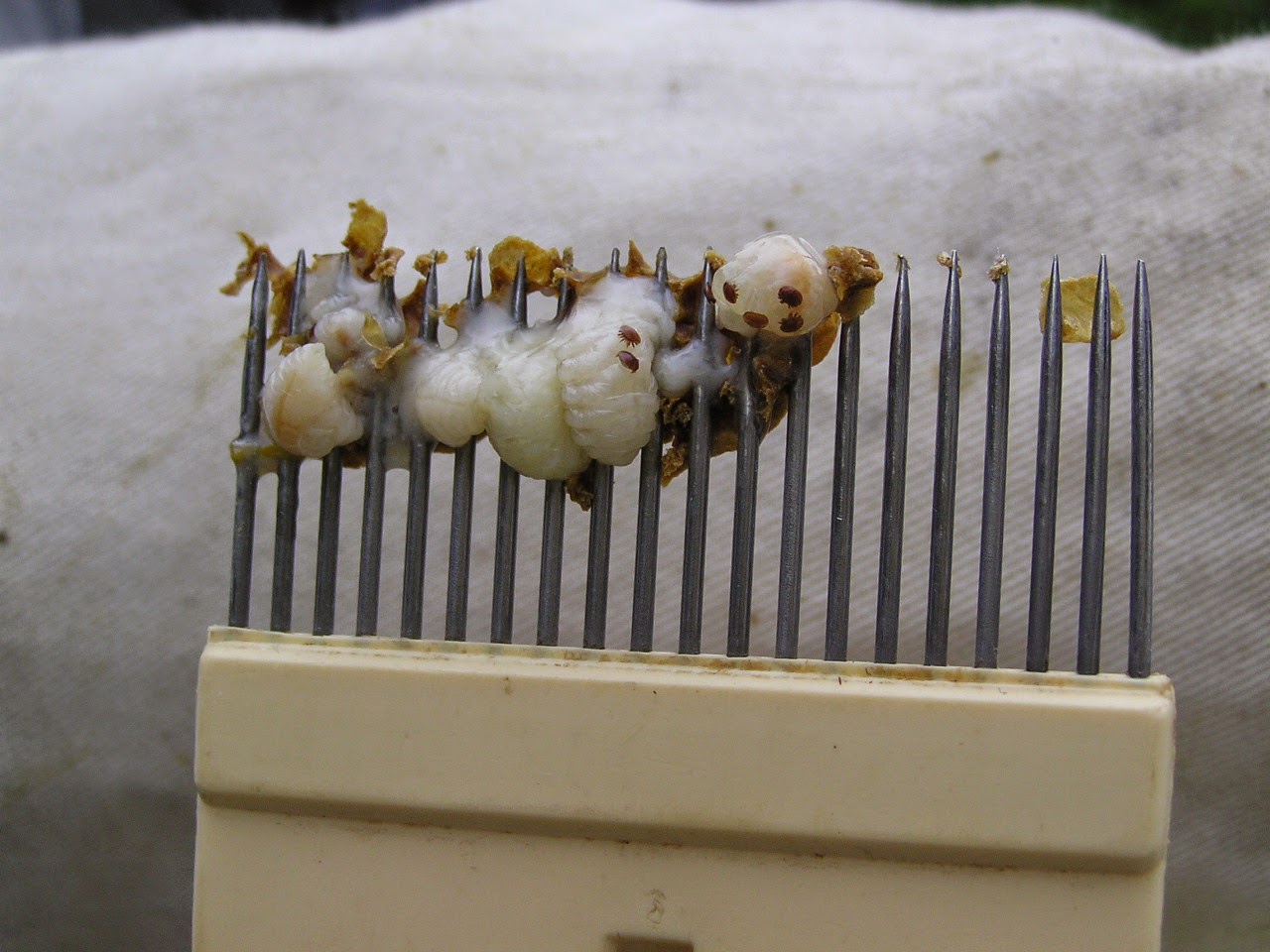
The appropriately named Varroa destructor arrived in Britain in the early 1990's and travelled across the country, spreading disease and changing the uncomplicated old ways of beekeeping forever. Imagine walking round with a cushion crawling around your body and you have an idea of the size of the mite and how inconvenient it must be.

Varroa on larvae pulled out of a cell

The Varroa reproduce in a cell on the frame in the hive. The mated female mite runs into a cell where there is a developing bee larva, shortly before the cell is capped over with wax. Then the mite lays eggs and the young mites feed on the blood of the pupa, mate in the cell and emerge into the colony with the fully developed bee to repeat the cycle.

Bee with Deformed Wing Virus

It’s not so much the mites which debilitate the bees, but the viruses that they inject into the bee’s blood as they feed. This bee has deformed wing virus, (one of 6 types of virus) which also bloats the stomach and renders them paralysed.

Give us more space!

All our colonies had DWV last year in varying degrees, but they all seemed to fly it off in the sunshine; or were there so many bees that we didn’t see the sick ones crawl away amongst them?

Heads in cells

So far this season, the deformed wing virus seems to be less prevalent but I had one colony out of 9 die out over the winter from sickness. When a colony is ill, the bees die off rapidly and there aren’t enough to keep each other warm or live within the bounds of the honey stores, so several bees had their heads in the cells, indicating that they were starving, when in fact, there was plenty of food.

The best way to get rid of diseased equipment.

Book Scorpion, Chelifer cancroides (Wikimedia Commons). Up to 4mm

Incidentally, the Beenature-Project in Germany which is studying the Book Scorpion has discovered, or rediscovered that associated with feral Honey Bee colonies (which often live in trees), are these tiny arachnids living in the cracks of the wood and feeding on the blood of the Varroa mite. Hope springs eternal! A great story, check it out - Beenature-Project. All those musty old books from your grandma’s attic can now be used to save the honeybee. Now, where’s that jumping spider………….

Camellia; blousy but simple enough for a bee to collect pollen.

Gill x

Wednesday, 6 August 2014

Honeybee freeloaders

Following Simpson's lead I've decided to have a try at this beekeeping thing. During a busy field season it means I get home even later, but on the other hand it is an excellent way to unwind.

The well-guarded hive entrance of the European Honey Bee (Apis mellifera). It is incredibly therapeutic to just sit and watch the comings-and-goings of  workers and drones.

We now have several hives which are packed to the rafters with honey and bee larvae, attracting a menagerie of predators and parasites. This means that during my new hobby, I still get to record new species!

Greater Wax Moth (Galleria mellonella)

The Greater Wax Moth is a new one for me; this individual met her demise in the top section of the hive (perhaps after being stung or balled to death by the workers). It lays its eggs on the waxy honeycomb, which then hatch into caterpillars and bore tunnels through the cells, feeding on the wax and other bee-substances. They can also burrow into the wood of the hive, so when present in high numbers they can cause a lot of damage to the structure.

I'm quite please with this pic. That red 'welt' on the top of the
abdomen is an individual Varroa Mite (Varroa destructor)

Varroa destructor is an apt name for this mite, indicating just how much beekeepers love them... Not only does this blood-feeding arachnid weaken the individual bees by sucking out their life-force, they spread several bee viruses and are incredibly difficult to contain. However, we do not intervene unless an infection is particularly severe. Symptoms can include stunted, scruffy, deformed wings and unsteady, drunk-looking bees. Having this mite must be like hanging out with your impulsive, booze-hound flatmate on a night out in town (not of course referring to anyone I live with right now).

 German Wasp (Vespula germanica)

Social wasps can be a right pain at this time of year (I need not tell). Attracted to the scent of the wonderful honey stores, as soon we lift the lid off the hive, then they appear, persistently pesky. They also scavenge the dead and dying bees from the ground around the hive; not such a bad thing in terms of good house keeping and removing infected individuals. This female German Wasp found a dying worker Honey Bee and set to it with her strong mandibles... There was an audible 'click' as she decapitated it!

Fencepost Jumper (Marpissa muscosa)

It seems that almost every time we start a check of the hives, a Marpissa jumping spider will pop out onto the side to see what all the fuss is about. They probably just use the hives as a well-defended shelter and are unlikely to bother the bees. Perhaps they love the sweet smell of honey and cedar wood as much as we do.

Beekeeper (Homo sapiens)

Of course, not forgetting those ultimate freeloaders! Which reminds me, it is about time I enter my first record for Homo sapiens into iRecord... Egotistical perhaps to submit myself as a specimen?

Nom.