Guest post: Brad Scott (Sussex Botanical Recording Society)
How many mosses and liverworts might you expect to find at Gatwick Airport? Surely it is hardly a rich space for these small plants; at first you'd think of tarmac, concrete and some marginal areas, none of which harbour that many species. However, the Gatwick estate is blessed with some nice, varied habitats and once you start looking it is surprising what turns up.
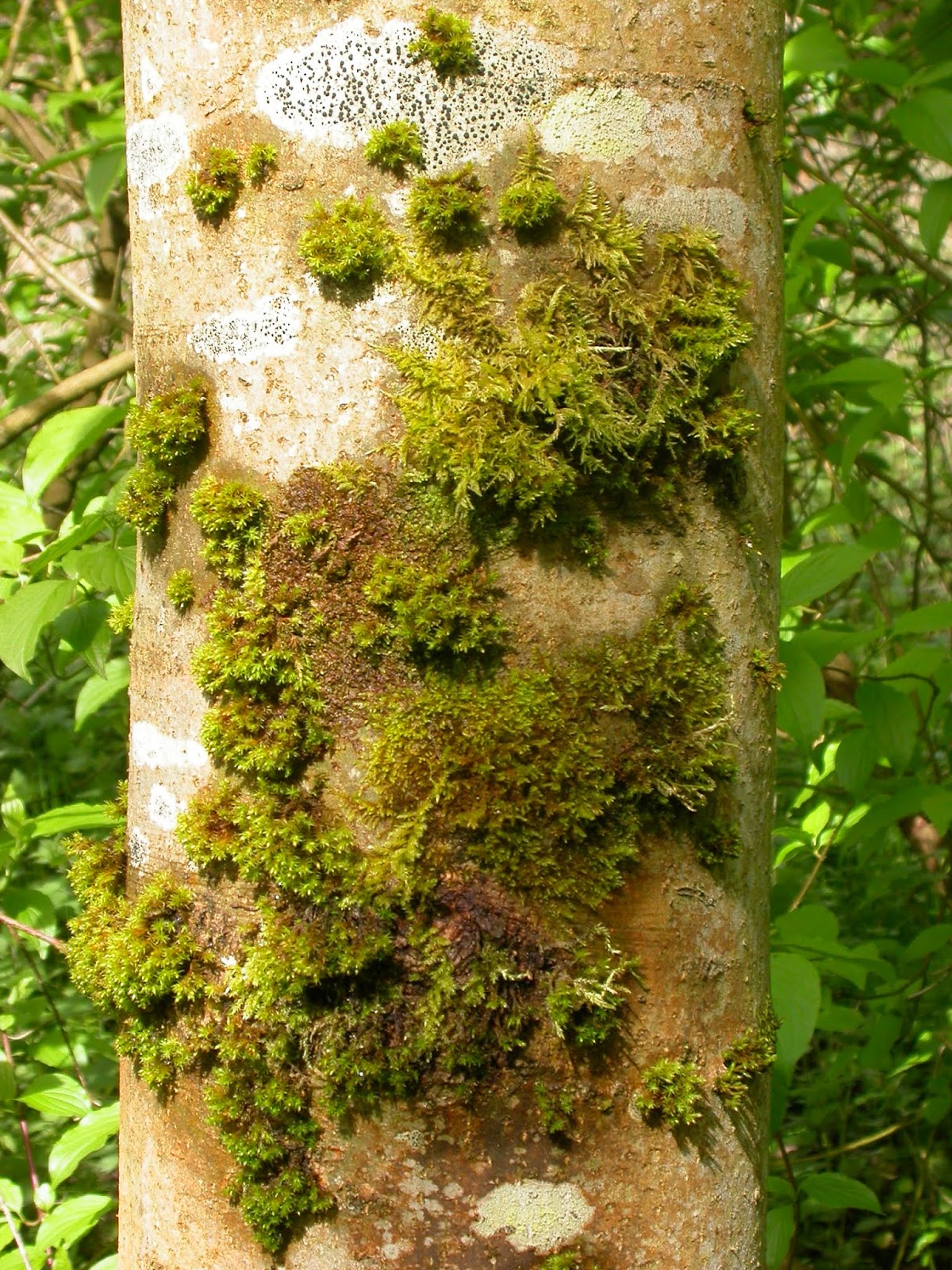
Rich epiphytic community on Ash
But before we look at what is there, why might we want to look at mosses and liverworts at all? Collectively, they are known as bryophytes and there are just over 1000 British species, which is about 60 per cent. of the entire European bryophyte flora, so these islands we live on are extremely rich in this plant group. Maybe half of the UK list has been found in the south east, so even in these drier counties there is quite a diverse range of plants.
Many bryophytes are quite specific to a particular habitat, so they are very important in helping botanists define the vegetation group that occurs in any given place, not least since they occur in all habitats and can be completely dominant in some spots. Furthermore, bryophytes are great at colonising areas, which can result in the build-up of very thin soils around them, and then providing habitat for other plants and tiny animals. Once you start looking within the mossy world you can find an astonishing range of very small organisms, which is at least as complex a habitat as any woodland, though not nearly as well studied or understood. Finally, these plants are sensitive to changes in their environment, so are useful as indicators of habitat change.
Orthotrichum pulchellum
I'd done occasional casual recording in some of the woods and other areas around the airport during various Gatwick wildlife events over the last few years, which had showed that the area looked quite promising, but had not done any systematic recording, so it was great that Rachel asked me to visit and spend some time exploring.
Now, Gatwick is in the modern administrative county of West Sussex, but for recording purposes it is in the old botanical vice-county of Surrey, and the vice-county boundary runs along Radford Road at the south of the site. It is also a corner of the county which had very few bryophyte records. This survey focused on the part of the Gatwick estate known as the Land East of the Railway Line; it is on the Weald Clay, and includes several woods, some of which are Ancient Woodland, and large areas are somewhat wet, which is what mosses like. In the end I made three visits, the first accompanied by Luśka, who has a good eye for finding tiny plants.
Recently-disturbed banks of the Gatwick Stream have several small colonisers. The green clumps in the stream are Cladophora, an alga
Other than the woods, the site also contains the Gatwick Stream. This area has been considerably disturbed in recent years, with major earth movement and other work to provide an area to ameliorate any flood risk, and also to minimise the likelihood of attracting large numbers of wetland birds, which are a major danger to aircraft. This means that large areas have been newly-colonised by bryophytes before larger vegetation moves in. Even the gravelly soil by the gate can accommodate several species which, since mosses are desiccation-tolerant, can manage to live in places where most vascular plants can't.
The most disturbed areas, including the gravel car park and the sandy soil near the stream, commonly have
Barbula unguiculata and
Bryum dichotomum with
Ceratodon purpureus,
Pseudocrossidium hornschuchianum,
Kindbergia praelonga and the relatively uncommon
Didymodon tophaceus. Recently-constructed banks may host
Dicranella schreberiana,
D. staphylina and
D. varia, and disturbed gaps among the grass contains
Funaria hygrometrica. The small amounts of woodland near Gatwick Stream are relatively poor in bryophytes compared with the other wooded parts of the site, and tend to contain only small quantities of some of the common species. Even so, a small amount of the epiphytic
Ulota phyllantha is present, and a tiny patch of the usually saxicolous
Grimmia pulvinata on Oak was the only occurrence of this very common urban species within the Action Plan boundary.
One of Britain’s commonest mosses, Kindbergia praelonga, in Upper Picketts Wood
Unsurprisingly, Upper Picketts Wood has a somewhat different flora. Epiphytes include
Frullania dilatata, Homalothecium sericeum, Hypnum andoi, Hypnum cupressiforme var. cupressiforme and
var. resupinatum, Isothecium myosuroides, Metzgeria furcata, M. violacea, Orthotrichum affine, O. pulchellum, and
Radula complanata, plus the tiny liverworts
Cololejeunea minutissima and
Microlejeunea ulicina; none especially rare, but a typical woodland assemblage. The banks are home to
Mnium hornum, Pseudotaxiphyllum elegans, Atrichum undulatum, Fissidens bryoides, Dicranella heteromalla and the liverworts
Calypogeia arguta and
Cephalozia bicuspidata, and rotting logs have both
Lophocolea bidentata and
L. heterophylla. The wetter parts of the woodland floor have mats of
Thuidium tamariscinum and occasional
Plagiomnium undulatum.
Cololejeunea minutissima with its five-pointed perianths
At the entry point to the wood from the parking area by Ashleys Field there is a small wooden bridge; when this was visited in 2015 after some work had been carried out there, the disturbed ground had a small population of
Ephemerum minutissimum; this is no longer present as larger vegetation has taken over.
The tiny Ephemerum minutissimum in 2015
Now partly wooded, the grassy area of Goat Meadow is decidedly wet and knitted with
Calliergonella cuspidata and abundant
Rhytidiadelphus squarrosus. Its woodland species are fairly similar to Upper Picketts Wood, though there are some additional taxa along the wet ditch at its border, such as the liverwort
Chiloscyphus polyanthos, and
Lunularia cruciata occurs occasionally on the wet woodland floor. The north-west corner of Goat Meadow contains a large old Willow, which has a fine array of epiphytes, including
Cryphaea heteromalla, Zygodon conoideus, Metzgeria violacea, Orthotrichum pulchellum, and
Ulota bruchii.
The great old willow with luxuriant epiphytes
Moving from here towards Lower Picketts Wood we find what is arguably the nicest bit of the site, bryologically. A patch of relatively young Ash is very rich in epiphytes, with frequent
Cryphaea heteromalla, several patches of
Ulota phyllantha and a variety of
Orthotricums:
affine; pulchellum; and
lyellii. One patch of
Syntrichia papillosa was also found on one of these trees. A wet, muddy hollow just before Lower Picketts Wood contained a small amount of
Brachythecium rivulare.
Copious brown gemmae on the relatively large moss Orthotrichum lyellii
Syntrichia papillosa, with its band of green gemmae down the middle of the leaf
At first sight there are few bryophytes in Lower Picketts Wood
On the face of it, the Ancient Woodland that is Lower Picketts Wood is much more botanically uniform than the other woods, yet has a similar number of bryophyte species compared with the others. However, on the whole they are less frequent. Epiphytes include
Zygodon viridissimus and a little more
Ulota phyllantha, and the wetter area is coated with abundant
Thuidium tamariscinum. A small stream enters the site in the north-east corner of the wood, and is the only location so far found for the common woodland species
Polytrichastrum formosum, along with
Calypogeia fissa and
Dicranella rufescens on the soil by the stream. A small amount of
Plagiothecium nemorale was also found on the damp woodland floor with
Fissidens bryoides.
Ulota phyllantha with brown gemmae on its leaf tips
Tortula truncata
Moving from the wood towards Horleyland Wood, Pond 4 had a
Crassula helmsii problem several years ago, which has now been resolved. While that work was being undertaken, much of the surrounding vegetation had been suppressed and when the site was visited in 2015 the ephemeral colonisers
Tortula truncata and the liverwort
Fossombronia wondraczekii were frequent. Neither are now present as other plants have moved in.
The liverwort Fossombronia wondraczekii with its black sporophytes in 2015
The characteristic spores of Fossombronia wondraczekii
Just outside the Action Plan area boundary there are grassy slopes and a gravelly track. This area includes several species that are infrequent or not present elsewhere on the site, such as the concrete assemblage:
Bryum dichotomum, Didymodon insulanus, Didymodon nicholsonii and
Barbula unguiculata. Other man-made habitats provide additional spaces for other common taxa, such as
Bryum argenteum on a thin layer of soil on a manhole cover,
Orthotrichum diaphanum and
Tortula muralis on a concrete post, plus
Barbula convoluta,
Ceratodon purpureus,
Didymodon fallax and copious
Marchantia polymorpha on the gravel around the power unit. Bright green patches of
Pseudocrossidium hornschuchianum were also found on some soil on gravel, and a few small tufts of fruiting
Bryoerythrophyllum recurvirostrum were on an old Willow near Pond 3.
Bryophytes on concrete and a manhole cover
Horleyland Wood
Horleyland Wood, the final parcel of Ancient Woodland, also has a fairly typical collection of species and includes
Eurhynchium striatum on some banks, and mats of
Isothecium myosuroides at the lower parts of many trees. Around Pond 2 the wet woodland floor has abundant
Thuidium tamariscinum, along with
Calliergonella cuspidata, Didymodon insulanus, Pellia epiphylla along the pond edge. Also by the pond,
Zygodon conoideus is epiphytic on Willow,
Leptodictyum riparium occurs on some roots by the water, and
Pseudoscleropodium purum is common among the brambly scrub, its only known location in the survey area.
In total, 79 taxa were recorded across this part of the Gatwick estate, which is a typical number and range of species for a site of this size on the Weald Clay. Many thanks to Howard Wallis, the Surrey bryophyte recorder, for his support and providing useful background information.
Brad and Luśka, Gatwick's woodlands April 2018