Showing posts with label Biodiversity Benchmark Award. Show all posts

Wednesday, 10 December 2014

Gatwick Airport wins The Wildlife Trusts Biodiversity Benchmark Award

We've done it!!!


This award means that Gatwick Airport has been formally recognised for protecting and enhancing its landholdings for wildlife, including some areas of remarkable biodiversity. Many challenges have been overcome regarding habitat management around such a busy aerodrome, but we have shown that where there's a will, there's a way for humans to work with nature.
   Winning this award has been a collective effort, bringing together many different people from the airport and wider areas, combing skills, knowledge and a passion for wildlife. There are so many to thank and our list of all those involved continues to grow. The group photo below is from the wildlife recording event we hosted back in summer 2014, which includes a very small subset of those working behind the scenes. Just to say a huge THANK YOU to absolutely everyone over the years, whatever the capacity of your involvement.
   Here's to the future of Biodiversity at Gatwick!

Gatwick Wildlife Recording Day - August 2014

Sunday, 23 November 2014

Desk-bound days

Location: JSA portacabin, base of the Old Control Tower
Crew: 1
Contract: 2.5 years to date


I might be embellishing slightly, but these past couple of weeks have been pretty flat out; entering a backlog of data, carrying out analyses and updating the networked drives ready for Gatwick's main Biodiversity Benchmark audit this week.

 In 'Moon', Sam's computer would talk back to him and made him tea

A Biodiversity Benchmark audit is a full-on 2 day assessment by The Wildlife Trust, covering everything from monitoring methodology, staff training and communication, management systems, data tracking and analysis to the action plans themselves. With help from Hannah and Karen in Gatwick's Environment Team (plus the GAL I.T Helpdesk), I've been sorting/syncing all of Gatwick's biological data and old ecological reports together onto the one network, sometimes using three different laptops at once.

Oh gahd not the fish

The Biodiversity Benchmark Award comprises of stringent rules and requirements (as it should), which are continually refined and updated making it a rather more involved process than it first sounds. It is given to encourage big business to perform better with long-term land management practices, thus proving a continued environmental commitment.

Plus some other reasons.

Thankfully on Friday, I had a brief interlude from my own data underworld to attend the National Biodiversity Network Conference (for which I'm very grateful to Penny Green at the Sussex Biodiversity Records Centre). Here we learned what happens to the UK's biological data (and places beyond) through inspirational talks given by some fascinating speakers. Charles Roper's 'speed-talk' on Open Data particularly stood out for me; the incredible power of the world wide web, how far we have already come and the future possibilities of data sharing.

The bigger picture: an intricate web of linked datasets as tracked by Charles to date

As if I needed more proscrastination fodder, I then found Charles' awesomely-written article for Adastra 2014, the Sussex Biological Recording annual reviewThe Future of Data Sharing

Anyhoo, once this audit is all over with I'm straight back outside to dig/saw/chase/record something. Will let you know of the outcome as soon as we know!

Monday, 3 November 2014

Not quite tree surgery


In the past few weeks, a group of arboriculturalists have injected some extra zeal and energy into our project, helping carry out some habitat enhancements in the North West Zone. The team from Roots Upwards Ltd, led by Matt and along with their own ecologist Ben, even gave up some of their precious weekend to move bat boxes in Brockley Wood.

Martyn Cooke from Surrey Bat Group and tree climber Adam scouting for boxes


Shinning up the tall oak trees in Brockley Wood is no problem for these guys, and Adam carefully checks each box for occupancy before they are cleaned out and re-hung on the tree. In the last box he was treated to an unexpected 'Close Encounter of the Fuzzy Kind'...

Adam: "Hang on a sec... there IS a bat in here..."

"Hey, lads! Ahh, you alright lads?"
Natterer's Bats (Myotis nattereri)

I love witnessing encounters like Adam's; it's so rare to see an animal like a bat close up like this and a privileged moment. Martyn identified this cosy bat cluster as a group of Natterer's Bats (though it probably consists of a few ladies as well as lads). After taking these pictures for us, Adam carefully closed the box back up and left them to their daytime snoozing.   
   Another great help has been ecologist Ben; boosting our wildlife records for this site, ensuring disturbance is minimized during the essential works, then overseeing some extra habitat enhancements:

Foundations of  a beetle bank; ready to be finished off in spring with a cap of top soil and seed 

On top of the scheduled habitat works I oversee with J S Agriculture, Tom Simpson and guys like these contribute a heck of a lot to the project, adding another string to our bow as we shoot for the Wildlife Trust's Biodiversity Benchmark Award (our main audit is happening at the end of this month!) 

Brash piles securely staked high up on the floodplain, providing extra cover for wildlife where clearance works have taken place

Who ya gonna call? Matt of Roots Upwards

At the end of a rather extended summer, we are off to a flying start with the 3rd year of autumnal conservation works. We have more habitat enhancements coming up from JSA, an intensive Harvest Mouse survey with Surrey Mammal Group and Mr Simpson's conservation schedule is quickly filling up. So you better drop us a line soon if you want to get involved!

Wednesday, 4 December 2013

November Summary

Judge Dredge: Our digger driver Scott re-profiling a small channel of the River Mole

November has been as wonderfully wet and variable as was predicted (and still we moan and groan). The beginning of the month saw Winter Thrushes and Fungi surveys, with some ace discoveries such as the entire skeleton of a Grass Snake and a sneaky Woodcock in the wet woodlands. Also, Redwing and Fieldfare can be heard in the hedgerows and surreptitious fungi found in almost every nook and cranny.

Yellow Brain (Tremella mesenterica), on a log pile in the North West Zone

I've had a busy time at my desk writing up this Summer's work - entering data, updating task trackers, two Biodiversity Action Plans and preparing for a Bio Benchmark internal audit. Karen from Gatwick's Environment Team visited our sites in the North West Zone, taking a close look at our protected species habitat works. This has resulted in some revised habitat targets for this winter and some exciting new surveys planned for the spring!

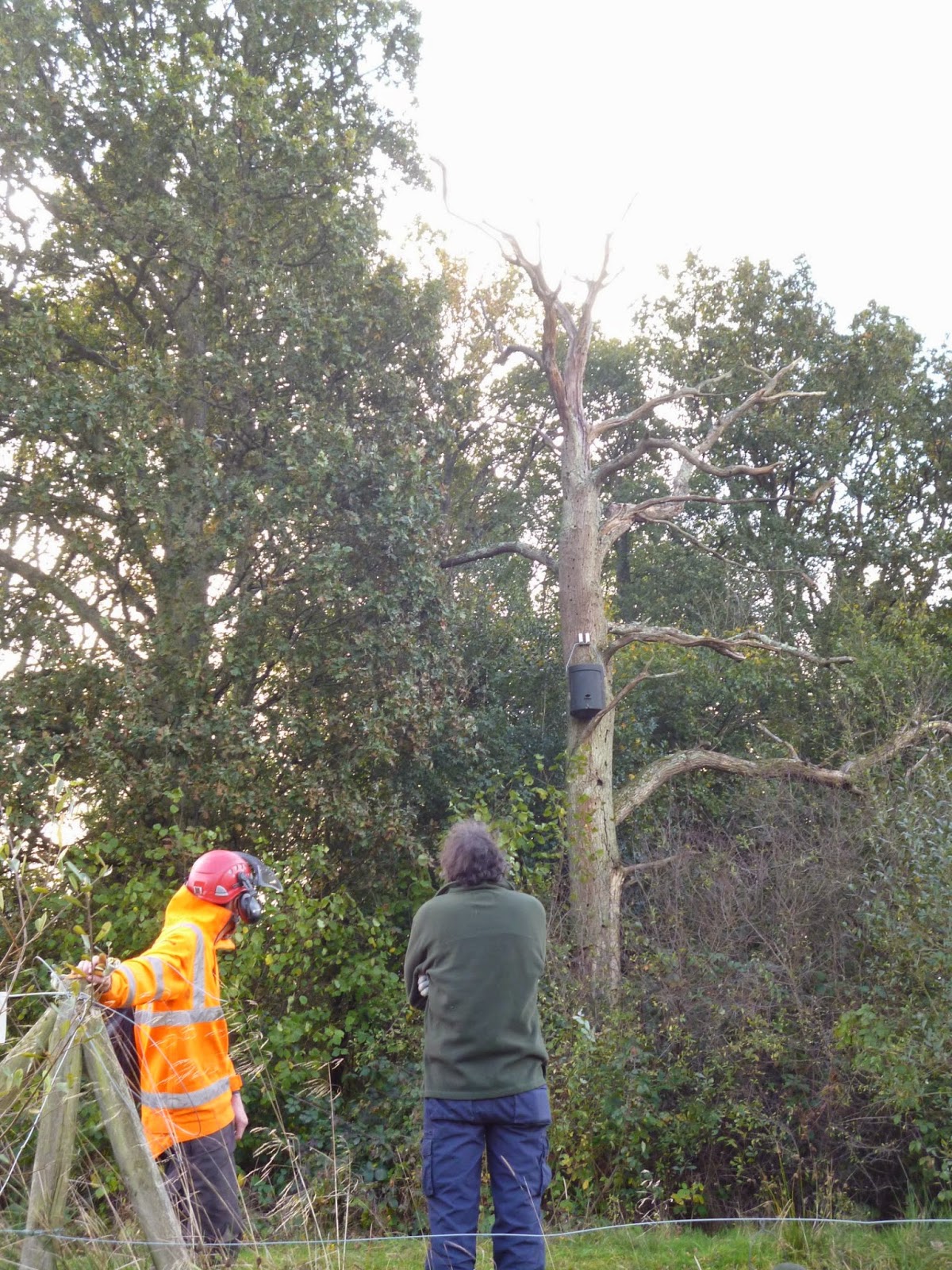
Bat roosting box 1: Outskirts of Brockley Wood, North West Zone

In terms of habitat conservation, JS Agriculture recently opened up a side channel on River Mole which had become obstructed with woody debris. Clearing this channel has allowed faster flow around the willow scrub, reducing the effects of over-silting.
   Gatwick Greenspace Ranger Tom Simpson has had a busy couple of weeks with various meetings and courses; when you coop-up a ranger it inevitably results in pent-up energy and zeal to get out for heavy duty works! He put me and our volunteer Josie to work, removing large and sickly Birch trees in Upper Picketts Wood and opening up an area to reinstate a traditional Hazel coppicing regime.

Josie from External Security demonstrates a 'gob cut' on a Birch tree. Or a 'face cut'. Or is it a 'bird's mouth'? Basically it's a wedge of wood.

She finishes the job with a 'felling cut'

Birch tree smack-down

Ex-Birch is now a habitat pile in Upper Picketts Wood

Just last week, I travelled many, many meters to Mickleham in Surrey for some RiverSearch training with Surrey Wildlife Trust volunteers. This brilliant initiative is being rolled out to encourage people to champion their own section of a local rivers. It enables them to record habitat features, recognise problems such as invasive plant species and identify where intervention might be needed. Surrey Wildlife Trust is working with the Environment Agency on initiatives such as RiverSearch to improve the health of the county's freshwater habitats. I'm really looking forward to getting stuck in with surveying Gatwick's main waterways.

Volunteers from Surrey Wildlife Trust being watched by a nosy young bullock.
Luckily no one was wearing red so we - oh wait...

As I am going to be spending a bit more time indoors, I'll be sharing a few of my desk-top discoveries. After trawling through some arachnid photos from over the summer, I found this prettily-patterned specimen, belonging to the jumping spider family (Salticidae). I had unknowingly snapped the notable spider Marpissa muscosa; a rather scarce species throughout Britain, although it may be fairly common to this locality.

 Marpissa muscosa - Not the best picture as I only had my camera phone on this day

Finally, here's something particularly awesome - the dried specimen of a captive-reared Death's-head Hawkmoth (Acherontia atropos). This is not something you get to see often in the wilds of Britain... although it just so happens I was lucky enough to see a live one with Tom Forward in 2012! You can read about our star find here: http://biodiversitygatwick.blogspot.co.uk/2013/07/death-on-swift-wings.html

Views of Acherontia atropos - This is a couple of years old so missing a few limbs

Many thanks to Paul who gave this to my mum at the Royal Oak Pub (she was pleased by the way!) I have now passed it on to my fella who teaches a class of Year 4 students; wish I could be a fly on the wall when the class sees this!
   Coming up in December: Harvest Mouse nest searches, hard-core Winter Bird surveys and more conservation works, this time focusing in the North West Zone.

Sunday, 10 February 2013

An introduction to Gatwick’s Greenspaces...

Gatwick Airport, its boundaries and our two main zones of conservation focus

Gatwick Airport is its own thriving town or city; just ask anyone who works here. It also happens to be an island surrounded by the beautiful Sussex and Surrey countryside; a very rare position for such a large specimen of airport... If you take an OS map you may be surprised by the amount of undeveloped land which exists here, also the number of public footpaths passing through habitats such as woodland, grassland, floodplain meadow and wild ponds. With such a range of habitats the resulting variety of wildlife is quite astounding, and seemingly unperturbed by busy air traffic. I am continually updating Gatwick’s wildlife records database which we began in summer 2012 (anyone who enjoys a spot of data entry do drop me a line) and I am excitedly anticipating what we might find each season. These records are shared with our local biodiversity record centres which collectively hold copious information on the species and habitats of the UK.

River Mole North of the runway

Our ultimate goal is to protect and improve what we can in terms of the existing natural habitats and species diversity on Gatwick landholdings. Over the decades Gatwick Airport has become ever busier, but equally people have been working ever harder to preserve its greener zones. Thanks largely to volunteers from the Gatwick Greenspace Partnership, the British Airways Engineering volunteers, the Sussex Wildlife Trust, helpful individual naturalists and the companies JS Agriculture Ltd and Ecology and Habitat Management Ltd, we are now making a concerted combined effort to achieve The Wildlife Trust’s Biodiversity Benchmark Award. 

                                Grassland and woodland habitat along the River Mole