An introduction to the invasive plant Himalayan Balsam (Impatiens glandulifera), found along the River Mole at Gatwick.

Thoughts and experiences of ecologists and conservationists working at one of the UK’s busiest airports
Showing posts with label himalayan balsam. Show all posts
Showing posts with label himalayan balsam. Show all posts
Monday, 5 October 2020

Thursday, 29 October 2015
Gatsbees B-Log: September 2015
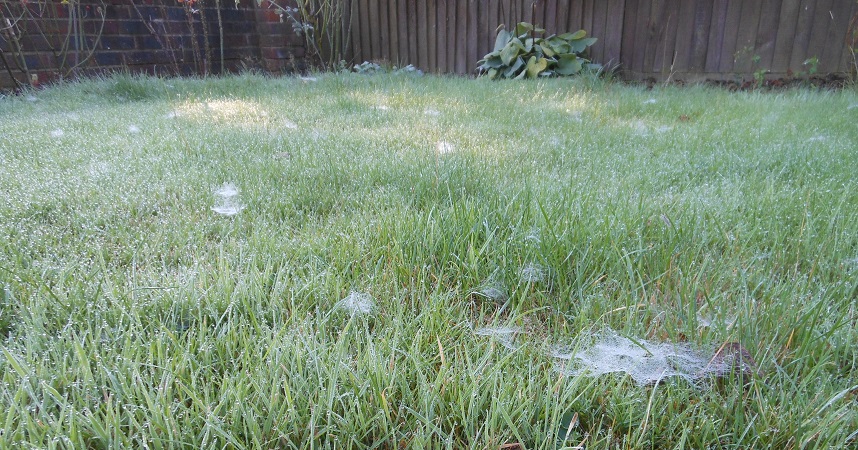
Money Spider (Linyphiidae)
September brought cold nights and tiny, immaculate spider’s webs in the grass

They are still throwing out unwelcome visiting wasps...

and are bringing in nectar and pollen from Himalyan balsam, Impatiens glandulifera. It begins to flower in July, is highly invasive, and is the tallest annual plant

with seed pods which burst, spreading them far and wide.

Beekeepers have a system for marking queens on their thorax with a coloured pen to denote which year they were born,

A small pink dot remain's from last year's marking
but generally I prefer to leave them unmarked so that I look for more than just a queen with a dot on her head. How influential are those that impress us first with their teaching!

Contain her, don't squash her!

It’s been good practice too for Tom and Rachel to find unmarked queens and now they are good queen spotters, it’s useful to mark one or two in the larger colonies. Job done!

Can you spot the queen? Answer next month...
It’s not easy to see queens amongst the 50,000 workers in summer...

unless she’s a big 1st or 2nd generation of commercially produced stock. As they interbreed with local drones, the queens get smaller. I look for a bee with long legs and a spidery walk, especially in the brood area where I’d expect to find her. Hope, not expect.


a retinue of worker bees surrounding her, exchanging food and pheromones with the queen, which over 24 hours, informs all the workers that the queen is still there.

Trophallaxis
They in turn pass on the pheromones to each other, called trophallaxis.

Hawthorn (Crataegus monogyna)

Blackening Waxcap (Hygrocybe conica)
There are fairies at the bottom of the garden.
Fuchsia

They fill every nook and cranny with comb in a nectar flow in the summer

so there was a bit of housekeeping to do where the girls had built comb in an area of the hive without a frame.

They were quite calm while we cut it out

but there was surprisingly little food in it due to the wet and cold August, so we’ll have to make sure they have enough stores for the winter.

Forest Bug (Pentatoma rufipes) on hive lid

Gillybee x
Tuesday, 26 August 2014
A Summer Summary
It's been a very busy summer so sticking with Rachel's trend of timely blogging, I
decided to wait til the Himalayan Balsam had started to
go over before kicking off the waders and getting back into the office to
contribute to the blog. When you see the
amount we've achieved in the last few months I think you'll agree that it was
worth the wait!
Himalayan Balsam’s dependence on river systems for seed
dispersal means that low-lying areas like Gatwick Airport
A little over a week later, volunteers from Southern Gas
Networks took up the mantle in Horleyland Wood where Balsam had taken up
residence in dense patches under the woodland canopy, encroaching from the
adjoining Gatwick Stream and sewage treatment works. The following day
reinforcements arrived in the form of GGP’s youth rangers. They set to work
with boundless energy, pulling back more valuable habitat from the Balsam’s
clutches.
We proceeded carefully, using scissors and secateurs to
carefully snip all of the seed pods into bin bags before ripping out the
remainder of the plant. Six bin bags of seed were removed and prevented from
entering the catchment that day.
As you can see from the map below we have made a big impact this year, and its all thanks to the fantastic work of our ever-growing volunteer network. All our volunteers have proved willing and able and always up for a challenge.

We’ve been re-surfacing woodland paths, creating new
habitats in the form of bug hotels and reptile hibernacula, not to mention
keeping up with the Great Gatsbees – our thriving Honey Bee population. As
always, however, one of the most important jobs has been trying to control the
spread of Himalayan Balsam (Glandulifera impatiens) across Gatwick’s
conservation zones and beyond.
This impressive plant can grow up to eight feet in a little
over sixteen weeks, using an explosive mechanism in its seed heads to disperse
seeds far and wide, before spreading quickly to dominate river banks, displacing
native flora in the process. If you’d like to find out more, there’s a helpful
article on the Sussex Wildlife Trust website here: http://www.sussexwildlifetrust.org.uk/blog/2014/07/greenspace-invader/
 | |
| Himalayan Balsam in flower |
After much deliberation (and some blindfolded pointing at a
map), we decided to begin our battle at Povey Cross in the North
West Zone with a team from Gatwick Airport
.jpg) |
| Engineering and Asset Integration with Balsam casualties at Povey cross |
 |
| Southern Gas came ready for action with matching overalls. |
.jpg) |
| Youth Rangers at Horleyland wood, accompanied by one slightly less youthful ecologist. |
By early July it was time to call in the elite squadron and
GGPs weekly volunteer group got to grips with the Balsam in Riverside Garden Park
A final sweep of Riverside
was carried out by a group of EDF office staff who came all the way from London
 |
| GGP Volunteers tackle towering Balsam at Riverside |
 |
| EDF's London team at Riverside |
As you can see from the map below we have made a big impact this year, and its all thanks to the fantastic work of our ever-growing volunteer network. All our volunteers have proved willing and able and always up for a challenge.
But as I said earlier, it hasn’t been all about Balsam this
summer. I’d like to say a heartfelt thank you to everyone who has turned out to
help with our many projects. And just to prove it, here are a few more
pictures.
And finally, the Insect Hotel has been slowly coming together over the summer with the help of Donald and Peter.


 |
| UK Power Networks and the huge pile of rubbish they cleared from Horleyland pond back in April. |
 | ||||||
| Dave and Stefan "discuss" how best to lay geotextiles while building a footpath in Upper Pickets wood. |
 |
| Rachel's mum, Sue and ecologist Natalie get the job done with a little less "discussion" (I'm not sure who that slacker is trying to sneak into shot) |
 |
| Another gang from UK Power Networks turned out in force in June, working competitively on woodland and grassland footpaths |
Not long until our programme of autumn works starts up again!
Friday, 26 July 2013
Gatwick's Alien Invaders
A battle is being fought all around Gatwick Airport... Aliens landed here quite some time ago, but together JS Agriculture and Gatwick Greenspace Partnership have plans for defeating these invasive species!

American Signal Crayfish (Pacifastacus leniusculus)

Signal Crayfish burrows in the bank and Himalayan Balsam growing along
a section of the River Mole at Povey Cross
An important part of our Biodiversity Action Plan is to monitor the presence of non-native species occurring on Gatwick's land and to come up with plans to tackle them. As they have been established in our countryside for quite some time they are virtually impossible to eliminate, so instead we aim to control them as best as possible, reducing their impact on our native flora and fauna.

Bucket 'o' crays: They have reached plague proportions in our part of the River Mole.
We humanely euthanise them under instruction from the Environment Agency
We humanely euthanise them under instruction from the Environment Agency

Tiny wee Signal Crayfish from the River Mole
The American Signal Crayfish (Pacifastacus leniusculus) was introduced to Britain in the 1970's and escaped from fish farms into our waterways. Having witnessed the size and quantity of their tiny larvae I'm not surprised they did! They are tough little pioneers and easily colonised our waterways; unfortunately they carry a disease which our native White-Clawed Crayfish (Austropotamobius pallipes) is vulnerable to. As a result White-Clawed Crayfish are now pretty rare and highly protected in areas where they still remain.

Our licensed crayfish traps with fish bait.
Signal Crayfish have a voracious appetite and eat whatever they can get their claws on, be it aquatic plants, fish fry or invertebrates. They also burrow deep into river banks which causes destabilisation, erosion and eventually bank collapse. By trapping them on a section of the river and reducing the number of large, voracious adults I hope to see a positive effect on the aquatic biodiversity.

Gatwick Greenspace volunteers Adrian and James removing Himalayan Balsam;
waders are not such a bad job on a hot summers day
Another problem alien here is Himalayan Balsam, which was introduced to Britain in 1839 as an attractive ornamental garden plant. It is a rapid coloniser, spreading along our waterways, growing very tall and quickly out competing our native flora. It has impressive pink flowers which are a good nectar source for bees and other pollinators, but perhaps at some cost to our own native wildflowers.

Himalayan balsam (Impatiens glandulifera) in flower

The root of the problem: the fleshy roots die back each winter, meaning the soil is left loose and exposed. This however does mean it is easy to pull up.
The seed pods are pressurized, popping open at the lightest touch, scattering seeds into waterways which are then carried far and wide. The roots of this plant are weak and die back each winter, resulting in exposed mud which then erodes easily away .

Gatwick Greenspace volunteers are all-weather people with the correct gear, precautions and an ample supply of refreshments (I can testify to their high-standard biscuit selection!) On one of the hottest days of the year, they tackled a good length of the River Mole around Povey Cross, pulling up every individual balsam plant they could find.

Balsam is heaped into piles to rot down before it has flowered and seeded

Volunteer Georgina with a near full-grown Signal Crayfish

Gatwick Greenspace Partnership conservation volunteers at Povey Cross, North West Zone

The JS Agriculture team, balsam-bashing in the southern part of Horleyland Wood,
Land East of the Railway Line
We are continuing the fight against Gatwick's invaders for the next few weeks. If you interested in volunteering and conservation around Gatwick then check out the website for Gatwick Greenspace Partnership, part of the Sussex Wildlife Trust.
Subscribe to:
Posts
(
Atom
)