Showing posts with label dormouse. Show all posts

Tuesday, 16 September 2014

Detours for Dormice

Sadly, we have yet to detect the charming Muscardinus avellanarius in our woodlands at Gatwick, so I have to get my fix elsewhere... 

Hazel Dormouse

Last weekend I nipped off on a trip to that fair Isle of Wight, with Laurie and my housemate Debbie who is working towards her PhD in genetics. We were collecting hair samples for DNA extraction and had joined up with volunteers for the People's Trust for Endangered Species, monitoring Dormouse populations on the island.

Step 1. Finding the woodland...


Step 2. Finding the correct bit of woodland


Step 3. Finding ridiculously small nest boxes within forests of bramble and densely coppiced Hazel.


These woodlands at Briddlesford were fantastically well-managed by the PTES, but this did mean the terrain was tough, with areas of brambles at chest-height. Goose-stepping all day is hard work! 

As deer are absent from the island, a lack of grazing pressure results in healthy woodland understory

The Hazel Dormouse is a protected species in the UK and their populations have declined historically, so this data is all valuable and could contribute towards the conservation of this species.


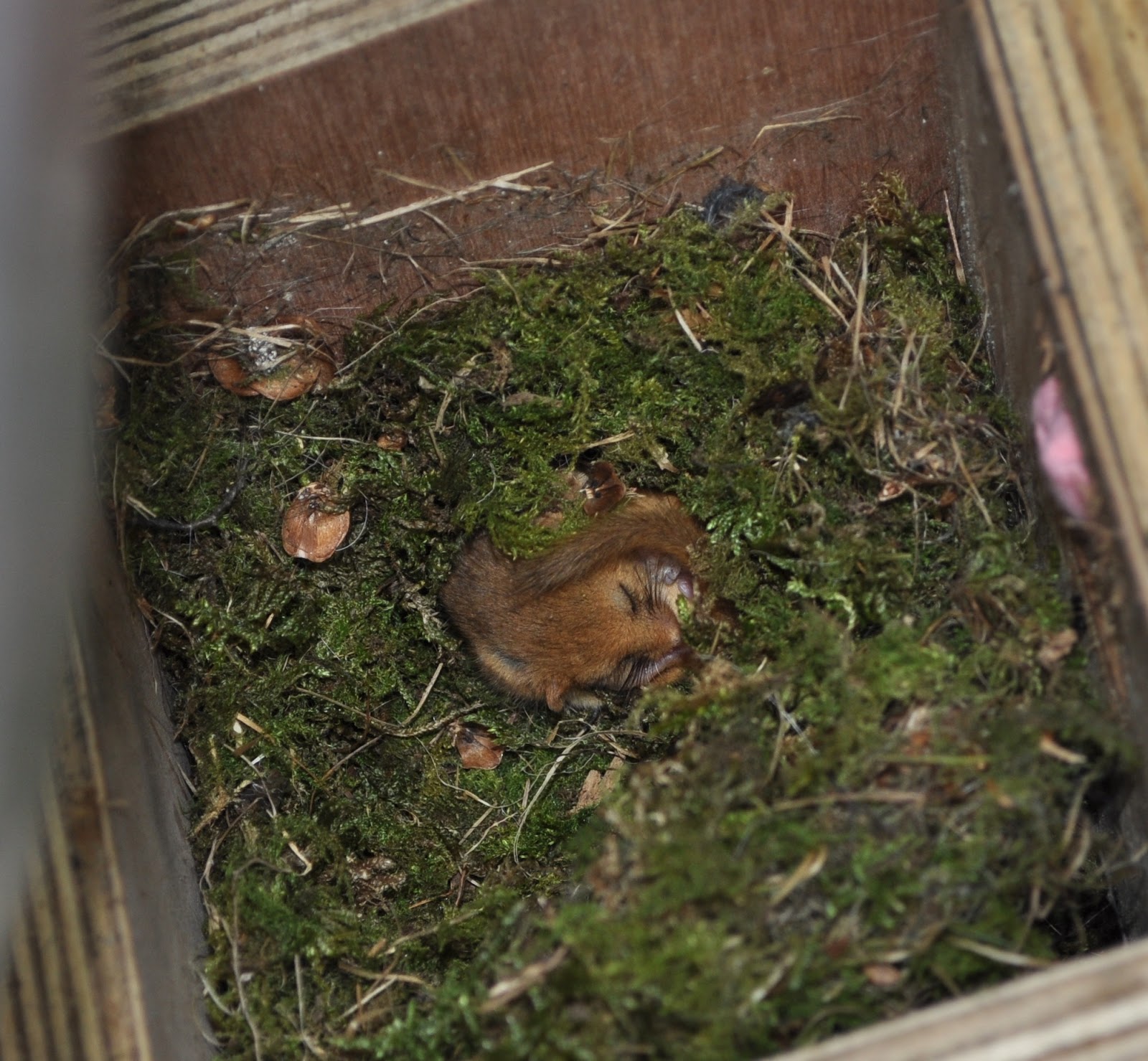
Sleepy Dormouse mother with babies

Juveniles, individually weighed before being popped back into their nest


Mum receives a small hair pluck before being safely returned to the nest box

Ah jeez...

In the end we got lots of data for Debs, plus the Isle of Wight offered up some other niceties:

Wood Mouse (Apodemus sylvaticus) juveniles in a Dormouse box

Wood Cricket (Nemobius sylvestris), a nationally scarce species. 
These were quietly churring in the background

Common Carder Bee (Bombus pascuorum) on Devil's-bit Scabious (Succisa pratensis)

Volucella pellucens on Devil's-bit Scabious

Loads of Devil's-bit Scabious

Elephant Hawk-moth (Deilephila elpenor) caterpillar

A Linyphia spider, possibly L.triangularis

We were also treated to a sighting of the Red Squirrel (Sciurus vulgaris), but kinda like my birding photos...

Yeah no chance.

Wednesday, 19 February 2014

Environmentally friendly

Last week, Gatwick's Environment, Health and Safety team got their (gloved) hands dirty, helping us put up 50 new dormouse boxes.


We were working within fragments of ancient woodland, over in the Land East of the Railway Line. Despite having previously detected signs of Dormice here, we are yet to find that definitive evidence of one curled up sleepily in a box.

A sludgy woodland trek

The team did an excellent job of getting the boxes up onto trees, seemingly enjoying themselves despite the now habitual rain and rivulets of mud. The boxes were put up in rows of consecutive numbers (no thanks to my lacking mathematics, leading to much confusion and switching boxes about...) which will make surveying all the easier in the seasons to come.
.
 
Tom S. of Gatwick Greenspace, 'papping' the team

So about an hour later than it should have been, we finally stopped for a well deserved tea and biscuit break. Before leaving the site, while looking around for signs of mammal tracks, I spotted this entire badger skull...

Badger skull found in Lower Picketts Wood. 
I like how the sagittal crest has a funky green mossy toupée

Badger skulls are pretty solid things, with the skull plate sutures well-fused and the bottom jaw often still connected to the base. They also have a large ridge towards the back called a sagittal crest, to which the strong jaw muscles would be attached. 


After a good clean up, the crest is slightly more obvious. It seems fairly small and I thought this might indicate it was a young badger. However, the teeth are also rather worn and an upper-rear molar looks badly infected (this now being the least of its problems.) There also seemed to be signs of recent badger activity very close by; some further investigation could be required by Gatwick Greenspace Partnership's Youth and Wildlife Rangers!

Tom's new friend, named in the honour of Environmental Secretary Owen Paterson
(O-Patz for short)

After lunch, it was back into the woodlands for some glade creation - we coppiced an area of the unmanaged hazel understory and several birch trees. All of the wood is kept on site, stacked into neat-ish habitat piles, maximising the space on the ground for woodland flora.

Of all the team, I'm not sure that Frank takes Environment, Health and Safety the most seriously.

Hand saws and tree loppers, along with grit and determination means we can achieve a lot in a short amount of time; we are now starting to feel on top of our winter habitat management targets. Around the place are signs that spring is just around the corner, meaning that time to complete last year's data entry is also running out...

Tops of bluebells

Wild daffodils

The 'dormouse boxing' team

A massive thank you again to all who came out to help and to Karen for organising. We hope to see you lot again on a drier day in summer!

Thursday, 18 April 2013

Ecologized

3… 2… 1… aaaaaand survey!!!

Reptile refugia in Ashley's Field, LERL. Copyright - Kevin Shaw Localworld 

Well I can’t really say that spring took me totally by surprise, but I’m still feeling slightly shell shocked! The ecological surveying has now kicked-off with reptiles, mammals, birds, amphibians, and roving records for macro-invertebrates such as butterflies; I am constantly trying to keep up with scheduling it all in!

Moschatel flowering along the banks of Gatwick Stream, LERL

Luckily I have keen volunteer ecology students and graduates assisting me who I'm enjoying showing around the place. So far we have successfully added several previously unrecorded birds on site, recorded our first Grass Snakes and butterflies of the year, started our Signal Crayfish removal from the River Mole and got our first confirmed Dormouse presence since our Biodiversity Action Plan began! Here are some pics just from this past week:

Signal Crayfish trapping with volunteer ecologist Julian

An invasive species: the American Signal Crayfish fresh out of the River Mole

One of our Mink tracking rafts repaired, re-sited and (I think) cleverly camouflaged along the River Mole

Honeysuckle bark strips are typical Dormouse nesting signs - Gatwick's ancient woodland

Rather odd-looking tracks in the mud along the River Mole, NWZ. Any ideas? Not likely to be Water Voles here but it almost looks like there is webbing between the toes.

Spring seemed to really hit here on Monday, and I got so many wildlife reports from around the airport I could barely keep up! Other sightings this week included Tadpoles, Peacock and Comma Butterflies, a speedy Merlin on the hunt for small birds and the arrival of spring migrants such as Swallow, Wheatear, Chiffchaff and Willow Warbler. Just over a week ago there was a period of overlap with the first Wheatear appearing around the North West Zone and winter migrant birds such as Redwing and Fieldfare still knocking about.

I excitedly contacted Tom Forward about hearing a flock of Siskins along the River Mole (a species not yet on our list in this area), when they somehow magically transformed themselves into a flock of Redwings. But hey ho... when I listen to their recorded calls again online I still think their chattering is kinda similar!
Hear the difference between Redwing song:

...and a flock of Siskin:


The Redwings all seem to have finally moved on, but not before giving us a special preview of their full song; an unusual occurrence around Britain as they don't tend to breed here. It is a sound which really grabs the attention, like a series of short descending blasts on a sports whistle...

And finally to finish off, here are a few more invertebrates I've been seeing around:

Glow Worm larvae found underneath a reptile refugia, LERL Copyright - Kevin Shaw Localworld

I think this is a Rustic Wolf Spider Trochosa ruricola, underneath a reptile refugia

Buzzing Spider Anyphaena accentuate, in a Dormouse box

Wednesday, 6 March 2013

Dormouse developments

On Friday of last week a new housing development was completed by the British Airways Engineering Volunteers in Gatwick's ancient woodland Horleyland Wood...

Dormouse box mounted in mature hawthorn with honeysuckle, Horleyland Wood

Torpid dormouse in a box, photo taken on a survey in nearby Crawley, 2012

As well as achieving pretty incomprehensible levels of cuteness, the hazel dormouse is an elusive wee beastie and the best way to survey for them is to tempt them in with luxury accommodation. Although I hesitate to use the word ‘fussy’ they sort of are... however by the same token they could be deemed good indicators of high quality woodland and levels of biodiversity.

A typical dormouse nest, photo taken at some nearby woodlands in Worth, 2012 

They tend to come out of hibernation around April and then start scoping out new accommodation for the breeding season. If their presence is confirmed then a licensed handler will be brought in to assist with weighing and sexing individuals, determining the health of the population. 

Dormouse bagged to be weighed and checked over, Crawley 2012

Due to their rapid decline in the past 100 years or so, the hazel dormouse is protected by law. Causes for the population crash are believed to be the loss of ancient woodland, fragmentation of woodlands, loss of hedgerows and unsympathetic woodland management; these issues we are confronting in our Gatwick Biodiveristy Action Plan.

The British Airways Engineering volunteers are a keen bunch with a zeal for helping improve the environment of Gatwick. They are very handy to have around with their technical skills and I will blogging all about their good work in the future.


Many thanks to Adrian Haines, Carl Treynor, Colin Sexton, Glyn Finch and Terry Sparrow of British Airways Engineering