Showing posts with label benhs. Show all posts

Thursday, 28 November 2019

Two wings are better than four

Two weeks ago I attended the Introduction to Flies course with the British Entomological and Natural History Society (BENHS), at their headquarters at Dinton Pastures Country Park. The centre is a very friendly and encouraging place, with volunteer tutors helping entomologists to improve their microscopy skills, receive guidance and gain confidence in different invertebrate groups.


The specimens room: rows of microscopes on work stations and cabinets line the walls

'Why study flies?' is a question we are asked A LOT when out in the field (members of public initially assume we are catching butterflies). As well as being important pollinators, they perform a wide variety of ecosystem functions. They make up a big part of the foodchain for other wildlife, they help to break down rotting organic matter and contribute to nutrient cycles. Without flies, quite frankly us vertebrates would not be here.

We don't often need to catch butterflies and the other larger 'macroinverts' for identification, as many are doable in the field or with a clear photograph. Also, there is only a small handful of butterfly species to become familiar with (there are 33 at Gatwick). Identification of flies however can be subtle, as they can be very small and are a huge group of insects, with over 7,180 species in the UK vs. just 59 butterflies!


What makes a fly a fly? They are defined by their scientific name Diptera, which means two wings. They would have four, but the rear pair of wings have evolved into halteres; two stick-like organs which are essential for balance and control, arguably making flies the best fliers. 


Dipterist extraordinaires Barbara and John Ismay led the workshop, with excellent introductory presentations aimed at just the right level of detail. We then sat at the microscope stations and each attendee was given a box of specimens, each labelled only with a number. It was up to us to run through the key and attempt to get each one down to a family.


Practicing with keys reinforces familiarity with the important invertebrate charactertics, such as position of eyes, shape of antennae, veination of wings, even the bristles on the legs.

The key to families of Diptera was pretty simple and easy to use. I will share a few of the initial steps below....

Step 1. Is your body plan freaky as heck, or do you basically look like a fly?

Step 2. Are your antennae rather simple and segmented, or highly modified?


Profile shot of a fancy modified antenna

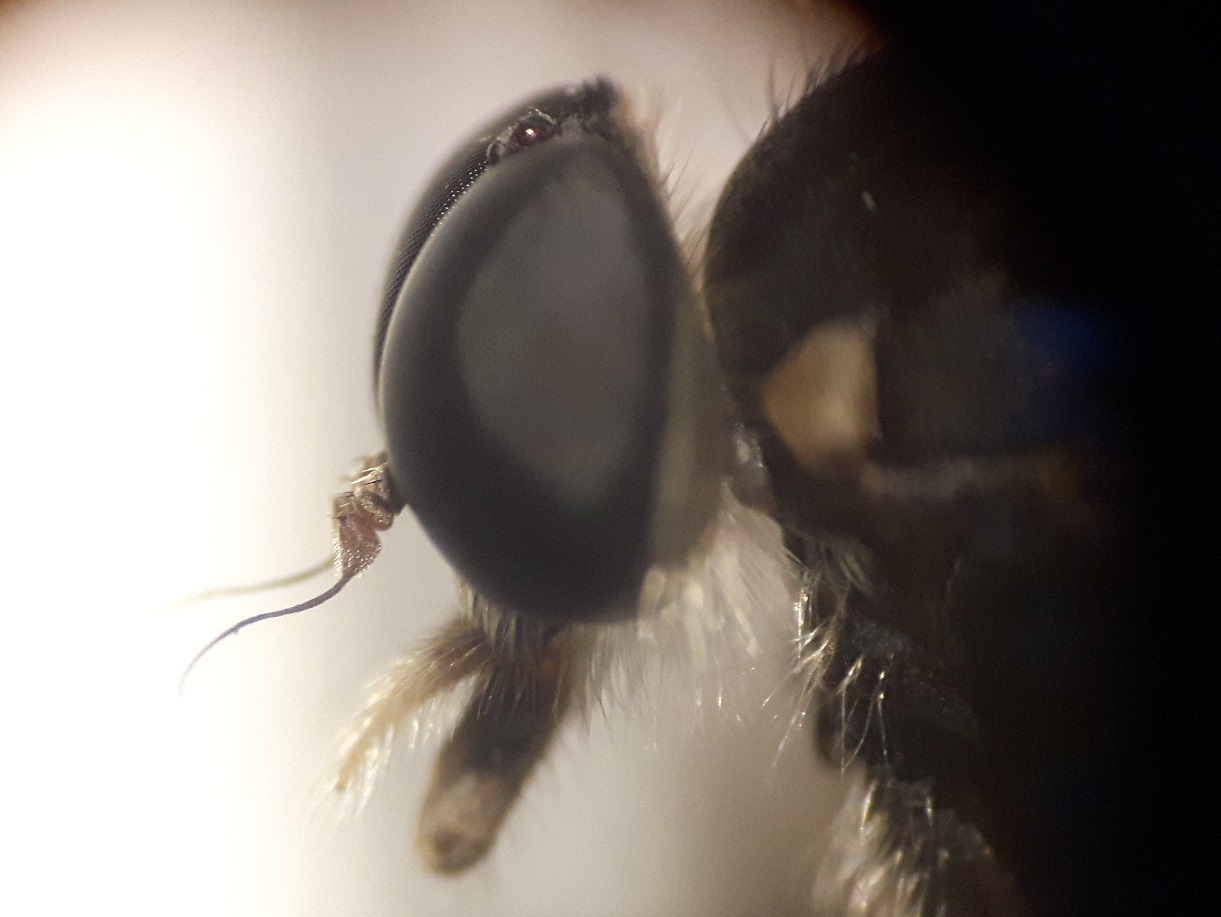
Step 3. What on earth is going on with that crack in your face?


And so on and so forth, until the key comes out at a family name.


Barbara and John run several workshops each year for the Dipterist's Forum, a group dedicated to the study and preservation of flies. They also run a busy consultancy together while volunteering their time to write papers and, of course, identify flies. Considering they are also married, I reckon this pair could have a side-line in writing couple counselling guides.


The BENHS workshops and field meetings are free and run by expert volunteers. If you do manage to get along to one of the sessions then I highly recommend that you sign up for membership to this worthy organisation.

Wednesday, 24 February 2016

Battling with beetles...

If the ground beetles (Carabidae) are like the European Knights of the 13th century - soldiers encased in ungainly, heavy steel plate armour...

Carabus nemoralis - Goat Meadow at Gatwick

...then the rove beetles (Staphylinidae) are the fearsome Mongolian warriors of the steppes, with overlapping scales of iron and flexible leather, allowing for furiously fast attacks on the enemy (I've been reading a lot of Conn Iggulden historical fiction of late).

Devil's Coach Horse (Ocypus olens) - Photo by W J Heeney

As mortal enemies, Carabids and Staphs will go into battle and the result comes down to the size of beast, which is highly variable. The biggest, baddest of the rove beetles is the Devil's Coach Horse pictured above, which makes Genghis Khan look like a lovable chap who'd give out free hugs.


Last Saturday was the Staphylinidae Identification Workshop with the British Entomological and Natural History Society, lead by Roger Booth and Peter Hodge. It was another excellent day of networking with beginner and expert entomologists alike, learning about the fearsome (and sometimes beautiful) variety of rove beetles.


Roger Booth lead the workshop on Saturday at Dinton Pastures

For me, it was throw back to entomology lessons at Royal Holloway University - Dr Angus was the lecturer who described invertebrate sexual strategy in such graphic detail, that his lectures became infamous (there's even a facebook page in his honour, with one lengthy thread on locust bits which is very NSFW).

A clumsy abdominal dissection

However, I'm not really sure how Dr A. would feel about this; my first attempt since uni at beetle genitalia dissection in order to determine the exact species... Needs a little more practice.

Tergites IX and X, plus one really mashed up aedeagus (male organ)

Aedeagi aside, all beetles at have the same basic body plan. Instead of iron, their exoskeleton is actually made up of a hardened material called chitin, particularly obvious in the solid wing cases (elytra). In Staphylinids, the wings are folded away and the wing case is particularly shortened, allowing for more flexibility in the body.

From Staphylinidae of Britain and Ireland

These are a few I've found about the place so far at Gatwick, usually lurking underneath reptile refugia and bits of bark...
Devil's Coach Horse (Ocypus olens) - a monsterous 30mm

This little bullet-shapped jobby is Tachinus rufipes - around 6mm in length

Drusilla canaliculata (some species names make even adult entomologists snigger), about 5mm

Mongol warriors, about 5ft 7"

Platydracus sp. Another large staph at around 20mm.
Photo by W J Heeney

There is something like 1,000 species of rove beetles in the UK, so lets just say I've got a few more to go! Thanks to Roger and Peter for a brilliant and inspiring workshop. 

Friday, 17 April 2015

The key thing about hymenoptera

My 5th weekend workshop at the British Entomological and Natural History Society (I know, I should just move right in) and I'm realising the best thing about these meetings (aside from the biscuits) is overhearing and chatting with such a diverse group of people about explorations into invertebrate identification.

BENHS HQ - Dinton Pastures workshop desks with light microscopes

Mike Edwards of BWARS led this course on Hymenoptera aculeata (bees, wasps, ants and sawflies), beginning with a presentation on their fantastic diversity and life strategies in the UK. These insects are broadly classified at having two pairs of clear wings (4 in total), joined by hooks and with an ovipositor at the rear which is modified into a 'stinger'. 

The walls are lined with drawers like this filled with carefully preserved and labelled specimens

Mike is an incredibly enthusiastic entomologist, one of many people trying to encourage a new generation of biological recorders. He asked us to bring along our specimens, so I brought some solitary bees from Gatwick, including one of my 'zom-bees' which came back to life after removing it from the fridge. I've subsequently learned a few tips on how NOT to preserve specimens...

...such as storing things in alcohol and then writing the labels in ink

Alcohol will also mat the hairs of insects which can be an important identification feature. 
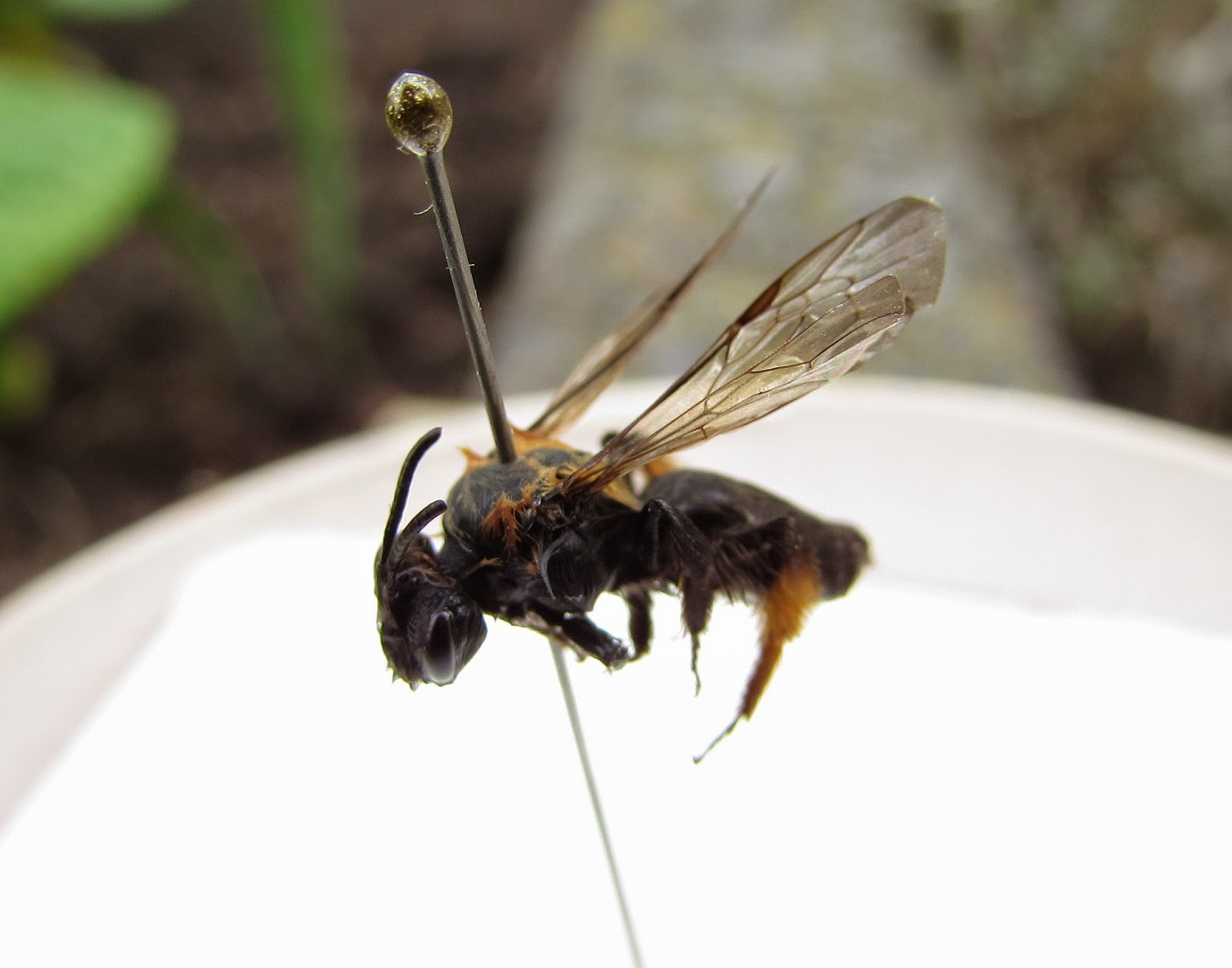
Plus its a little undignified. This was an Andrena solitary bee, species is probably clarkella 

Just to make a brief point here: I don't collect invertebrate specimens for fun or for ownership (I'm no Pokémon master). Present day Entomologists collect specimens in order to identify a species, and because certain features can only be practically observed when something is no longer moving. You can read more about the entomology code of conduct here:


Identification keys are quite like the 'Choose Your Own Adventure' books, in that you are presented with options and your choice tells you which page to go to. Mike has recently been updating and simplifying a key to British bees, this is a quick demo of part of it...
   For the pics I've used a smart phone down the lense of a microscope, but better naturalists than me will sketch features by hand as this helps with learning!

How to work out if your bee is male or female...

This female had 12 antennal segments...

...and 6 visible tergites (segments) on its rear end

So we know it is female, onto Key 2...


I can see 3 submarginal cells, slightly out of focus

Over to couplet 15...


Surface of eyes are definitely not hairy, and the marginal cell on the wing was relatively broad...

Over to couplet 16...

Couldn't see the tongue, but the wing vein was straight, plus the inner margin of the eyes are more straight than concave; over to 17...

I'm sure you get the jist! This one eventually keyed out to the genus Nomada, which is a type of Cuckoo Bee. These are common parasites of other solitary bees, laying their own eggs which after hatching then eat the larvae and food stores.

Now really is a good time to be getting into wildlife recording; with social media and online recources, everything is so much more accessible. Also, being able to share experiences with people at workshops or online means the entomological pursuit is no longer such an isolating one!

Many thanks again to Mike and everyone at BENHS who helps to put these workshops together.

Tuesday, 10 March 2015

Ground Beetles (Carabids) workshop

When we were kids in the 90's, my bro and I would squabble over who got to be the first to read the new issue of 'Bugs' magazine (I think that was what it was called). It came with free 3D specs for a double-page center image of a terrifying invertebrate, plus collectible glow-in-the-dark pieces of a spider model. It was also where I first read about the obnoxious habits of carabid beetles such as the Bombardier, which can spray a nasty concoction of boiling chemicals from their rear ends into the faces of predators... Those rascals.

Beetle body-plan: the weirdly named Sausage Ground Beetle (Carabus granulatus)

Last Saturday I visited the British Entomological and Natural History Society at Dinton Pastures, Reading to take part in the Ground Beetle (Carabidae) identification workshop. This is the 4th BENHS workshop I've been along to now and each one is uniquely fascinating.

Entomologist John Walters with the BENHS collection of Carabids

Today's course was jointly run by entomologists Mark Telfer (of Pan-species listing fame) and John Walters. It began with a presentation introducing the Carabidae family of beetles and their wonderful diversity in the UK. These include your classic black Ground Beetles, stunning Peacock Beetles, monstrous Tiger Beetles and the relatively tiny Bembidions.

Mark's precisely labelled and positioned specimens

Beetles are like living tanks with awesome customized add-ons which vary depending on their lifestyles. Being almost entirely predatory, carabids are monsters of the undergrowth with huge, curved jaws, massive eyes and spiked sprinting legs... Pimp My Beetle wouldn't work as a TV show, as they are already too damn pimped. 

Carabus granulatus (Sausage Ground Beetle) under the microscope. 
My Sony Xperia phone seems to take fairly good images this way 

The classroom session involved selecting specimens from the workshop collection and trying out different identification books and keys, including handy worksheets produced by Mark and John. These guys are on a mission to make the study and identification of insects (entomology) more accessible to beginners...

A detailed identification key to the features of Carabid beetles

But these brilliant worksheets were much more user-friendly

Superficially similar: Carabus granulatus on the left, Carabus arvensis on the right.

Of course is it always a beautiful day whenever microscopes are involved! Fortunately we had the opportunity to step outside for some live beetle handling/wrangling, learning about useful identification features out in the field:

Beetle wrangling (like a boss)

A live Violet Ground Beetle (Carabus violaceus) in the hand. 

The idea is to firmly grasp the middle and hind legs, which mostly immobilizes them so you can then examine from all angles. Their nip doesn't hurt too bad (unless you have open cracks on the sides of your thumb, then it bloody hurts).

Flipping the beetle

Momentary distraction with 3 Red Kites flying over our heads

At the end of the day, Mark demonstrated mounting a dead beetle specimen onto card... not your classic hallmark type of card (although I bet Mark wouldn't mind receiving one like that).


My first mounted Gatwick beetle specimen: Black Clock Beetle (Pterostichus madidus)


I had a sort through some of the Gatwick pitfall-trap sample jars, in which we had just 2 very common carabid species: Pterostichus madidus and Abax parallelepipedus.


So I'm 2 species down with some way to go before I amass a collection like Mark's. Hmmm, I forgot to ask when exactly he started off...

Mark Telfer's Website : A great resource for beetle identification keys and literature.
John Walter's Website : Beautiful natural history illustrations as well as downloadable identification keys
British Entomological and Natural History Society : Field meetings and indoor workshops, open to anyone with an interest in the astounding diversity of UK insects and other invertebrates.