Showing posts with label Great Crested Newt. Show all posts

Monday, 16 May 2016

Why i-Record wildlife

This week has been a monumental one for many biological recorders, thanks to the new fantastic phone app by the innovative iRecord team (seriously my favourite people right now)...

Links for phone downloads here: http://www.brc.ac.uk/app/irecord-app

Why am I so excited about this (free) app? Because it effectively cuts down on hours and hours (and cups of coffee and biscuits), spent entering data into excel spreadsheets or online at the desk. Instead, you can input wildlife records swiftly and with ease while out and about, maximising time spent out in the field (hey, you could even lose weight using this app!). It's basically why I chose a hefty Samsung S5 after renewing my phone contract - to be iRecord-ready!!

Entering a biological record

The interface is clean and simple; the fields are editable just by tapping on them, but you can lock any for repeated use. The entire database of UK wildlife (scientific and common names) is pre-loaded, and it draws the locations from the phone GPS, with the added option to just select a point on a map. 


Easy to create, edit or delete whole lists of wildlife records

Most pivotally, it works offline, so all data is automatically saved onto the device, ready for when you escape the 4G-blackspot or regain WiFi. A single tap, and all of your day's wildlife sightings are uploaded to the iRecord database, ready to be verified and feed into national wildlife recording schemes!
  For my work at Gatwick this has arrived in the nick of time, as things go crazy on our two biodiversity sites at the peak of breeding season and ecological surveys are back-to-back.
 
Great Crested Newt egg on a leaf (photo by Rina Quinlan)

Other recent highlights include Great Crested Newts (Triturus cristatus), returning to breed in Pond 3 after the humane removal of hundreds of fish just last year. A successful ending to this pond project, and no better seal of approval from our newts! Many thanks to all who were involved.

BAM! Record goes in.
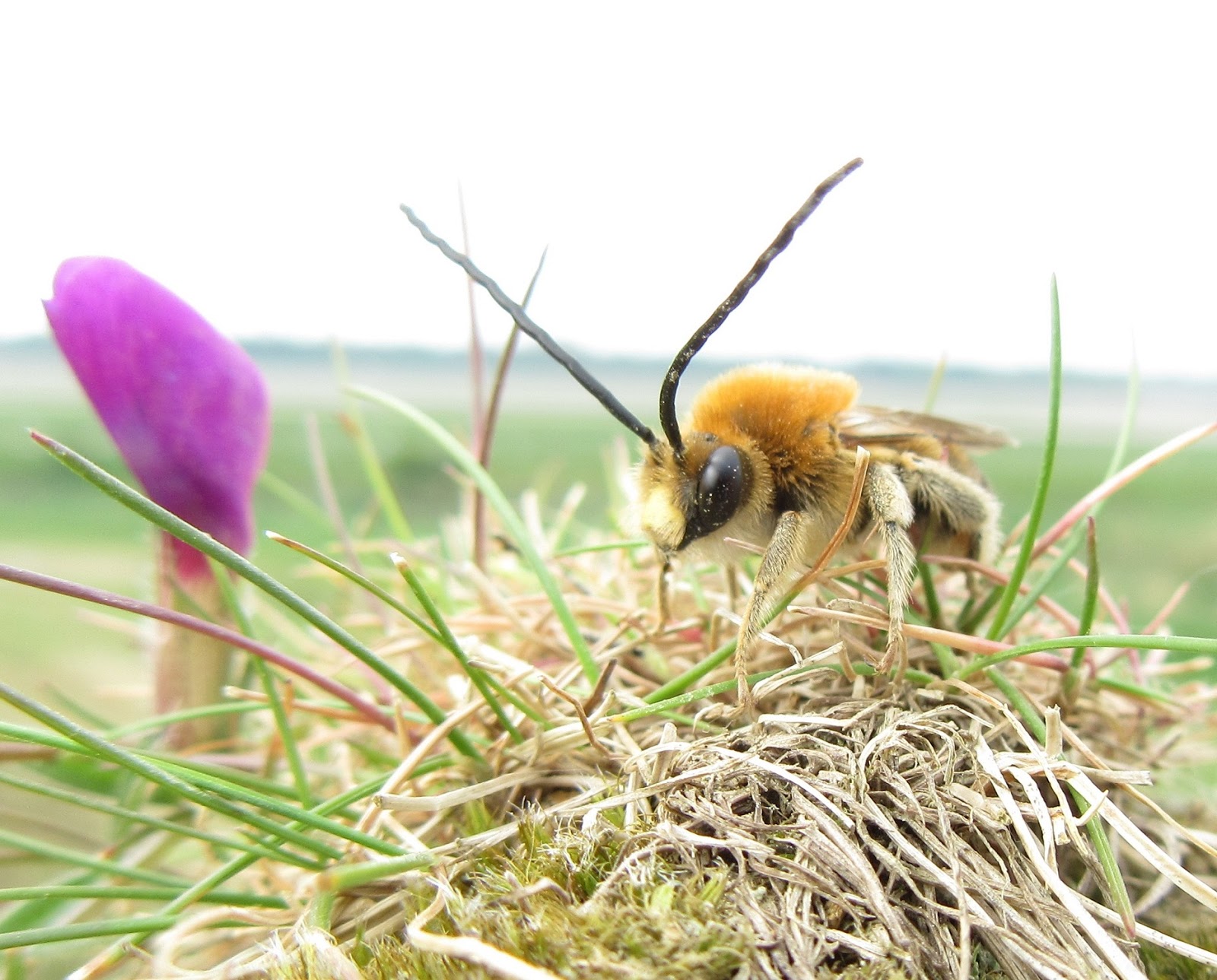
Our first male Long-horned Bees (Eucera longicornis) have also emerged last week; quite perfectly timed with the first flowers opening of Common Vetch (Vicia sativa) upon which these bees specifically nectar. Such amazing processes which happen beyond our detection!


Long-horned Bee with Common Vetch flower

BAM! Another record in. 

Gatwick has recently contributed a Buglife case study for this charismatic bee; you can find the publication and read more about our targeted habitat management by clicking here: Long-horned Bee at Gatwick Airport.

Eucera longicornis and a BA plane, Gatwick's North West Zone. 12/05/16

Cuckoo bees, other parasites and predators of solitary bees are also out in force and I'm only just learning about all the different varieties. Now that I'm saving on the data entry time (I <3 you iRecord!), I can finally put the guide to Bees by Steven Falk to good use. I think the lady pictured below is a Painted Nomad (Nomada fucata).. I'm happy to be corrected!


Just to top off a momentous week, we are now up to two male Nightingales (Luscinia megarhynchos) singing clearly in the North West Zone... and potentially even a third! I'll continue checking the site after evening moth and newt surveys; it would be incredible if they managed to breed here.

On the subject of Nightingales, I was recently shown this link by David Plummer - it's a famous recording of Nightingales signing in a Surrey garden on May 19th 1942. In the background, at about 2 minutes 30 seconds in, 197 Wellington and Lancaster bombers can be heard flying overhead on a raid to Germany. When you think about the violence and destruction these planes were portending, it gives the Nightingale song a rather melancholic edge.


Perhaps not so far from the site where that recording was taken, we unwittingly created a an updated version with a sound backdrop of a modern aerodrome.


Tuesday, 30 June 2015

What lies beneath

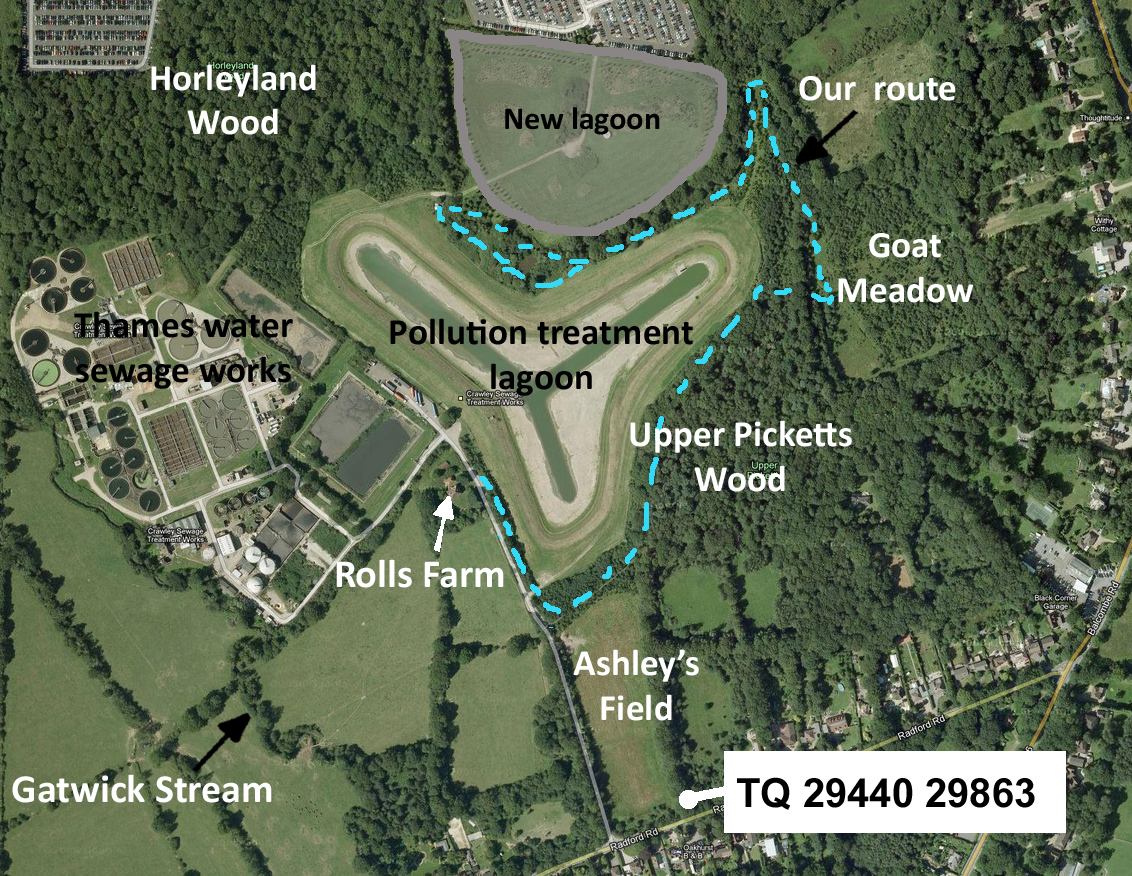
In early June, at the South Terminal long-stay car park, a small group of ecologists gathered for Gatwick's final newt survey of the season. 


Not the most obvious of wildlife settings, but a secret short cut from here takes us through to some secluded woodland ponds. These ponds seem to have been here a long time and are home to five different species of amphibian, all native to the UK. 

The infamous Bill Wadsworth of Chris Blanford Associates

Great Crested Newts are fully protected under UK and European law and you must be a licence holder to survey for them. Bill is a newt-extraordinaire, monitoring this pond over a number of years since the completion of a new water treatment area nearby. Counting newts means that we can estimate the population density, keeping an eye on the population health and ensuring that no long term impacts are apparent.


Specialist torches are used (1 million candle power) in order to cut through murky waters. The first thing we came across on this evening was....

Mirror Carp (Cyprinus carpio); a massive one at that

Not quite what we were hoping for! Fish are voracious predators of newts and so do not often occur together, however this particular pond is one we are restoring for amphibians. The fish were artificially introduced here, so this coming autumn electrofishers will humanely remove and relocate them, relinquishing the pond back to our amphibian friends. 
  Over to the next pond; now this is more like it....

Great Crested Newt (Triturus cristatus), male

Either a Smooth or Palmate Newt (Lissotriton sp.), female

Torching is quite a challenge in these particularly murky waters, resulting in a number of double-takes at a leaf-like-newt. Or is it a newt-like-leaf?

Common Toad (Bufo bufo)

Common Frogs and Common Toads are also quite a challenge to spot, until you get your eye in, then they are blooming everywhere!
   Another method to survey for newts is bottle-trapping, which might sound ridiculous but is very effective...

Preparing bottle traps

When Fat Duckweed dominates the pond surface, torching is out and bottle trapping is in

Trapping newts is quite an intrusive way to count them, so we only do it here when absolutely necessary, again with appropriate licences. The traps are placed out the day before and then collected back in very early the next morning; we want to minimise any disturbance to these guys and gals.

Great Crested Newt (Triturus cristatus), female
 This one is quite odd in lacking belly pattern

Great Crested Newt (Triturus cristatus), female

Ecology student Mark gives us a hand with the traps

Newts love hitting the bottle

Smooth Newt (Lissotriton vulgaris), male

Palmate Newt (Lissotriton helveticus), male, 
with heavily webbed back feet and a filamentous end to the tail

Palmate Newt (Lissotriton helveticus), female. 
The throat of this species tend to be rosy pink and unspotted

The breeding season is over for another year and most newts are leaving the ponds, but the next generation are still there, lurking just beneath the surface...

Tuesday, 27 May 2014

Roving Records: Un-bee-lievable find in the North West Zone (20/05/2014)

Overlapping ecology surveys and a good dose of sleep deprivation means I'm a bit behind in blogging!
 North West Zone aerial map

After a morning newt-surveying at the Nursery ponds (which turned up only 2 adult Great Crested Newts), mum and I headed off to check on the reptile mats. Just as we arrived, the weather switched from warm and sunny to cloudy and blustery. These rubbishy, changeable conditions have been standard this past month; frustrating when looking out for winged invertebrates. This is what we turned up...

Mother Shipton Moth (Callistege mi), named after a 16th century soothsayer-witch

Long-jawed Orb-weaver Spider (Tetragnatha extensa)

Glow Worm larva (Lampyris noctiluca). Actually a type of beetle and close to pupating

Black Clock or Necklace Ground Beetle (Pterostichus madidus), munching on a caterpillar

While checking the reptile refugia in the scrubby areas for any of our scaley guests, I realised that a couple of mats had gone missing... Subsequently, I've heard they were used as props under the wheels of a Land Rover which had got stuck in some mud nearby. I'm pretty confident that action would have failed and that our Grass Snakes would have benefited from them more!

Reptile refugia (roofing felt mat) - not for un-sticking trucks

So, at the end of a slightly truncated survey, we turned up three Grass Snakes: two less than 20cm long and a 1 meter, camera-shy individual. Its head was buried right down into its coils, in a case of I-can't-see-you you-can't-see-me.

Grass Snake (Natrix natrix)

We also noticed this lovely little plant growing near to the dry grassy slope...

Shepherd's Purse (Capsella bursa-pastoris) seed pods

Shepherd's Purse (Capsella bursa-pastoris) flowers

After completing the reptile transect, I decided to loop around the clay slope one more time, just in case we could turn up something interesting. Jeremy Early advised me to keep an eye on this area on sunny days, as solitary bees and wasps could be taking up residence in it.


Winged insects, such as Butterflies and Damselflies, like to disappear from view as clouds pass over, then will suddenly reappear with the sun. Reaching the top of the slope, the fickle British sun popped out again and suddenly, small flying things were busily buzzing about. Frustratingly, my netting skills were lacking and I was entirely absorbed while ignoring Mum's incessant calls...

Until I heard that magic word: 'Bees!!'


But this ain't just any type of Bee. Oh no my friend.

Long-horned Bee (Eucera longicornis) males

This is is the Long-horned Bee, Eucera longicornis; a very scarce species in Britain and we did not only find one, but a small community! Their antennae are extraordinarily long which makes them very distinctive, and laughably cute like little cartoon characters. 

NBN Gateway Distribution

As you can see from the above map, their distribution is very limited and there are very few records since 2000. The designation for this species is Nationally Notable A, which means rare and scarce. It is also UK BAP priority species, meaning it needs some conservation action to help it out, so we will be updating our Biodiversity Action Plan with some new targets! 

Look at that face!! I think they look like some kind of Pokemon

Judging from Jeremy's excitement (that would be very excited indeed), this is one of the best species to have stumbled across in our fair isles. It loves high quality, flower rich grasslands for foraging and clay areas for nesting, which we have in abundance along the sculpted River Mole floodplain. We counted at least 10 of these little guys, possibly even more buzzing around the wildflowers below the clay slope. They will be nectar feeding on the plentiful vetches, meadow vetchling, clover and trefoils.

Difficult to snap as they were eagerly chasing each other around, as well as any poor, unsuspecting Damselflies and Butterflies

My photos don't do this gorgeous little beastie much justice, so here are a couple of Jeremy's which were taken in the past few weeks over at another site...

Long-horned Bee (Eucera longicornis) male. Photo by Jeremy Early

Long-horned Bee (Eucera longicornis) male. Photo by Jeremy Early

Once this annoying weather starts behaving again, I'll be back up on that slope trying to spot our first female!

Wednesday, 19 June 2013

Bat-Air Traffic Control

Last Friday an odd thing happened; the wind dropped, the clouds parted and the evening air was warm... The bat walk I had organised actually went ahead and 8 of us were led through Upper Picketts Wood by Martyn Cooke of Surrey Bat Group (also an air traffic controller here at Gatwick).

Torchlight trek through Upper Pickett's Wood

Gatwick's Land East of the Railway Line

As the sun was setting we stopped off at Roll's Farm, an old abandoned farm house by the sewage works. With its wild, tangled garden and loose roof tiles it really looks like the perfect bat haunt. Our bat detectors were on and we were busy chatting when suddenly a series of louds clicks swept us by... A Common Pipistrelle (Pipistrellus pipistrellus) was on the wing and loudly echolocating! Martyn was able to show us on his Anabat detector screen the 'hockey-stick' pattern of a Pipistrelle call:

The call of a Common Pipistrelle bat (Pipistrellus pipistrellus) which peaks between 45 and 50kHz

People were excitedly pointing but annoyingly I still couldn't see anything. It was getting frustratingly dark - suddenly I saw my first Pipistrelle bat as it veered around us, much lower and closer than I had expected! No chance of them bumping into us though as these tiny predators are aerial experts, catching their insect prey and eating on the wing. Martyn said they were probably feeding on midges which our group was attracting in (and beginning to feel!) I did my best to get a photo, if you look carefully you can just about make out the tiny bat as it shot past...


Ok a little joke, I didn't attempt a photo. However it was a great privilege to see and hear these usually unnoticed creatures. We heard only Common Pips but then at the very end of the walk we heard a Soprano Pipistrelle (Pipistrellus pygmaeus), which were only recently declared a separate species. Martyn is a brilliant source of bat info and has some great stories, including the only reported 'bat strike' in the UK... (Disclaimer Alert: bats pose zero threat to aircraft!)

Light Emerald moth (Campaea margaritata)

We also tested out torching for Great Crested Newts at our two woodland ponds; we were able to make out 2 large female G.C.N. and 1 small male. Also spotted were several Smooth Newts and 2 Common Frogs. While people were using their torches I was attempting (and mostly failing at) bare-handed capturing of moths drawn in by the light. I did manage to grab 2 macromoths which I potted and took home to photograph in the daylight.

Light Emerald (Campaea margaritata)

Common White Wave (Cabera pusaria)

Common White Wave (Cabera pusaria)

I feel a bit mean that I haven't shown any pictures of a bat, so here is a photo of two lovely little Common Pipistrelle, one of which a friend of mine rescued in Copthorne back in 2007. We took it over to the Jenny Clark of Sussex Bat Group who rehabilitated and released it back into the wild...

'Boost' the female pipistrelle and her new buddy 

You can find out about all of the UK's different bats species here: Bat Conservation Trust