Showing posts with label bioblitz. Show all posts

Thursday, 23 August 2018

Gatwick Wildlife Day 2018

The Gatwick Aviation Museum is a hidden gem of a place, containing an impressive collection of well-kept British aircraft manufactured between the 1940s and the 1970s. The main building is a large aircraft hangar located in a large field, north-west of Gatwick's runway.


The landscape here is made up of wetlands, hedgerows, mature English Oak trees and margins of long grass, which combined with a lack of human disturbance results in some excellent areas for wildlife. The site also has very few biological records, and as species listing helps us to build up a picture of the ecosystem health, this is an ideal location for our 5th annual wildlife recording event!

North West of the runway


The bioblitz area

Event kick-off: Friday 22nd June, 7pm

(One day after the summer solstice.)


On the second longest day of the year, there was plenty of time before sundown for the Gatwick Greenspace Partnership team to set up the recording base camp. We readied ourselves for a long evening of wildlife discovery, which involved brewing plenty of coffee and a bit of impromptu kazoo playing.

Aviation Museum pond

It was an incredibly warm summer evening with hardly a breeze. As the first guests arrived, our task was to put the overnight moth-trapping equipment out into the heart of the site. 


Next up was the setting of longworth traps (used for live capture of small mammals) which were placed out around the perimeter of the site. As the sun finally began to set at around 9.20pm, Martyn Cooke and Kevin Lerwill began the bat activity survey. 

Static bat recorder

Martyn's specialist bat recording software produced over 3000 sequences, and approximately 25,000 individual bat calls. Three species were positively identified; Common Pipistrelle, Soprano Pipistrelle and Noctule. Two species of Myotis bats were recorded, and noted as probable Bechstein's and Whiskered. A possible Leisler's bat flagged up, but was unfortunately the recording was quite poor.

Total bat species: 5

By the evening's end we had gathered many wildlife records of the nocturnal kind, including several species of amphibian, bats, spiders, and a very vocal Tawny Owl

Common Toad Bufo bufo

Common Frog Rana temporaria 
(Photo by Helen Cradduck)

Total amphibian species: 3

A beautifully polished Walnut Orb-weaver Nuctenea umbratica


Around midnight it was time to put the kazoos away and turn in for an ambitious attempt at getting some shut-eye next to an airfield. 


Saturday June 23rd: 6am


(Photo by Lucy Groves)

The sun popped up again much sooner than we would have liked, and the team was mobilized at 6am. The first task of the day was a bird survey, which involved walking the entire perimeter of the site, keeping a sharp eye out and listening for calls.


The areas of wet scrub proved very productive, and we were greeted by the sounds of Reed BuntingGoldfinch and Common Whitethroat. Along the mature hedgerows and Oak trees, the most vocal birds were Nuthatch and Song Thrush.

Common Buzzard Buteo buteo
(Photo by Helen Cradduck)

Total bird species (seen and heard): 32

After the birds, it was straight on to checking the small mammal traps, with local mammal expert Lucy Groves leading the group. We found 5 species of small mammal which we considered good going for a short survey; Wood Mouse, Yellow-necked Mouse, Bank Vole, Common Shrew and Pygmy Shrew.


Wood Mouse Apodemus sylvaticus 
(Photo by Lucy Groves)

Larger mammals which were also seen on site included Rabbit, Red Fox, Roe Deer, Grey Squirrel and Brown Rat.

Red Fox Vulpes vulpes 
(Photo by Helen Cradduck)

Total mammal species (not including bats): 12


After a quick breakfast and some fresh pots of coffee, next up was the moth trap reveal with Laurie Jackson and Bob Foreman leading the show. The overnight traps were emptied with every moth, large and small, closely examined for identification and then counted.

Elephant Hawk-moth Deilephila elpenor 
(Photo by Helen Cradduck)


We were looked on by the yellow-and-black caterpillars of the Cinnabar moth, making short work of the Common Ragwort growing nearby.

But the rarity of the day (which caused the most excitement in the mothers' world) was the Dotted Fan-foot Moth, a nationally scarce species...


Total moth species: 68

Late morning rolled in (along with a fresh lot of guests!) and we sent out the troops out with their sweep nets, chasing down the numerous invertebrates out on the wing and hiding up in tall vegetation.

Banded Demoiselle Calopteryx splendens
(Photo by Helen Cradduck)


Total dragonfly & damselfly species: 7

Vince Massimo carried out a survey around the perimeter of the site, giving our butterfly species list a boost. The most rewarding find for him was a Purple Hairstreak high up in the canopy of the oldest Oak Trees.
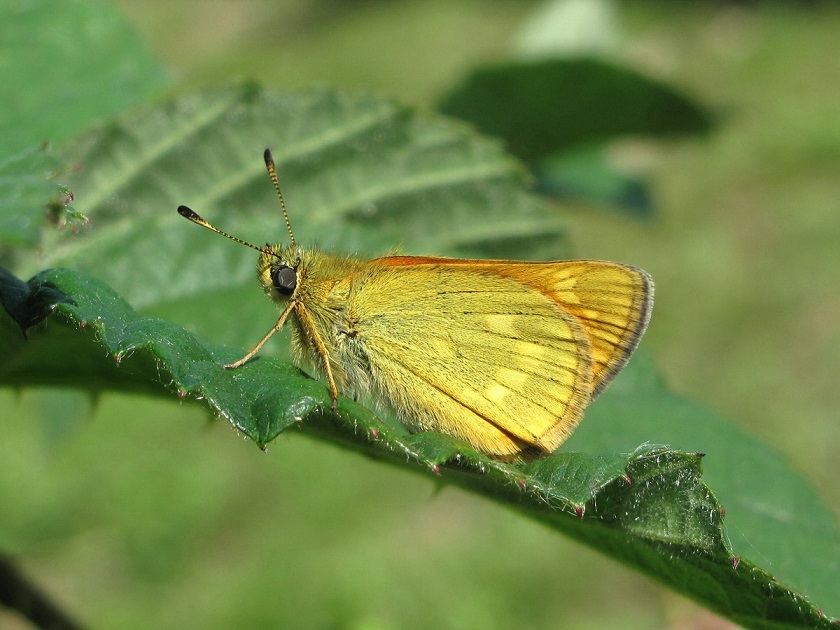

Large Skipper Ochlodes sylvanus 
(Photo by Vince Massimo)

Small Tortoiseshell Aglais urticae 
(Photo by Vince Massimo)

Total butterfly species: 17

Other invertebrate groups can be a great challenge to identify to species level, so we were lucky to have experts on site such as Peter Hodge who did a brilliant job of sorting out the beetles for us...

A species of Soldier Beetle - Cantharis rufa

Cantharis nigra

A tiny lacewing larvae


Labyrinth Spider Agelena labyrinthica


Total beetle species: 42
Total spider species: 7
Total fly species: 16

And not forgetting the plants and fungi, with specialists Nick Aplin, Clare Blencowe, Brad Scott and Arthur Hoare helping to cover these challenging groups...

Arthur Hoare in action


Marsh Thistle (Cirsium palustre)

Total vascular plant species: 59
Total lower plant species: 6
Total fungi species: 14


The final part of the day involved pond dipping for aquatic invertebrates. We are able to identify a few of the dragonfly nymphs and water bugs, as well as getting up close to the young frogs and newts.


Dragonfly nymph 
(Photo by Lucy Groves)

Newt larva
(Photo by Lucy Groves)

By the end of the day, at about 2pm we had our running total, but it didn't stop there with experts taking away notebooks and specimens for closer examination.

This was the total count at around 2pm

As of now, the grand total for the day stands at 323 species!

A huge thank you to Tom Simpson, Kevin Lerwill, Tamara Jewell, and to all of the volunteers and guests who attended on the day. A special thank you also to Ashley and Jon of the Gatwick Aviation Museum for allowing use of their excellent site and facilities.

The latest breakdown of group totals from Lois Mayhew at the Sussex Biodiversity Record Centre:
amphibian3
bird32
beetles42
flies16
moss and lichen6
plants59
moth68
butterfly17
earwig1
true bugs27
dragonfly7
hymenoptera6 (includes 1 gall)
isopod1
mollusc2
Grasshoppers and crickets3
mammals12
spider7
fungi/rust14
Total Species323
Total Records423

Friday, 29 September 2017

Gatwick Wildlife Recording day 2017

This post is a round up our 24 hour Wildlife Recording Event, this year held once again at Rolls Field and the Gatwick Stream flood attenuation area.
  So, why carry out a 24 hour intensive wildlife recording event (sometimes called a Bioblitz) on our sites at Gatwick?

Base camp at Rolls Field. Photo by Lucy Groves

The main goal is to boost the biological records of under-surveyed areas, by inviting groups of naturalists of varying specialisms to focus on their chosen wildlife groups, such as birds, plants, flies, bats or fungi. This way, under-recorded common species, as well as rare species, can be confirmed utilising the site. For example, we hadn't known that Marbled White Butterflies can be found along the river banks here, and that a rare type of Yellow-faced Bee is nesting in the bare clay. We then pass on the information to the local Biological Records Centres, who store and catalogue data from all resources, both historical and present.

Site map produced by the Sussex Biodiversity Records Centre. Habitats here include remnant hedgerows, wildflower-seeded low lying meadow and a re-aligned river

The second incentive is to engage and share knowledge with naturalists of all levels, including people who've never previously taken such a close look at the nature on their doorstep.

Rolls Field. Photo by Lucy Groves

And the final reason? It's blooming good fun!

July 7th: 6PM

In contrast to the previous year, it was a warm and balmy evening as we set up (which is why we were repeating the event at this site again!) and the conditions meant lots of butterflies, bees and beetles were already being collected for proper identification the following day.


Martyn Cooke's static bat detectors set up on site


Baiting mammal tunnels (Photo by Lucy Groves)

After setting the Longworth mammal traps and footprint tunnels, we set off for a bat walk led by bat surveyor Martyn Cooke. It was a fairly quiet evening, but we still did better than the previous year, and we notched up our first few records of vertebrate species...

Photo by Helen Cradduck

Bats (2 species):
Serotine
Common Pipistrelle

Amphibians:
Common Frog

Birds:
Tawny Owl

With mammal traps set, static bat detectors running, trail cameras switched to record and moth light traps on, it was time to turn in for the night.

Base camp in the evening (Photo by Helen Cradduck)


Next day (July 8th):

It was an early start to the morning in order to tot up some bird records before the site got too busy with people. A few of us covered different areas, making observations with binoculars or simply listening out for calls, then met back at base camp to compile the list while enjoying some freshly brewed coffee.


The trail cameras picked up some useful records for us too...

Kingfisher (Alcedo atthis); blink and you'll miss it but the call is unmistakable. Kingfishers are on the amber list for conservation as per the Birds of Conservation Concern 4 report 

This is the completed bird list from the end of the day:

Birds (34 species):
Blackbird
Chaffinch
Carrion Crow
Great Tit
Grey Wagtail
Starling
Stock Dove
Swallow
Mallard
Bullfinch
Great Spotted Woodpecker
Swift
Buzzard
Goldcrest
Goldfinch
Grey Heron
Hobby
Jackdaw
Long-tailed Tit
Magpie
Song Thrush
Tawny Owl
Whitethroat
Woodpigeon
Wren
Marsh Tit
Robin
Blackcap
Green Woodpecker
Kestrel
Reed Warbler
Nuthatch
Pied Wagtail
Kingfisher

Grey Wagtail (Motacilla cinerea) - a red listed species of conservation concern

Once the morning guests had arrived, the next job was to liberate any overnight guests from the Longworth mammal traps. Mammal ecologist Lucy Groves led this busy session, discovering Wood Mouse, Yellow Necked Mouse, Bank Vole and Common Shrew occupants.


Wood Mouse (Apodemus sylvaticus)

Sightings of some larger mammals were also coming in...

Roe Deer (Capreolus capreolus) - ignore the date stamp on video

Martyn's checked his static bat detectors which had picked up two species; he was able to show us the call of a Common Pipistrelle on his bat sonogram software...


Mammals (8):
Roe Deer
Rabbit
Wood Mouse
Bank Vole
Yellow-necked Mouse
Common Shrew
Common Pipistrelle Bat
Serotine Bat


Sussex Biodiversity Record Centre desk, run by Lois and Nick


Invertebrates:
Our recording table already had specimens from the previous day, such as hoppers, butterflies and beetles, which were identified and then released. Brad Scott identified and tweeted our tiniest new records. In fact, this is our very first springtail record for Gatwick...


We were visited by Dr Ian Beavis who was able to record some of our tiny solitary bees and wasps, including this Red Data Book species of Hylaeus bee...


Spined Hyleaus bee (Hylaeus cornutus), the female with central depression in the face
which is used for carrying pollen loads


Rosels Bush Cricket. Photo by Helen Cradduck

Moths (88):
Lepidopterists Jake Everitt and Laurie Jackson collated the list of the moths from all three of our 3 traps, which is no mean feat! Species highlights for Jake were Antler Moth (declining all across Sussex), Least Carpet (Uncommon resident) and Lunar-spotted Pinion (Uncommon), all of which are lovely catches.

Poplar Hawkmoth

Photo by Lucy Groves

Black Arches Moth (Photo by Lucy Groves)

Elephant Hawkmoth (Photo by Lucy Groves)

Thanks to local butterfly expert Harry Clarke and others for compiling our comprehensive butterfly species list. I think the abundance of Purple Hairstreaks and Marbled Whites were the clear favourites!

Butterflies (19):
Small Heath
Gatekeeper or Hedge Brown
Meadow Brown
Common Blue
Marbled White
Green-veined White
Speckled Wood
Small Copper
Purple Hairstreak
Ringlet
Small Skipper
Comma
Peacock
Large Skipper
Painted Lady
Essex Skipper
Large White
Small White
Red Admiral


Marbled White (photo by Lucy Groves)

Purple Hairstreak (Photo by Lucy Groves)

Nick Aplin has once again shown us a window into the bizarre world of fungi, and gave our species list a boost despite it not being an ideal time of year.

Epichloë baconii (on Bent Grass)

The above is a new species record for Vice County Surrey! Nick tells me that Epichloë species of fungus are also often called 'Choke', and you can see why in the photo! But far from being parasitic, they're actually symbionts of grasses and actually produce various novel compounds which protect the grass from herbivores, including mammals and insects. The fungus also positively affects the plant's growth and protects it from drought, even though it looks like it's strangling it. 


Photo by Helen Cradduck, who first spotted this gorgeous Wasp Spider hanging out in the meadow

Riverfly surveying with Kevin Lerwill (Photo by Martyn Cooke)

Towards the end of the day, I managed to record a few spiders, carabids (ground beetles) and had some Twitter help with the identification of a staphylinid (rove beetle).

Selection box of spiders, box anyone? Clockwise from top left: Neoscona adianta, Larinioides cornutus, Argiope bruennichi (the Wasp Spider)

Black Clock Beetle (Pterostichus niger)

Staphylinus dimidiaticornis which accidentally hitched a ride home with me in my handbag

With valuable help from Nick and Lois at the record centre, this was our final total and the species breakdown:

Taxon group
New Species
Total Species
Amphibians
1
Beetles
8
14
Birds
1
34
Butterflies
1
19
Crustacean
1
Dragonflies
1
2
Earwigs
1
1
Ferns
1
Fungi
9
9
Grasshoppers and Crickets
3
5
Harvestman
1
1
Hymenoptera
3
15
Mammals
1
8
Molluscs
1
2
Moths
69
88
Pseudoscorpiones
1
1
Slime Moulds
1
1
Spiders
11
11
Springtails
3
3
True Bugs
5
6
True Flies
18
20
Vascular Plants
20
63
Totals
158
306
Total Records
469


These events just wouldn't happen without the incredible work of the Gatwick Greenspace Partnership, our local ecologists and volunteer naturalists, thank you all so much. It gets better every year!