Showing posts with label gatwick moth trap. Show all posts

Monday, 27 May 2019

Mothursday Night

The days in May suddenly seem to get incredibly very long as the number of evening ecology surveys peaks, yet there never seems to be enough hours in the day! 

On Thursday 16th we had our first moth trap session of the year, but a cold start to the month has meant very poor results in moth traps for surveyors everywhere. Jacob Everitt is the Senior Countrsyide Warden for Horsham District Council, and has been surveying moths here at Gatwick since 2013. This evening he left nothing to chance, bringing along 3 different types of moth trap.


We set up at the base of the River Mole environment (or noise) bund, which extends about 1km along the River Mole. The bund is a mix of scrub and seeded wildflower grassland, and is undisturbed due to the chainlink fence along the base and around the perimeter of Pond M. We set up three traps at the end closest to Brockley Wood.


As expected, things were very quiet, and so we played the patient game of not-looking-directly-at-the mercury-vapour-bulb, while waiting for the first of our lepidopteran light-addicts to show up.


Jake and his assistant Ian

As it got darker, the insect activity picked up around the lights, which initially were small flies and non-biting midges. On one of the checks at around 10pm, we swept a torch around the surrounding grassland and were surprised to see this big beauty quietly roosting in the grass...

Lime Hawkmoth

Soon there were a few moths bouncing around the light, and this lovely Pebble Prominent was again one of the larger species to show up.

Cardboard egg boxes inside the trap allow moths to safely perch or hide away 

At around 11pm it had cooled down to 9 degrees with no sign of anything else on the wing, so we decided to call it a night and count up our meagre catch.


The final list for the evening was a grand total of 8 species! Jake said this was actually a better result than most of his recent evenings.
  • Common Swift = 2
  • Green Carpet = 5
  • Lime Hawk-moth = 1
  • Pale Tussock = 2
  • Pebble Prominent = 1
  • Purple Bar = 1
  • Monopis weaverella = 1
  • Elchista argentella = 1

A few specimens which I photographed and released the next day...


Lime Hawk-moth (Mimas tiliae)


Pebble Prominent (Notodonta ziczac), warming up for take off


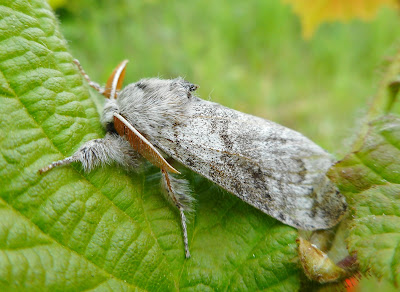
Pale Tussock (Pterostoma palpina)

Moth faces are ridiculously underrated, I mean would you just look at this....

Pale Tussock, ready for its close-up


Green Carpet (Colostygia pectinataria)


A tiny Elchista argentella

This beautiful ground beetle was also spotted as it dashed past one of the traps....

Carabus nemoralis

We also recorded a large bat while standing on the top of the environment bund, hawking over Pond M; is it a Noctule, or a Serotine perhaps? (The static noise is from my Batbox Duet).


Wednesday, 19 September 2018

Goat Meadow moth trap - Sept 2018

It was the end of a long week, and I was still suffering from a CRTI (Crisp Related Throat Injury) due to a temporarily lodged Salt & Malt Vinegar McCoys. However, as one not inclined to moan, I soldiered on to join Jake Everitt of Sussex Moth Group for an evening moth survey. 


At around 7.30pm we set up a generator and light trap over at Goat Meadow, a herb-rich patch of grassland east of the woodlands. There are good reasons to monitor moths, as both the adults and caterpillars are important food sources for birds, predatory invertebrates, small mammals and bats. Moths are also indicators of local habitat conditions, as they are heavily dependent on a range of plants for their caterpillars and the adults which feed on nectar (making them effective night-time pollinators).

Evidence of chainsaw fairies out on site again

We had time for a site walk-over in the dusk, which was an opportunity to show Jake how the meadow has changed in the past year under management by Tom's conservation volunteers. Our groups have been working hard to reduce the amount of dominating willow scrub while opening up more of the valuable, species-rich grassland areas. 

The temperature dropped to around 14 degrees celsius, but otherwise the night was wind-less and peaceful; we were surrounded by nocturnal wildlife including feeding Pipistrelle bats and calling Tawny Owls


The Sallow Xanthia icteritia

Back at the light trap, and the moths were starting to gather in good numbers. Macro moths have some of the best (and most ridiculous) common names in natural history; many of those coming in were types of 'Sallow' moth. As we finally emptied the trap out at about 11pm, I collected a few up to photograph the next day...

The SallowXanthia icteritia

Barred SallowTiliacea aurago

Centre-barred SallowAtethmia centrago

And for the last one of the set.... I was too slow on the shutter :-(

Pink-barred Sallow - Xanthia togata 
(was 'ere)

Jake's highlight were the Oak Lutestrings which turned up towards the end.

Oak Lutestring - Cymatophorima diluta

Eudonia angustea (a type of micromoth)

Common Marbled Carpet  - Dysstroma truncata

Not only moths are attracted to the light, here is a selection of the evening's by-catch:

European Hornet - Vespa crabro

Great Blackclock - Pterostichus niger

Night-flying Dung Beetle - Aphodius rufipes

Green Shieldbug - Palomena prasina

Not a bad count in all for a September evening, and typically for this time of year Square-spot Rustic were in the greatest numbers.

Common Name
Scientific Name
Total Count
Aleimma loeflingiana
1
Epinotia ramella
Epinotia ramella
1
Epinotia cinereana
Epinotia cinereana
2
Eudonia angustea
Eudonia angustea
1
Oak Hook-tip
Drepana binaria
1
Oak Lutestring [sp]
Cymatophorima diluta
3
Common Marbled Carpet
Chloroclysta truncata
1
Willow Beauty
Peribatodes rhomboidaria
2
Light Emerald
Campaea margaritata
3
Large Yellow Underwing
Noctua pronuba
7
Lunar Yellow Underwing
Noctua orbona
1
Lesser Yellow Underwing
Noctua comes
1
Square-spot Rustic
Xestia xanthographa
28
Brindled Green
Dryobotodes eremita
1
Centre-barred Sallow
Atethmia centrago
1
Barred Sallow
Xanthia aurago
1
Pink-barred Sallow
Xanthia togata
2
The Sallow
Xanthia icteritia
6
Copper Underwing
Amphipyra pyramidea
1
Straw Dot
Rivula sericealis
5
The Snout
Hypena proboscidalis
2

Tuesday, 20 June 2017

Long haul (of lifers)

There is a secret society, an underworld some might say, within ecology. These people can look just like any nature lover you've met before; in fact, you have probably even passed them on the street...
 

There is an easy way to find them out though, as on a warm summer evening twitter feeds will light up with the phrases such as 'good haul!', and 'lifer!' or 'moth bonanza'! These are the moth recorders, and now and then, I join in to live life vicariously as a moth trapper.

Common Bird's-foot Trefoil and Meadow Vetchling, River Mole Grasslands

First off is some sweeping of the vegetation with nets, which turns up a few species which wont come to the light trap. I couldn't believe my luck with I spied this critter in the bottom of my net - an immaculate Six-belted Clearwing Moth (again something I have only ever seen before on other people's twitter feeds!)

Six-belted Clearwing (Bembecia ichneumoniformis
Nationally Scarce B. A good mimic of a parasitic wasp

We are lucky to have Jake Everitt leading us; he is the warden at Warnham Local Nature Reserve and has been running moth traps at Gatwick for around 4 years now. It sounds like this was a pretty exceptional summer night along the River Mole, as together he and Laurie Jackson counted 448 of 98 different species.

Angle Shades (Phlogophora meticulosa) - a common but lovely moth


This excellent field guide is the ultimate companion for any mother. (Jake has another guide like this which is devoted specifically to the micromoths!)

Macromoth identification is very visual and doesn't often require a entomological key 
(unlike the micromoths)

Blood-vein (Timandra comae) my personal favourite

Jake's highlights were the 13 Elephant Hawk-moths, 2 Southern Wainscott, the Dotted Fan-foot (a lifer for him) and Nephopterix angustella, which is a rare and distinctive little micro.

Elephant Hawk-moth (Deilephila elpenor) Another common species, the caterpillar 
feeds on willowherbs, fuscias and Himalayan Balsam

Ecology student Connor with his new Elephant Hawk pal

A rather poor photo of a Dotted Fan-foot (Macrochilo cribrumalis)
(Nationally Scarce B)

I felt pretty guilty that I had to leave at midnight, as Laurie and Jake were still out emptying and packing up the traps after 1.30am! What an incredible time of year to be out though, often I don't even want to go home...