Showing posts with label aculeate. Show all posts

Friday, 17 April 2015

The key thing about hymenoptera

My 5th weekend workshop at the British Entomological and Natural History Society (I know, I should just move right in) and I'm realising the best thing about these meetings (aside from the biscuits) is overhearing and chatting with such a diverse group of people about explorations into invertebrate identification.

BENHS HQ - Dinton Pastures workshop desks with light microscopes

Mike Edwards of BWARS led this course on Hymenoptera aculeata (bees, wasps, ants and sawflies), beginning with a presentation on their fantastic diversity and life strategies in the UK. These insects are broadly classified at having two pairs of clear wings (4 in total), joined by hooks and with an ovipositor at the rear which is modified into a 'stinger'. 

The walls are lined with drawers like this filled with carefully preserved and labelled specimens

Mike is an incredibly enthusiastic entomologist, one of many people trying to encourage a new generation of biological recorders. He asked us to bring along our specimens, so I brought some solitary bees from Gatwick, including one of my 'zom-bees' which came back to life after removing it from the fridge. I've subsequently learned a few tips on how NOT to preserve specimens...

...such as storing things in alcohol and then writing the labels in ink
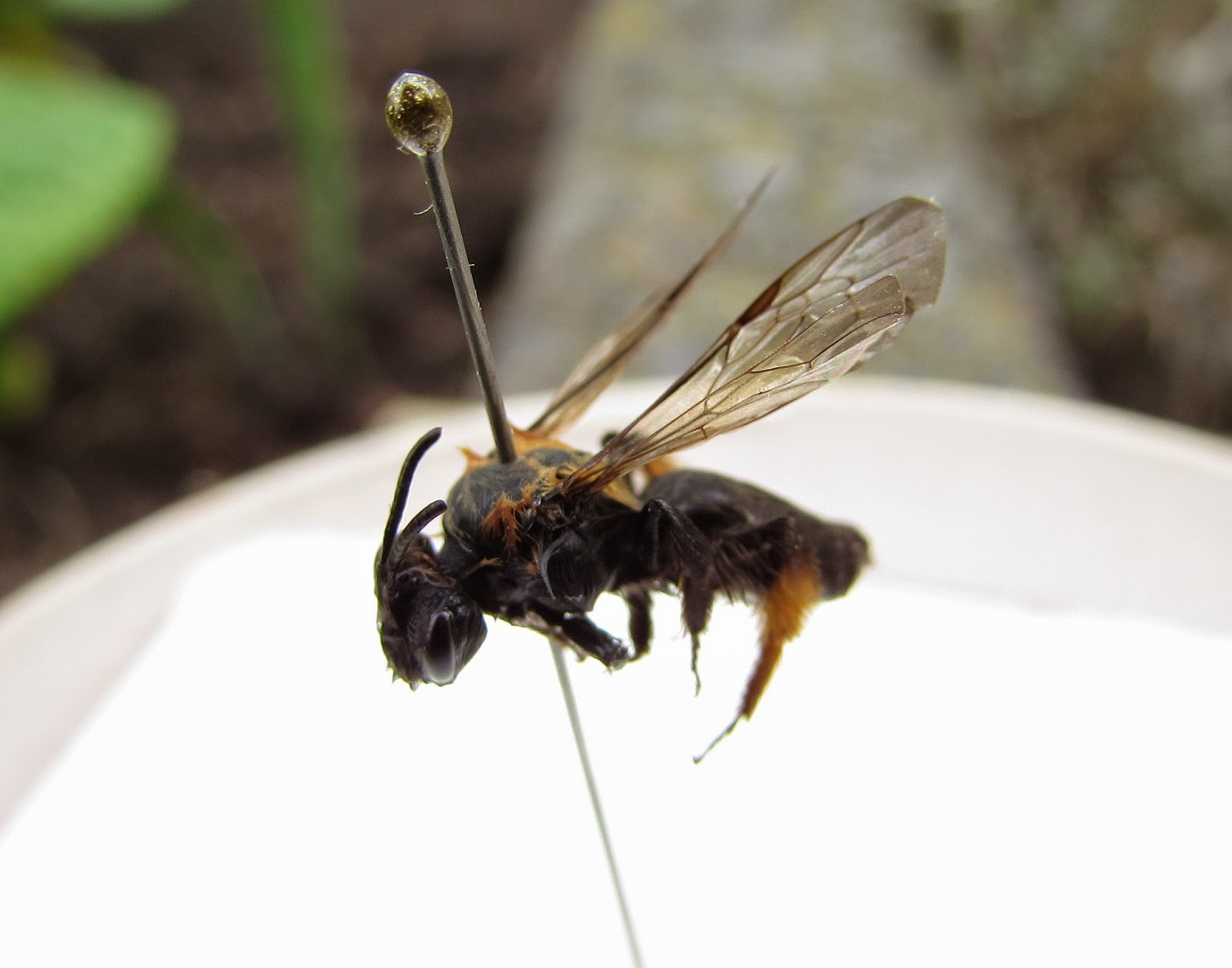
Alcohol will also mat the hairs of insects which can be an important identification feature. 
Plus its a little undignified. This was an Andrena solitary bee, species is probably clarkella 

Just to make a brief point here: I don't collect invertebrate specimens for fun or for ownership (I'm no Pokémon master). Present day Entomologists collect specimens in order to identify a species, and because certain features can only be practically observed when something is no longer moving. You can read more about the entomology code of conduct here:


Identification keys are quite like the 'Choose Your Own Adventure' books, in that you are presented with options and your choice tells you which page to go to. Mike has recently been updating and simplifying a key to British bees, this is a quick demo of part of it...
   For the pics I've used a smart phone down the lense of a microscope, but better naturalists than me will sketch features by hand as this helps with learning!

How to work out if your bee is male or female...

This female had 12 antennal segments...

...and 6 visible tergites (segments) on its rear end

So we know it is female, onto Key 2...


I can see 3 submarginal cells, slightly out of focus

Over to couplet 15...


Surface of eyes are definitely not hairy, and the marginal cell on the wing was relatively broad...

Over to couplet 16...

Couldn't see the tongue, but the wing vein was straight, plus the inner margin of the eyes are more straight than concave; over to 17...

I'm sure you get the jist! This one eventually keyed out to the genus Nomada, which is a type of Cuckoo Bee. These are common parasites of other solitary bees, laying their own eggs which after hatching then eat the larvae and food stores.

Now really is a good time to be getting into wildlife recording; with social media and online recources, everything is so much more accessible. Also, being able to share experiences with people at workshops or online means the entomological pursuit is no longer such an isolating one!

Many thanks again to Mike and everyone at BENHS who helps to put these workshops together.

Tuesday, 18 March 2014

Accumulating aculeates

I was really chuffed to have local naturalist Jeremy Early visit our sites last Thursday, staking out some possible bee and wasp 'hotspots' for surveying in the coming season. I had only recently learned the word aculeate, which is the group of invertebrates including bees, wasps and ants.


At the moment, you might be noticing a lot of pale-yellow fuzz on trees: these are the catkins of Willow or Sallow trees (Salix sp.). Before their leaves are fully open, the male trees produce catkins with copious pollen and nectar; a great food source for early invertebrates waking up from hibernation. 

Small Tortoiseshell Butterfly on Willow catkins, North West Zone

The past week or so, we had been seeing plenty of large bumblebees on the wing, but this day was comparatively quiet despite the good weather. Instead, some other niceties were out and about including Peacock and Small Tortoiseshell Butterflies. Just a few days earlier, this same Willow was frequently visited by large, sleepy queen bumblebees, newly awoken from hibernation. Here is a pic of a lovely queen Buff-tailed Bumblebee (Bombus terrestris) I had managed to net...

Buff-tailed Bumblebee queen (Bombus terrestris)

I hear that bumblebees would have to be severely provoked to sting us. Also, that the sting of queen bumbles cannot penetrate human skin, although I'd rather not test this theory!
   Over in Ashley's Field we staked out some of the flowering Blackthorn shrubs to see what would come humming by...

This type of hoverfly, called a Drone-fly (Eristalis tenax), is an excellent bee mimic

 Bee Fly (Bombylius major).
Another great mimic, this is a parasite of solitary bees and lays its eggs in their nests.

So, those were some of my pics. Here are some of Jeremy's photos from the day... They're not too bad I guess.

Peacock Butterfly (Inachis io) - Jeremy Early

Male Drone-fly (Eristalis tenax) - Jeremy Early

Small Tortoiseshell Butterfly (Aglais urticae) - Jeremy Early

As well as being a keen entomologist, Jeremy's hobby is wildlife photography and he is particularly skilled at snapping nature in-situ (as in its natural surroundings). I need to invest in a better camera!
   Tom S. and I recently met Jeremy at the Surrey Biological Recorders Seminar, where he was giving a talk about all the wildlife in his Surrey garden. We were already excited about our plans for Honeybees at Gatwick, so after his talk I made a beeline (ha!) over to him to ask about one of his slides: a photo depicting a massive bee house made out of natural materials.


Jeremy's insect boxes, aka the Bee and Wasp Hilton
Jeremy's garden has given us some great inspiration for a new volunteer project and one we can build on over time. He has many bee boxes and areas of standing deadwood to suit all manner of bees (he has recorded over 80 different species so far in his garden!). Boxes with drilled wood, bricks, bamboo canes, reeds and cardboard tubes have all proved popular with the local aculeates.


The wire mesh protects the homes of these hard-working insects from becoming a feeding station for birds such as Blue Tits and Great-spotted Woodpeckers.


The boxes have been well used since Jeremy installed them. As you can see, some of these tubes look like they have been plugged up. This is because they have been used by solitary nesting bee species such as the Red Mason (Osmia bicornis).

Jeremy and his splendid camera

You can check out more of Jeremy's photography and find out more about his incredibly absorbing book on natural history here: My Side of the Fence 
   Bees and wasps, like many invertebrates, are often overlooked and misunderstood by us. Did you know we have around 250 species of bee on the British mainland? They also play vitally important roles in ecosystems, such as pollinating flowering plants and providing food for other animals. If we ever lost them, and I don't just mean the Honeybees, we could be in quite a bit of trouble.


Many aculeates also lead fascinating and dangerous lifestyles, such as the sneaky behaviour of cuckoo bees, or the life-and-death struggle of spider-hunting wasps, all which can be seen in the British landscape. As the season goes on, I hope we can get records at Gatwick of as many different species of bee and wasp as possible.
   Find out more about Britain's bees at the Bumblebee Conservation Trust