Showing posts with label Cuckoo bee. Show all posts

Monday, 16 May 2016

Why i-Record wildlife

This week has been a monumental one for many biological recorders, thanks to the new fantastic phone app by the innovative iRecord team (seriously my favourite people right now)...

Links for phone downloads here: http://www.brc.ac.uk/app/irecord-app

Why am I so excited about this (free) app? Because it effectively cuts down on hours and hours (and cups of coffee and biscuits), spent entering data into excel spreadsheets or online at the desk. Instead, you can input wildlife records swiftly and with ease while out and about, maximising time spent out in the field (hey, you could even lose weight using this app!). It's basically why I chose a hefty Samsung S5 after renewing my phone contract - to be iRecord-ready!!

Entering a biological record

The interface is clean and simple; the fields are editable just by tapping on them, but you can lock any for repeated use. The entire database of UK wildlife (scientific and common names) is pre-loaded, and it draws the locations from the phone GPS, with the added option to just select a point on a map. 


Easy to create, edit or delete whole lists of wildlife records

Most pivotally, it works offline, so all data is automatically saved onto the device, ready for when you escape the 4G-blackspot or regain WiFi. A single tap, and all of your day's wildlife sightings are uploaded to the iRecord database, ready to be verified and feed into national wildlife recording schemes!
  For my work at Gatwick this has arrived in the nick of time, as things go crazy on our two biodiversity sites at the peak of breeding season and ecological surveys are back-to-back.
 
Great Crested Newt egg on a leaf (photo by Rina Quinlan)

Other recent highlights include Great Crested Newts (Triturus cristatus), returning to breed in Pond 3 after the humane removal of hundreds of fish just last year. A successful ending to this pond project, and no better seal of approval from our newts! Many thanks to all who were involved.

BAM! Record goes in.
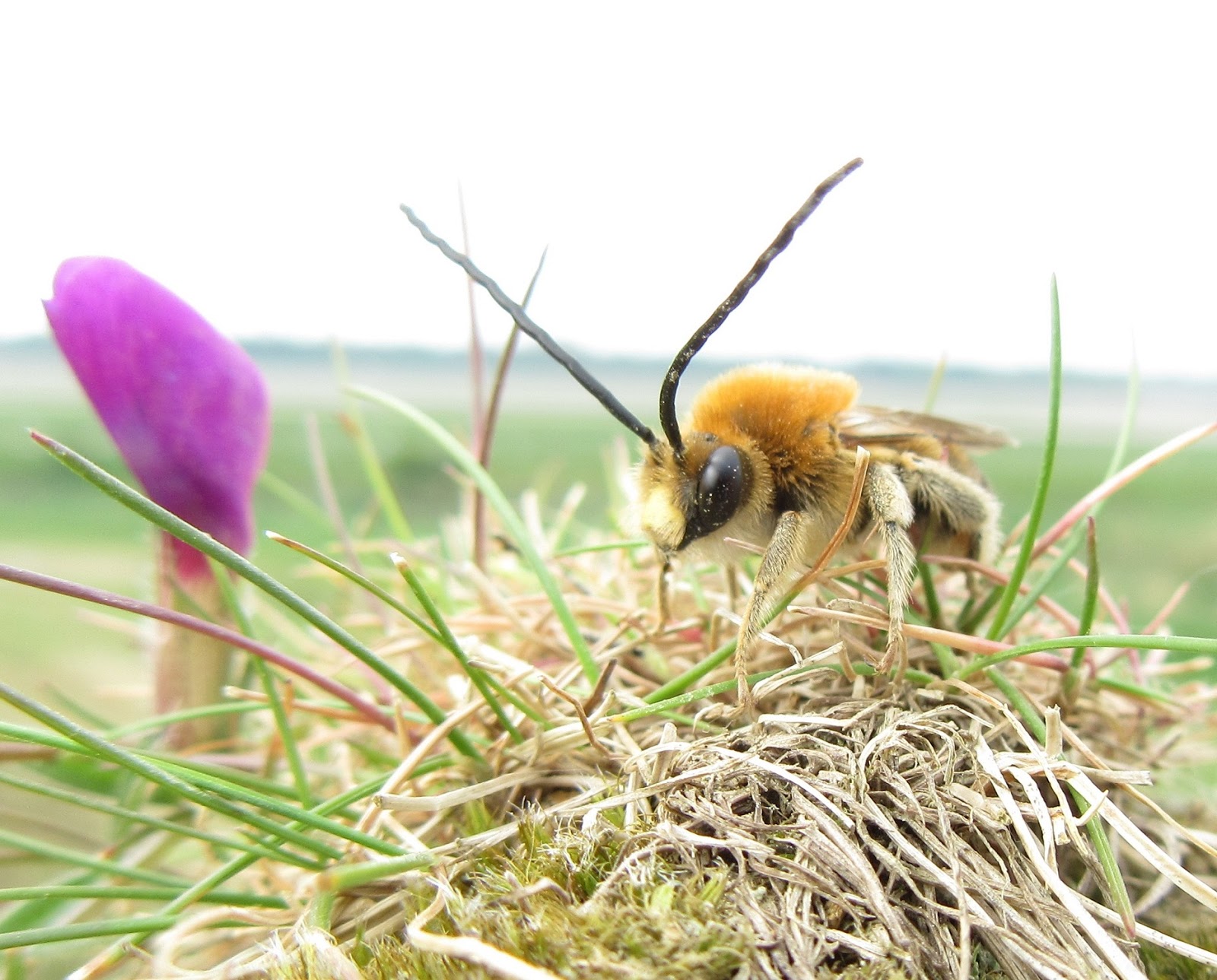
Our first male Long-horned Bees (Eucera longicornis) have also emerged last week; quite perfectly timed with the first flowers opening of Common Vetch (Vicia sativa) upon which these bees specifically nectar. Such amazing processes which happen beyond our detection!


Long-horned Bee with Common Vetch flower

BAM! Another record in. 

Gatwick has recently contributed a Buglife case study for this charismatic bee; you can find the publication and read more about our targeted habitat management by clicking here: Long-horned Bee at Gatwick Airport.

Eucera longicornis and a BA plane, Gatwick's North West Zone. 12/05/16

Cuckoo bees, other parasites and predators of solitary bees are also out in force and I'm only just learning about all the different varieties. Now that I'm saving on the data entry time (I <3 you iRecord!), I can finally put the guide to Bees by Steven Falk to good use. I think the lady pictured below is a Painted Nomad (Nomada fucata).. I'm happy to be corrected!


Just to top off a momentous week, we are now up to two male Nightingales (Luscinia megarhynchos) singing clearly in the North West Zone... and potentially even a third! I'll continue checking the site after evening moth and newt surveys; it would be incredible if they managed to breed here.

On the subject of Nightingales, I was recently shown this link by David Plummer - it's a famous recording of Nightingales signing in a Surrey garden on May 19th 1942. In the background, at about 2 minutes 30 seconds in, 197 Wellington and Lancaster bombers can be heard flying overhead on a raid to Germany. When you think about the violence and destruction these planes were portending, it gives the Nightingale song a rather melancholic edge.


Perhaps not so far from the site where that recording was taken, we unwittingly created a an updated version with a sound backdrop of a modern aerodrome.


Thursday, 1 May 2014

April Summary

The trend is broken and my monthly summaries are now going over into next month (it was never going to last!). Ah well, here is what we have been up to in April...

The clearing by the Hornbeam in Lower Picketts Wood

Our habitat management has quietened down for spring, so now is the time for wildlife walks and educational talks. Last weekend, Tom S. led a guided walk in the Land East of the Railway Line, looking at the results of our winter works and the flourishing wildlife there. 

The footpath through Horleyland Wood

The woodland groundflora looks fantastic right now and the clearings are busy with foraging flies and bees. Tom knows a whole lot about woodlands because of his background in forestry, so even the tough questions get an answer!
   While out and about in these areas, I have been collecting a small number of Cuckoo Bees (Nomada spp.) for further identification. To dispatch them humanely, I put them in the freezer for several days...

'Zom-bee'

Then after just a few minutes under the warm microscope, this little Nomada jerked back into life and was off to freedom! Somewhere in the Portacabin at least.

Close up of a Cuckoo Bee head under the microscope (x10)

The malaise trap is back up, this time in the North West Zone. I have mixed feelings about this as I still have a massive backlog of last year's insect samples to sort... All the same, many thanks to Tom S. and assistant Lewis.

Malaise trap: flying insects hit a panel inside then try to fly upwards,
 eventually falling into the collecting pot at the apex

We had an interesting and vibrant River Mole Catchment Partnership meeting, with both Surrey Wildlife Trust and the Environment Agency hosting. The talks were well illustrated, to the point and particularly interesting were some statistics for the recent flooding around the airport; the floodplain of the diverted section of river was praised!

The illustrious Jim Jones, Surrey Wildlife Trust's Wetlands Officer, giving a talk on recent conservation works and techniques to improve river channels. His ever-changing hair style keeps audiences rapt

 A felt 'Ketso' board - an interactive way of sharing and noting down ideas of how we can improve the river system. This was fun, but we're gonna need a bigger board!

We have completed a full check of all Gatwick's Dormouse boxes, both old and new. Finding over 100 boxes in one afternoon is no mean feat (it sucks), so I was massively grateful to be accompanied by Mum plus one of my sisters, Evie.


Also very helpful was Evie's iPhone, since I lost all my pens somewhere among those pesky Bluebells. The results are in; sadly no Dormice, but we do have around 40 nesting Blue Tits and Great Tits, plus two Yellow-necked Mice.

Newly hatched Blue Tit chicks

Yellow-necked Mouse (Apodemus flavicollis)

Here are some other wee beasties you might have seen out and about this past month:

One of Tom Simpson's Honeybees, drinking out of a puddle. Some bees have no standards

Grass Snake in a brash pile, Goat Meadow

Dark-bordered Beefly (Bombylius major)

Large Red Damselfly (Pyrrhosoma nymphula). My first of the year

Green-veined White Butterfly (Pieris napi). Lots of these about at the moment

Common Carder Bee (Bombus pascuorum). This is probably a queen

This large jumping spider is sometimes called the Fencepost Jumper (Marpissa muscosa). It is fairly common to South East but scarce in other parts of the UK

An oak apple gall, caused by a Gall Wasp. Possibly Biorhiza pallida

Finally, we got results from the infrared trail camera; sadly no Badger as of yet. I had been spending quite a lot of time watching through the video clips with absolutely nothing on them, so the very end of this video made me jump...

Monday, 13 May 2013

Roving Records - Land East of the Railway Line: 10/05/13


On Friday I carried out a check of our dormouse boxes in the LERL; sadly no further evidence of their nesting activity. However the boxes are certainly being put to good use by the Blue Tits and Great Tits...

At the moment over 1/3 of the boxes contain either Blue Tit or Great Tit nests

I was crouched down while making some notes and when I looked up I don't know who was more surprised, me or this male Roe Deer...

Hazel coppice understory, a dense Bluebell carpet and a curious Roe Deer in Horleyland Wood

It wandered in a large circle around me and casually sauntered off, another male not far behind it. I must have blended in pretty well; my clothing has definitely become more 'grungy' since I first started here (whether that's a good thing or not.) I'd like to think I'm becoming a better naturalist; most recently I have acquired some collecting pots, bought a utility-belt (i.e. a bumbag) and I've mostly stopped caring about getting my feet wet.

Common Frog tadpoles in the shallows of Pond 3 (I like our exciting pond names)

I was checking the final Dormouse box when I spied this well-hidden nest between the boles (thick stems) of an old coppiced hazel, proving it to be rather useful habitat. They are likely Blackbird chicks and might have a harsh appearance just now, but their eyes are beginning to open and in a few more days their feathers will be pushing through...

Blackbird chicks in a nest

 Comma Butterfly (Polygonia c-album) in Horleyland Wood. These guys are territorial; it flew laps around me and always landed back at this spot

  (The butterfly formally known as Cabbage White) a Large White Butterfly (Pieris brassicae), over in Goat Meadow

It was a good week for butterflies as well as other invertebrates; the first Large Red Damselflies have been taking to the wing over in the North West Zone, Orange Tip and Peacock Butterflies have been busy along the River Mole, Gatwick Stream and our woodland margins. I was chuffed to get a photograph today of one of these beasties out on the move, they rarely keep still long enough to snap...

A rather conspicuous stalker...

A few days previously Scotty Dodd, Surrey Wildlife Trust's expert entomologist, visited this site with me in preparation for summer invertebrate surveys. I netted one of these and took a picture before releasing it back out. Scotty identified it as a type of Cuckoo Bee, most likely the species Nomada leucophthalma.

Potted for a close-up of this cool little wasp-like bee

No pollen-collecting bags on her back legs... this tiny sneak travels light!

Although very wasp-like in appearance with its shiny hairless abdomen, this is actually a type of bee and a 'cleptoparasite' of other solitary bees... Basically Nomada has a rather sinister lifestyle which involves following other foraging bees back to their burrow, then sneaking in to lay their own eggs on the hard-earned food supply. There were a plenty of these tiny little lurkers about, which also indicates a good size host population...
I spotted many of these tiny burrows along the edge of the path in the woodland strip - likely to be Nomada's target host

The host solitary bee in question - Andrena clarkella, eyeing me suspiciously

This little lady is what the Nomada are busy hounding - an early ground-nesting bee with the lovely name of Andrena clarkella. They are an early season solitary bee and mainly collect the pollen of willow flowers. It was great to take a moment and watch the bustling activity of all these different invertebrates, deeply engrossed in their individual missions while the good weather held out.

Brown Tree Ants (Lasius brunneus). They nest in the old deadwood of trees, probably in one of our large veteran oaks of the woodland strip

Then a bonus end to the day is finding your only pencil where you carefully left it on the footpath.