
This has never been my favourite time of year as it usually signifies the end of
things – life slows down, flowers disappear, invertebrate diversity drops, the grass turns yellow, evenings creep in earlier and the mornings take their sweet time to get going. Migrating birds, such as Swallows and Martins, ram this point home by flying thousands of miles, risking storms, starvation and predators just to get away from it all. This time last year, sitting in my portacabin next to an aircraft hanger, a sense of poignancy pervaded.


The last of the dragons - a female Migrant Hawker, one of the latest active dragonflies
However, this year feels a little different as September has signified the beginning of new things. With the added help of other naturalists I have been squeezing in as many different ecological surveys as possible and we still have some exciting new ones to come including fungi, small mammals and pond invertebrates. I have been trying to cover as wide a range of species as possible.



The two main components of our Biodiversity Action Plan consist of monitoring wildlife, then hands-on conservation work to improve habitats. As the main survey season ends, our autumn practical tasks are kicking off with activities such as dead-hedging, reptile and amphibian hibernacula construction (a dug pit filled with rubble, logs and brash) and thinning out of old and dense tree plantations.


Our first airport staff volunteers of the season were the Accounts Payable Department, lead by West Sussex County Council's Volunteer Co-ordinator, Darren Rolfe and assistant Tom Weedon. The day was a definite success; no wind, no rain, no trees dropping onto volunteers plus only one piece of equipment went missing in the long grass - must be some kind of record!


The rare Bechstein's Bat we found earlier this month in Brockley Wood, North West Zone

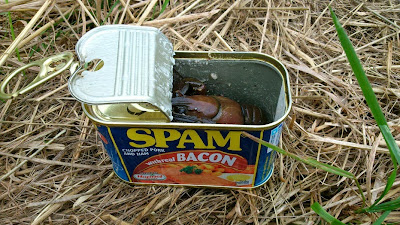
The removal of American Signal Crayfish continues in a section of the River Mole - they love the spam.

The most commonly found species in our dormouse boxes - a Copper Underwing Moth

So there is life out there other than Craneflies!
The two main components of our Biodiversity Action Plan consist of monitoring wildlife, then hands-on conservation work to improve habitats. As the main survey season ends, our autumn practical tasks are kicking off with activities such as dead-hedging, reptile and amphibian hibernacula construction (a dug pit filled with rubble, logs and brash) and thinning out of old and dense tree plantations.

Airport volunteers opening up a woodland ride into Upper Picketts Wood. This creates
space for the remaining trees to reach their full, healthy potential...

...also allowing the sun's valuable energy to strike the woodland floor, benefiting groundflora and fauna
Our first airport staff volunteers of the season were the Accounts Payable Department, lead by West Sussex County Council's Volunteer Co-ordinator, Darren Rolfe and assistant Tom Weedon. The day was a definite success; no wind, no rain, no trees dropping onto volunteers plus only one piece of equipment went missing in the long grass - must be some kind of record!

Thinning out the young tree plantation, targeting the Crack Willow for removal

Ashley's Field with a well-supplied work station
I joke of course, all our volunteer days go more than smoothly here. This group were a fantastic bunch with bags of enthusiasm and together they made a great difference. I must say I’ve never seen conservation workers so well kitted out, I mean, a cafetiere in the middle of a
field? Fair play... mine's an espresso macchiato, please!

Gatwick Greenspace Partnership (GGP) of the Sussex Wildlife Trust are the main conservation group here, carrying out community and environmental projects in and around Gatwick. I hear it has been nearly 20 years and they are still going strong. So when's the party, guys?

Gatwick Greenspace Partnership (GGP) of the Sussex Wildlife Trust are the main conservation group here, carrying out community and environmental projects in and around Gatwick. I hear it has been nearly 20 years and they are still going strong. So when's the party, guys?
Another aim of ours is to increase local awareness of GGP's work and to strengthen ties with the airport's numerous departments. Earlier this month, we set up a communications stand at the British Airways offices at Jubilee House, demonstrating the conservation works around Gatwick in order to engage the staff.

Phil Townrow, aka 'Phil the Bin', also joined us on the day: an interesting British Airways engineer who is green of mind and passionate about reducing the environmental impacts of aircraft operations, through projects such as aircraft waste recycling and biofuel production. Another example of how much is going on behind the scenes of an international airport and how little is known about it!


Kevin Lerwill of Gatwick Greenspace Partnership and Phil Townrow of British Airways Engineering
Phil Townrow, aka 'Phil the Bin', also joined us on the day: an interesting British Airways engineer who is green of mind and passionate about reducing the environmental impacts of aircraft operations, through projects such as aircraft waste recycling and biofuel production. Another example of how much is going on behind the scenes of an international airport and how little is known about it!

British Airways has ground-breaking plans for a biofuel plant, due to start operating in 2015
And so looking ahead there will be no time to relax in October, with a final push on reptile and mammal surveys, a jam-packed conservation schedule and a brand new Gatwick Greenspace team member joining the ranks; the pace is now picking up on Gatwick's Biodiversity Action Plans.

A surprise visit by this Dunnock who flew into the portacabin - maybe it was after my hobnob biscuits?


