Showing posts with label River Mole floodplain. Show all posts

Wednesday, 30 December 2015

Early Winter Bird Survey 2015 - North West Zone

Friday December 18th

R2-D2 Dreamliner

It was an incredibly a mild December morning when Jedi Birder Tom Forward, of the order Gatwick Greenspace Partnership, swooped in for our early winter bird survey.

The North West Zone, located in the Outer Rim Territories of Gatwick

Straight away we felt a strong presence in the force, scooping up a brand new species for our surveys landside at Gatwick... A Coot! 

It's a little odd that we haven't picked up Coot on previous surveys, but I have checked the ancient iRecord archive scrolls, dating back a whole 3 years and true it is confirmed to be.
  In some nearby scrub, we gained privileged views of a lone Fieldfare breaking its fast on tasty rose hips...


Other thrush species picked up here were Redwing, Song Thrush, Blackbird and Mistle Thrush. An excitedly singing Dunnock also made its presence known from a nearby hedgerow. 
   At the end of the canalised section of river, where the Mole begins to meander, we saw a dark shape nip into the reed bed... could it be?

The Water Rail victory dance

The calls of Water Rail are pretty unmistakable (and bizarre), sounding more like a squealing piglet than a wetland bird. Reed Bunting, Song Thrush and Wren also sounded off, hidden from view in the reeds, while a flock of Long-tailed Tits moved through the trees.

Reeds along the River Mole

Passing around the north side of Brockley Wood, Carrion Crow, Jackdaw and Jay were our first corvids of the day and the lively sound of a Redwing flock came from somewhere in the gloom. Incredibly, signs of spring were cropping up everywhere...

Elder (Sambucus nigra) coming into leaf


Out of the woods and into a busy section of floodplain, with Fieldfare flying overhead and mixed flocks of Blue Tits, Great Tits and Goldcrests foraged in the tree tops. As we rounded a bend in the river, the landscape was contrastingly tranquil, with softly calling Song Thrush and a lonely-sounding Bullfinch. 


Then again, all Bullfinches sound lonely... Maybe if they lightened up a little they would have more friends.
   Along the next section of river, the ground up from the boggy floodplain is on a rather steep incline and whippy Alder scrub makes the going tougher.


More Redwing zipped back and forth, busily foraging in the dense scrub and a Green Woodpecker spooked us with a loud yaffle, erupting up out of the grass.


A the furthest point downstream, just outside of our allowed survey time, we were treated to the sight of a Kingfisher perching directly in front of us and a small group of Roe Deer trotting off around the corner. (Even if noted outside of the survey time, we enter all of the day's species into iRecord.)


A final word of advice: before beginning your linear transect of 3km over difficult terrain, do check you have your car keys with you and they are not locked in the car all the way t'other end.

Fieldfare departs LGW

Species total: 32
  • Blackbird
  • Blue Tit
  • Bullfinch
  • Carrion Crow
  • Chaffinch
  • Common Buzzard
  • Coot
  • Dunnock
  • Fieldfare
  • Goldcrest
  • Goldfinch
  • Great Spotted Woodpecker
  • Great Tit
  • Green Woodpecker
  • Herring Gull
  • Jackdaw
  • Jay
  • Kingfisher
  • Long-tailed Tit
  • Magpie
  • Meadow Pipit
  • Mistle Thrush
  • Moorhen
  • Pied Wagtail
  • Redwing
  • Reed Bunting
  • Robin
  • Song Thrush
  • Starling
  • Water Rail
  • Wood Pigeon
  • Wren

Friday, 27 June 2014

Late summer invertebrating

You might not think there's much in the way of quality habitat around an airport. Fair doos, as I used to think that too.

Clay Slope, North West Zone

Last Monday, Jeremy, Scotty D and his little dog Ro returned to our site in the North West Zone for the follow-up invertebrate survey. By surveying twice at the same site, both early and late in the season, we can detect a greater diversity of species.
   
River Mole floodplain

The past few weeks, the River Mole floodplain at Gatwick has looked the bee's knees (I'll be coming back to the subject of bees!). This is the result of some large-scale sculpting works which took place back in 2000 when the watercourse was diverted. It is now a veritable hotspot in terms of floral diversity... 

Greater Burnet (Sanguisorba officinalis)

Grass Vetchling (Lathyrus nissolia)

Betony, Ladies Bedstraw, Quaking Grass

Meadow Vetchling, Greater Bird's-foot Trefoil, Lesser Stitchwort to name but a few. 
Artificially seeded? Either way, this lovely wildflower mix is a great thing for biodiversity

So colourful that my outlandish running trainers almost blend in

For this survey, we spread out to cover as great an area of the North West Zone as possible. The variety habitats, their different ages and structure provide plenty of options for food, water and shelter; potentially pleasing to even the fussiest kinds of invertebrate! 

Scotty grubbing around the dry slope while Jeremy searches for bees down on the floodplain

Ro the dog, focusing his efforts on keeping cool


Bishop's Mitre Shieldbug (Aelia acuminata). 
The weird angular head and stripes reminds me of the Muto in the latest Godzilla movie

Small Skipper (Thymelicus sylvestris) in cute begging pose


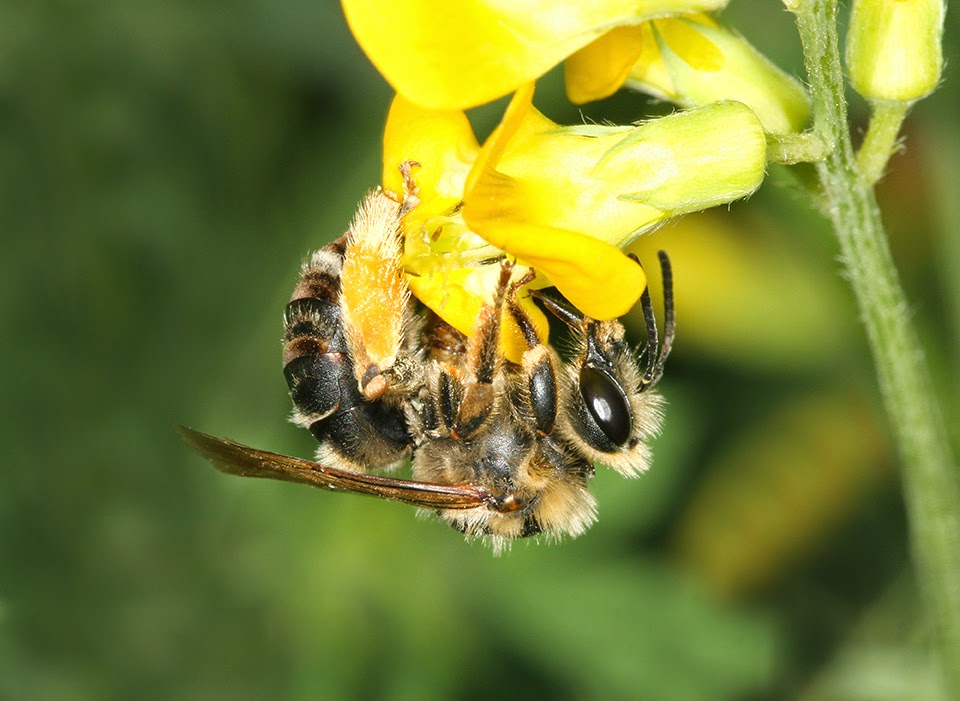
Since our recent exciting find of a rare species of bee, Jeremy and I spent some time staking out this section of the clay slope. We were hoping to see a few of the female Long-Horned Bees (Eucera longicornis) returning to their nesting sites...

Possible Eucera burrow?

I'll let you know the result of our great Eucera count at the end of this post!

Sharing observations

A pretty good indicator of how well a survey has gone is the number of specimens which Scotty has to take home for further microscope identification...

Just a few of his tubes; dude's got his work cut out

This type of sampling might look a bit grim, but we are unlikely to impact any populations and it is all in the name of science, with all data being passed onto the Biodiversity Record Centres.
   The following is a selection of Jeremy's excellent shots from the day (thanks again Jeremy!)...

 Broad Centurion (Chloromyia formosa) female. This looks like a Hoverfly but is actually a Soldierfly

Dusky Cockroach (Ectobius lapponicus) female. 
This is the first Cockroach species I have seen in Britain, and it is local to the south

An uncommon and nationally notable species of Hoverfly (Neoascia interrupta) female

Hoverfly (Scaeva pyrastri) male. This is a migrant species to Britain

Semaphore Fly (Poecilobothrus nobilitatus) male. Lots of these happy chaps gathered around small pools in the wet clay. They are named for the outlandish dance which the males perform with their wings

Striped Slender Robberfly (Leptogaster cylindrica), one of the most noticeable species out and about 

Water Ladybird (Anisosticta 19-punctata), the first time I have knowingly seen this lovely beetle

And last, but most definitely not least...

Long-horned Bee (Eucera longicornis) female. In the end we only spotted 3 individuals, so we had sadly missed its peak. In previous weeks we have counted over 10 in just one small area.

I'm afraid I will keep banging on about this particular bee until the cows come home (I have no cows).
Seriously though, the world of entomology means I can never be bored again!

Monday, 10 March 2014

To tree or not to tree...

...that was the question last Monday when a bout of bizarre weather rolled in. We have been up against some pretty rubbish conditions to get more Black Poplar trees planted on the River Mole floodplain. 

Braving the elements

Although intense rain and hail does add a certain edge to a task

It was the Security Leadership Team who drew the short straw, and fair play to them for persisting with this job! We had hoped to get a line of trees planted as close to the main channel as possible, which is a quite a challenge when the River Mole decides to misbehave. In addition to those we planted last year, these young Black Poplar whips were kindly provided by the Sussex Wildlife Trust and Wakehurst Place, so we are doing all we can to give them a good start.

Our line of native Black Poplar

The native Black Poplar tree Populus nigra subsps. betulifolia is under serious threat, with only around 38 mature specimens left in Sussex and 7000 in the whole of the UK. This tree naturally occurs in riverside woodland, which itself is now a rather scarce habitat due to modern land management practices. You can read more about the importance of this habitat and some of the efforts going into restoring it here: http://www.treesontheriveruck.org.uk/floodplain-woodlands.html


As these tree guards could be knocked over by the high flow (the Mole has a habit of quick-rising water levels and surges), Tom S. has directed the team in creating some log deflectors to snag debris and protect the bases of trees from getting bashed. These deflectors are staked into the ground with cut willow and we can continue building them up in time with extra logs.


Around 15 years ago, the River Mole here at Gatwick was diverted and sculpted to create large, natural-looking meanders and floodplain grassland. This habitat helps reduce the rapid water flow and flooding off the surrounding urban and airport areas, undeniably of benefit during the extreme wet weather at the end of 2013.

Scrub clearance to the west of Brockley Wood

After the trees were sited in their new homes, we continued on with some willow scrub coppicing to the west of Brockley Wood.

Habitat piling

Dead-hedging

As the day went on, Nathan was gradually morphing into another Tom...

Perhaps an improvement on the old Tom? I'd watch out if I were you buddy!

I imagine people might enjoy hearing about how badly behaved this lot were, but they actually mucked in and did a really grand job, plus not a single one of them ended up in the water... Sorry about that.

Carolyn, Nathan, Chris, Andrew, Allison and Julian

Thanks again team, we hope to see you out and about again this coming summer (if you haven't been put off!)