Showing posts with label grass snake. Show all posts

Saturday, 2 May 2020

Breathing new life into a neglected Farm Pond

The Gatwick Woodlands, sitting on heavy clay soils, are typical of the Low Weald landscape. The area is home to a series of small wet woods such as Aldar Carr in Upper Pickets Wood, Hazel and Hornbeam coppice in Lower Pickets, ancient semi-natural Oak woodlands in Horleyland Wood Local Wildlife Site (LWS) and the wet grasslands of Goat Meadow. These habitats contain a network of small ditches and ponds which hold water throughout the year and are important features for amphibians and reptiles, particularly Grass Snakes (Natrix helvetica). The most abundant reptile at Gatwick, the Grass Snake is a target species on our Biodiversity Action Plan. We have a well-recorded population with, interestingly, a small percentage of melanistic (black) snakes.


A number of individuals have turned up which are completely black (melanistic),
Image by Rachel Bicker

The mix of natural and man-made ponds across the site are in a constant state of change. Ponds will naturally silt-up over time, turning into other habitats such as bogs and, eventually, scrub and woodland. Historically, this was not an issue as new ponds would be created through natural processes like holes being left behind from wind-blown trees and flood or rain water filling scrapes. However, in the modern developed environment, habitats are fragmented and natural processes disrupted. Therefore, on a site like this, we actively manage our ponds to keep them open. Thanks to long-serving Gatwick Greenspace Partnership volunteer Adrian Slaughter, we have an excellent historical record of the management of some of our ponds. Adrian’s record-keeping helped to inform a recently-completed project that we hope will boost our reptile and amphibian populations further and also provide a fantastic space for environmental education.


The Gatwick woodlands once sat within the landholdings of Rolls Farm (Roles Farm on the above map from 1903), which was divided into two farmsteads of Upper and Lower Rolls Farm. The garden of the old Lower Rolls farmhouse contained a small pond which had been well maintained over the years. It even had a dipping platform built in 2003 by former Gatwick Greenspace Partnership (GGP) employee, now Senior Ranger at Buchan Country Park, Simon Rowledge.

Simon Rowledge (back) building a dipping platform with volunteers in 2003

GGP Staff removing pond weed from Rolls Farm pond in 2007

I visited the pond with Adrian in August 2018, shortly before the Rolls Farm building was demolished, with a view to restoring it to its former glory. We found the area overgrown with vegetation and the pond itself now only a shallow depression full of silt. However, the pond profile and skeleton of a dipping platform were intact. We decided that “all” we needed to do was remove the silt, check and level the banks, put in a new liner, landscape the entire area, and to add a couple of amphibian hibernacula and some pond plants.

Clearly, we were going to need some help! Luckily Gatwick Airport Ltd (GAL) staff are always willing to work for wildlife in their local green space and, combined with GGP’s experienced volunteers, this was shaping-up to be an exciting project. 
Rolls Farm Pond in a state of neglect in 2018

GAL Security and Terminals removing the silt

Work began in October 2018 when a team from GAL Security and Terminals  spent a day removing accumulated silt and clearing vegetation. This gave us a better view to measure-up for a new liner, which was funded by GAL’s Community Engagement department.


It was almost a year later, in September 2019, when we made it back to the pond with GAL’s I.T department. These fantastic volunteers went “all-in” on the project, committing four groups for a day each over the following three months in order to prepare the pond for the following spring.


GAL I.T working on the pond with GGP Volunteers


Their work was complemented by a group of enthusiastic volunteers from UKPowerNetworks who followed Amphibian and Reptile Conservation Trust's advice to build a new Grass Snake egg-laying heap. These heaps have proven to be a simple yet effective way of boosting juvenile recruitment. The key to their success is their composition and structure, which allow the heaps to maintain an even temperature, perfect for incubating grass snake eggs, but are not too compact so the animals can move around within them.


UKPower Networks in front of the Grass snake Egg-laying heap

The pond was completed in late January - just in time for storms Ciara and Desmond to fill it. The final touches were added by GGPs young Wildlife Rangers, the next generation of conservationists who could be looking after these habitats in years to come. They gave the pond a botanical boost by carefully translocating sedges, rushes, water mint and plantain from the nearby Gatwick Stream flood meadow. We would expect these plants and others to colonise naturally over time, however, providing some instant cover for amphibians and invertebrates can speed up the process and help the habitat get going.


The Wildlife Rangers found three large clumps of frog spawn in the flood meadow scrapes, a sure sign that there are amphibians in the area. Due to social distancing measures currently in place we will have to wait until next spring to sow some wildflower seed around the edges and to check the pond’s progress so far but we like to imagine that the local wildlife is flourishing in the area.


The pond restoration has been a fantastic addition for wildlife and environmental education and a project that would not have been completed without the willing volunteers of GAL and GGP. In future, the pond and surrounding habitats will be used as a space for local school children to learn all about wildlife and will, perhaps, inspire the next generation to keep our beloved ponds healthy and thriving for years to come. 


A huge thank you to everyone involved and particularly to Gatwick Greenspace Partnership volunteer Adrian Slaughter who has clearly demonstrated both the importance and pleasure of maintaining recorded links to the history of our wonderful landscape.


Thanks Adrian!

Monday, 31 December 2018

Wildlife calendar year at Gatwick

A selection of wildlife commonly found on the biodiversity sites, landside at Gatwick Airport.

January


Roe Deer - Capreolus capreolus

Our largest mammal species on site. I've also seen Fallow Deer very closeby, but never actually within our site boundaries.

February


This isn't a fungus, but is actually a type of bacteria called Nostoc commune; a colonial species of cyanobacteria.


Cyanobacteria are thought to have converted Earth's early atmosphere into an oxygen-rich one. It occurs extensively on the bare clay soil around the North West Zone and from a distance resembles squished rabbit poops.

March


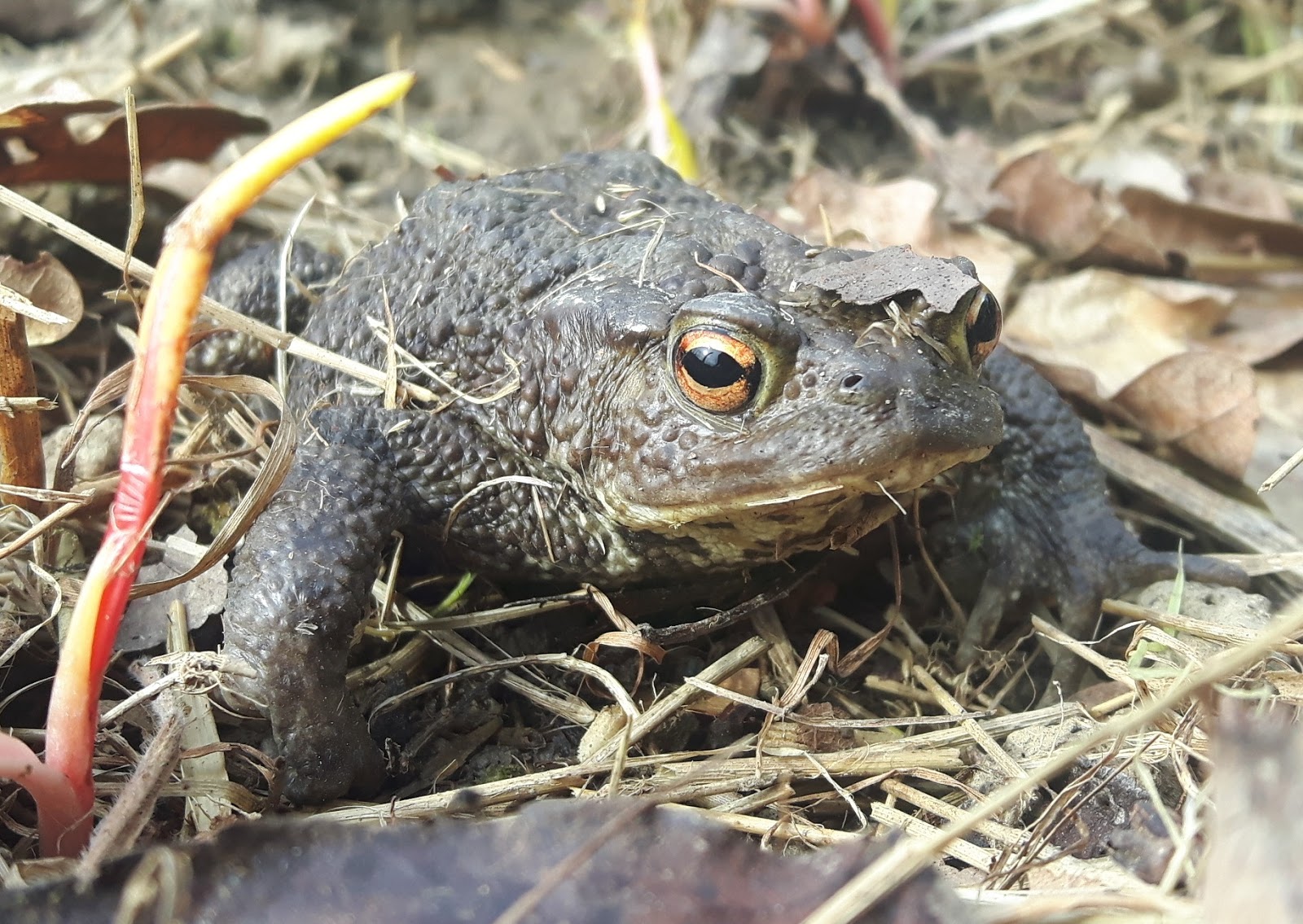
Common Toad - Bufo bufo

We often find Toads under the reptile matts long before the Grass Snakes wake up from their winter sleep. Breeding occurs in the ponds and within the reedbeds along the River Mole. Unlike frogs, Toads lay their eggs in long strings.

Toad spawn, North West Zone

April

Bluebells Hyacinthoides non-scripta. Horleyland Wood

Found throughout the woodlands at Gatwick, this ancient woodland indicator species crates a heady scent on warm spring days.

May


Not a mirror image, but in fact a mating pair of Eyed Hawk-moths Smerinthus ocellata, spotted by Tom Forward along the River Mole grasslands.


June

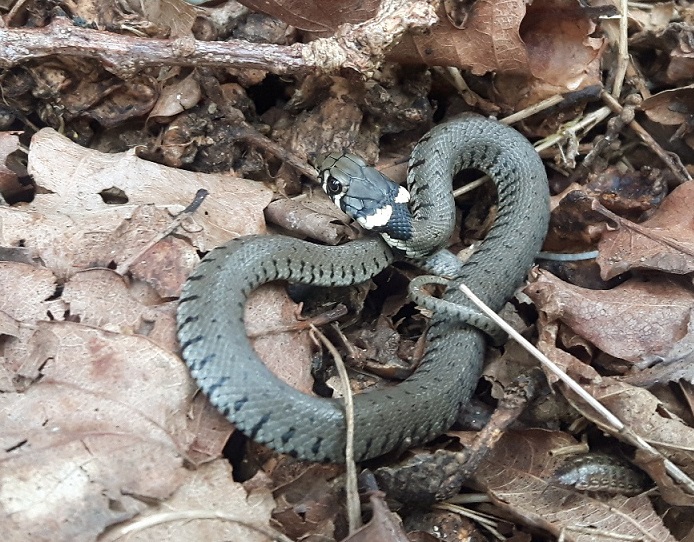
Grass Snake  - Natrix helvetica

Our most common reptile species at Gatwick; widespread across both sites but they are particularly found of the grassy margins of scrub areas.

July

Platystomos albinus - (a type of fungus weevil)

This is a Nationally Notable B species, found in a well-rotted pile of oak and willow logs. It may not seem obvious from the pic, bit this little dude measured only about 1cm from nose to rear! (Thanks to Graeme Lyons for correcting my I.D on this one).

August


A colony of these Willughby's Leafcutter Bees (Megachile willughbiella) set up shop in a bee hotel constructed by Tom Simpson's volunteers.


Leafcutter bee nest

September


Harvest Mouse - Micromys minutus

One of our smallest mammal species, these tiny mammals weigh in at around 5g. Their nests
are commonly found in the reed beds along the River Mole.


October

Brown Long-eared bats - Plecotus auritus

Arguably the cutest bat species on site, they often utilise the bat boxes in the Land East of the Railway Line. In order to open and check bat boxes, a licence holder must be present, which in our case is ex-air traffic controller Martyn Cooke.

November


Eyelash Cup Fungus - Scutellinia scutellata. Upper Picketts Wood

These tiny and beautiful fruiting bodies are commonly found on very damp, well-rotted wood.

December


Tawny Owl Strix aluco

It just so happens that Tawny Owls are the subject of a current BTO survey, which members of public can also join in on.


Happy New Year everyone and all the best for 2019!!

Thursday, 5 May 2016

And a Nightingale sang in... Gatwick Airport?!

Roving Records: North West Zone 3rd May 2016


There are certain clues that it will be a day of burgeoning wildlife, such as an incredibly warm morning after an extended cold snap. As soon as we got out of the car we spotted a flock of Swifts (Apus apus) high overhead, screaming as they drifted northwards - the first of 2016 for our site.

Scrub and grassland west of Brockley Wood

We wandered through a cacophony of different warbler songs; Chiffchaff, Common Whitethroat, Lesser Whitethroat, Blackcap and Garden Warbler could all be heard here.

Reed beds along the River Mole

Reed Warblers (Acrocephalus scirpaceus) are summer visitors from Sub-Saharan Africa, and they have now begun their chugging tunes along the River Mole...


A young male Kestrel seemed to watch us disapprovingly, until the alarm calls of small woodland birds caused it to move on.

My 2nd worst picture ever taken of a Kestrel (yes, there are worse)

Walking our usual reptile transect, we counted 6 Grass Snakes (Natrix natrix) under the refugia, including a massive adult female and 2 tiny juveniles (probably last year's hatchlings). There was no sign of the unusually striped or black individuals from last year.

A faded yellow collar on a Grass Snake can indicate an aged individual

Of course, it is not just the reptiles using these mats...

Common Toad (Bufo bufo)

A young vole, possibly Short-tailed Vole (Microtus agrestis)

Glow-worm larva (Lampyris noctiluca)

Donald meets his first ever Glow-worm

As we stood up from replacing a reptile mat, a low, bubbling call made Donald and myself exchange the exact same quizzical look, and a hesitation to be the first to speak...

   'That's a.....'
   'Nightingale!' Donald finished.

As if on cue, a wonderful stream of notes, then it blasted into full song. This really is an exciting find, so as soon as got back to the computer I trawled Gatwick's old ecological reports... yes, this is a new species for the site! 

I popped back around 11pm last night with Katherine to take this recording

We suspect this male might be a bit out on a limb here, so fingers crossed that a passing female hears him too. Although they can be heard in the daytime, they are definitely best heard at night, when all the other birds have quietened down.
  
Nightingale from The RSPB on Vimeo.

Nightingales (Luscinia megarhynchos) are a rapidly declining species in UK, largely due to the loss of their out-grown, scrubby habitats. Fortunately a few nature reserves such as the Knepp Re-wilding project have become hotspots for these birds. They only tend to sing from May until early June, so get your Nightingale fix now and book onto a Knepp Safari !

Tuesday, 10 June 2014

Magnificent moths and more


Last Friday, Sir Jacob of Everitt, Warden of Horsham returned to Gatwick with his trusty moth trap and his (mostly trusty) generator. We had high hopes for some excellent mothing conditions after such a warm and humid day.

A massive column of midges above our heads kept us company

We made sure the generator and trap were up and running before the sun set, giving us time to explore the grass and scrubland habitat of Goat Meadow in twighlight.

'Dusking' for moths

Eudonia pallida - a common micromoth species

Meshweaver Spider (Dictyna arundinacea). It looks like it's covered in cowhide 

Burnet Moth caterpillar, not far off pupating

Common Crab Spider (Xysticus cristatus), female

The air temperature was still pretty warm, but even then, while checking under one of the reptile refugia I wasn't expecting this incredible sight...

Grass Snake fest: five large adults (around a meter long) and one rather small fella all huddled up together

That's definitely the most snakes I've seen under one refugia! It's also right by our new and improved Grass Snake brash and log pile, so we must be doing something right.
   Back to the trap to see how we're getting on... 

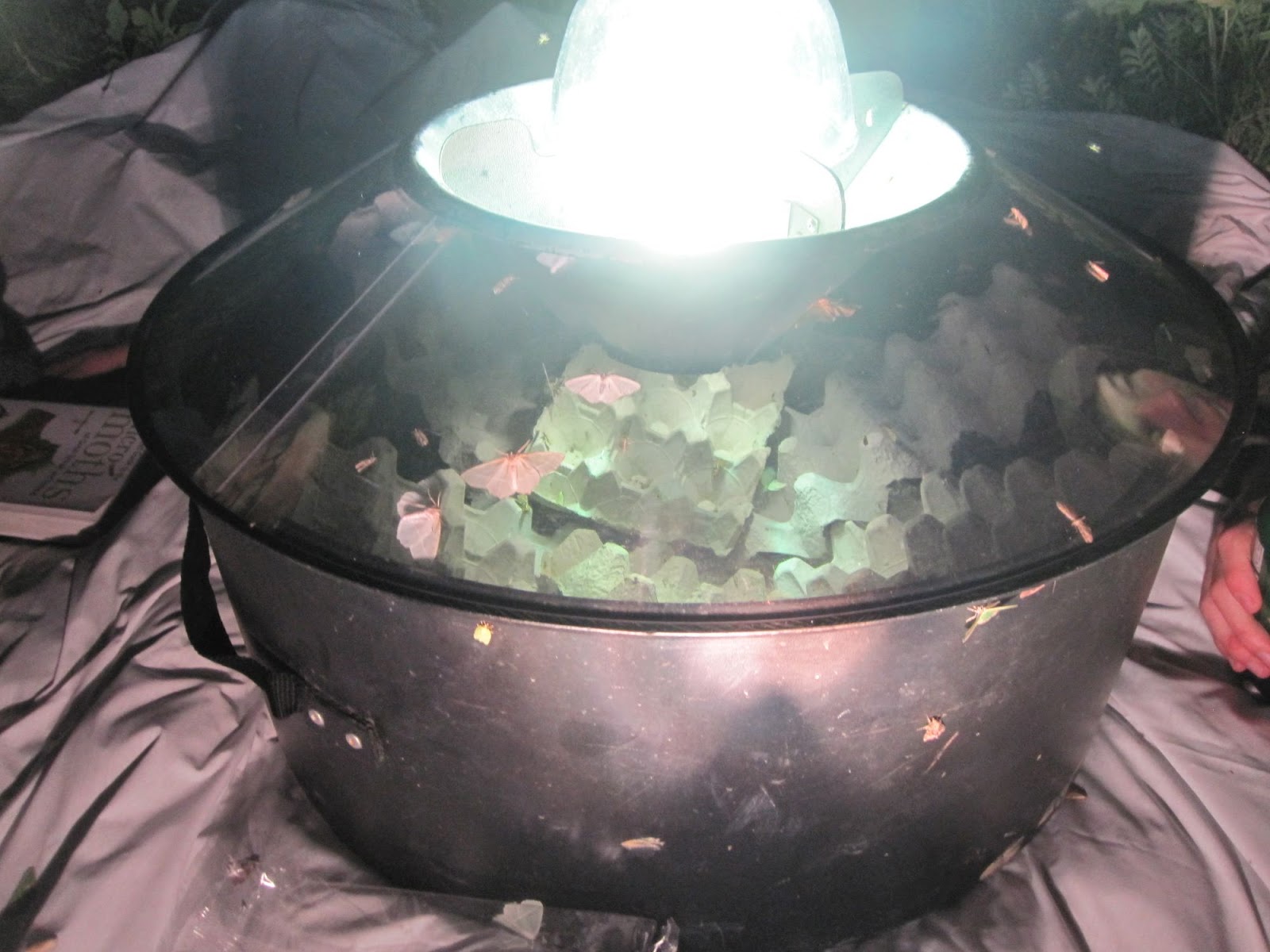
Jake's trap: a large actinic light bulb and a plastic bucket filled with egg boxes for the moths to settle on

The great thing about moths is not only their incredible diversity, but their aptly descriptive names which make them more memorable. They are well worth surveying for as they can indicate habitat quality; which food-plant species are thriving, whether there is a good woodland/grassland structure, if air pollution is high, or if pesticides are being used. The cool and windy weather can really put them off, but luckily tonight was mild and the moths began arriving at the trap before it was even fully dark...

Light Emerald (Campaea margaritata)

Blotched Emerald (Comibaena bajularia), but renamed 'Carlsberg Moth' by us

Coxcomb Prominent (Ptilodon capucina), side view

Coxcomb Prominent (Ptilodon capucina). It's like a tiny, fluffy Lion! 

We left the trap to carry on its work and went searching for flowering shrubs in the torch light, checking for nectar-loving species. We hadn't gone far before we stumbled across something else pretty awesome!

A funky green LED, out in the middle of the grassland

Photo taken with the camera flash on... 

This is a female Glow Worm (Lampyris noctiluca). It is not a worm at all but actually a type beetle, belonging to the Firefly class of insects (which incidently is my favourite class of spaceship). The end of her abdomen glows through bioluminescence, which is basically the light produced through an internal chemical reaction. I've regularly been finding Glow Worm larvae under the reptile refugia, even males in a moth trap, but this was my first glowing adult female!

Scorched Wing (Plagodis dolabraria), genuinely looks like a scorched piece of papery bark... 
I guess it has its reasons 

Back to the moth trap and soon it's time to start collating all the species. A comprehensive species tick-list makes things a bit easier with one person calling out the names and another recording.

Peach Blossom (Thyatira batis)

Peppered Moth (Biston betularia)

Moth accessories must be worn at all times

Jake says we got around 67 species from just one trap, which is not a bad haul. In fact, it was enough that some of them even decided to hitch a ride home in my rucksack; a Large Yellow Underwing flapping about your face while you're driving isn't ideal.
   Moths are blooming fantastic things when looked at more closely, so here are the profile pics of all 67 species I have diligently photographed...

Clouded Silver (Lomographa temerata)

Beautiful Golden Y (Autographa pulchrina)

Common Swift (Hepialus lupulinus)

Large Fruit-tree Tortrix (Archips podana) 

Just kidding, I do have some kind of social life at the weekend.
Even more moths and invertebrates to come this month!