Showing posts with label Surrey Wildlife Trust. Show all posts

Wednesday, 23 March 2016

Getting into ecology and conservation

Ask any ecologist or conservationist how they got into this line of work, and almost all will tell you about how they got stuck in with volunteering, and what awesome days they were!


Me in 2012, volunteering on a Water Vole survey with Row Baker at Arundel

Volunteering for the Sussex Wildlife Trust opened up to me a new world of local wildlife, and the passionate people who are trying to conserve it. There are many wildlife organisations out there wanting to engage with volunteers and recruit new members, and now social media makes it even easier to connect with these groups... a healthier use of Facebook and Twitter!

Myself and Laurie Jackson (who I also met through volunteering) have come up with a list of wildlife groups and recording schemes which people can get involved with, whether you're a student of biological sciences, a recent graduate, or just someone who is looking to get outdoors more and discover an endlessly rewarding new hobby...

Firstly, consider starting to keep a species list by signing up to iRecord: http://www.brc.ac.uk/irecord/

Events/ short courses in wildlife identification, ecology and field skills:


Sussex Wildlife Trust https://www.sussexwildlifetrust.org.uk/whats-on/category/adult-learning
Surrey Wildlife Trust http://www.surreywildlifetrust.org/whats-on?categoryid=7&categoryid=7
Knepp Wildlands Safaris https://www.kneppsafaris.co.uk/Safaris
Field Studies Council (FSC) http://www.field-studies-council.org/individuals-and-families.aspx


For families and kids:


Sussex Wildlife Trust family events https://sussexwildlifetrust.org.uk/whats-on/category/family-events
Surrey Wildlife Trust family events http://www.surreywildlifetrust.org/whats-on?categoryid=9
Amateur Entomologists' Society Bug Club  http://www.amentsoc.org/bug-club/
Field Studies Council family activities http://www.field-studies-council.org/individuals-and-families/family.aspx


Specialist courses and training ecological consultants:


Bat Conservation Trust http://www.bats.org.uk/pages/professional.html
Mammal Society http://www.mammal.org.uk/training
Amphibians and Reptiles Group http://www.arguk.org/events
British Trust for Ornithology http://www.bto.org/news-events/training
Chartered Institute of Ecology and Environmental Management (CIEEM) : http://www.cieem.net/events/category/56/cieem-workshopstraining
Acorn Ecology http://www.acornecology.co.uk/ecology-courses
Field Studies Council (FSC) environmental professionals http://www.field-studies-council.org/professional/courses-for-environmental-professionals.aspx
British Entomology & Natural History Society http://www.benhs.org.uk/about/meetings/
Freshwater Biological Association https://www.fba.org.uk/courses

The best advice after going on any training course or event? Get involved with wildlife surveys or field meetings straight away, either through the organisation you've just trained with, or a wildlife group local to you. Carry on with the learning and keep those newly acquired field skills honed; we all started out somewhere! 

National recording schemes & surveys:


There are many more than I have listed here, so you could also take a look at the Biological Records Centre website: http://www.brc.ac.uk/recording-schemes

Most these groups also have facebook pages with very active online communities, so there are always people to turn to for advice.

And for those of you more local to the Gatwick area, check out these active groups...


Wildlife groups and recording in Sussex:


Sussex Biodiversity Record Centre http://sxbrc.org.uk/
Sussex Mammal Group http://www.sussexmammalgroup.org.uk
Sussex Amphibian and Reptile Group http://www.sussexarg.org.uk
Sussex Bat Group http://www.sussexbatgroup.org.uk/
Sussex Ornithological Society http://www.sos.org.uk/
Sussex Botanical Recording Society http://sussexflora.org.uk/
Sussex Moth Group http://www.sussexmothgroup.org.uk/
Butterfly Conservation – Sussex Branch http://www.sussex-butterflies.org.uk/
British Dragonfly Society - Sussex Group http://www.webjam.com/bdssx
Sussex Sea Search https://sussexwildlifetrust.org.uk/what-we-do/living-seas/sussex-seasearch
Forest Row Natural History Group https://naturesbook.wordpress.com/events/

Sussex & Surrey:


West Weald Fungus Recording Group  http://www.westwealdfungi.co.uk/

Surrey:


Surrey Biodiversity Information Centre http://www.surreybic.org.uk/
Surrey Mammal group (Facebook page) https://www.facebook.com/groups/surreymammals/?fref=ts
Surrey Dormouse Group http://www.surreydormousegroup.org.uk/
Surrey Amphibians and Reptile Group http://www.surrey-arg.org.uk/
Surrey Bat Group http://www.surreybats.org.uk/
Surrey Birding Club http://www.surreybirdclub.org.uk/
Surrey Botanical Society http://www.surreyflora.org.uk/
Surrey Butterfly Conservation - Surrey & SW London branch http://butterfly-conservation.org/286/surrey--sw-london-branch.html
RiverSearch & RiverFly surveys http://www.surreywildlifetrust.org/what-we-do/living-landscapes/conservation-projects/riversearch


So there you go! My apologies as if I missed any off - please comment below and I can add to the lists.

Friday, 26 June 2015

Early invertebrate survey (the one that got away)

Wet weather and blustery conditions means that winged insects struggle to fly, instead staying hunkered down low in vegetation or hidden away in nooks and crannies (I wish it was the same for us ecologists).

Land East of the Railway Line

Earlier in the month, on a rare day of both sun and stillness, Surrey Wildlife Trust entomologist Scotty packed up his van and invertebrate surveying kit, stopping by to see what is happening under the radar of all the tourists and jet-setters.

Preparing sample tubes

Our task today was to check out some habitats which were missed off the previous surveys and needed looking at more closely. We've been keen to get back out to the Gatwick Stream since the flood alleviation project has come to a close...

Gatwick Stream grasslands

Wetland scrape with Great Reedmace (Typha latifolia), Gatwick Stream grasslands

Now the floodplain has had a full season of vegging up, in places it is looking quite stunning (albeit with the odd random exotic plant species cropping up). As the vegetation advances, the invertebrate lifeforms also begin to recolonise...

Agelena labyrinthica - Labyrinth Spider on dewy web

Underside of a Long-Jawed Orbweaver (Tetragnatha sp.)

A species of large diving beetle (Colymbetes fuscus)

Red-headed Cardinal Beetle - Pyrochroa serraticornis

Invertebrates form the essential base of many food chains and so can be excellent indicators of habitat quality. By seeing what species are dominating or what is absent, we can judge the success of our habitat management, then in a few years time we resurvey to measure the progress.

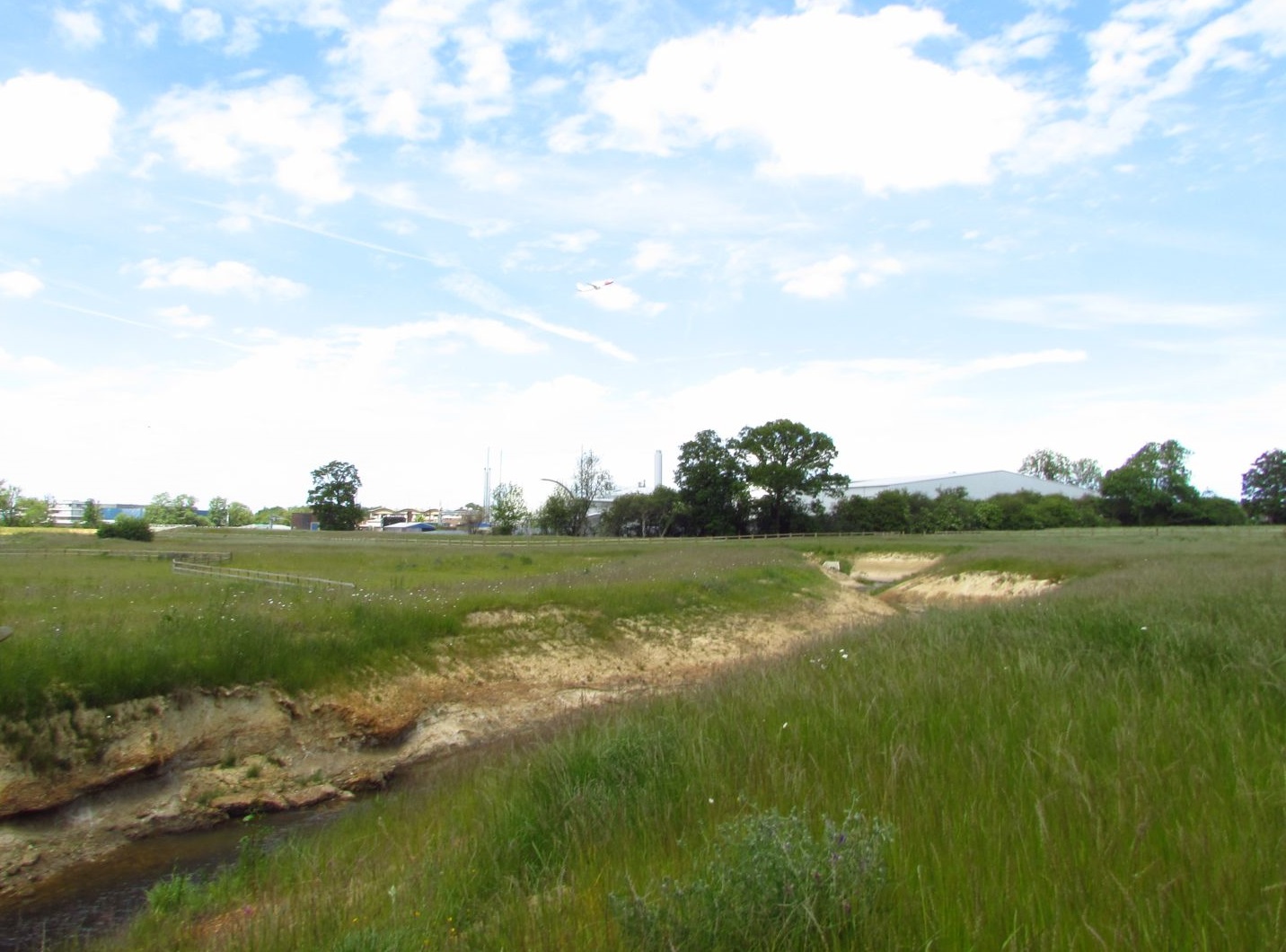
Gatwick Stream channel with its sculpted clay cliffs

The Gatwick Stream banks are still yet to green up, but even bare clay is appealing to some lifeforms, creating an interesting habitat matrix, suiting mining bees, mason wasps and beetle species. Even some birds too...

Kingfisher burrow

Here we had a brief interlude for some ancient bottle-collecting along the banks. These must have been underground for some time and washed out during the river re-alignment works...

Early 20th centruy Tizer bottle. "That belongs in a museum" 

Indiana Jones moment passed, it was time to look more closely at the pollen and nectar-gathering species...


Bumblebees on Fodder Vetch (Vicia villosa). Most were workers of either the Buff-tailed or White-tailed variety, as well as Tree Bumblebee

Corizus hyoscyami, aka the Cinamon Bug, or Squash Bug, or Scentless Plant Bug. 
(The perils of common names for invertebrates)

Over to another grassland area; Ashley's Field which is the subject of our green hay strewing project and home to our Honey Bee apiary, aka the 'Gatsbees'...

Ashley's Field - perhaps a little heavy on the Buttercup

Hitch-hiker: another Long-jawed Orbweaver

Into Upper Picketts Wood our the way to Goat Meadow, we stopped off to take a closer look at the understory.


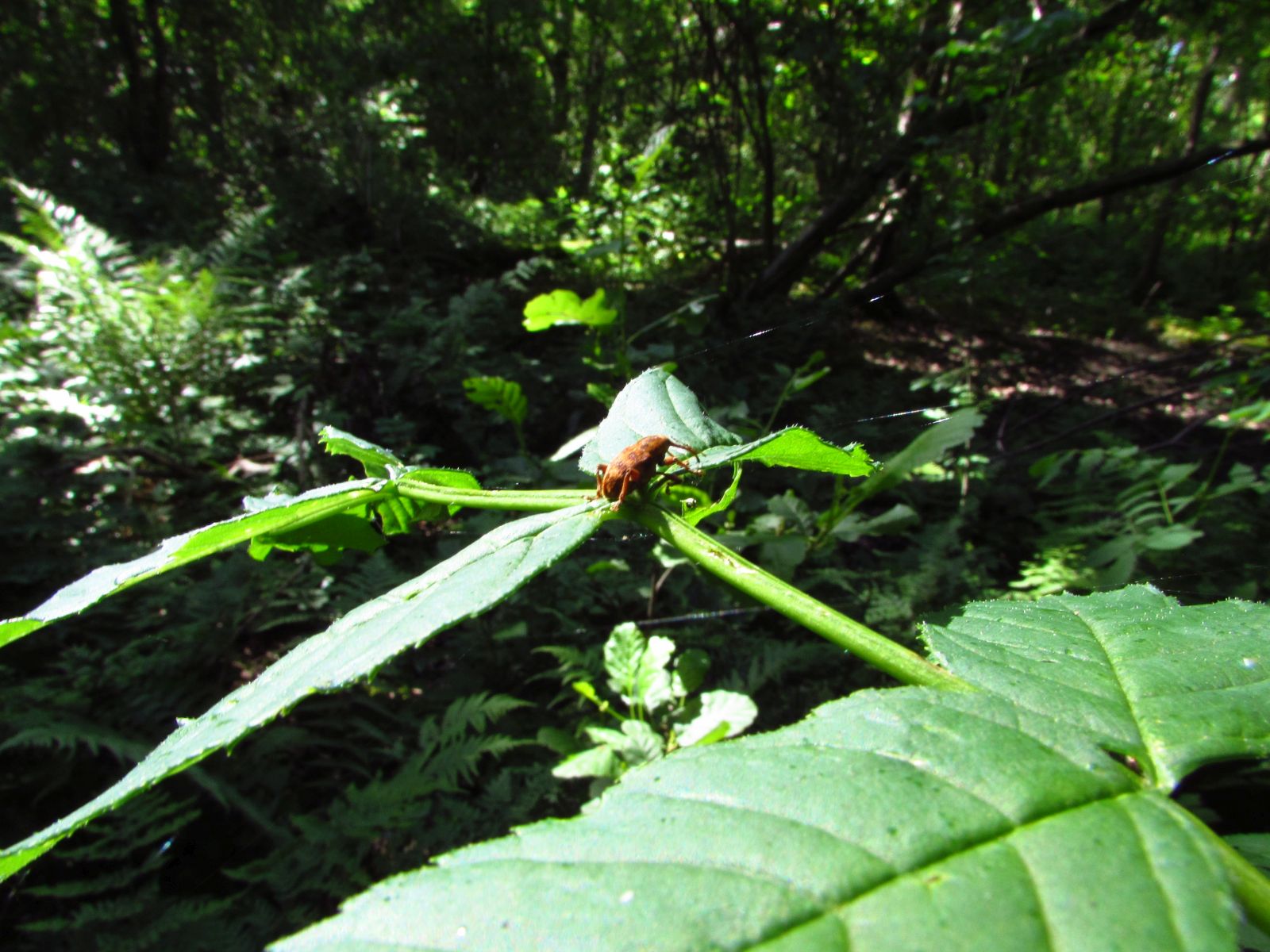
Nut Weevil (Curculio nucum

...giving Scotty a nip with its sharp, finger-boring mandibles!

Mr Finger-borer unfortunately took a nose-dive before I could focus for a close up.
   Over to Goat Meadow; a quieter, sheltered area of grassland. This lovely scrubby matrix is a real haven for butterflies and Grass Snakes. 


A few molluscs have made their way here too...

Wandering Pond Snail (Radix sp.)

Brown-lipped Snail (Cepaea nemoralis)

Scotty spent some time sweeping and beating the willow and oak scrub, turning up many interesting things including this funky little micromoth...

Alabonia geoffrella, with its funky, upturned labial palps

And I swept this punky caterpillar...

Vapourer Moth caterpillar (Orgyia antiqua). 
The adult female moths are wingless and emit pheromones to attract in winged males

14-spot Ladybird (Propylea 14-punctata)


A type of treehopper (Centrotus cornutus), one of only two species which occurr in the UK

Glowworm (Lampyris noctiluca) larva, commonly found under the reptile refugia

Scotty then called me over to take a look at this little beauty... 


A lovely little Jewel Beetle (Agrilus sp.)

Jewel Beetles are not very common in this area, so this could be quite an exciting find. We cooed over it for a bit, turning it over in the tube and I popped it back onto the willow leaf to get a better snap. It didn't stick around for long and this was as good as it got...

Agrilus sp. indet. cf.bickerisabloodymindedliberator

On handing Scotty back the empty tube, his face fell... Apparently there are over 3000 species of beetle in this single genus and he needed to check it under the microscope to identify to species level! Ooops.

...Fly, my pretty!

Thursday, 23 January 2014

A bad spate of affairs

I really feel for people in this area whose homes were affected by the recent flooding. On the other hand, it has made for some pretty good photo opportunities...

River Mole to the north of the airfield, North West Zone (Jan 2014)

Gatwick Airport operations were disastrously impacted over the Christmas period when an electricity substation flooded out in an unprecedented event. A lot of urgent work then had to be done to save several of the airfield regulators. Many people in surrounding areas such as Charlwood, Horley and Crawley were also badly affected, with some properties being flooded out on several occasions over the past month.

Airfield Engineering had a rather challenging time over the Christmas period (photo by David Maurice, Dec 2013). A contender for next year's airport greeting card, perhaps?

Apparently, a weather station at Reigate Grammar School measured 70mm (2.8") of rainfall over 23rd and 24th December, the highest ever recorded for (modern county) Surrey over a 24 hour period. With so much water falling so quickly in a largely concreted and industrialised area, the water drainage systems were severely pushed to their limits. In our woodlands and grasslands, the already saturated ground just couldn't take anymore and water was soon running off in torrents along paths and roads. The unseasonably warm weather means we probably have more heavy rain to come!

No training today at the Fire Training Ground (David Maurice, Dec 2013) 

Gatwick Stream and the cycle path (underwater) along the A23 at City Place (David Maurice, Dec 2013) 

The A23 by the South Terminal (David Maurice, Dec 2013) 

Although we might call this a '1 in 100 year' flood, we tend to have rather short memories when it comes to the weather. Apparently back in 1968 after an extreme rainfall (apparently in one area about 100mm fell in 24 hours), the water was halfway up these crash barriers as well as the South Terminal baggage system ending up under water. 

River Mole north of the airfield - March 2013. Here the river is in-channel

River Mole floodplain last week (Jan 2014)

The floodplain from the diverted River Mole section to the north of the airfield was created in 2000 and designed to hold a vast amount of water. The large meanders and natural pooling areas of the lower ground help to slow down the flow, hold more water and relieve some of the pressure further downstream in urban areas of Horley. This is a good example of an important ecosystem service which floodplains provide us.

River Mole Culvert Corner - December 2012

River Mole Culvert Corner - Jan 2014

For some wildlife, such as wetland birds, this is all rather fun with those pesky humans spending more time indoors and plenty of extra wetland about for foraging in. For other wildlife however, this amount of water could be devastating, particularly for ground hibernating animals such as harvest mice, bats, reptiles and invertebrates. There have been strange reports of whole armies of leatherjacket grubs (Cranefly larvae) marching out from saturated lawns. Those which cannot get away will die off, possibly meaning depleted food sources for other wildlife in the months to come.

River Mole netted section - April 2013

River Mole netted section - January 2014

This has all been rather interesting for the Surrey Wildlife Trust's RiverSearch project, which is building up a profile of the River Mole and associated streams as part of a catchment-wide scheme. At times like this, we can really see how these waterways are functioning: their attributes, limitations and what work needs to be done to ensure they keep functioning.


Finally, another trusty Gatwick coconut has made an appearance. I am currently tracking down the full story on these!

Wednesday, 4 December 2013

November Summary

Judge Dredge: Our digger driver Scott re-profiling a small channel of the River Mole

November has been as wonderfully wet and variable as was predicted (and still we moan and groan). The beginning of the month saw Winter Thrushes and Fungi surveys, with some ace discoveries such as the entire skeleton of a Grass Snake and a sneaky Woodcock in the wet woodlands. Also, Redwing and Fieldfare can be heard in the hedgerows and surreptitious fungi found in almost every nook and cranny.

Yellow Brain (Tremella mesenterica), on a log pile in the North West Zone

I've had a busy time at my desk writing up this Summer's work - entering data, updating task trackers, two Biodiversity Action Plans and preparing for a Bio Benchmark internal audit. Karen from Gatwick's Environment Team visited our sites in the North West Zone, taking a close look at our protected species habitat works. This has resulted in some revised habitat targets for this winter and some exciting new surveys planned for the spring!

Bat roosting box 1: Outskirts of Brockley Wood, North West Zone

In terms of habitat conservation, JS Agriculture recently opened up a side channel on River Mole which had become obstructed with woody debris. Clearing this channel has allowed faster flow around the willow scrub, reducing the effects of over-silting.
   Gatwick Greenspace Ranger Tom Simpson has had a busy couple of weeks with various meetings and courses; when you coop-up a ranger it inevitably results in pent-up energy and zeal to get out for heavy duty works! He put me and our volunteer Josie to work, removing large and sickly Birch trees in Upper Picketts Wood and opening up an area to reinstate a traditional Hazel coppicing regime.

Josie from External Security demonstrates a 'gob cut' on a Birch tree. Or a 'face cut'. Or is it a 'bird's mouth'? Basically it's a wedge of wood.

She finishes the job with a 'felling cut'

Birch tree smack-down

Ex-Birch is now a habitat pile in Upper Picketts Wood

Just last week, I travelled many, many meters to Mickleham in Surrey for some RiverSearch training with Surrey Wildlife Trust volunteers. This brilliant initiative is being rolled out to encourage people to champion their own section of a local rivers. It enables them to record habitat features, recognise problems such as invasive plant species and identify where intervention might be needed. Surrey Wildlife Trust is working with the Environment Agency on initiatives such as RiverSearch to improve the health of the county's freshwater habitats. I'm really looking forward to getting stuck in with surveying Gatwick's main waterways.

Volunteers from Surrey Wildlife Trust being watched by a nosy young bullock.
Luckily no one was wearing red so we - oh wait...

As I am going to be spending a bit more time indoors, I'll be sharing a few of my desk-top discoveries. After trawling through some arachnid photos from over the summer, I found this prettily-patterned specimen, belonging to the jumping spider family (Salticidae). I had unknowingly snapped the notable spider Marpissa muscosa; a rather scarce species throughout Britain, although it may be fairly common to this locality.

 Marpissa muscosa - Not the best picture as I only had my camera phone on this day

Finally, here's something particularly awesome - the dried specimen of a captive-reared Death's-head Hawkmoth (Acherontia atropos). This is not something you get to see often in the wilds of Britain... although it just so happens I was lucky enough to see a live one with Tom Forward in 2012! You can read about our star find here: http://biodiversitygatwick.blogspot.co.uk/2013/07/death-on-swift-wings.html

Views of Acherontia atropos - This is a couple of years old so missing a few limbs

Many thanks to Paul who gave this to my mum at the Royal Oak Pub (she was pleased by the way!) I have now passed it on to my fella who teaches a class of Year 4 students; wish I could be a fly on the wall when the class sees this!
   Coming up in December: Harvest Mouse nest searches, hard-core Winter Bird surveys and more conservation works, this time focusing in the North West Zone.