Guest post: Brad Scott (Sussex Botanical Recording Society)

River Mole track, North West Zone
The bryophyte survey of Gatwick started in 2018, focusing on the eastern part of the estate, and this activity has now continued during 2019, exploring the western area, along the River Mole and Brockley Wood. Both parts of the site contain largely similar species, though the character of the two areas is different, and a good number of species were recorded this year which had not been found before.
The corridor of trees, scrub, grass and banks along the River Mole at the north of the site contains a relatively limited flora. Grass and scrub contain the common species Brachythecium rutabulum, Calliergonella cuspidata and Kindbergia praelonga, and common epiphytes are found throughout the area. Willow is a particularly rich host for epiphytic bryophytes, and consequently on the trees along the river can be found Cryphaea heteromalla, Metzgeria furcata, Metzgeria violacea, Orthotrichum affine, O. diaphanum, O. lyellii, O. pulchellum, Radula complanata, Syntrichia laevipila, S. latifolia and Ulota phyllantha, some in good quantity. On the river banks and other frequently inundated areas can be found Platyhypnidium riparioides.

Syntrichia latifolia
Path edges and soil are often colonised by small acrocarpous bryophyte species, which include Barbula unguiculata, Dicranella staphylina, various Didymodon species and Pseudocrossidium hornschuchianum, and the liverwort Lunularia cruciata. Many of these are part of a dynamic flora, changing over the years as larger species move in. This means that some transient taxa can be found, the most significant being the small frilly-leaved liverwort Fossombronia caespitiformis, which is a rare colonist with a Mediterranean-Atlantic distribution. A more common species in this genus was found in 2015 in the eastern part of the Gatwick estate; these can only be determined with fertile plants, with capsules present, so that the decoration of the spores can be examined. It sounds harder than it is. Fossombronia caespitiformis was found with Weissia controversa var. controversa on an otherwise bare bank about 10m back from the river.

F. caespitiformis spore
The middle section of the river comprises slightly richer wooded habitats, including species such as Atrichum undulatum, Eurhynchium striatum and Mnium hornum. Some additional epiphytes were also found, such as the tiny liverwort Cololejeunea minutissima (often, but not always, on Ash), Orthotrichum stramineum and Zygodon viridissimus, with its distinctive longitudinally septate gemmae. Brachythecium albicans can be found on various sandy banks, and a number of other common species associated with buildings, concrete and similar substrates occur.

River Mole at high flow
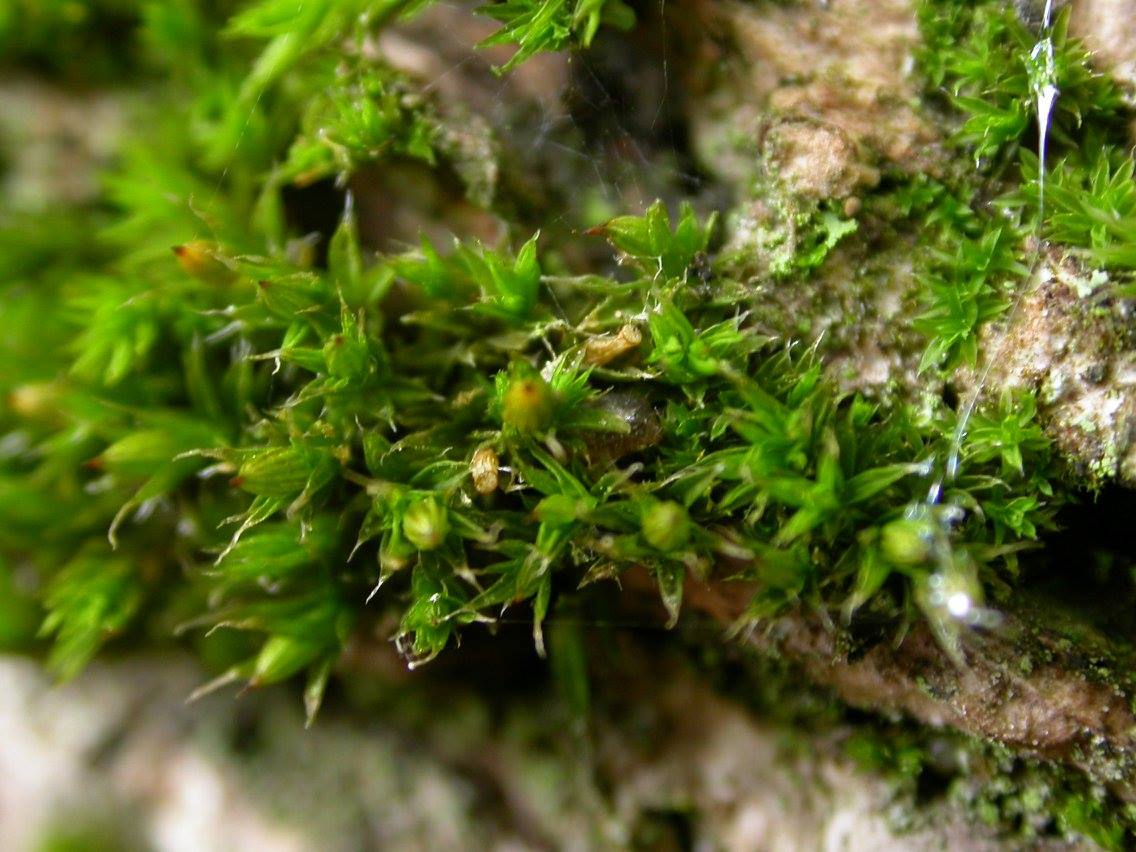
The southern-most section has a slightly different character, with occasional patches of the large scented liverwort Conocephalum conicum above the water by the river, and the moss Oxyrrhynchium speciosum in among the wet, scrubby area west of Larkins Lane; this is rare in the south-east, and I had to compare my sample with some material collected a few years ago in Cambridgeshire on a meeting of British Bryological Society. Additional epiphytes were recorded along the river and in Brockley Wood, such as Syntrichia papillosa, Ulota crispa and Zygodon conoideus, and large areas of drainage and boundary banks near Horley Road were often abundantly covered with the scarce moss Epipterygium tozeri. This species has a world distribution which is mainly of xerophilous Mediterranean communities. In the UK it is at the edge of its range, and is mostly known from Devon, Cornwall and south-west Wales, with scattered records in other southern counties.

Epipterygium tozeri leaf

E. tozeri

Ditch habitat within River Mole woodlands
This second survey has turned up a number of fairly common species which were not recorded in 2018, plus a few rarer ones, bringing the total to 96 taxa, which is a very good number for a low Weald site. Some of these may have been overlooked, while others either have little suitable habitat across Gatwick as a whole, or within LERL. The river, with its frequent willows, provides good habitat for a wide range of epiphytes, as well as several species that occur on the edge of flowing freshwater habitats. Disturbed soil often hosts many early colonising species, and the various groundwork and other activities provides considerable opportunity for many different bryophytes to thrive. Most of the site is neutral to basic, as evidenced by the species present, but some areas contain more calcifugous species.

River Mole at medium flow
Continuing attention to the site in the coming years may well reveal additional species, and the slowly-changing flora may be profitably monitored as the years go by, as new groundwork is undertaken, and the recent landscaping settles and matures.