Showing posts with label Yellow-necked Mouse. Show all posts

Monday, 28 September 2015

Dormouse discoveries!

It is the end of a busy Friday afternoon and Laurie's phone rings. She looks down at the caller I.D., sighs and wonders what random question Rachel now has about bats (I still find bats incredibly complex and alien beings). Or birds. Or moths. Or Harvest Mice.
 

After reading my excited text, she tries to call me back right away. Of course, as I'm somewhere in Gatwick's woodlands with unpredictable phone reception, this goes on for sometime... 
   And so, after finally getting through to each other, I then get to say the words: we've got Dormice!

The elusive Hazel Dormouse (Muscardinus avellanarius)

Gatwick's sneaky ginger-ninjas have finally been spotted in the fur; they couldn't elude us anymore! Laurie is a licence holder for several UK protected species and experienced in Dormouse handling, so I was awesomely appreciative that she shot up to Gatwick to lend us a hand. We found two individuals in separate boxes; here they are, resplendent in their golden-brown refinery!
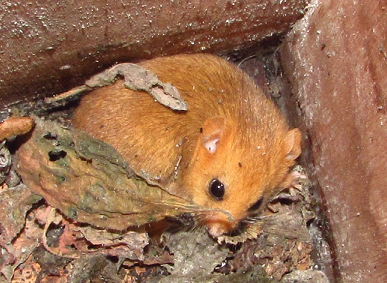
Hazel Dormouse (Muscardinus avellanarius)

We reckon these might some of the best-looking Dormice around too... (Not that we're biased).

Hazel Dormouse (Muscardinus avellanarius)
Big eyes, small ears, fuzzy tail. Evolved for maximum cuteness

These furry fiends are notoriously difficult to detect - they live in low numbers, are arboreal (tree-dwelling) and mostly come out at night. Still, after 3 years of surveying it was starting to wear that we hadn't seen the little blighters in the fur. Quite frankly, they were making us look bad. 

On the other hand, our Wood Mouse and Yellow-necked Mouse record database had really come along!

For comparison: Yellow-necked Mouse (Apodemus flavicollis);
 darker fur, bigger ears, pointy nose... Bigger attitude!

She might look chunky, but this little female weighed about 19g, making her over half the weight of a Yellow-necked Mouse which tipped the scales at 40g. 

Hazel Dormouse (Muscardinus avellanarius
Hey, remember folks, the camera adds 10 pounds

Slightly insulting was the fact that they were found in boxes installed by Tom Simpson's volunteer group, rather than mine from the 3 years before. This goes to show there is just no accounting for Dormouse taste (being from Crawley after all).

Laurie checks age and sex, then pops it into the weighing bag. 

Unoccupied nest - the centre is tightly woven with fine strands of Honeysuckle bark,
 the outside is layered with recently fresh hazel leaves

For now, we will continue with monitoring the Dormouse population at this site under the supervision of licence holders, carrying out regular box checks and looking out for signs of breeding.
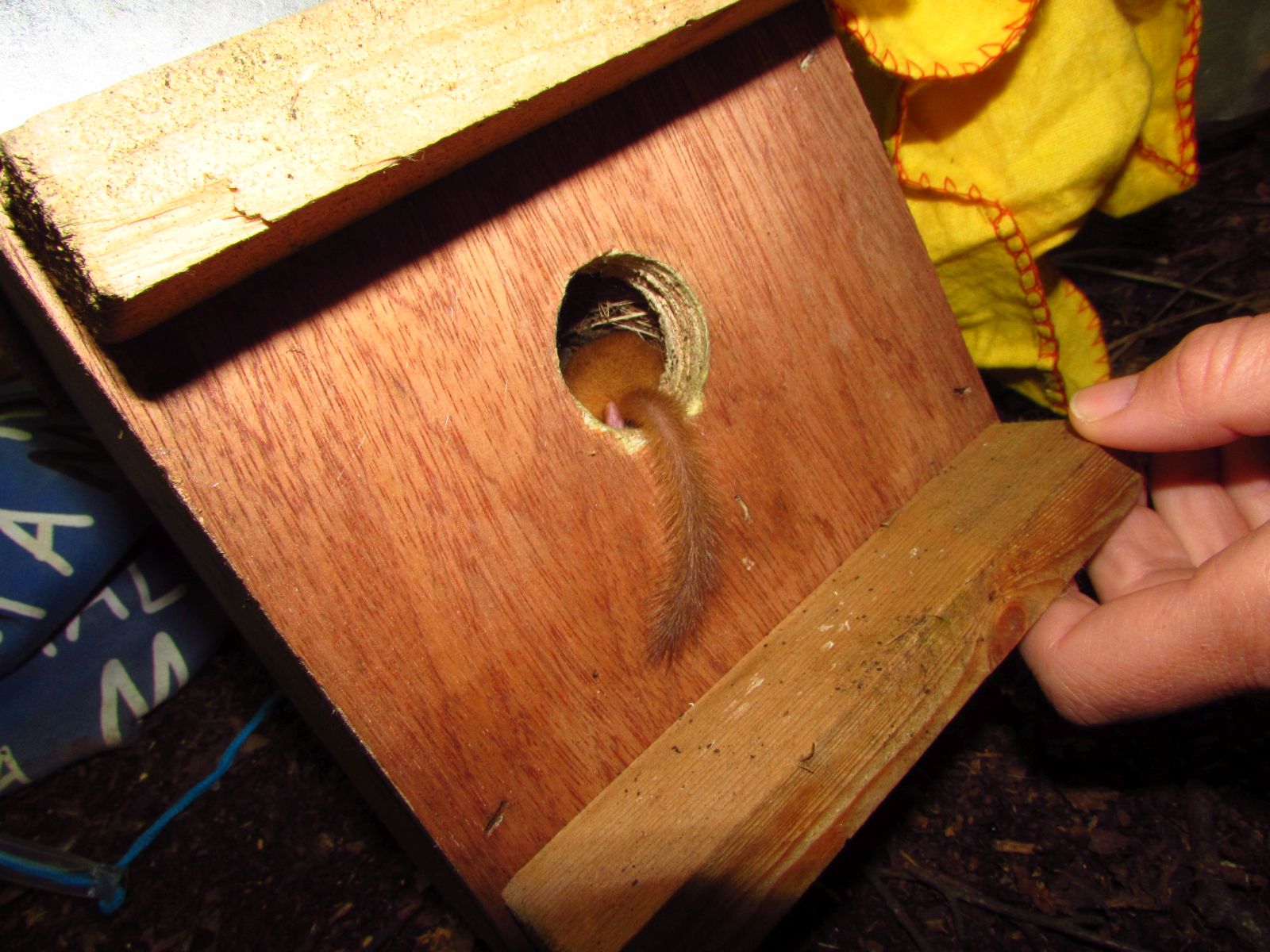
Home-sweet-home

About this time every year, a YouTube vid makes the rounds of the internet, featuring a Dormouse apparently snoring. The mammal officer who took the footage says the ridiculous sound was added on afterwards; the actual sound is more like a high-pitched whistle (d'awww!). Still, it is gorgeous seeing a Dormouse in torpor (deep sleep).


To find out more about the Hazel Dormouse, check out the People's Trust for Endangered Species.

Wednesday, 16 April 2014

Small mammals vs. large mammals

Working with animals and teenagers may at first seem a hairy sort of idea, but then again you might be surprised.

At the end of a manic March, a group of around 15 of the Gatwick Greenspace Partnership's Youth Rangers visited our woodlands and grasslands, over in the Land East of the Railway Line. The main aim of the day was to survey Gatwick's small mammals, targeting the different habitats to see what we could find. 

A Longworth trap in woodland undergrowth

Vacancies: a free overnight stay with full board

In the 3 days leading up to this event, I set out some humane Longworth traps which were checked and reset every 12 hours. They were stuffed with plenty of warm hay, a generous stash of porridge oats, fresh carrot and mealworms to suit all mammally tastes.
  Surveying over several days gives time for the small mammals to acclimatise to the presence of the traps, so every day our capture rate increased. On the last day we got a record number of mammal captures, so it was fortunate having the Youth Rangers to carry out the brunt of the work!


This group did an awesome job, becoming efficient at emptying each trap carefully into a bag, recording the weight and sex of the critter before releasing it out and finally resetting the trap. I was impressed by how well they communicated with each other and minimised the stress to these small furry beasts. Here's a selection of what we came across...


Bank Vole (Clethrionomys glareolus)

Bank Vole (Clethrionomys glareolus)

Wood Mouse (Apodemus sylvaticus)

Yellow-necked Mouse (Apodemus flavicollis) with distinctive yellow collar across the chest

Wood Mouse (Apodemus sylvaticus), back out to freedom

Out of the 28 traps, almost every single one had triggered overnight (a few possibly accountable to intrepid slugs), 19 of them containing a small rodent. We found 3 different species, the commonest being Wood Mouse with 14 individuals counted.
  .

Checking our Hedgehog tracking pads

Lots of tiny tracks which are much too small for Hedgehog, so most likely Wood Mouse or Bank Vole

But the work did not stop there, as I wanted to get my money's worth out of this keen bunch! We also checked the Hedgehog tracking tunnels and cracked on with building the new stands for future Harvest Mouse surveys (an idea we blatantly plagiarised from the Surrey Mammal Group - thanks again Jim!).

Creating Harvest Mouse trap stands

I had also set up a camera trap in a hidden part of the woods, as I am keen to finally pick up recorded evidence of Gatwick's Badgers. We trekked over to the site and found that our badgery lure of raisins and peanuts had all been hoovered up, so it was with excitement that we played back the camera footage....

Tip: when setting up a camera trap, check the batteries are working.

...my bad. Still, it's always a good day out with the Gatwick Greenspace Partnership volunteers and I'm lucky to work with such an ecclectic bunch of people of all ages. Thanks again to everyone involved: Tom S, Tom F and the Sussex Mammal Group for lending your time and equipment, and finally to all of you teens - you're al'ight, yeah.
  If you or anyone you know is interested in local wildlife and conservation around the Gatwick area, check out the Gatwick Greenspace Partnership webpage

Friday, 31 January 2014

January Summary

JS Agriculture carrying out birch thinning in Horleyland Wood, Land East of the Railway Line

Things have been relentlessly damp here as that niggling hole in my hiking boots can attest to. The mud and standing water makes accessing sites with heavy duty equipment much harder work.

Coppicing on the south bank at Pond 3, Land East of the Railway Line 

Somewhere here, the pond stops and the path begins

JSA with Gatwick Greenspace, coppicing and habitat piling on the grassy slope, North West Zone

Creating bare earth patches on the grassy slope, North West Zone. Areas like this can be beneficial to certain invertebrate groups such as burrowing bees and carabid beetles

I quite like writing these summaries - searching through my photos from the the past month causes an 'oooh yeah, I forgot about that' moment.

A rare frosty day in January 2014. Wet scrubland west of Brockley Wood

I have continued with the odd wildlife survey and as the season progresses, our visiting thrushes seem to have changed their activity. They have been spending more time foraging at ground level while they search in the leaf litter. I am still seeing high numbers of Redwing, but much fewer Fieldfare then last month. The winter RiverSearch surveys have have been challenging, as the river features I am supposed to be mapping are mostly under the muddy water.

River Mole at Povey Cross. Today it was in-channel and mostly behaving

Also, we have carried out a dormouse box maintenance and winter clean-out job in Horleyland Wood. There has finally been some definite mammal activity in them, with plenty of Yellow-necked mice moving in. It is a similar story at the woodlands in nearby Crawley, where we even found a new nest of Yellow-necked mouse pinkies (babies). Despite the strange season, they will probably be doing quite well in this mild weather.

George turfing the old nesting material out of the dormouse boxes

Yellow-necked Mouse (Apodemus flavicollis), 
reluctantly waiting for us to finish the cleaning so she can move back in.

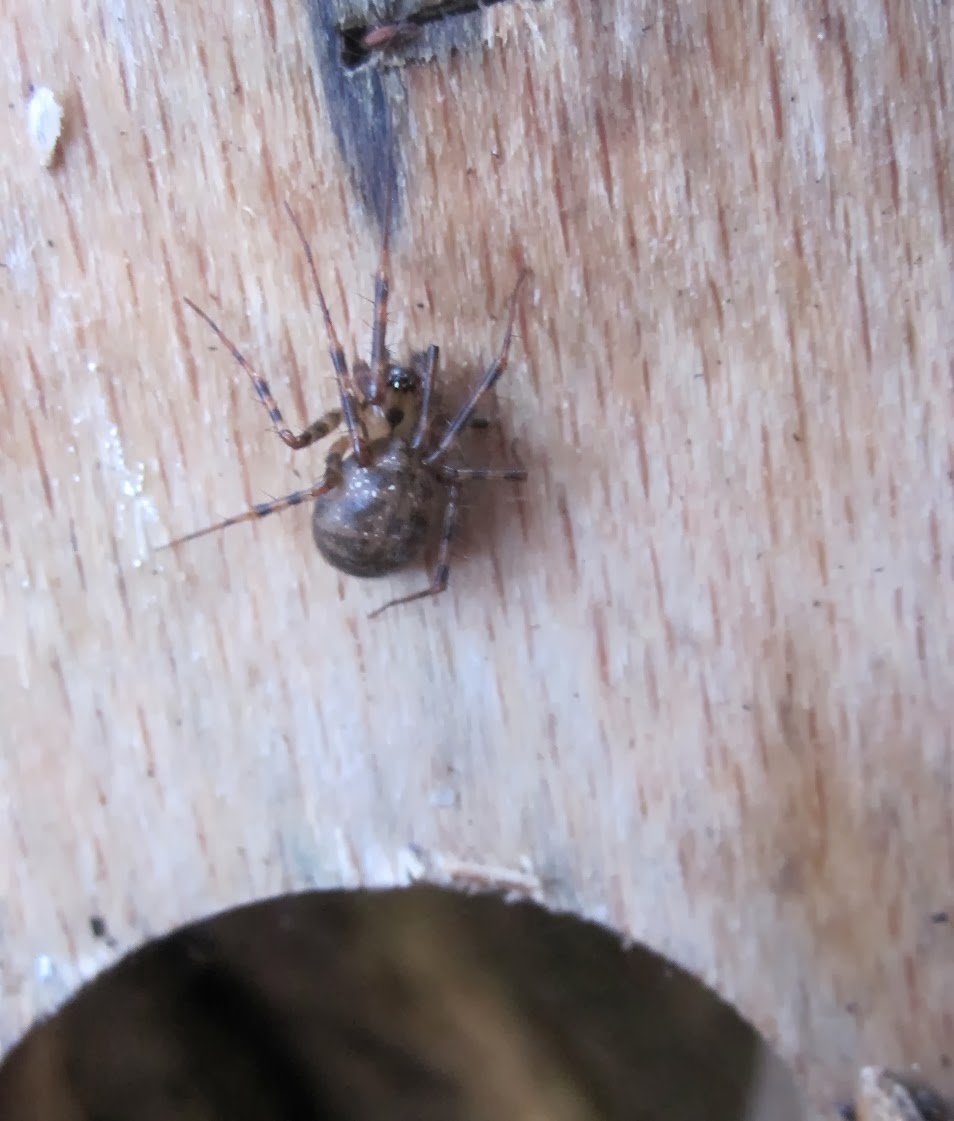
Making good use of our nesting boxes over winter, is the local spider community. I found around 6 different species on this day...

Your friendly neighbourhood Walnut Orb-weaver (Nuctenea umbratica),
 trying its best to look inconspicuous

Labulla thoracica, which belongs to the same family as the Money Spiders (Linyphiidae)

A small False Widow (Steatoda nobilis). And no, it did not go straight for my jugular

Thanks a bunch to Katie, George and my mum Sue for helping me out on these most recent surveys.
   I am amassing a collection of invertebrate pictures as I sort through the malaise trap invertebrate samples. One of the coolest things I've found so far is this awesome Sawfly: I think the genus is Cladius. It's feathered antennae look like massive antlers... I'll have to dedicate a separate post at some point to my desktop invertebrate finds.

Underside of a Sawfly (x10 magnification)

   I am still catching up on my species data entry for the past year. The final American Signal Crayfish count was 482, fished out of a 200m stretch of the River Mole. It will be interesting to see how many I get out of the same stretch next summer.

This was a single haul of the invasive crayfish species Pacifastacus leniusculus,
at the peak of summer 2013