Showing posts with label Mesolithic. Show all posts

Tuesday, 23 April 2013

The Holy Grail (Archaeological update)

Ok so a bit of a cheap hook I've used there… But hey, what a find!!


Some seriously interesting stuff seems to have turned up at this grassland site intersected by Gatwick Stream. The picture above is actually of a burial urn from the Iron Age, containing human cremation remains (which have now been taken off-site for cleaning/further inspection.) This person might have been someone of importance and was possibly female judging by the other objects recovered nearby.

A long-range view of the dig site at Gatwick Stream during yet more extreme weather conditions (maybe someone was trying to tell them something?)
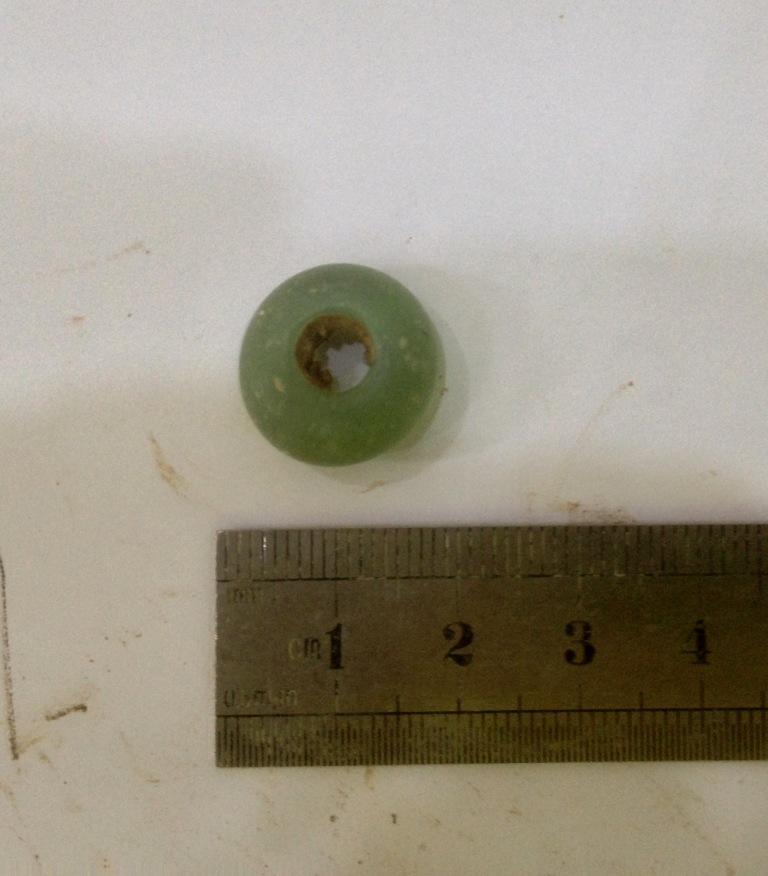
A glass bead found close to the burial urn, Iron Age

A spindle whorl, part of a tool once used for spinning fibres. Iron Age

The dig has been going on since early March and it seems to have turned up a rather decent assemblage of archaeological periods on just one site.


Evidence of an Iron Age settlement onsite was in the form of two roundhouses, associated boundary ditches, pits and some possible evidence of iron-working. Andrew Hunn of Network Archaeology told me one of the 1 metre-square test-pits produced 164 worked flint fragments of the Mesolithic era; the second most productive pit probably did not produce half as many!


Hope is another archaeologist with Netarch and she found this impressive specimen; apparently her first ever skeletal discovery... Not a bad one I'm guessing! It is a horse lying on its back, its legs akimbo. Dating has proved difficult due to the nature of the remains and its positioning in the soil, so the speculative range given so far is from the Medieval period up to a couple of hundred years before present.

The ribs and lower mandible of the horse: it also had some unusually large tusk-like teeth which were probably the result of a genetic mutation

Another of the Mesolithic worked flint fragments which have been found on this site; still sharp!

Just to prove there was some ecological purpose to my being here: a picture of two Common Buzzard wheeling over the site during a bird survey. (My birding photos are generally all terrible like this one.)

And last but not least... a five pence piece. Also, here is a tanged and barbed flint arrowhead discovered by Andrew Hunn in 2012 at the nearby site of the water treatment lagoon.

This excavation at Gatwick Stream is almost over and I will be sad to see the interesting ensemble of people leave but you never know... there may be more discoveries yet!
Here is a link to the previous blog post about Gatwick's archaeology:
http://biodiversitygatwick.blogspot.co.uk/2013/03/underwater-excavations.html

Monday, 25 March 2013

Underwater excavations

A flood alleviation scheme is underway along Gatwick Stream just off Radford Road. This is a project to widen the channel and increase the water holding capacity of the adjacent grasslands.

Archaeological dig site along Gatwick Stream, LERL

An ancient piece of worked flint, fresh out of the Gatwick clay

I have never seen an archaeological dig before. So far this one has been beset by freak blizzards, a WW2 bomb scare, nosy ecologists, relentless rain and flooded excavation pits – the archaeologists assure me this is all quite standard stuff and they crack on with the work regardless. And I had thought JSA and GGP were weather-hardened!

Week 1, Day 1

Week 2, Day 2

Week 2, Day 3. What would Indy do?

But a little water doesn't stop these guys and girls, and the team are successfully uncovering flint items from around the Mesolithic period, which is about 10,000 to 5000 BC. Nomadic humans would have used their expert 'knapping' skills on this flint to create a variety of useful tools...

Flint fragment, possible evidence of the flint having been actually worked on this site

I don't know what this would be used for but I want one.

On the biodiversity side of things, this is a chance for the creation of another floodplain meadow, a species-diverse habitat which has become increasingly scarce. Wetland species such as Black poplar, Bur-reed, Meadowsweet, Flowering rush and Marsh marigold flourish in floodplains and support a great assortment of wildlife. Agricultural intensification and the lack of appropriate management have probably been the biggest cause of loss of wetlands.

Gatwick Stream as it stands at the moment: narrow channel and in places very steep sides

I have been on site each morning keeping an eye out for any breeding birds while JSA came in to remove the scrubby vegetation along the stream and future floodplain. Although the hostile weather seems to have kept ideas of nesting at bay, i have witnessed many aerial skirmishes within and between species including Pied Wagtail vs. Meadow Pipit and Blue Tit vs. Robin.

I keep a log of all the species I see out and about for this kind of work, here is a link to the list of what has turned up so far... Gatwick Stream Species March 13
Mink tracks, banks of Gatwick Stream

Black-headed gull tracks in the muddy fields

Roe deer hoof prints, showing an imprint of the rear 'dewclaws'

The team from Network Archaeology are going to be here for the next few weeks and I am excited to see what might come out of Gatwick’s ground next (humans being a part of Biodiversity history too!)