Showing posts with label early winter birds. Show all posts

Friday, 14 December 2018

Early Winter Bird Survey - North West Zone 12/12/18


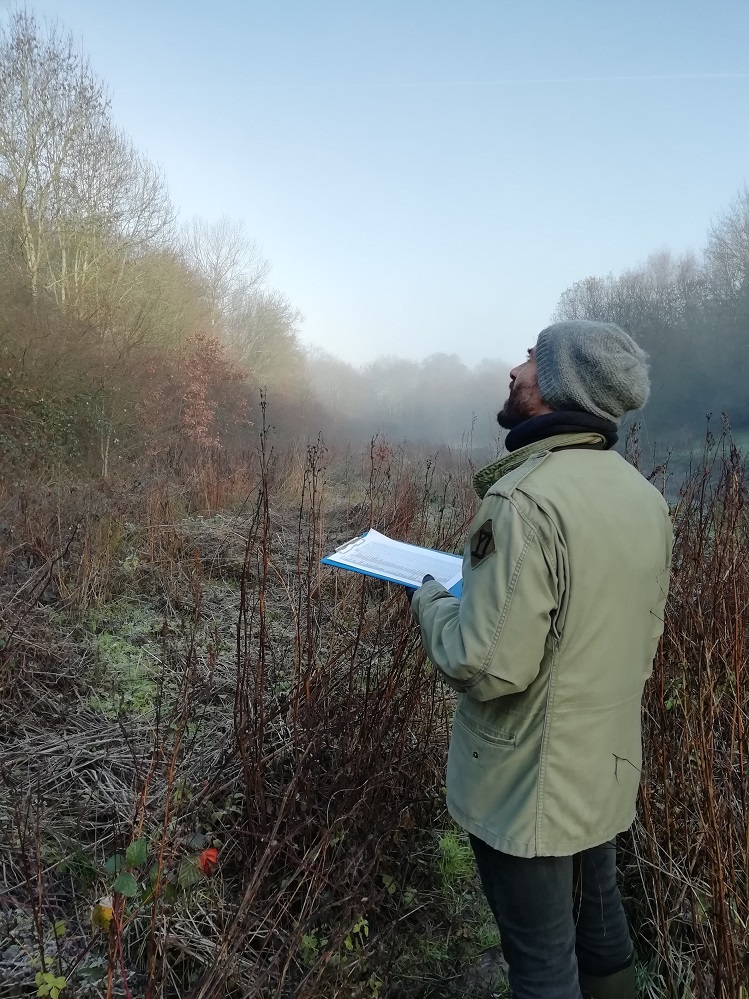
This morning was the start of a real cold snap here in Sussex, which always seems to tie in with our North West Zone bird survey transect. Tom F. and I set off along the northern side of the airfield fence a little after sunrise, giving the birds some time to get moving and active. Tom commented right away that this was a spookily quiet morning...


A group of Meadow Pipits are typically the first birds we come across, bouncing along the airfield fence. A Robin and several Dunnocks called sporadically, hidden away along the banks of the River Mole. Our first red-status species was a Song Thrush, giving it's subtle 'tseep' alarm call as it fled, nipping down into the river bank vegetation.


Down on the floodplain it truly felt bone-achingly cold. The reed beds seemed devoid of life, then a fiesty Wren struck up an alarm call as it faced us off from the top of a reed. Finally, a Reed Bunting called, although only faintly and with no replies forthcoming. It really felt like the birds hadn't got out of bed yet.


Further along the floodplain, we caught the distant calls of Water Rails. These secretive birds seem to be more vocal in winter, and their call is highly weird. If you happen to be standing right next to one when it sounds off, it's pretty alarming!


Over to the scrub west of Brockley Wood, a few Blue Tits and Long-tailed Tits were foraging together on the woodland edge. A sole Green Woodpecker headed off calling and a group of Wood Pigeon broke from the trees. Over in woodlands, a distant Nuthatch called.


This sheltered patch of grassland is one of my favourite spots in summer, dense in long herbaceous vegetation and absolutely humming with invertebrates. In winter however this tends to be the favourite patch of another highly-secretive and red-status bird; the Woodcock. We flushed one from the low scrub; its low, whirring flight really does give the appearance of a giant bat. 


Poking our heads into the north of Brockley Wood, we were hoping for some Redwing activity, however the flocks were conspicuously absent from the site this morning. The collective alarm calls of  Blackbird, Magpie and Wren indicated the presence of an avian predator, likely a perched-up Tawny Owl or Sparrowhawk. Whatever it was then moved off, as the alarm calls rapidly followed it through the wood.


Our final section of grassland along the River Mole turned up two Common Snipe, which had been well hidden in the rushes. One put on an amazing display, flying a wide loop over the environment bund and then skimming low past us at about waist-height. This whole transect was again peculiarly quite, and surprisingly one of the most numerous birds was Bullfinch; we counted a total of 6.


At the very end of the transect we had a buzz of excitement in the form of a perched Sparrowhawk, apparently causing upset with the resident Ring-necked Parakeets. It casually took off over the trees, leaving in its wake a string of songbird alarm calls.


Final species count = 34

Common name
Species
Blackbird
Turdus merula
Blue Tit
Cyanistes caeruleus
Bullfinch
Pyrrhula pyrrhula
Buzzard
Buteo buteo
Carrion Crow
Corvus corone
Chaffinch
Fringilla coelebs
Coal Tit
Periparus ater
Dunnock
Prunella modularis
Goldcrest
Regulus regulus
Goldfinch
Carduelis carduelis
Great Spotted Woodpecker
Dendrocopos major
Great Tit
Parus major
Green Woodpecker
Picus viridis
Grey Heron
Ardea cinerea
Jackdaw
Corvus monedula
Jay
Garrulus glandarius
Long-tailed Tit
Aegithalos caudatus
Magpie
Pica pica
Mallard
Anas platyrhynchos
Meadow Pipit
Anthus pratensis
Moorhen
Gallinula chloropus
Nuthatch
Sitta europaea
Reed Bunting
Emberiza schoeniclus
Ring-necked Parakeet
Psittacula krameri
Robin
Erithacus rubecula
Siskin
Spinus spinus
Snipe
Gallinago gallinago
Song Thrush
Turdus philomelos
Sparrowhawk
Accipiter nisus
Treecreeper
Certhia familiaris
Water Rail
Rallus aquaticus
Woodcock
Scolopax rusticola
Woodpigeon
Columba palumbus
Wren
Troglodytes troglodytes

Sunday, 17 December 2017

Early winter bird surveys - Dec 2017

A round up of our early winter bird surveys (and a photo series of Tom F looking very cold in different habitats at Gatwick).

North West Zone

Tuesday December 12th: 8am


We hopped out of the car to find the ground was pretty much frozen solid. At around -3.5 degrees, this was the coldest morning of the year so far.


All seemed very quiet, with our first record being Blue Tits feeding on seed heads along a tall herb stand. Down within the channel of the River Mole, a flurry of activity and some strange calls indicated that we had just spooked a Water Rail...


Taxiway Juliet, adjacent to the River Mole

Further along the river, we came to a wet field with stands of rushes. Along the hedge line, a group of three Roe Deer carefully squeezed their way through a broken fence. As we walked steadily through the field, we kept our eyes peeled in case we flushed some winter visiting waders. The lumbering ecologists enjoyed a partial success with one noisy Common Snipe...


Common Snipe (Gallinago gallinagoRSPB

Further along the river, Dunnock, Wren and Reed Bunting called from the reed beds and a small group of Fieldfare shot over our heads, their colour catching brilliantly in the morning light. Several more Common Snipe nipped off as we headed further down into the floodplain and upon reaching the water's edge a small group of Teal took flight. This is the first time we've seen Teal here since our bird surveys began in 2012.

River Mole floodplain grassland

In the grassland and scrub adjacent to Brockley Wood, we flushed another winter visiting wader; a Woodcock looks rather similar to a Snipe, except that it is a much bulkier bird and they prefer to feed under the cover of scrub and woodland.

Woodcock (Scolopax rusticola) RSPB


Winter sun, northern edge of Brockley Wood

Rounding the north of Brockley Wood, a pair of Ring-necked Parakeets were calling loudly and then making quieter sub-vocalisations. This non-native seems to be increasing its range along the transect, and so might soon become a new breeding species in Brockley Wood.

Ring-necked Parakeet (Psittacula krameriRSPB


Fieldfare and Song Thrush put on a good show along the lines of scrub of the River Mole valley, with only a few Redwing apparent today. Mixed flocks of smaller birds such as Long-tailed Tits and Goldcrests were also enjoying the dense scrub. A Great Spotted Woodpecker torpedoed past us while a pair of Goldfinches were feeding busily on the river bank teasels.


River Mole floodplain grassland

Toward the end of the transect, things seemed to go rather quiet again. Pushing through the woody vegetation on the riverbank, we caught a view of a group of small birds pursuing a Sparrowhawk above the treeline. The group about-turned and passed back over our heads, their calls identifying to us a victorious band of Goldfinches.


Final count: 36 species (just one off our winter bird survey record):

Blackbird
Blue Tit
Bullfinch
Carrion Crow
Chaffinch
Common Buzzard
Dunnock
Fieldfare
Goldcrest
Goldfinch
Great Spotted Woodpecker
Great Tit
Green Woodpecker
Jackdaw
Jay
Kestrel
Magpie
Mallard
Meadow Pipit
Moorhen
Nuthatch
Pheasant
Pied Wagtail
Redwing
Reed Bunting
Ring-necked Parakeet
Robin
Snipe (Common)
Song Thrush
Sparrow Hawk
Teal
Treecreeper
Water Rail
Wood Pigeon
Woodcock
Wren


Land East of the Railway Line

Thursday December 12th: 8am


Flood attenuation area, Gatwick Stream

A marginally warmer day, but with a stronger breeze meant the cold was still felt by this weather-hardened ornithological pair. 

Bring zipped right up to the top helps stop the teeth chattering

Being coffee-d up to the eyeballs certainly helps though, and it is always with a sense of excitement that we stomp our way through the relatively young grassland habitat here. Sadly, we didn't manage to flush any Snipe this morning, instead just a few Wood Pigeon and Carrion Crow were about as exciting as it got, and a flock of Goldfinches bouncing over our heads.

Flood attenuation area, Gatwick Stream

Things took a quick upward turn however, when I found us a new species to the airport! It was while standing next to a thick stand of Soft Rush that I saw something my brain refused to register... 

'Erm, Tom, is that a melanistic Long-tailed Tit, or a Dartford Warbler?!'

Dartford Warbler (Sylvia undataRSPB


This feisty little bird put on quite a show, so Tom clapped me on the back and I felt that warming smugness of being the first to spot a new species on a survey.

The dense stands of Soft Rush in the flood attenuation area

We left the low lying floodplain and trekked into the Upper Picketts Wood, the entrance of which was busy with ground-feeding Song Thrushes and Redwings. The center of the woodland was much quieter, and some sudden Blue Tit alarm calls caused us to look up high; a Red Kite was skimming low over the tree tops. This is another new species for the transect.

Red Kite (Milvus milvusRSPB


A roving tit flock moving through the canopy included a noisy group of Lesser Redpolls, which are becoming a more frequent occurrence here in recent winters. A skirmish between three Nuthatches caught our eye, with undersides flashing orange in the sunlight, causing us to give a double take...

But this was not the orange-coloured bird that we were looking for.

Bee hotel and dead hedge in Goat Meadow

Pushing through Goat Meadow, we unfortunately didn't turn up our trusty Marsh Tits, despite hearing them here regularly. In a clearing next to Lower Picketts Wood, I was distracted by a loudly alarm-calling Fieldfare which I then followed, hoping to spot a bird of prey. While I was busy looking the other way, it was then that Tom F spotted something sitting up proudly on a massive old Hawthorn bush...


Hawfinch (Coccothraustes coccothraustesRSPB

This was most definitely a new species to the airport! Hawfinches are incredibly elusive around these parts, with most being winter visitors and very few resident or breeding in the UK. They are rather shy and their calls are almost Robin-like, making this a tricky one to I.D. by sound. We knew there had been an unusually large influx of birds flying in from the continent this winter, with many sightings across Surrey and Sussex.


I have known Mr Forward a long time now, and he is a very honest chap, so let the record state that he recorded Gatwick's first Hawfinch (but I got the first Dartford Warbler).

Twisting Hornbeam, Lower Picketts Wood

Continuing through the woodland strip, we turn up our trusty Chaffinch calling from the same corner every year. The other finch species frequently present here is Bullfinch, and we glimpsed of a pair of white rumps disappearing away from us. At the end of the transect, by the railway line bordering the western edge of Horleyland Wood, we were treated to a mega-flock of Long-tailed Tits, Blue Tits, Great Tits, Coal Tits, Tree Creepers and Goldcrests.

So that makes 3 new species to the survey; Red Kite, Dartford Warber and Hawfinch, the latter 2 being new to the airport. These surveys never get dull, and I'm already excited about the next ones in February!

Final count = 36 species (again)

Blackbird
Black-headed Gull
Blue Tit
Bullfinch
Carrion Crow
Chaffinch
Chiffchaff
Coal Tit
Collared Dove
Common Buzzard
Dartford Warbler
Dunnock
Fieldfare
Goldcrest
Goldfinch
Great Spotted Woodpecker
Great Tit
Green Woodpecker
Grey Heron
Hawfinch
Jackdaw
Jay
Long-tailed Tit
Magpie
Meadow Pipit
Mistle Thrush
Nuthatch
Pied Wagtail
Red Kite
Redpoll (Common/Lesser)
Redwing
Robin
Song Thrush
Stonechat
Treecreeper
Wood Pigeon
Wren

Friday, 9 December 2016

Early winter bird surveys 2016 (Part 1)

Land East of the Railway Line: December 8th


Dawn breaks over the Gatwick Stream, and Tom Forward is about to have a date with destiny...


Actually, the date is with a Snipe, but this is not just any old Common Snipe (although we did see 7 of those); it's a little bit scarcer than that. He wanders along the wet flushes, keeping out a sharp eye...


A sudden burst of wings from the ground and it's off like a shot - a Jack Snipe! Another new record for our bird list at Gatwick.

Jack Snipe (Lymnocryptes minimus) RSPB

Common Snipe (Gallinago gallinago) RSPB

Much quieter than Common Snipe, the Jacks have a shorter bill and are a shorter, dumpier bird in general. The Common types will shoot off up into the air before you can get close, but Jacks can hold on until you almost step on them, then dropping onto the ground again after a short, low flight.
  A small flock of Meadow Pipits bounced past us through the air, and a Grey Wagtail descended rapidly down into the river channel.

 
Our next new discovery for this site is a Barn Owl roost in our 'Little Owl-Oak'. Not sure if the little-er owls would think much of their new neighbour....

White wash (owl wee) on the tree above what might be the Little Owl nesting hole

Barn Owl pellet

Poking our heads over the bank of the Gatwick Stream by the sluice gates, and were surprised to see a dark, sleek mammal gamboling in the water. American Mink are insatiably curious and this one actually came towards us, then hid in a small clump of rushes to check us out.

Not much of a photo of course.
How to tell apart Otter and Mink - a handy Wildlife Trust fact sheet.

Dashing back over grasslands to the next transect, and we were stopped in our tracks by a pair of Kingfishers zooming low over the grass. Although strongly associated with water courses, they are known to sometimes cut corners and even head into woodland habitat to do so. Hey, I would too!


Into the woods and a flock of Redwing were busy foraging in the understory. Winter thrushes vary what height they forage at depending on available food source. Towards the end of winter they feed more on the ground.

More white-wash beneath a mature oak - favored perching point for a Common Buzzard?


A Song Thrush sang from a distant hedgerow. A Wren and Robin were also in song; only a few birds do this through winter.
   At Dunnock corner, there were constant loud calls which signified the usual debauchery. They always seem to get louder in winter, kind of like my own family. I guess domestic drama helps to keep small birds warm. I still get Dunnock and Kingfisher calls mixed up, which after 4 years of these surveys Tom F. must be getting fed up with.


Through the woodland strip and out into Lower Picketts Wood, mixed flocks were abound of Long-tailed Tits, Blue Tits and Goldcrests. We checked a little closer through the binoculars but sadly couldn't turn any of them into a Firecrest. At the end of the transect, our trusty Treecreeper finally called.


The final species count for the morning was 33 (not 34, as I only recorded Common Buzzard when I returned to site at the end of the day):

1
Blackbird
Turdus merula
2
Black-headed Gull
Chroicocephalus ridibundus
3
Blue Tit
Cyanistes caeruleus
4
Bullfinch
Pyrrhula pyrrhula
5
Buzzard
Buteo buteo
6
Canada Goose
Branta canadensis
7
Carrion Crow
Corvus corone
8
Coal Tit
Periparus ater
9
Dunnock
Prunella modularis
10
Goldcrest
Regulus regulus
11
Goldfinch
Carduelis carduelis
12
Great Spotted Woodpecker
Dendrocopos major
13
Great Tit
Parus major
14
Grey Heron
Ardea cinerea
15
Grey Wagtail
Motacilla cinerea
16
Jack Snipe
Lymnocryptes minimus
17
Jackdaw
Corvus monedula
18
Jay
Garrulus glandarius
19
Kingfisher
Alcedo atthis
20
Linnet
Linaria cannabina
21
Long-tailed Tit
Aegithalos caudatus
35
Magpie
Pica pica
22
Mallard
Anas platyrhynchos
23
Meadow Pipit
Anthus pratensis
24
Mistle Thrush
Turdus viscivorus
25
Pied Wagtail
Motacilla alba subsp. yarrellii
26
Redwing
Turdus iliacus
27
Robin
Erithacus rubecula
28
Siskin
Spinus spinus
29
Snipe
Gallinago gallinago
30
Song Thrush
Turdus philomelos
31
Starling
Sturnus vulgaris
32
Treecreeper
Certhia familiaris
33
Woodpigeon
Columba palumbus
34
Wren
Troglodytes troglodytes

American Mink
Neovison vison
Eastern Grey Squirrel
Sciurus carolinensis

Barn Owl (roost)
        Tyto alba