Tuesday, 20 May 2014

Roving Records - Land East of the Railway Line (14/05/2014)

Powerline Ride in Horleyland Wood

This is probably my favourite spot in the whole of Gatwick (perhaps with the exception of a departure lounge)...

Footpaths in the LERL and woodland rides

Who needs a holiday when you can escape to a spot like this! 

This set of powerlines, running north to south along one edge of Horleyland Wood, is honestly more exciting than it first sounds. A couple of years ago, the path was opened up after some major clearance works in order to keep the overhead cables free from vegetation. Now it has a shrubby edge of coppiced Hazel, graduating down into patches of Bramble and woodpiles, blending further into a fragrant border of Bluebell and Red Campion.

Large White Butterfly (Pieris brassicae)

This is an insect-haven, catching the sun for much of the day and is largely sheltered from the wind. The mixture of open grassland flora and woodland edge flora provides food resources for a greater suite of species. I could literally spend hours on this path, trying to record the awesome variety of inverts or just watching them bumbling about on their personal business. If only I had the hours to spend in spring!

 
Red-headed Cardinal Beetle (Pyrochroa serraticornis) is a distinctive red beetle 
common at this time of the year 

Less common is the Black-headed Cardinal Beetle (Pyrochroa coccinea)

A species of Crab Spider (Misumena vatia), with the distinctive markings of a male

You might think that your common old Bramble looks unimpressive and not worth the effort, but when the sun hits it, the flowers come alive with excitable aculeates...

Early Bumblebee (Bombus pratorum) male

Honey Bee (Apis melifera). This female worker might be one of Tom's tribe

Cuckoo Bee (Nomada spp.)

Plenty of other lovely stuff could be seen in the woods and grasslands on this day, including Azure Blue and Large Red Damselflies, Small and Green Veined White Butterflies, Garden Warblers singing in the woodland edge and Carrion Crows fighting in the open skies with a Common Buzzard.    

Wild Garlic, or Ramsons (Allium ursinum) carpeting the woodland floor in a tasty, pungent layer

Right now the woodland groundflora is at its peak: Bluebells, Red Campion, Cuckoo Flower and Greater Stitchwort all to be found in one spot

Dingy Skipper Butterfly (Erynnis tages) in Goat Meadow

Another one of my excellent birding pics - Common Buzzard (speck in the clouds)

This ride is also where we found that fantastic specimen of Araneus angulatus, which I'm afraid I am still banging on about a year later...

Tuesday, 13 May 2014

Early summer invertebrating

Invertebrates are insanely underrated organisms; up close and personal, their hugely varied body plans and lifestyles make the humans in tabloid magazines look decidedly average.

This spider (Cyclosa conica) has a rear-end a Kardashian can only dream of...

When it comes to managing habitats around an airport, the best practice is not to do anything which might encourage large flocking birds to the area. This can make conservation more of a challenge, but focusing on habitat management for invertebrates is a smart way to go.
   Invertebrates are highly versatile and incredibly important for ecosystems: grazers, predators, nutrient recyclers, soil aerators, habitat manipulators and plant pollinators; to name but a few. Without them, food webs would collapse and biodiversity (including us) would be non-existant.

Searching for deadwood invertebrates

Just last week, I was lucky enough to have a crack team of entomologists visiting our sites in the North West Zone, just north of the airfield. Scotty D, Jeremy and Keith were looking at a variety of habitats, using varied searching techniques in order to list as many different invertebrates as possible.
  Here are some of the habitats we were scrabbling about in:

Entomologist in natural habitat, scrub west of Brockley Wood

Shaded section of Man's Brook, Brockley Wood

Brockley Wood South Ride

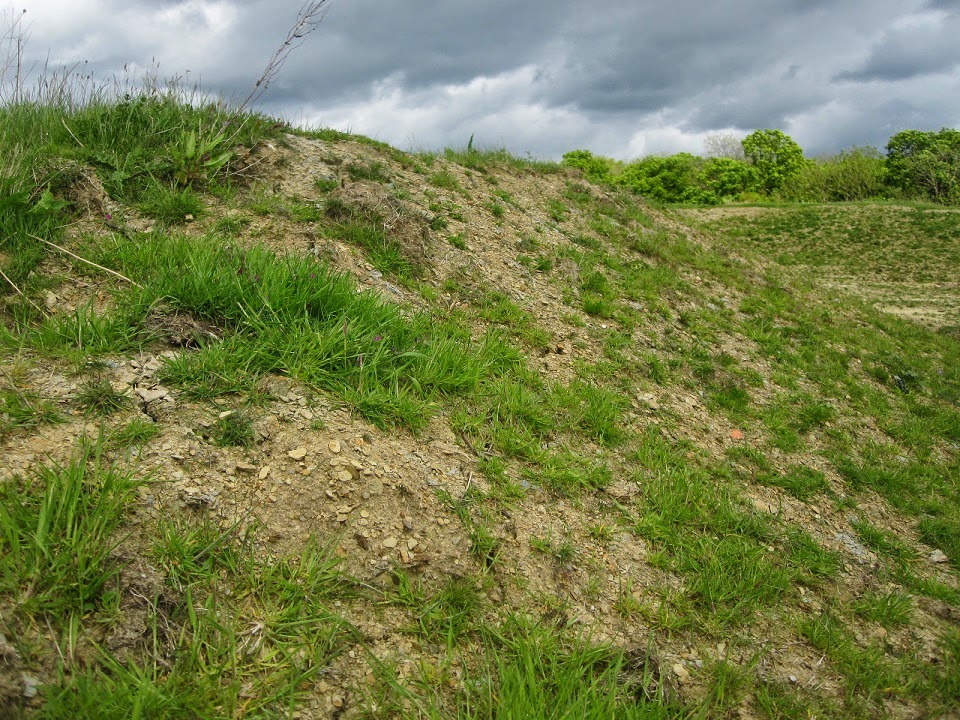
Excavated soil on a grass slope

River Mole floodplain grasslands

Everyone was kept busy as Jeremy searched out the solitary bee species, Keith hunted for deadwood invertebrates and Scotty listed everything and anything. Despite the variable weather conditions, the list grew rapidly and the 100 species target was easily passed. Here are some of my highlights (i.e. the stuff I could photograph before it got away)

Silver-ground Carpet Moth (Xanthorhoe montanata)

Spider with no common name (Cyclosa conica), but which I shall now think of as Cone-Bum Spider

Violet Ground Beetle (Carabus violaceus)

Shiny Woodlouse (Oniscus asellus), which is only half shiny because it is in the process of shedding its old exoskeleton in order to grow

 A less common wetland species of woodlouse (Trachelipus rathkii)

Green Hairstreak Butterfly (Callophrys rubi)

Thistle Tortoise Beetles (Cassida rubiginosa), a copulating pair

Flat-backed Millipede (Polydesmus angustus)

I've saved Jeremy's pics until last; these really show the jewel-like quality of certain insects. It's incredible to think that we swat these things away and think of them as a nuisance...

Black Colonel (Odontomyia tigrina), a type of Soldier Fly

Malachite Beetle (Malachius bipustulatus) female

Longhorn Beetle (Rhagium mordax) on Hawthorn

Mining Bee (Andrena carantonica) female on Hawthorn

Orange-tailed Mining Bee (Andrena haemorrhoa) female on Hawthorn

Scorpion Fly (Panorpa communis), male

Hoverfly (Helophilus pendulus), female

Hoverfly (Xanthogramma pedissequum)

Wasp Beetle (Clytus arietis)

It seems like most things want to be a wasp these days.
   I'm already looking forward to the follow up survey later in summer!

Thursday, 1 May 2014

April Summary

The trend is broken and my monthly summaries are now going over into next month (it was never going to last!). Ah well, here is what we have been up to in April...

The clearing by the Hornbeam in Lower Picketts Wood

Our habitat management has quietened down for spring, so now is the time for wildlife walks and educational talks. Last weekend, Tom S. led a guided walk in the Land East of the Railway Line, looking at the results of our winter works and the flourishing wildlife there. 

The footpath through Horleyland Wood

The woodland groundflora looks fantastic right now and the clearings are busy with foraging flies and bees. Tom knows a whole lot about woodlands because of his background in forestry, so even the tough questions get an answer!
   While out and about in these areas, I have been collecting a small number of Cuckoo Bees (Nomada spp.) for further identification. To dispatch them humanely, I put them in the freezer for several days...

'Zom-bee'

Then after just a few minutes under the warm microscope, this little Nomada jerked back into life and was off to freedom! Somewhere in the Portacabin at least.

Close up of a Cuckoo Bee head under the microscope (x10)

The malaise trap is back up, this time in the North West Zone. I have mixed feelings about this as I still have a massive backlog of last year's insect samples to sort... All the same, many thanks to Tom S. and assistant Lewis.

Malaise trap: flying insects hit a panel inside then try to fly upwards,
 eventually falling into the collecting pot at the apex

We had an interesting and vibrant River Mole Catchment Partnership meeting, with both Surrey Wildlife Trust and the Environment Agency hosting. The talks were well illustrated, to the point and particularly interesting were some statistics for the recent flooding around the airport; the floodplain of the diverted section of river was praised!

The illustrious Jim Jones, Surrey Wildlife Trust's Wetlands Officer, giving a talk on recent conservation works and techniques to improve river channels. His ever-changing hair style keeps audiences rapt

 A felt 'Ketso' board - an interactive way of sharing and noting down ideas of how we can improve the river system. This was fun, but we're gonna need a bigger board!

We have completed a full check of all Gatwick's Dormouse boxes, both old and new. Finding over 100 boxes in one afternoon is no mean feat (it sucks), so I was massively grateful to be accompanied by Mum plus one of my sisters, Evie.


Also very helpful was Evie's iPhone, since I lost all my pens somewhere among those pesky Bluebells. The results are in; sadly no Dormice, but we do have around 40 nesting Blue Tits and Great Tits, plus two Yellow-necked Mice.

Newly hatched Blue Tit chicks

Yellow-necked Mouse (Apodemus flavicollis)

Here are some other wee beasties you might have seen out and about this past month:

One of Tom Simpson's Honeybees, drinking out of a puddle. Some bees have no standards

Grass Snake in a brash pile, Goat Meadow

Dark-bordered Beefly (Bombylius major)

Large Red Damselfly (Pyrrhosoma nymphula). My first of the year

Green-veined White Butterfly (Pieris napi). Lots of these about at the moment

Common Carder Bee (Bombus pascuorum). This is probably a queen

This large jumping spider is sometimes called the Fencepost Jumper (Marpissa muscosa). It is fairly common to South East but scarce in other parts of the UK

An oak apple gall, caused by a Gall Wasp. Possibly Biorhiza pallida

Finally, we got results from the infrared trail camera; sadly no Badger as of yet. I had been spending quite a lot of time watching through the video clips with absolutely nothing on them, so the very end of this video made me jump...