Friday, 21 August 2015

Gatsbees B-Log: July 2015


‘Look girls’, I said,
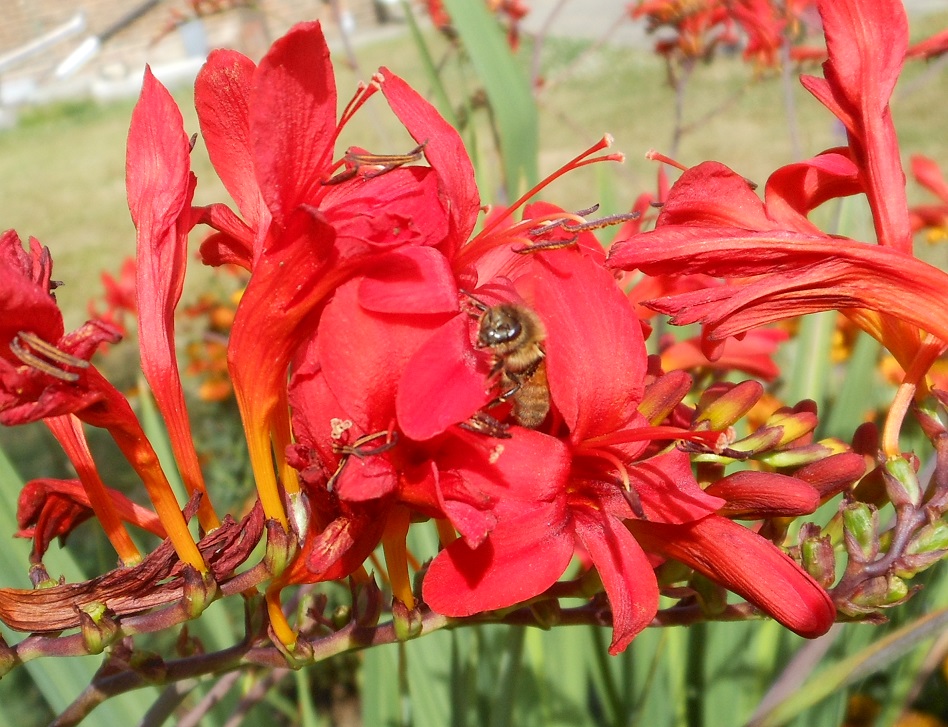
Crocosmia 'lucifer'(non-invasive type of Montbretia)

it’s the end of July


and I’m all beed out.


Too many swarms. Too many colonies.


Next time I go to the apiary and see a swarm


I’m going to ignore it……….


let it fly away and find itself a new home………..


Oh!
Lavandular angustifolia

Sort yourselves out, I’m going home...

Helenium 'Moorheim Beauty'

to do some gardening!


I’m back now, and you’re still there? OK, same routine; shake into box, check!


Girls fanning to send out location with their 'Nasonov' gland pheromone, check!


Bees going into hive?

Rachel: front-line photographer
Check!

Tom and myself checking on the new colony

Sometimes the bees freestyle with their comb if they’re not properly contained in the hive -


properly for us, that is, not them...


so we have to rearrange their perfectly air conditioned house if we don’t want them to permanently jam themselves in, normally using elastic bands (but airfield tape will do in an emergency),


which they chew off


while they attach the comb properly to the frame


and we remove the remaining tape asap.
Anybody spotted the queen above? A puzzle because she’s a mated queen and I couldn’t think where she’d come from...


until I found the other nucleus box empty, because they’d decided that wasn’t where they wanted to live!

Great Willowherb (Epilobium hirsutum)

Birdsfoot Trefoil (Lotus corniculatus)


Going back to this photo from earlier...


I thought you might like to see a close up of this row of tiny claws supporting the weight of the cluster. Remarkable!


I can only guess that they clustered like this because the hive was too full of bees, so I gave them a super with empty frames for a bit of space and something to do. Spoilsport!

Gatekeeper Butterfly (Pyronia tithonus), because we support all Gatwick pollinators!

Gillybee x

Monday, 17 August 2015

Superb summer

The past few months have been another level of busy, I've had to look back over photos again just to remember what has been happening one day to the next!
   We've had various site meetings with airport project supervisors for habitat assessments along some new infrastructure...

Westfield Stream diversion

Grass Snake habitat enhancements

We've been catching ups with our biodiversity partners, plus Gatwick's two Biodiversity Action Plans have now been updated to 2017...


There has been continued reduction of the invasive plant species Himalayan Balsam, with thanks to Tom Simpson's volunteers and JSA Group, Gatwick's ground maintenance contractors...

Gatwick Airport staff volunteers

Balsam-conquering

JSA Group operative Lauren

I recently spent a few days airside with trainee airport operatives on a birdstrike course, run by Birdstrike Management Ltd. It focused on airside bird identification and the prevention of collisions with aircraft...

Airside and Gatwick's Control Tower

Group exercises in bird identification

There have been regular check ups on our thriving Gatsbees colonies and sample collecting for the Sentinel Apiary Project...

Gill checks the health of a newly collected swarm

I also visited the nearby National Trust site at Leith Hill, to learn about the bird ringing and monitoring carried out by lead ranger Sam Bayley.

Tree Pipit, waiting for it's new bling

The coded language of bird ringers

We've had bat surveys coming out of our ears with Laurie and Martyn on our sites...

Twilight along the River Mole

Bat poop-sampling

Bats  infinity

And finally (the bit I like best), biological recording on our sites with a fantastic bunch of volunteers...

Back of the net

A Hoverfly - Sphaerophoria scripta 
(I.D. by Ryan Mitchell)

Ryan and Elliott collect materials for a new bee hotel

Original bee hotel - currently occupied by male Leafcutter Bees

Brown Hairstreak Butterfly - Thecla betulae

Assessing newt habitat suitability (Helen, Elliott & Me)

Emperor Dragonfly - Anax imperator

Wasp Spider - Argiope bruennichi
(Photo by Elliott Lloyd)

Dormouse box checks

Small mammal identification: Yellow-necked Mouse - Apodemus flavicollis

Brown Argus Butterfly - Aricia agestis

Our volunteers always give me an incentivised-boost with biological recording and species monitoring, so a massive thank you to all who have been involved this summer, particularly Helen, Elliott, Ryan and Mark!

Monday, 3 August 2015

Gatsbees B-Log: June 2015

This has been one of the busiest years for beekeepers who offer to deal with swarms reported by the public, and it’s unusual for many of us to have ‘too many bees’; a welcome situation brought on by an excellent summer, and financially a bonus as bees are expensive to buy.


To prepare for swarming, the bees begin to build small cups of wax – the start of a cell in which a new queen will develop and when the majority of workers agree, the queen lays an egg in it, or they place one into it.


All eggs take 3 days to hatch and a queen larva is fed for 5 days with ‘royal jelly,’  which is a rich food made in the hypopharyngeal gland in the worker’s head.


The cell is lengthened as the larva develops...


...and we’re back to last month’s swarming B Log; the moment a queen cell is capped after 8 days so that the new queen can pupate.


And the resident egg-laying queen (in this case, Eve)...


...leaves the hive with around half of the colony in a joyous, roaring, swirling swarm. One of nature’s wonders.


They land nearby to check the queen is still with them


and if a beekeepers are called, they will box them up and take them away as a new colony.


Meanwhile, back at the half empty hive and 7 days later, the new queen cuts her way out of the cell with her mandibles and a hinged flap is a tell tale sign that a queen has emerged.


I should mention drones (the boys) at this stage, which are stockier than workers and whose job is to mate with virgin queens in a series of flights which she makes over several days.


The cells in which drones develop (left) are larger than those of the worker bees (right) and are only built from around April to July, after which the workers begin to chase them out of the nest, if the colony has a laying queen.


This is Geronimo, a virgin queen, fully developed, but needing a few days to mature. She is a similar size to the worker at the moment, but after she has mated...


she looks like this - spermatheca full, making her visibly larger than a worker...


...and with a life of egg laying ahead.

Honey Bee eggs look like tiny grains of rice

The worker larvae are fed royal jelly for the first few days, but as they grow they are now fed ‘brood food’ by the nurse bees...


made of honey...

and pollen. Back on the bread and honey. Quite remarkable that two eggs with the same DNA could become a worker or a queen by the quality of food they are fed.


They are still collecting water in their honey sacs, but are now using it to cool the hive by unloading it onto the frames and walls and evaporating it by fanning their wings. Cool dudes!


Cotoneaster horizontalis - A flower which has the bees searching each tiny bud for nectar.


Not an obvious choice for flowers in June, but Laurel (Prunus laurosarusus) provides food from nectaries on the back of the leaf.


Geraniums, not Pelargoniums, and Chives, Allium schoenoprasum.


Scabiosa caucasica - Enough of honeybees. Get the buzzzzzzzzz………

Buff-tailed Bumblebee (Bombus terrestris)

Gillybee x