Tuesday, 10 December 2019

Airport Bryology (Second year survey of mosses and liverworts at Gatwick)

Guest post: Brad Scott (Sussex Botanical Recording Society)


River Mole track, North West Zone

The bryophyte survey of Gatwick started in 2018, focusing on the eastern part of the estate, and this activity has now continued during 2019, exploring the western area, along the River Mole and Brockley Wood. Both parts of the site contain largely similar species, though the character of the two areas is different, and a good number of species were recorded this year which had not been found before.

The corridor of trees, scrub, grass and banks along the River Mole at the north of the site contains a relatively limited flora. Grass and scrub contain the common species Brachythecium rutabulum, Calliergonella cuspidata and Kindbergia praelonga, and common epiphytes are found throughout the area. Willow is a particularly rich host for epiphytic bryophytes, and consequently on the trees along the river can be found Cryphaea heteromalla, Metzgeria furcata, Metzgeria violacea, Orthotrichum affine, O. diaphanum, O. lyellii, O. pulchellum, Radula complanata, Syntrichia laevipilaS. latifolia and Ulota phyllantha, some in good quantity. On the river banks and other frequently inundated areas can be found Platyhypnidium riparioides.

Syntrichia latifolia

Path edges and soil are often colonised by small acrocarpous bryophyte species, which include Barbula unguiculata, Dicranella staphylina, various Didymodon species and Pseudocrossidium hornschuchianum, and the liverwort Lunularia cruciata. Many of these are part of a dynamic flora, changing over the years as larger species move in. This means that some transient taxa can be found, the most significant being the small frilly-leaved liverwort Fossombronia caespitiformis, which is a rare colonist with a Mediterranean-Atlantic distribution. A more common species in this genus was found in 2015 in the eastern part of the Gatwick estate; these can only be determined with fertile plants, with capsules present, so that the decoration of the spores can be examined. It sounds harder than it is. Fossombronia caespitiformis was found with Weissia controversa var. controversa on an otherwise bare bank about 10m back from the river.

F. caespitiformis spore

The middle section of the river comprises slightly richer wooded habitats, including species such as Atrichum undulatum, Eurhynchium striatum and Mnium hornum. Some additional epiphytes were also found, such as the tiny liverwort Cololejeunea minutissima (often, but not always, on Ash), Orthotrichum stramineum and Zygodon viridissimus, with its distinctive longitudinally septate gemmae. Brachythecium albicans can be found on various sandy banks, and a number of other common species associated with buildings, concrete and similar substrates occur.


River Mole at high flow

The southern-most section has a slightly different character, with occasional patches of the large scented liverwort Conocephalum conicum above the water by the river, and the moss Oxyrrhynchium speciosum in among the wet, scrubby area west of Larkins Lane; this is rare in the south-east, and I had to compare my sample with some material collected a few years ago in Cambridgeshire on a meeting of British Bryological Society. Additional epiphytes were recorded along the river and in Brockley Wood, such as Syntrichia papillosa, Ulota crispa and Zygodon conoideus, and large areas of drainage and boundary banks near Horley Road were often abundantly covered with the scarce moss Epipterygium tozeri. This species has a world distribution which is mainly of xerophilous Mediterranean communities. In the UK it is at the edge of its range, and is mostly known from Devon, Cornwall and south-west Wales, with scattered records in other southern counties.

Epipterygium tozeri leaf

E. tozeri

Ditch habitat within River Mole woodlands

This second survey has turned up a number of fairly common species which were not recorded in 2018, plus a few rarer ones, bringing the total to 96 taxa, which is a very good number for a low Weald site. Some of these may have been overlooked, while others either have little suitable habitat across Gatwick as a whole, or within LERL. The river, with its frequent willows, provides good habitat for a wide range of epiphytes, as well as several species that occur on the edge of flowing freshwater habitats. Disturbed soil often hosts many early colonising species, and the various groundwork and other activities provides considerable opportunity for many different bryophytes to thrive. Most of the site is neutral to basic, as evidenced by the species present, but some areas contain more calcifugous species.

River Mole at medium flow

Continuing attention to the site in the coming years may well reveal additional species, and the slowly-changing flora may be profitably monitored as the years go by, as new groundwork is undertaken, and the recent landscaping settles and matures.

Thursday, 28 November 2019

Two wings are better than four

Two weeks ago I attended the Introduction to Flies course with the British Entomological and Natural History Society (BENHS), at their headquarters at Dinton Pastures Country Park. The centre is a very friendly and encouraging place, with volunteer tutors helping entomologists to improve their microscopy skills, receive guidance and gain confidence in different invertebrate groups.


The specimens room: rows of microscopes on work stations and cabinets line the walls

'Why study flies?' is a question we are asked A LOT when out in the field (members of public initially assume we are catching butterflies). As well as being important pollinators, they perform a wide variety of ecosystem functions. They make up a big part of the foodchain for other wildlife, they help to break down rotting organic matter and contribute to nutrient cycles. Without flies, quite frankly us vertebrates would not be here.

We don't often need to catch butterflies and the other larger 'macroinverts' for identification, as many are doable in the field or with a clear photograph. Also, there is only a small handful of butterfly species to become familiar with (there are 33 at Gatwick). Identification of flies however can be subtle, as they can be very small and are a huge group of insects, with over 7,180 species in the UK vs. just 59 butterflies!


What makes a fly a fly? They are defined by their scientific name Diptera, which means two wings. They would have four, but the rear pair of wings have evolved into halteres; two stick-like organs which are essential for balance and control, arguably making flies the best fliers. 


Dipterist extraordinaires Barbara and John Ismay led the workshop, with excellent introductory presentations aimed at just the right level of detail. We then sat at the microscope stations and each attendee was given a box of specimens, each labelled only with a number. It was up to us to run through the key and attempt to get each one down to a family.


Practicing with keys reinforces familiarity with the important invertebrate charactertics, such as position of eyes, shape of antennae, veination of wings, even the bristles on the legs.

The key to families of Diptera was pretty simple and easy to use. I will share a few of the initial steps below....

Step 1. Is your body plan freaky as heck, or do you basically look like a fly?

Step 2. Are your antennae rather simple and segmented, or highly modified?


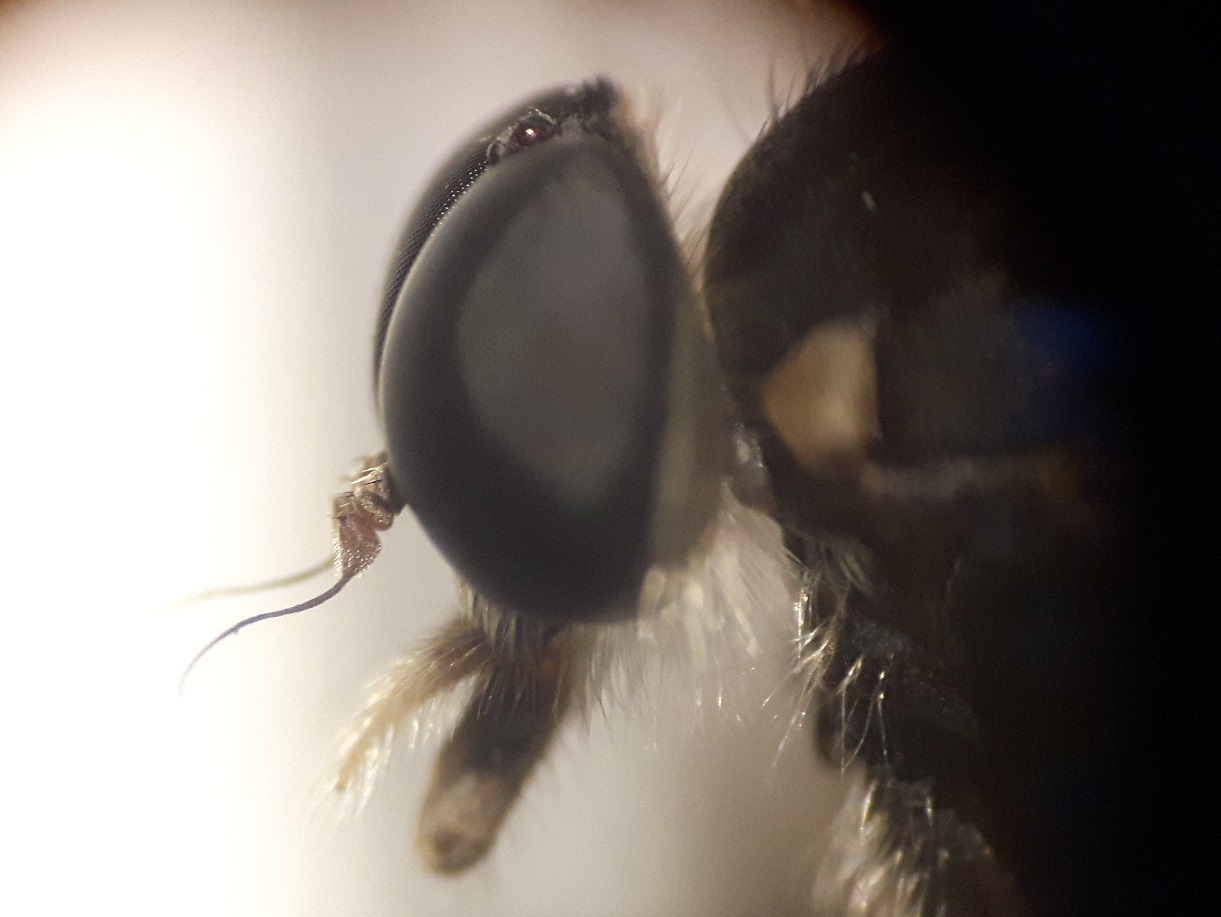
Profile shot of a fancy modified antenna

Step 3. What on earth is going on with that crack in your face?


And so on and so forth, until the key comes out at a family name.


Barbara and John run several workshops each year for the Dipterist's Forum, a group dedicated to the study and preservation of flies. They also run a busy consultancy together while volunteering their time to write papers and, of course, identify flies. Considering they are also married, I reckon this pair could have a side-line in writing couple counselling guides.


The BENHS workshops and field meetings are free and run by expert volunteers. If you do manage to get along to one of the sessions then I highly recommend that you sign up for membership to this worthy organisation.

Tuesday, 5 November 2019

Mink raft cam - Part 1

This Mink raft has been sitting at the back of our storage shed for years (I got bored with it as it never seemed to turn up any signs in the tracking pad). After recently seeing trail camera footage online of the another raft, it showed a range of riverside species taking quite an interest. I thought I'd give it another try, leaving it anchored to the bank for now rather than floating.

Testing.... still can never tell whether it is on.

A curious European Robin (Erithacus rubecula)

This rather annoying Grey Squirrel (Sciurus carolinensis) became obsessed, filling up most of the memory card. It had a good chew on the raft corners.

Grey Wagtail (Motacilla cinerea) - one of my favourite waterside birds; also a red-listed species

Eurasian Jays (Garrulus glandarius) always seem interested by the advanced technology. 
You can hear the Grey Wagtail calling in the background


An indecisive Wood Mouse (Apodemus sylvaticus), or might be a small Yellow-necked Mouse


The weather takes a turn for the worse. Meanwhile I'm away in London, completely oblivious to the storm...

Uh oh, really should have brought the camera in on the Friday!


Phew, got away with it this time - the water has receded quite a bit.

Now something WAS just on the right hand corner of the raft in that final clip; you can hear as it splashes into the water. What could it have been, a Mallard? Moorhen? A mystery wetland mammal?!

I'll put this camera out again when the weather improves, although perhaps aim for a wider angle (and safer height).

Wednesday, 28 August 2019

Working with a live specimen

On Friday I found this potter wasp (one of the small, solitary nesting wasps) running around on the landscape contractor's bright green car. I thought I'd have a crack at identifying it to species using just a hand lens, which turned out to be an arduous way to spend a Saturday...


Step 1:  Put wasp in tube into the fridge to anesthetise


Step 2: Take out the book on solitary wasps


Step 3: Turn to first key in book, take chilled wasp out the fridge, start keying...


It seems that everything pretty well matches the family Eumenidae, which takes me to the next part of the book...

Step 4: Keying from the Eumenidae, following on until we get to couplet 7, which is over to the next page.


Oh no!


Ah jeez.


Step 5: Get stool from kitchen, retrieve tiny wasp from ceiling.


She's back in the tube and she's angry.

Quickly, to the next page....


It looks like she's an Ancistrocerus! We are getting there.

Step 6: Continuing on to try to get her down to species...


Hmm, a groove or step on 2nd ventral plate.... Is this it?

To me it looks like there is a step, but then a bulge. It's very difficult to get a decent picture in the hand and at the correct angle. Even after putting her back in the fridge for a while, she simply warms up again very quickly and dashes about.


Might she be Ancistrocerus nigricornis?

I'm just not sure whether this is simply the normal join between two ventral plates on the abdomen. Looking ahead in the rest of the key, it refers to the underside of the 2nd ventral plate, but my pictures are not clear enough. This is where we get stuck without using a microscope and other preserved specimens for comparison.


For many small invertebrates, photographs can only really take you so far in terms of identification, so I'll be told by entomologists that I should have kept the specimen. But seeing as I have a backlog of other material to microscope...

See ya Ancistrocerus sp., back to caterpillar hunting you go. 

Wednesday, 14 August 2019

Woodland fence trail camera - part 2

(A continuation from a previous blogpost on monitoring of the fenceline apertures and movements of wildlife.)

An old broken fenceline has proved an important passing point for a variety of mammals, including Badger, Fox, Rabbit and Grey Squirrel. We left trail cameras in two locations to see how often the gaps at the bottom of the fence were being used.


Badger (Meles meles)


 Grey Squirrel (Sciurus carolinensis)


Red Fox (Vulpes vulpes) with prey, perhaps a Jackdaw


A fox nibbling a slug. Later on it returned to eat the whole thing!


Pair of Red Fox

Where the new section of fence has been installed, apertures purposely created for wildlife are now being regularly used by Foxes and Badgers. Not all of the footage came out so well, but we did get a few niceties...


Pair of Badgers


A dog Fox shows his approval

Here's a final clip of a young Roe Deer. They grow up so fast!

Roe Deer (Capreolus capreolus) kid and doe

A comparison between the two sites over 7 days of monitoring:

Site 1 (old fence)
Red Fox = 8 passes
Badger = 2 passes

Site 2 (new fence with man-made aperture)
Red Fox = 7 passes
Badger = 5 passes
Grey Squirrel = 2 passes

Many thanks to ecology volunteers Tasmin and Anna, for helping set up the cameras and for sorting through the footage.
Previous blogpost here: https://biodiversitygatwick.blogspot.com/2019/06/woodland-fence-trail-camera.html

Tuesday, 9 July 2019

Gatwick's Annual Biodiversity Review 2018

A little bit later than planned, the 2018 Gatwick Annual Biodiversity Review is now available to download via Gatwick Airport's main website:

We would like to thank everyone who contributed to the content of this report; local ecologists, conservationists, volunteers, the Gatwick Greenspace Partnership and Gatwick Airport Ltd staff. 

Thursday, 20 June 2019

Woodland fence trail camera

Back in May I left a trail camera in the woodland where a new fence line had been recently installed. Part of the work included leaving apertures in the fence wide enough for foxes, badgers and other mammals to pass through. This can result in wildlife being funneled through to certain spots, making it a very useful place to put a trail camera.

Below are a selection of clips and the final result is at the end of the post.

Red Fox (Vulpes vulpes)


European Rabbit (Oryctolagus cuniculus)


A male Roe Deer (Capreolus capreolus) notices the camera for the first time


Second male Roe Deer (slightly different tines on his antlers)


Once the wildlife gets used to the presence of the camera, more natural behaviour starts to come out...


Fox carrying food


Male Roe Deer chasing each other


This particular Fox looks like he might be a new visitor, as he is nervous of the gap in the fence.


Lovely to see a family group of Roe Deer; the young (called kids) will only have been born sometime in the past couple of weeks.


It looks as if this female Roe Deer might be being courted by the male. The strange breathing sound is his communicating. A lot more creepy than attractive in my opinion.


The male Roe Deer were chasing each other up and down the fence several times per day, and this lone female on the other side was obviously interested...


An hour later, and she solved the problem.

Total number of movements through the aperture over the 6 days (likely an underestimate as not every movement may have been recorded):
  • Fox = 14
  • Rabbit = 1
  • Roe Deer = 1