Friday, 31 January 2014

January Summary

JS Agriculture carrying out birch thinning in Horleyland Wood, Land East of the Railway Line

Things have been relentlessly damp here as that niggling hole in my hiking boots can attest to. The mud and standing water makes accessing sites with heavy duty equipment much harder work.

Coppicing on the south bank at Pond 3, Land East of the Railway Line 

Somewhere here, the pond stops and the path begins

JSA with Gatwick Greenspace, coppicing and habitat piling on the grassy slope, North West Zone

Creating bare earth patches on the grassy slope, North West Zone. Areas like this can be beneficial to certain invertebrate groups such as burrowing bees and carabid beetles

I quite like writing these summaries - searching through my photos from the the past month causes an 'oooh yeah, I forgot about that' moment.

A rare frosty day in January 2014. Wet scrubland west of Brockley Wood

I have continued with the odd wildlife survey and as the season progresses, our visiting thrushes seem to have changed their activity. They have been spending more time foraging at ground level while they search in the leaf litter. I am still seeing high numbers of Redwing, but much fewer Fieldfare then last month. The winter RiverSearch surveys have have been challenging, as the river features I am supposed to be mapping are mostly under the muddy water.

River Mole at Povey Cross. Today it was in-channel and mostly behaving

Also, we have carried out a dormouse box maintenance and winter clean-out job in Horleyland Wood. There has finally been some definite mammal activity in them, with plenty of Yellow-necked mice moving in. It is a similar story at the woodlands in nearby Crawley, where we even found a new nest of Yellow-necked mouse pinkies (babies). Despite the strange season, they will probably be doing quite well in this mild weather.

George turfing the old nesting material out of the dormouse boxes

Yellow-necked Mouse (Apodemus flavicollis), 
reluctantly waiting for us to finish the cleaning so she can move back in.

Making good use of our nesting boxes over winter, is the local spider community. I found around 6 different species on this day...

Your friendly neighbourhood Walnut Orb-weaver (Nuctenea umbratica),
 trying its best to look inconspicuous
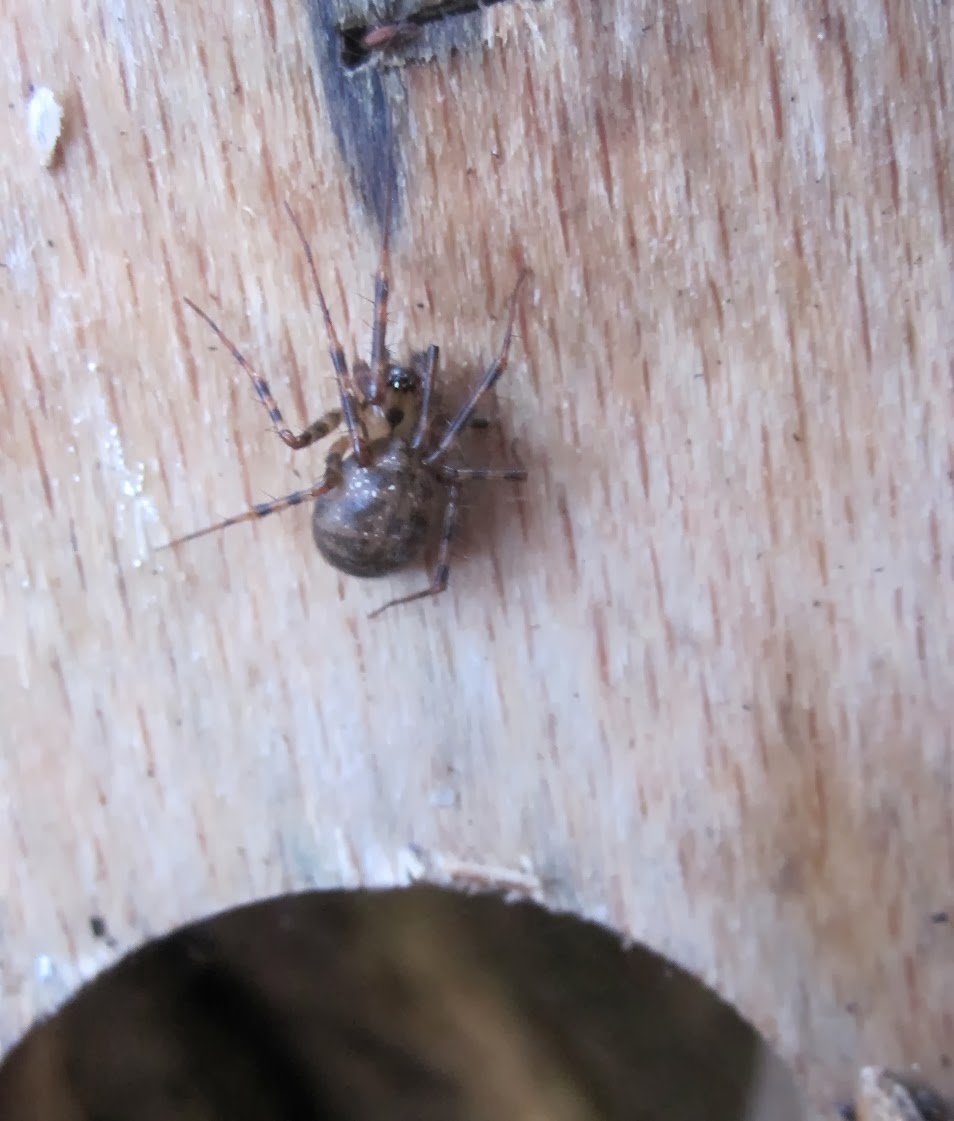
Labulla thoracica, which belongs to the same family as the Money Spiders (Linyphiidae)

A small False Widow (Steatoda nobilis). And no, it did not go straight for my jugular

Thanks a bunch to Katie, George and my mum Sue for helping me out on these most recent surveys.
   I am amassing a collection of invertebrate pictures as I sort through the malaise trap invertebrate samples. One of the coolest things I've found so far is this awesome Sawfly: I think the genus is Cladius. It's feathered antennae look like massive antlers... I'll have to dedicate a separate post at some point to my desktop invertebrate finds.

Underside of a Sawfly (x10 magnification)

   I am still catching up on my species data entry for the past year. The final American Signal Crayfish count was 482, fished out of a 200m stretch of the River Mole. It will be interesting to see how many I get out of the same stretch next summer.

This was a single haul of the invasive crayfish species Pacifastacus leniusculus,
at the peak of summer 2013

Thursday, 23 January 2014

A bad spate of affairs

I really feel for people in this area whose homes were affected by the recent flooding. On the other hand, it has made for some pretty good photo opportunities...

River Mole to the north of the airfield, North West Zone (Jan 2014)

Gatwick Airport operations were disastrously impacted over the Christmas period when an electricity substation flooded out in an unprecedented event. A lot of urgent work then had to be done to save several of the airfield regulators. Many people in surrounding areas such as Charlwood, Horley and Crawley were also badly affected, with some properties being flooded out on several occasions over the past month.

Airfield Engineering had a rather challenging time over the Christmas period (photo by David Maurice, Dec 2013). A contender for next year's airport greeting card, perhaps?

Apparently, a weather station at Reigate Grammar School measured 70mm (2.8") of rainfall over 23rd and 24th December, the highest ever recorded for (modern county) Surrey over a 24 hour period. With so much water falling so quickly in a largely concreted and industrialised area, the water drainage systems were severely pushed to their limits. In our woodlands and grasslands, the already saturated ground just couldn't take anymore and water was soon running off in torrents along paths and roads. The unseasonably warm weather means we probably have more heavy rain to come!

No training today at the Fire Training Ground (David Maurice, Dec 2013) 

Gatwick Stream and the cycle path (underwater) along the A23 at City Place (David Maurice, Dec 2013) 

The A23 by the South Terminal (David Maurice, Dec 2013) 

Although we might call this a '1 in 100 year' flood, we tend to have rather short memories when it comes to the weather. Apparently back in 1968 after an extreme rainfall (apparently in one area about 100mm fell in 24 hours), the water was halfway up these crash barriers as well as the South Terminal baggage system ending up under water. 

River Mole north of the airfield - March 2013. Here the river is in-channel

River Mole floodplain last week (Jan 2014)

The floodplain from the diverted River Mole section to the north of the airfield was created in 2000 and designed to hold a vast amount of water. The large meanders and natural pooling areas of the lower ground help to slow down the flow, hold more water and relieve some of the pressure further downstream in urban areas of Horley. This is a good example of an important ecosystem service which floodplains provide us.

River Mole Culvert Corner - December 2012

River Mole Culvert Corner - Jan 2014

For some wildlife, such as wetland birds, this is all rather fun with those pesky humans spending more time indoors and plenty of extra wetland about for foraging in. For other wildlife however, this amount of water could be devastating, particularly for ground hibernating animals such as harvest mice, bats, reptiles and invertebrates. There have been strange reports of whole armies of leatherjacket grubs (Cranefly larvae) marching out from saturated lawns. Those which cannot get away will die off, possibly meaning depleted food sources for other wildlife in the months to come.

River Mole netted section - April 2013

River Mole netted section - January 2014

This has all been rather interesting for the Surrey Wildlife Trust's RiverSearch project, which is building up a profile of the River Mole and associated streams as part of a catchment-wide scheme. At times like this, we can really see how these waterways are functioning: their attributes, limitations and what work needs to be done to ensure they keep functioning.


Finally, another trusty Gatwick coconut has made an appearance. I am currently tracking down the full story on these!

Friday, 10 January 2014

Malaising stuff

I am always amazed by the amount of rubbish appearing on shop shelves at Christmas; an annual bloom of crap. Where does it all go after it has been unwrapped and politely chuckled at? No wonder the retailers are working up a sweat every year, we are all running out of cupboard space.
   But this year, Secret Santa did good... I discovered a secondary use for my Xmas-tat in the form of a new invertebrate sample test-tube stand. So ta very muchly, whoever you were!

Wasp tequila slammer, anyone?

Back to our Malaise Trap: Gatwick Greenspace Partnership (GGP) helped install this tent-like apparatus last July in a small open area in the Land East of the Railway Line. This is an energy-saving way of collecting invertebrate samples because despite their fantastic physiology, refined adaptations and resilience, insects are actually pretty dumb. When meeting this in the field, the insect hits a central wall of fabric and instinctively flies upwards, being directed into a funnel at the apex then eventually dropping down into a collecting pot at the top. 

Assembling a malaise trap - People and Wildlife Officer Kev and volunteer Eloise from GGP

It might look gruesome and destructive, but we collect this way in just one small area for one season, minimising any impact on the local invertebrate populations. Some mini-beasts need to be very closely examined to determine the particular species and identification can involve pulling apart teeny-tiny genitalia, comparing the diverse shapes and structures under a microscope while referring to technical books. For the time being I'm passing that work onto someone else, instead just sorting these guys into orders such as flies (Diptera), bees and wasps (Hymenoptera) and beetles (Coleoptera), then from there into smaller groups such as families.

Collecting pot from the malaise trap. This haul was in the peak of summer after just one day

A pitfall trap - these were sunk into the ground nearby to target the trundling invertebrates

Natural history is a subject open to absolutely anyone with an inquiring mind, and entomology has an increasingly accessible side through online resources for identification such as iSpot, plus your local wildlife and conservation groups. You could perhaps start with the larger, more obvious things such as bees or butterflies, carefully collecting them into pots without causing them harm. Take a look, snap photos on your macro setting or test yourself online. Work away at that over a couple of seasons, getting to know the species which occur locally. Then you might decide you need more of a challenge, moving onto things requiring as closer look such as beetles and spiders. 

1 down, only 19 to go...

Invertebrate diversity is mind-blowingly huge, so getting to know the different species is an ongoing journey with always more to discover. Even if you don't know what it is you are looking at, its still bloody fascinating. As an entomologist from the NHM put it on Radio 4 the other day: its not rocket science, but it is value science! 
   There are some brilliant blogs out there with excellent macro photography of the small and unique, such as the very readable The Lyons DenMark Telfer's Blog and particularly the Cabinet of Curiosities for a window into that under appreciated part of our world.

Sunday, 29 December 2013

December Summary

 
Veteran oak tree, Land East of the Railway Line

It feels like we have packed an incredible amount into December. Winter provides us with only a short window for cracking on with habitat management and it is a race to complete these jobs before the spring wildlife starts waking up again. With the incredible amount of wet weather resulting in Gatwick's rivers and streams flooding out, this will be no mean task
   Earlier this month, conservation work started with JS Agriculture and Gatwick Greenspace Partnership working together in the North West Zone. We coppiced the willows and scrub on a grassy slope which was becoming over shaded.

Coppicing willows on the grassy slope


Gatwick's ranger Tom S then improvised by staking the cut wood into habitat piles half-way up the slope, providing cover for wee beasties but leaving the wet grassland clear of debris at the bottom.

Scott finishing up our hibernacula in the Scrub West of Brockley Wood

More recently, Scott T did a grand job of moving some logs and tree stumps onto the new hibernacula in Scrub West of Brockley Wood. Sometimes I wish I could be trained to use a digger, but then with great power comes great responsibility and I can get a little power hungry.

Another completed hibernaculum - not pretty but perfect for invertebrates, reptiles and other wildlife

Our regular group of British Airways Engineers (BAE) definitely have a pact with the weatherman; on a revoltingly sunny day in mid-December, they were led by Gatwick Greenspace Partnership (GGP) on a woodland conservation task. They bridged the ditch on the main path into Brockley Wood, improving access for future work, also removing the old barbed wire, plastic tree guards and some litter. Because they can smash out these jobs in record time, I barely got any photo opportunities...

BAE installing a footbridge, East of Brockley Wood

Railway sleeper footbridge

BAE and Gatwick Greenspace Partnership

As part of the National Harvest Mouse Survey by the Mammal Society, volunteers Rachael, Sue and me carried out some nest searches along the River Mole. We had a successful haul with 4 nests on single transect along a path in the grasslands. This helps inform us where to carry out further mammal surveys in the coming year.

Well-hidden: a ball of woven grass hidden in a large tussock

A rather large Harvest Mouse nest constructed of Cock's Foot grass. 
It was probably used as a breeding nest earlier this year

While carrying out these searches, we were lucky enough to be serenaded by a very loud Water Rail. This wading bird turned up in our winter bird survey last year but eluded us on our most recent one. It still counts though as an individual record and will be added to Gatwick's species database. I think they sound a bit like excitable piglets.


We completed our final early winter bird survey this month in the Land East of the Railway Line. The pace has really picked up with thrushes - mixed flocks of Fieldfare, Redwing, Song Thrush, Mistle Thrush and Blackbird are abound, testing our identification skills.

Recording on our Winter Bird survey

Goat Meadow's mug-holder tree. Sadly no coffee was left in them... Mean dog walkers.

Tom F in the scrub, deep in conversation with a flock of Redwing

Looking ahead to January and February, there is an incredible amount to do and we are going to need all the volunteer help we can get. My to do list will probably keep on growing, but I seem to be running out of whiteboard...

*gulp*

Tom S is planning some conservation taster days in the New Year, so if you want to find out whether all this 'getting-back-to-nature' stuff is overrated, drop Tom a line at thomassimpson@sussexwt.org.uk or learn more here about Gatwick Greenspace Partnership and their work.


River Mole culvert, North West Zone after recent heavy rains

A massive, massive thank you to all who have been involved this past year, you have helped make this a brilliant project to work on. We hope to see you again in 2014!

Thursday, 12 December 2013

Early Winter Bird Survey - North West Zone

Gatwick Landscape Photographer of the Year
(self-appointed)

Sunrise: 07:45 December 9th 2013

Gosh... 

Spider webs on Dock seed heads, North West Zone

Oh my... 

 
Rough grassland and hedgerows, North West Zone

Goodness me...

Frost in the rough grassland, North West Zone

Ok, that's enough of that. On Monday morning, we began our Winter Bird Survey transect in the rough grasslands, north of the runway. I was accompanying Tom Forward of Gatwick Greenspace and volunteer James, for whom this was a first venture into birding. 

Rambling rosehips in the hedgerows

The open areas of grassland were mostly quiet and still, with bird activity being concentrated in the hedgerows. In the mud, there were plenty of animal tracks; clues as to who else had recently passed by...

Roe Deer tracks: the rear dew-claw marks are just about visible

Moorhen tracks

The hedgerows looked pretty awe-inspiring in the winter sun. Every section seemed to contain at least one singing Song Thrush; pretty unusual as spring is the normal time for staking out territories. A flock of around 10 Meadow Pipits broke the relative peace, peeping frantically overhead before settling in the hedgerows furthest from us.

Listening for thrushes in the hedgerows

Reed Buntings were in good numbers, hiding away in the tall Reed Canary Grass and then flitting up into the scrub. A Robin and a Dunnock were actively singing; a few Redwing were 'tseeping'; and mixed flocks of Great, Blue and Long-tail Tits nosily contact-called while foraging.

Blackthorn fruits (i.e. Sloe berries) and lichen

Approaching the first bend in the River Mole, a Moorhen squawked its presence and a Pied Wagtail passed overhead in bouncing flight. Our first flock of Fieldfare, a winter-visiting thrush from northernmost Europe, were nosily chatting away in the large Oaks overlooking the floodplain. On a bare patch of earth near the grassy slope, a Green Woodpecker had left its usual calling card...

In certain light, even bird poop can look quite marvelous.

Break it open and you will find the chitinous remains of ants

We had a poke around in the reed beds but sadly no signs of Water Rail, so Tom regaled us with an ear-splitting impression (although neither James nor I were really qualified to critique it). Still scattered around in the grass were feathers from the dead Grey Heron found earlier in the week - the foxes had an early Christmas dinner! 

Scrub West of Brockley Wood

Entering the scrub west of Brockley, a bout of action could be heard in the woodland margins with brawling Song Thrushes and a jeering audience of Redwing. Rounding the corner of the woodland, where the river passes close by, a mixed flock of Fieldfare and Redwing were happily foraging in the Hawthorn scrub.

Candlesnuff Fungus on river driftwood

Beginning our second transect further downstream along the Mole, Chaffinch, Goldfinch, Magpie and Reed Bunting were all in abundance. We also picked up a new first for this birding transect: a lone Rook. These birds are generally common around the airport so it is by chance they haven't cropped up earlier on our survey. 
   Continuing up the corridor of grassland along the river, we then entered a Fieldfare battle-zone! They were zipping back and forth over the river, between the lines of scrub and trees. Sounding rather like fighter plane machine-guns, one even let loose a small, tactical aerial-attack (fortunately though not directly overhead!).


Counting them was quite a challenge but we noted around 80 individuals in this one section, plus the usual handful of Redwing and Song Thrush. This is one of my favourite parts of the River Mole corridor, where the water passes over stones and gravel, creating 'riffles'. These fast-flowing areas are particularly beneficial for aquatic invertebrates, such as Stonefly and Caddisfly larvae.


Towards the end of transect 2, we paused to watch a brightly coloured Jay perched just a few meters ahead, posing proudly with acorn in beak. A moment later, there was a flash of orange and a Kingfisher appeared up on the tree. Then, it shot past us upstream, showing off its electric blue upper-side and bullet-like profile. We were also greeted by the lumbering flight of an impressive Grey Heron, moving off downstream... For James, these were two species he had never seen up-close, so well worth the early morning start!

Our two transects