Monday, 16 May 2016

Why i-Record wildlife

This week has been a monumental one for many biological recorders, thanks to the new fantastic phone app by the innovative iRecord team (seriously my favourite people right now)...

Links for phone downloads here: http://www.brc.ac.uk/app/irecord-app

Why am I so excited about this (free) app? Because it effectively cuts down on hours and hours (and cups of coffee and biscuits), spent entering data into excel spreadsheets or online at the desk. Instead, you can input wildlife records swiftly and with ease while out and about, maximising time spent out in the field (hey, you could even lose weight using this app!). It's basically why I chose a hefty Samsung S5 after renewing my phone contract - to be iRecord-ready!!

Entering a biological record

The interface is clean and simple; the fields are editable just by tapping on them, but you can lock any for repeated use. The entire database of UK wildlife (scientific and common names) is pre-loaded, and it draws the locations from the phone GPS, with the added option to just select a point on a map. 


Easy to create, edit or delete whole lists of wildlife records

Most pivotally, it works offline, so all data is automatically saved onto the device, ready for when you escape the 4G-blackspot or regain WiFi. A single tap, and all of your day's wildlife sightings are uploaded to the iRecord database, ready to be verified and feed into national wildlife recording schemes!
  For my work at Gatwick this has arrived in the nick of time, as things go crazy on our two biodiversity sites at the peak of breeding season and ecological surveys are back-to-back.
 
Great Crested Newt egg on a leaf (photo by Rina Quinlan)

Other recent highlights include Great Crested Newts (Triturus cristatus), returning to breed in Pond 3 after the humane removal of hundreds of fish just last year. A successful ending to this pond project, and no better seal of approval from our newts! Many thanks to all who were involved.

BAM! Record goes in.
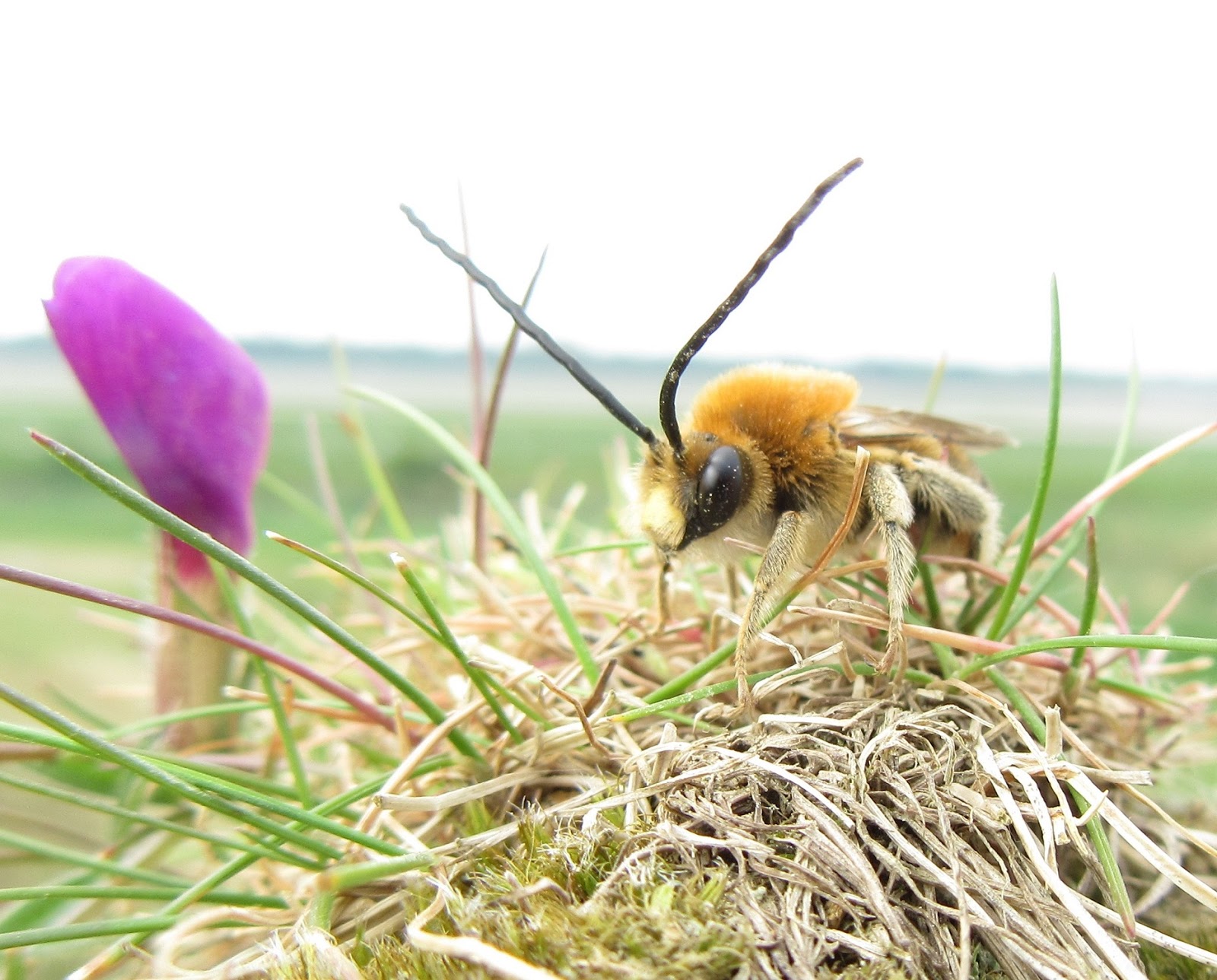
Our first male Long-horned Bees (Eucera longicornis) have also emerged last week; quite perfectly timed with the first flowers opening of Common Vetch (Vicia sativa) upon which these bees specifically nectar. Such amazing processes which happen beyond our detection!


Long-horned Bee with Common Vetch flower

BAM! Another record in. 

Gatwick has recently contributed a Buglife case study for this charismatic bee; you can find the publication and read more about our targeted habitat management by clicking here: Long-horned Bee at Gatwick Airport.

Eucera longicornis and a BA plane, Gatwick's North West Zone. 12/05/16

Cuckoo bees, other parasites and predators of solitary bees are also out in force and I'm only just learning about all the different varieties. Now that I'm saving on the data entry time (I <3 you iRecord!), I can finally put the guide to Bees by Steven Falk to good use. I think the lady pictured below is a Painted Nomad (Nomada fucata).. I'm happy to be corrected!


Just to top off a momentous week, we are now up to two male Nightingales (Luscinia megarhynchos) singing clearly in the North West Zone... and potentially even a third! I'll continue checking the site after evening moth and newt surveys; it would be incredible if they managed to breed here.

On the subject of Nightingales, I was recently shown this link by David Plummer - it's a famous recording of Nightingales signing in a Surrey garden on May 19th 1942. In the background, at about 2 minutes 30 seconds in, 197 Wellington and Lancaster bombers can be heard flying overhead on a raid to Germany. When you think about the violence and destruction these planes were portending, it gives the Nightingale song a rather melancholic edge.


Perhaps not so far from the site where that recording was taken, we unwittingly created a an updated version with a sound backdrop of a modern aerodrome.


Thursday, 5 May 2016

And a Nightingale sang in... Gatwick Airport?!

Roving Records: North West Zone 3rd May 2016


There are certain clues that it will be a day of burgeoning wildlife, such as an incredibly warm morning after an extended cold snap. As soon as we got out of the car we spotted a flock of Swifts (Apus apus) high overhead, screaming as they drifted northwards - the first of 2016 for our site.

Scrub and grassland west of Brockley Wood

We wandered through a cacophony of different warbler songs; Chiffchaff, Common Whitethroat, Lesser Whitethroat, Blackcap and Garden Warbler could all be heard here.

Reed beds along the River Mole

Reed Warblers (Acrocephalus scirpaceus) are summer visitors from Sub-Saharan Africa, and they have now begun their chugging tunes along the River Mole...


A young male Kestrel seemed to watch us disapprovingly, until the alarm calls of small woodland birds caused it to move on.

My 2nd worst picture ever taken of a Kestrel (yes, there are worse)

Walking our usual reptile transect, we counted 6 Grass Snakes (Natrix natrix) under the refugia, including a massive adult female and 2 tiny juveniles (probably last year's hatchlings). There was no sign of the unusually striped or black individuals from last year.

A faded yellow collar on a Grass Snake can indicate an aged individual

Of course, it is not just the reptiles using these mats...

Common Toad (Bufo bufo)

A young vole, possibly Short-tailed Vole (Microtus agrestis)

Glow-worm larva (Lampyris noctiluca)

Donald meets his first ever Glow-worm

As we stood up from replacing a reptile mat, a low, bubbling call made Donald and myself exchange the exact same quizzical look, and a hesitation to be the first to speak...

   'That's a.....'
   'Nightingale!' Donald finished.

As if on cue, a wonderful stream of notes, then it blasted into full song. This really is an exciting find, so as soon as got back to the computer I trawled Gatwick's old ecological reports... yes, this is a new species for the site! 

I popped back around 11pm last night with Katherine to take this recording

We suspect this male might be a bit out on a limb here, so fingers crossed that a passing female hears him too. Although they can be heard in the daytime, they are definitely best heard at night, when all the other birds have quietened down.
  
Nightingale from The RSPB on Vimeo.

Nightingales (Luscinia megarhynchos) are a rapidly declining species in UK, largely due to the loss of their out-grown, scrubby habitats. Fortunately a few nature reserves such as the Knepp Re-wilding project have become hotspots for these birds. They only tend to sing from May until early June, so get your Nightingale fix now and book onto a Knepp Safari !

Friday, 15 April 2016

Fire-training amphibians


It was around this time last year when I received a call about newts trapped in some grating, at Gatwick's Fire Service Training Ground. I collected my airside pass, a permit for my tools-of-the-trade (aka net and bucket), and was escorted by airside operatives to the western end of the runway.

Shooting along Taxiway Juliet (at the breakneck speed of 30mph) 

When I arrived, those sneaky newts were nowhere to be seen, but it looked as if they might easily able be to climb out of the shallow grating. However, after checking some open drains, we did find a few lost-looking toads and newts...


Each year around the country, thousands of toads, frogs and newts - often while migrating to their breeding ponds - accidentally fall into drains and roadside gullies. If they cannot climb back out, they will eventually die of starvation or drowning.

Smooth Newts (Lissotriton vulgaris), fortunately rescued in time

This year, I returned with back-up in the form of Barry, Cici and Aidan of the Sussex Amphibians and Reptiles Group (SxARG). Another 'tools of the trade' pass for more odd equipment (nets, buckets, metal plates, plus a sizeable roll of Enkamat plastic mesh), back through the airside security gate and this time a fire service escort over to the training grounds...

Fishing for amphibians in the separation tank

A pair of Common Toads (Bufo bufo)

Smooth Newts (Lissotriton vulgaris)

We managed to fish out around 11 newts, 2 toads and 2 frogs which were already swimming around in the seperation tank. Barry and Aidan then installed the specially designed drain ladders (weighted plastic mesh), enabling any other trapped amphibians to climb out under their own volition.

Laying the Enkamat lining

Steep, but climbable by most small amphibians

In order to become a fully-qualified firefighter, you have to be put through the paces with a series of physical tests. These toads and newts have shown a lot of promise (sticky feet mean they can ace the 'grip test'). So, those which are fit enough to clamber out will automatically qualify as honorary Gatwick Fire Service team members!

Dan and Jules with their new mascots (it's not all about cats stuck up in trees)


Released back into the nearby pond

Many thanks to Simon, Ryan, Jules and the rest of the fire team for giving Gawick's amphibians a leg up, and thanks to Cici for her photos. Find out more about the use of amphibian ladders in this article on the Sussex ARG page.

Sunday, 3 April 2016

Gatsbees B-Log: Late Winter 2016


While I waited for the bees to go to bed in the mildest winter for years, our local hedgehog, which had clearly been living here for much longer than me, finally made itself known in mid December. By the way, I’m not feeding it baked beans, the tin is my measuring stick so I can judge their size...


and a couple of weeks later her friend came along. How exciting; hedgehogs!


The fox left a gift in their feeding bowl to show it’s appreciation of our efforts.


I was surprised to see honey bees collecting pollen from Viburnum tinus in my garden in January. They rarely do, so maybe they are planted in too much shade for the nectar to flow.


We finally had a flurry of snow, but unfortunately it didn’t stay long enough for me to get to the apiary in Ashley's Field to photograph the hives looking wintery. Sorry!


Hurray! Clear skies at night and freezing cold mornings. The bees have gone to bed at last!

Snowdrops – an early supply of pollen and nectar


On the last check before the bees go to bed, we carefully lift the hive on the two sides, one at a time, to feel the weight of it. This is called hefting and we generally do that once a month to make sure they have enough stores of honey. If it’s getting light, we put some fondant under the roof in direct contact with the bees.


On a warm, sunny afternoon in February, the bees flew out to defecate away from their hive, and clearly one of them got caught short (bottom left hand side). We will have to look out for colonies which have persistant diarrhea as they may have a fungal disease of the gut called Nosema apis.


They also forage for food whenever possible and those running up the front of the hive seem to want to gain some height for take off.

A queen wasp hibernating in the log pile.


Not quite in the ‘other visitors to the hive’ category, but a ground beetle (Pterostichus sp.) living under a piece of wood under one of the hives.

March. ‘ Hurry up, out of my way, pollen to unload, places to go…………’ 

Blackbirds singing, bees buzzing, spring has arrived and very soon, we’ll be looking to see what the girls have been doing all this winter. We will keep you posted. 

Gillybee

Wednesday, 23 March 2016

Getting into ecology and conservation

Ask any ecologist or conservationist how they got into this line of work, and almost all will tell you about how they got stuck in with volunteering, and what awesome days they were!


Me in 2012, volunteering on a Water Vole survey with Row Baker at Arundel

Volunteering for the Sussex Wildlife Trust opened up to me a new world of local wildlife, and the passionate people who are trying to conserve it. There are many wildlife organisations out there wanting to engage with volunteers and recruit new members, and now social media makes it even easier to connect with these groups... a healthier use of Facebook and Twitter!

Myself and Laurie Jackson (who I also met through volunteering) have come up with a list of wildlife groups and recording schemes which people can get involved with, whether you're a student of biological sciences, a recent graduate, or just someone who is looking to get outdoors more and discover an endlessly rewarding new hobby...

Firstly, consider starting to keep a species list by signing up to iRecord: http://www.brc.ac.uk/irecord/

Events/ short courses in wildlife identification, ecology and field skills:


Sussex Wildlife Trust https://www.sussexwildlifetrust.org.uk/whats-on/category/adult-learning
Surrey Wildlife Trust http://www.surreywildlifetrust.org/whats-on?categoryid=7&categoryid=7
Knepp Wildlands Safaris https://www.kneppsafaris.co.uk/Safaris
Field Studies Council (FSC) http://www.field-studies-council.org/individuals-and-families.aspx


For families and kids:


Sussex Wildlife Trust family events https://sussexwildlifetrust.org.uk/whats-on/category/family-events
Surrey Wildlife Trust family events http://www.surreywildlifetrust.org/whats-on?categoryid=9
Amateur Entomologists' Society Bug Club  http://www.amentsoc.org/bug-club/
Field Studies Council family activities http://www.field-studies-council.org/individuals-and-families/family.aspx


Specialist courses and training ecological consultants:


Bat Conservation Trust http://www.bats.org.uk/pages/professional.html
Mammal Society http://www.mammal.org.uk/training
Amphibians and Reptiles Group http://www.arguk.org/events
British Trust for Ornithology http://www.bto.org/news-events/training
Chartered Institute of Ecology and Environmental Management (CIEEM) : http://www.cieem.net/events/category/56/cieem-workshopstraining
Acorn Ecology http://www.acornecology.co.uk/ecology-courses
Field Studies Council (FSC) environmental professionals http://www.field-studies-council.org/professional/courses-for-environmental-professionals.aspx
British Entomology & Natural History Society http://www.benhs.org.uk/about/meetings/
Freshwater Biological Association https://www.fba.org.uk/courses

The best advice after going on any training course or event? Get involved with wildlife surveys or field meetings straight away, either through the organisation you've just trained with, or a wildlife group local to you. Carry on with the learning and keep those newly acquired field skills honed; we all started out somewhere! 

National recording schemes & surveys:


There are many more than I have listed here, so you could also take a look at the Biological Records Centre website: http://www.brc.ac.uk/recording-schemes

Most these groups also have facebook pages with very active online communities, so there are always people to turn to for advice.

And for those of you more local to the Gatwick area, check out these active groups...


Wildlife groups and recording in Sussex:


Sussex Biodiversity Record Centre http://sxbrc.org.uk/
Sussex Mammal Group http://www.sussexmammalgroup.org.uk
Sussex Amphibian and Reptile Group http://www.sussexarg.org.uk
Sussex Bat Group http://www.sussexbatgroup.org.uk/
Sussex Ornithological Society http://www.sos.org.uk/
Sussex Botanical Recording Society http://sussexflora.org.uk/
Sussex Moth Group http://www.sussexmothgroup.org.uk/
Butterfly Conservation – Sussex Branch http://www.sussex-butterflies.org.uk/
British Dragonfly Society - Sussex Group http://www.webjam.com/bdssx
Sussex Sea Search https://sussexwildlifetrust.org.uk/what-we-do/living-seas/sussex-seasearch
Forest Row Natural History Group https://naturesbook.wordpress.com/events/

Sussex & Surrey:


West Weald Fungus Recording Group  http://www.westwealdfungi.co.uk/

Surrey:


Surrey Biodiversity Information Centre http://www.surreybic.org.uk/
Surrey Mammal group (Facebook page) https://www.facebook.com/groups/surreymammals/?fref=ts
Surrey Dormouse Group http://www.surreydormousegroup.org.uk/
Surrey Amphibians and Reptile Group http://www.surrey-arg.org.uk/
Surrey Bat Group http://www.surreybats.org.uk/
Surrey Birding Club http://www.surreybirdclub.org.uk/
Surrey Botanical Society http://www.surreyflora.org.uk/
Surrey Butterfly Conservation - Surrey & SW London branch http://butterfly-conservation.org/286/surrey--sw-london-branch.html
RiverSearch & RiverFly surveys http://www.surreywildlifetrust.org/what-we-do/living-landscapes/conservation-projects/riversearch


So there you go! My apologies as if I missed any off - please comment below and I can add to the lists.

Wednesday, 2 March 2016

Biodiversity and the Beaver

I had an excellent opportunity last weekend to join a group of ecologists visiting the Devon Beaver Project, a trial study looking into how Eurasian Beavers (Castor fiber) adapt their surroundings, creating vital wetland habitat.

Beaver lodge and pool - the enclosure is about 2.8ha in total

Led by Mark Elliott of Devon Wildlife Trust, this fascinating project has now been running for 5 years. Beaver pools and dams provide excellent ecosystem services; holding the excess water, allowing gradual release back into rivers and streams after extreme flooding events (it turns out they might be even more effective landscape managers than us costly humans).

One of several Beaver dams - this one extends for over 20m

Their forte is creating a series of staggered pools, interconnected by small canals so that they can ferry woody materials around. They carry out all their own maintenance and repairs, needing absolutely no input from us.

Horizon pool (something I've always fancied in my garden)

These fluffy aqua-engineers have been gone from our landscapes over 400 years, hunted to extinction for their meat, fur and some weird medicinal value of their glands. Beavers are a 'keystone species', meaning their presence is important for the structure and function of a particular habitat. Remove the keystone and the habitat changes so drastically that the whole ecosystem on that site collapses.
   Beavers are nocturnal, so we didn't get a chance to see them in person, but the field signs of these massive rodents are pretty unmistakable...

Is that some Beaver hedge-laying? Tom Simpson himself would be impressed

Mark explained to us that many of these partially felled trees will continue to grow, with the fresh coppice regrowth creating Beaver 'salad bowls', on which they feed.


Not a T-Rex, but the Right hind footprint of Beaver, Europe's biggest rodent

Data are being meticulously gathered with the help of the University of Exeter. Water monitoring stations collect vital information on changes in flow and water quality on the site, all of which are improving for the better.


Of course, the thing us ecologists noticed the most after stepping rather gingerly into the site, is how Beavers create incredibly stunning, biodiverse and lush habitat! 


The act of opening up the dense scrub, allowing light to reach the network of pools and canals has resulted in a true habitat mosaic - all the work of just two adult Beavers.
   Increased amounts of frogspawn indicate a benefit to the amphibian populations...


The wet wood is no doubt a haven for aquatic invertebrates, hidden away in the cracks and crevices of the dams. Certainly the can fungi benefit from all of this fallen deadwood...

Scarlet Elf Cup (Sarcoscypha coccinea)

Blushing Bracket (Daedaleopsis confragosa)

Miniature water gardens contain many plant species, a few of which were not only new to me...

Beaver burrow

Young basal leaves of Marsh Ragwort (Senecio aquaticus)  - identified by Mark Elliott

Water Forget-me-not (Myosotis scorpioides), Water Mint (Mentha aquatica) and some type of Crowfoot

...which turned out to be Round-leaved Crowfoot (Ranunculus omiophyllus) - identified by Dave Green

Bog Pimpernel (Anagallis tenella) - identified by Mark Elliott

Lesser Spearwort (Ranunculus flammula) - identified by Mark Elliott

I can only imagine how spring and summer will bring even more burgeoning wildlife to this site. 
Thanks to Mark, Penny, Dave and David for letting me tag along, it really was a privilege. 

Find out more about the scientific benefits of Devon's Beavers in this report, and the positive effects on communities in the below video.